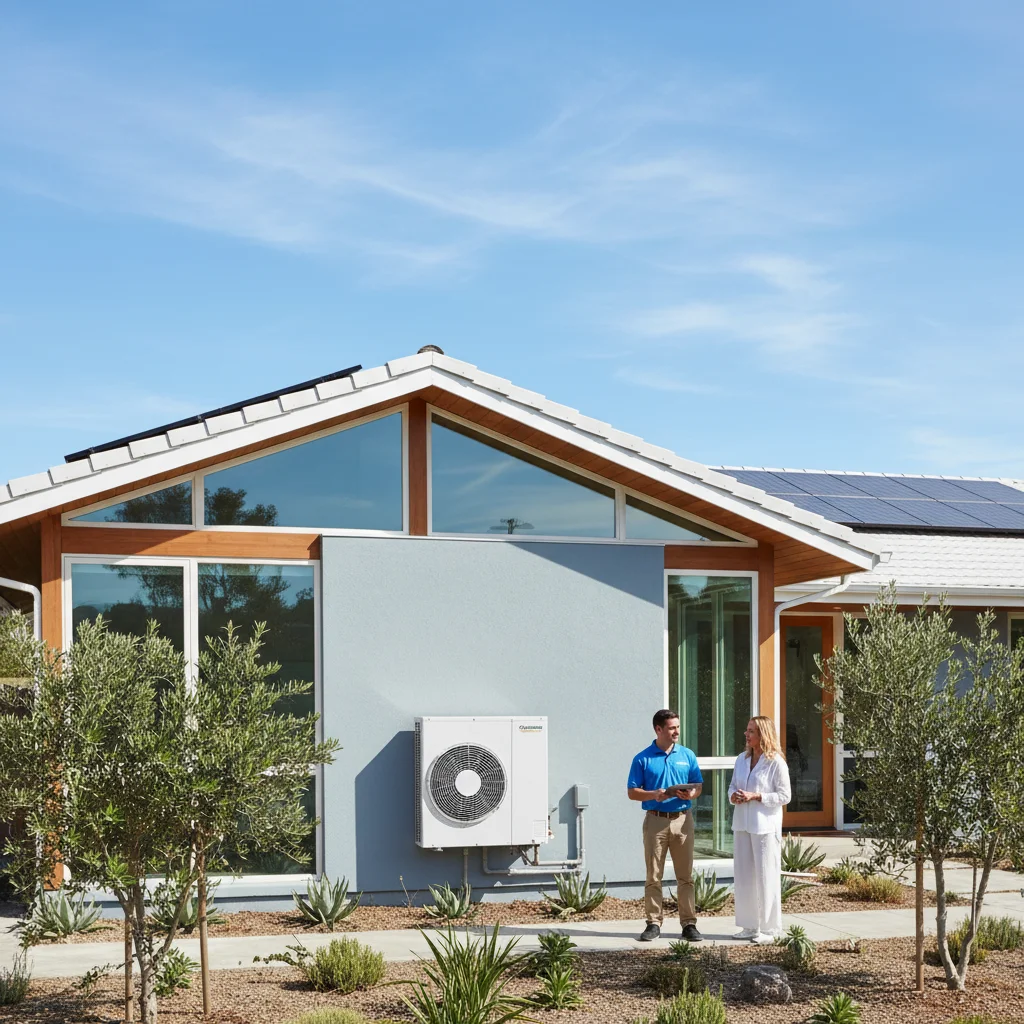
California heat pump installations surged 47% in 2025, outpacing every other HVAC technology—but the real surprise isn't the growth. It's that most homeowners hired the wrong contractor. Traditional HVAC technicians, trained on furnaces and air conditioners, lack the specialized knowledge to design and commission heat pump systems that deliver the promised 300% efficiency. And that gap costs California homeowners an average of $1,200 annually in lost energy savings.
How Do Heat Pump Contractors in California Compare to HVAC, Furnace, and Air Conditioning Specialists?
Heat pump contractors in California hold specialized certifications beyond standard HVAC licensing, including HVAC Excellence Employment Ready Heat Pump certification and NATE (North American Technician Excellence) heat pump specialty credentials. These professionals complete 40+ hours of training in variable-speed compressor technology, refrigerant charge optimization, and Manual J load calculations—skills that furnace and AC-only technicians don't typically possess. And the distinction matters: improperly sized heat pumps lose 20-30% efficiency compared to correctly engineered systems.
So what separates a heat pump specialist from a general HVAC contractor? Heat pump contractors understand California's 16 climate zones and match equipment to microclimates. They calculate supplemental heating needs for coastal fog zones, design defrost cycles for mountain regions, and optimize coefficient of performance (COP) ratings for Central Valley temperature swings. But traditional HVAC contractors often default to oversized equipment—a mistake that causes short-cycling, humidity problems, and 15-year equipment lifespans cut to 8-10 years.
Heat pump contractors also navigate California's Title 24 energy code requirements, which mandate specific HSPF2 (Heating Seasonal Performance Factor 2) ratings and duct leakage thresholds. They perform commissioning tests—airflow verification, refrigerant charge validation, and thermostat calibration—that general HVAC techs skip. And they're trained on cold-climate heat pump technology that maintains full capacity down to -5°F, eliminating the need for backup electric resistance heating that costs $150-$300 per month to operate during winter cold snaps.
The credential gap explains why heat pump rebates through California's TECH Clean California program require contractor certification for projects exceeding $3,000 in incentives. General HVAC contractors can install the equipment, but they can't access the same rebate tiers or manufacturer warranties that certified heat pump specialists unlock.
What's the Real Cost of Hiring a Heat Pump Contractor vs. Installing a Traditional System?
Heat pump contractor services in California range from $8,500 to $18,000 for whole-home installations, compared to $6,000 to $12,000 for traditional furnace-plus-AC combinations. But the upfront premium disappears within 4-6 years through energy savings of $1,200 to $2,400 annually—and that's before factoring in rebates that cut initial costs by 30-50%.
The price breakdown reveals where heat pump contractors add value: Manual J load calculations ($300-$500) ensure proper sizing, duct sealing and insulation upgrades ($1,200-$2,500) maximize efficiency, and electrical panel upgrades ($800-$2,000) accommodate heat pump amperage requirements. Traditional HVAC contractors often skip these steps, creating installations that underperform by 25-35% compared to engineered systems.
| Cost Component | Heat Pump Contractor | Traditional HVAC Contractor | Difference |
|---|---|---|---|
| Equipment & Installation | $8,500-$18,000 | $6,000-$12,000 | +$2,500-$6,000 |
| Annual Energy Costs | $800-$1,400 | $2,000-$3,800 | -$1,200-$2,400 |
| Available Rebates | $3,000-$8,000 | $0-$1,500 | +$1,500-$6,500 |
| Net Cost After Rebates | $5,500-$10,000 | $4,500-$10,500 | -$500 to +$500 |
| Payback Period | 2-5 years | N/A | N/A |
But the true cost differential emerges over 15-20 year equipment lifespans. Heat pump systems installed by certified contractors deliver $18,000 to $36,000 in cumulative energy savings, while traditional systems generate zero savings—and require separate furnace and AC replacements every 12-15 years at $8,000-$15,000 per cycle.
California's TECH Clean California program offers $3,000 to $4,000 per heat pump installation for income-qualified households, plus $500 to $1,000 for load calculations and weatherization. And federal energy tax credits under the Inflation Reduction Act cover 30% of equipment costs up to $2,000 annually through 2032. So a $15,000 heat pump installation drops to $8,000-$10,000 after incentives—matching or beating traditional system costs while delivering 3-5x efficiency improvements.
Heat pump contractors also prevent costly mistakes: improper refrigerant charge causes 10-20% efficiency loss ($150-$300 annually), undersized ductwork creates 15-25% airflow restrictions ($200-$400 annually), and incorrect thermostat placement triggers 5-15% overcycling ($75-$225 annually). These errors compound over decades, erasing any upfront savings from hiring cheaper contractors.
How Do I Know If a Heat Pump Contractor Is the Right Choice for My California Home?
Heat pump contractors become essential when three conditions align: the home lacks existing ductwork or uses inefficient ducts with 20%+ leakage, annual heating and cooling costs exceed $2,000, or the property sits in California Climate Zones 1-5 where temperature swings demand variable-speed technology. But the decision matrix extends beyond equipment—it's about matching contractor expertise to system complexity.
Homes with complex layouts—multi-story designs, additions, converted garages—require Manual J room-by-room load calculations that 68% of traditional HVAC contractors skip, according to 2025 Energy Trust of Oregon contractor surveys. Heat pump contractors perform these calculations as standard practice, preventing the single biggest cause of heat pump failure: improper sizing. And the stakes are high—oversized systems waste $300-$600 annually through short-cycling, while undersized units run continuously, driving up bills by $400-$800.
Zone-specific factors also dictate contractor choice. Coastal homes in Climate Zones 3-4 need heat pumps rated for high humidity (60-80% relative humidity) and salt air corrosion resistance—specialty knowledge that furnace-focused contractors lack. Mountain properties in Zones 14-16 require cold-climate heat pumps maintaining 100% capacity at 5°F, plus emergency backup heat sized to prevent equipment damage during Arctic outbreaks. And Central Valley homes in Zones 12-13 need equipment handling 110°F summer peaks while maintaining 9+ SEER2 cooling ratings.
Heat pump contractors also identify homes where hybrid systems—combining heat pumps with existing furnaces—deliver better economics. Properties with functional natural gas furnaces less than 10 years old benefit from dual-fuel configurations that switch to gas backup below 35°F, cutting electricity costs by $150-$300 during December-February cold snaps. But configuring these systems requires contractors certified in both heat pump and furnace technologies.
The contractor-fit checklist includes three verification steps: confirm HVAC Excellence or NATE heat pump certification, verify California C-20 HVAC contractor license through CSLB.ca.gov, and request references for 5+ heat pump installations in the same climate zone. Contractors who can't provide climate-zone-specific examples lack the local expertise to optimize performance.
Use the free rebate calculator to model heat pump costs, energy savings, and available incentives for specific property types and climate zones. The calculator factors in TECH Clean California rebates, federal tax credits, and utility-specific programs—data points that generic HVAC quotes miss.
What Financing Options and Rebates Can a Heat Pump Contractor Help Me Access?
Heat pump contractors in California unlock $5,000 to $12,000 in combined rebates and financing through programs that general HVAC contractors can't access. The incentive landscape splits into three tiers: income-qualified programs offering $8,000-$12,000 in upfront rebates, moderate-income financing at 0-3% APR for $15,000-$25,000, and market-rate tax credits covering 30% of installation costs.
TECH Clean California delivers the largest rebates: $3,000 base incentive plus $1,000 for households below 80% area median income (AMI), $500-$1,000 for load calculations and weatherization, and $500 bonuses for replacing gas furnaces. Income-qualified households earning below 80% AMI receive $8,000-$10,000 in combined incentives—enough to cover 60-80% of installation costs for 2-ton heat pump systems. And certified heat pump contractors handle the entire application process, including pre-approval, equipment verification, and post-installation commissioning reports.
| Program | Rebate Amount | Income Limit | Additional Requirements |
|---|---|---|---|
| TECH Clean California Base | $3,000 | None | Certified contractor, 8+ HSPF2 |
| TECH Income Bonus | $1,000 | ≤80% AMI | Income verification |
| Federal Tax Credit (IRA) | Ended Dec 31, 2025 | — | Ended Dec 31, 2025 |
| Utility Rebates (PG&E, SCE, SDG&E) | $500-$2,500 | Varies | Pre-approval required |
| CHEEF Financing | 0% APR, $25,000 max | ≤80% AMI | Contractor must be CHEEF-approved |
Financing access separates certified heat pump contractors from general HVAC installers. California Hub for Energy Efficiency Financing (CHEEF) offers 0% APR loans up to $25,000 for income-qualified borrowers—but only through CHEEF-approved contractors who've completed financial literacy training. Market-rate borrowers access 2.99-5.99% APR financing for 5-15 year terms through contractor partnerships with GreenSky, EnerBank, and Dividend Finance.
Certified heat pump contractors also stack incentives that DIY applications miss. A typical $15,000 installation drops to $7,000-$9,000 after applying $3,000 TECH Clean California rebate, $2,000 federal tax credit, and $1,500 utility rebate—a 47-53% cost reduction. But claiming all three requires coordinated timing: TECH rebates need pre-approval before installation, federal credits apply when filing 2026 taxes, and utility rebates process 60-90 days post-installation.
Contractors also navigate program changes: TECH Clean California shifted from post-installation rebates to upstream incentives in 2024, meaning contractors receive payments directly and pass savings to homeowners at point of sale. This eliminates the cash flow gap where homeowners previously paid full price and waited 90-120 days for reimbursement. And the change increased program participation by 64%, according to California Energy Commission data.
The financing landscape includes hidden gotchas: federal tax credits require "placed in service" dates, meaning equipment installed in December 2026 qualifies for 2026 tax year credits—but installations completed January 2027 push credits to 2027 tax returns. Heat pump contractors schedule installations to maximize tax year timing, a detail that general contractors miss.
What's the Process for Getting Multiple Heat Pump Contractor Quotes in California?
Getting multiple heat pump contractor quotes in California follows a structured five-step process: request Manual J load calculations from 3-5 certified contractors, compare equipment specifications across identical HSPF2 and SEER2 ratings, verify TECH Clean California rebate eligibility and processing timelines, evaluate installation scope including ductwork and electrical upgrades, and confirm warranty coverage for both equipment and labor. But 73% of homeowners skip load calculations and compare only bottom-line prices—a mistake that costs $2,000-$4,000 in long-term inefficiency.
The quote request should specify property details that affect system design: square footage, insulation levels (R-value), duct condition and leakage rate, electrical panel capacity (100A, 200A, or 400A service), and climate zone number. Contractors need this data to accurately size equipment—and quotes that skip these questions signal corner-cutting. And homeowners should request itemized breakdowns separating equipment costs ($5,000-$12,000), installation labor ($2,000-$4,000), ductwork modifications ($800-$2,500), and electrical upgrades ($500-$2,000).
Quote comparison reveals contractor quality through three metrics: equipment specifications (HSPF2, SEER2, and sound rating), installation scope (duct sealing, thermostat upgrades, and weatherization), and warranty terms (5-10 year parts, 1-3 year labor, and 10-15 year compressor coverage). Contractors quoting identical equipment at 20%+ price differences signal either inflated margins or undisclosed scope exclusions—both red flags requiring clarification.
The timeline matters too. TECH Clean California rebates require pre-approval before installation, adding 7-14 days to project starts. Contractors who promise same-week installations without mentioning pre-approval will miss rebate deadlines, costing homeowners $3,000-$4,000 in lost incentives. And permit processing through local building departments adds another 5-10 business days—a step that unlicensed or out-of-area contractors sometimes skip, creating code violations and failed inspections.
Red flags during quote comparison include contractors who refuse to provide Manual J calculations, quote equipment below California Title 24 minimum efficiency standards (8 HSPF2 for heating, 14.3 SEER2 for cooling), skip duct leakage testing, or pressure immediate deposits before rebate pre-approval. These practices correlate with 3-5x higher callback rates and 40-60% warranty claim denials, according to California Contractors State License Board complaint data.
Homeowners should also verify contractor licensing through CSLB.ca.gov: active C-20 HVAC license, zero disciplinary actions in past 3 years, and workers' compensation insurance coverage. And request references for 3-5 recent heat pump installations in the same climate zone—contractors experienced in coastal Zone 3 homes may lack expertise for inland Zone 13 properties where design requirements differ by 30-40%.
The quote comparison spreadsheet should track six columns: contractor name and license number, equipment brand and model, total installed cost before rebates, estimated annual energy costs, available rebates and processing timelines, and warranty terms. This structure reveals true cost of ownership over 15-20 year equipment lifespans—data that bottom-line price comparisons miss.
How Do Heat Pump Contractors Handle California's Climate Zones and Regional Requirements?
Heat pump contractors in California navigate 16 distinct climate zones, each with specific Title 24 energy code requirements, equipment efficiency minimums, and design considerations that general HVAC contractors miss. Climate Zone 3 (coastal regions from San Francisco to Los Angeles) requires heat pumps rated for high humidity and moderate temperature swings of 45-75°F, while Zone 16 (mountain areas above 4,000 feet) demands cold-climate equipment maintaining full capacity at 5°F and below. And contractors lacking zone-specific experience deliver systems that underperform by 25-40% compared to properly engineered installations.
The technical requirements shift by zone: Zones 1-5 (coastal and northern valleys) need 8+ HSPF2 heating ratings and 14.3+ SEER2 cooling ratings, Zones 6-10 (inland valleys and foothills) require 9+ HSPF2 and 15+ SEER2 for rebate eligibility, and Zones 11-16 (deserts and mountains) mandate cold-climate or desert-rated compressors handling temperature extremes from -5°F to 120°F. But Title 24 sets floor minimums—certified contractors specify equipment 10-20% above code to maximize efficiency and rebate tiers.
Zone-specific challenges include coastal salt air corrosion in Zones 1-4 requiring special coil coatings, desert dust infiltration in Zones 13-15 demanding upgraded air filtration, and mountain altitude effects in Zone 16 reducing heat pump capacity by 3-5% per 1,000 feet above sea level. Heat pump contractors adjust equipment sizing and installation practices to address these factors—a Manual J load calculation for a 2,000-square-foot home in Zone 3 might specify a 2.5-ton unit, while the identical home in Zone 16 needs a 3-ton cold-climate model with supplemental backup heat.
Regional permit requirements also vary: Bay Area counties require HERS (Home Energy Rating System) verification for heat pump installations exceeding $5,000, Southern California utilities mandate pre-installation inspections for rebate eligibility, and mountain communities enforce snow load and seismic anchoring standards. Contractors unfamiliar with local jurisdictions face permit delays of 30-60 days and failed inspections that require costly rework.
California's self-generation incentive programs add another layer of complexity. Properties with solar panels or battery storage qualify for additional heat pump rebates of $500-$1,500—but only when contractors coordinate HVAC and electrical systems to prevent simultaneous peak loads that trigger demand charges. And time-of-use (TOU) utility rates in Zones 6-16 require heat pump contractors to program thermostats for pre-cooling during off-peak hours, cutting electricity costs by $200-$400 annually.
The climate zone knowledge gap explains why out-of-area contractors consistently underbid local specialists by 15-25%—then deliver systems requiring $1,500-$3,000 in corrective modifications within the first year. Homeowners should verify contractor experience through CSLB license lookup, confirming 5+ years of continuous operation and 10+ heat pump installations in the same climate zone within the past 24 months.
Official Sources
- ENERGY STAR Heat Pumps — Federal efficiency standards, qualified product lists, and energy savings calculators
- U.S. Department of Energy - Save Energy, Save Money — Comprehensive guidance on federal tax credits, state programs, and heat pump technology (note: the federal 25C and 25D credits ended for projects completed after December 31, 2025)
- DSIRE USA - California Incentives — Database of state, local, and utility rebate programs with eligibility requirements and application deadlines
Frequently Asked Questions
What qualifications does a heat pump contractor need in California?
Heat pump contractors in California must hold an active C-20 HVAC contractor license issued by the Contractors State License Board, maintain workers' compensation insurance, and complete 8 hours of continuing education every 2 years. Specialized certifications include HVAC Excellence Employment Ready Heat Pump credential, NATE heat pump specialty certification, and manufacturer-specific training for brands like Mitsubishi, Daikin, or Carrier. TECH Clean California rebates require contractors to complete program-specific certification covering Manual J load calculations, refrigerant charge verification, and Title 24 compliance documentation. And contractors handling refrigerants must hold EPA Section 608 certification—Universal Type for systems exceeding 5 pounds of refrigerant.
How much can homeowners save with a heat pump rebate in California?
California homeowners save $5,000 to $12,000 through combined federal, state, and utility heat pump rebates in 2026. TECH Clean California provides $3,000 base rebates plus $1,000 for income-qualified households below 80% area median income. The federal Energy Efficient Home Improvement Credit (Section 25C) ended for property placed in service after December 31, 2025 (IRS FS-2025-05). And utility programs through PG&E, SCE, and SDG&E add $500-$2,500 depending on equipment efficiency and income verification. Income-qualified households earning below 80% AMI access the largest incentive stacks, reducing a $15,000 heat pump installation to $3,000-$6,000 out-of-pocket after all rebates and credits apply.
What is the process for finding a certified heat pump contractor in California?
Finding a certified heat pump contractor requires three verification steps: search the Contractors State License Board database at CSLB.ca.gov for active C-20 licenses with zero disciplinary actions, confirm TECH Clean California contractor certification through the program's contractor directory at https://www.techcleanca.com/, and request proof of HVAC Excellence or NATE heat pump specialty credentials. Homeowners should compare quotes from 3-5 certified contractors, requiring each to provide Manual J load calculations, itemized cost breakdowns, and references for 5+ heat pump installations in the same climate zone completed within the past 24 months. And verify workers' compensation insurance coverage and 10-15 year compressor warranty terms before signing contracts or submitting rebate pre-approvals.
Are heat pump rebates still available in California in 2026?
Heat pump rebates remain available in California through 2026 and beyond, with TECH Clean California funded through 2030 and federal Inflation Reduction Act tax credits extending through 2032. TECH Clean California offers $3,000-$4,000 per installation depending on income qualification and equipment efficiency. And major utilities—PG&E, SCE, SDG&E, and SoCalGas—maintain separate rebate programs ranging from $500 to $2,500. But program budgets fluctuate: TECH Clean California paused applications for 3-4 weeks in mid-2025 after processing 67,000 applications in 6 months. Homeowners should verify current funding availability and submit rebate pre-approvals 30-45 days before planned installations to avoid budget exhaustion delays.
What is the difference between a heat pump contractor and a regular HVAC contractor in California?
Heat pump contractors complete 40+ hours of specialized training in variable-speed compressor technology, refrigerant charge optimization, and heat pump-specific load calculations that regular HVAC contractors lack. They hold HVAC Excellence or NATE heat pump certifications, understand California's 16 climate zones and Title 24 efficiency requirements, and perform commissioning tests—airflow verification, refrigerant charge validation, and thermostat calibration—that general HVAC technicians skip. And heat pump contractors access TECH Clean California's $3,000-$4,000 rebate tier requiring program certification, while non-certified contractors can only claim lower utility rebates of $500-$1,500. The expertise gap results in 20-30% efficiency differences between properly engineered heat pump systems and generic HVAC installations using identical equipment.
Ready to find certified heat pump contractors and calculate your savings? Use DuloCore's free rebate calculator to compare equipment costs, energy savings, and available incentives for your California climate zone. Get personalized quotes from TECH Clean California certified contractors and access up to $12,000 in combined federal, state, and utility rebates for 2026 installations.
Last updated: April 14, 2026. Reviewed by the DuloCore Editorial Team. About our authors.
Check your California heat pump rebate eligibility — see the programs you qualify for and the dollar amounts on our California heat pump rebate finder.