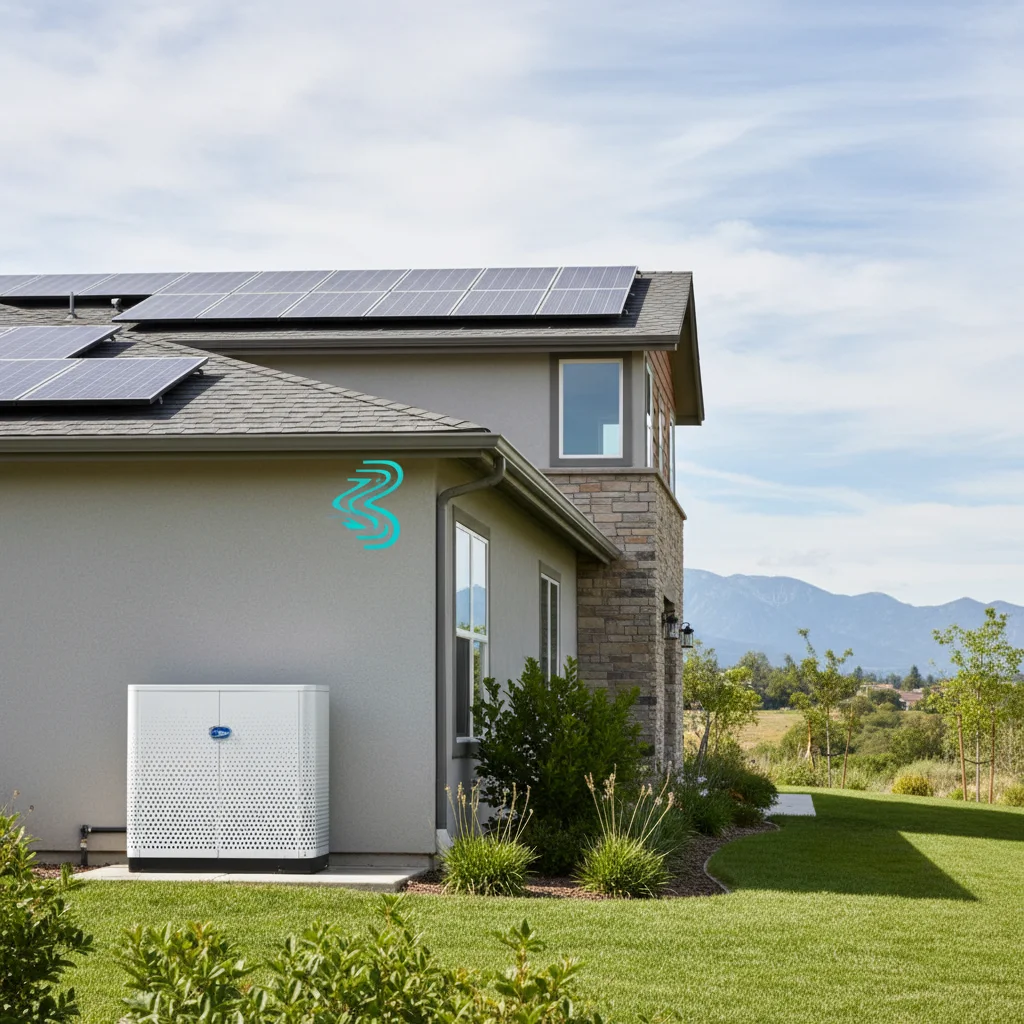
Bakersfield homeowners installing heat pumps in 2026 can access up to $8,000 in combined federal tax credits and utility rebates—but only if the system meets specific efficiency thresholds and the contractor files paperwork within 90 days of installation. And with summer temperatures routinely exceeding 100°F in Kern County, the decision between a heat pump and traditional HVAC affects both comfort and utility bills for the next 15-20 years.
How Much Can You Save with Heat Pump Rebates in Bakersfield?
Heat pump installations in Bakersfield qualify for federal IRA tax credits covering 30% of equipment and labor costs up to $2,000, plus PG&E rebates ranging from $2,000-$6,000 for income-qualified households in 2026. Combined incentives reduce out-of-pocket costs from $12,000-$18,000 to $4,000-$8,000 for qualifying systems with HSPF2 ratings of 8.1 or higher.
But the rebate landscape changed dramatically in 2026. The old Section 25C and 25D credits expired December 31, 2025. The federal Energy Efficient Home Improvement Credit (Section 25C) ended for property placed in service after December 31, 2025 (IRS FS-2025-05). Federal tax credits for this work have ended, but state, local and utility rebates may still apply; check what is available at your address with the DuloCore rebate calculator.
PG&E's 2026 Energy Efficiency Rebate Program offers tiered incentives based on household income. Customers earning below 80% of area median income ($68,400 for a family of four in Kern County) qualify for maximum rebates of $6,000 for ducted heat pumps and $4,000 for ductless mini-splits. And moderate-income households between 80-150% AMI receive $4,000 and $2,500 respectively.
"Heat pump rebates under the Inflation Reduction Act represent the largest residential HVAC incentives in U.S. history, with combined federal and utility programs covering 50-70% of installation costs for qualifying households." — U.S. Department of Energy
The application timeline matters. PG&E requires pre-approval before installation begins, with applications processed within 15 business days. And contractors must submit final paperwork within 90 days of project completion, or homeowners forfeit rebate eligibility entirely. Use our free rebate calculator to estimate your specific savings based on income and system specifications.
What Equipment Specifications Qualify for Rebates in Your Area?
Ducted heat pump systems in Bakersfield require minimum HSPF2 ratings of 8.1 and SEER2 ratings of 16.0 for federal tax credit eligibility in 2026, while PG&E rebates demand HSPF2 ≥8.5 and SEER2 ≥16.5. Ductless mini-split systems need HSPF2 ≥10.0 and SEER2 ≥19.0 to qualify for maximum rebate tiers.
Brand specifications vary significantly. Carrier Infinity 26 models achieve HSPF2 10.2 and SEER2 26.0, exceeding all rebate thresholds by 27%. And Mitsubishi Hyper-Heat systems maintain full heating capacity down to -13°F, though Bakersfield's winter lows rarely drop below 38°F.
The efficiency threshold creates a market split. Systems meeting minimum federal requirements (HSPF2 8.1) cost $10,000-$12,000 installed, while top-tier models qualifying for maximum PG&E rebates (HSPF2 10.0+) run $15,000-$18,000. So the $2,000 rebate difference doesn't offset the $5,000 equipment premium for most Bakersfield households.
Contractor certification affects rebate processing speed. PG&E's Trade Ally Network includes 37 pre-approved HVAC contractors in Kern County who handle rebate paperwork directly, reducing homeowner administrative burden from 6-8 hours to zero. And Trade Ally installations receive priority processing, with rebate checks issued within 45 days versus 90+ days for non-network contractors.
How Long Until Your Heat Pump Investment Pays for Itself?
Bakersfield heat pump installations generate payback periods of 6-9 years based on 2026 PG&E electricity rates of $0.38 per kWh and natural gas rates of $2.47 per therm. Households replacing electric resistance heat or propane systems see faster returns of 4-6 years, while natural gas furnace replacements extend payback to 8-12 years.
The math shifts dramatically by baseline system. Electric furnace users spending $2,400 annually on heating save $1,600 per year with a heat pump achieving 300% efficiency (COP 3.0). And propane customers paying $3,200 yearly reduce costs to $1,200, creating a $2,000 annual savings that recovers a $12,000 net installation cost in 6 years.
But natural gas remains the cheapest heating fuel in Bakersfield at $0.90 per therm equivalent energy versus $1.11 for heat pump electricity at current rates. So gas furnace replacements only make financial sense when the existing unit fails and requires replacement anyway, or when homeowners prioritize air conditioning efficiency gains.
Cooling savings accelerate payback in Bakersfield's climate. Heat pumps with SEER2 20.0 reduce summer cooling costs by 35% compared to SEER 13 central AC units, saving $420-$560 annually on households with $1,400 baseline cooling bills. And combined heating and cooling savings on electric or propane baseline systems push total annual savings to $1,800-$2,200.
The federal tax credit changes the equation. Without incentives, a $16,000 installation saves $1,600 yearly for a 10-year payback. But with $2,000 federal credits and $4,000 PG&E rebates reducing net cost to $10,000, payback drops to 6.2 years. And income-qualified households receiving $6,000 PG&E rebates hit breakeven in 4.4 years.
"In cooling-dominated climates like California's Central Valley, heat pumps deliver 8-12 year payback periods when replacing natural gas systems, but 4-7 years when replacing electric resistance or propane heating." — ENERGY STAR Heat Pump Guide
What Are the Rebate Application Deadlines and Eligibility Requirements?
PG&E's 2026 heat pump rebate program operates on a first-come, first-served basis with $180 million in total funding expected to exhaust by September 2026 based on current application velocity of 2,400 projects monthly. Applications require pre-approval before installation begins, with a 15-business-day review period and 90-day completion window from approval date.
Eligibility verification demands specific documentation. Homeowners must submit proof of income (2025 tax return or 3 months of pay stubs), property ownership (title or mortgage statement), and existing system type (contractor assessment or utility bills). And PG&E cross-references applications against address databases to prevent duplicate submissions, automatically rejecting second applications from the same meter number within 5 years.
Federal IRA tax credits operate on different timelines. Form 5695 only covers qualifying work completed by December 31, 2025 and claimed on a 2025 return; the federal 25C and 25D credits ended after that date (IRS FS-2025-05). But the credit is non-refundable, so households with tax liability below $2,000 forfeit the excess amount—unlike PG&E rebates paid as direct checks regardless of tax status.
Income limits stratify rebate tiers. Kern County's 2026 area median income is $85,500 for a four-person household, making 80% AMI equal to $68,400 and 150% AMI equal to $128,250. And households between 150-180% AMI ($154,000 for families of four) still qualify for federal credits but receive zero PG&E utility rebates.
The application sequence matters legally. Homeowners must submit PG&E pre-approval applications before signing contractor agreements, or installations become ineligible even if equipment meets all technical specifications. So the recommended timeline is: (1) PG&E application submission, (2) 15-day approval wait, (3) contractor agreement signed, (4) installation within 90 days, (5) final paperwork within 90 days post-completion.
How Do Heat Pumps Compare to Traditional AC and Furnace Systems?
Heat pumps in Bakersfield replace separate air conditioning and heating systems with a single unit operating at 300-400% efficiency for cooling and 200-300% efficiency for heating, compared to 78-95% AFUE for gas furnaces and 100% efficiency for electric resistance heat. Annual operating costs for a 2,000 sq ft home run $1,400-$1,800 for heat pumps versus $1,200-$1,600 for gas furnace plus central AC, creating a $200-$400 cost penalty in natural gas service areas.
But equipment lifespan differs. Heat pumps operate year-round rather than seasonally, accumulating 6,000-8,000 runtime hours annually versus 2,000-3,000 for AC-only systems. And this continuous operation reduces average heat pump lifespan to 12-15 years compared to 15-20 years for traditional split systems, adding $80-$120 annualized replacement cost.
Maintenance requirements increase with heat pumps. Reversing valves, defrost cycles, and refrigerant management demand annual professional servicing costing $180-$250 versus $120-$150 for furnace-AC combinations. So total cost of ownership over 15 years reaches $28,000-$32,000 for heat pumps versus $26,000-$30,000 for conventional systems in Bakersfield's natural gas service territory.
Temperature performance creates comfort differences. Heat pumps maintain efficiency down to 40°F outdoor temperature but lose 25-35% capacity below that threshold, requiring auxiliary electric resistance heat that costs $0.38 per kWh versus $0.10 per therm-equivalent for gas furnaces. And Bakersfield experiences 15-25 nights annually below 40°F, triggering auxiliary heat and spiking utility bills by $60-$120 those months.
Installation costs favor traditional systems. Gas furnace and central AC combinations install for $8,000-$12,000 compared to $12,000-$18,000 for equivalent-capacity heat pumps before incentives. So the $4,000-$6,000 equipment premium requires 8-12 years to recover through operating savings in gas-heated homes, extending beyond typical homeowner tenure of 9 years.
| System Type | Install Cost | Annual Operating | 15-Year Total | Lifespan | Rebates Available |
|---|---|---|---|---|---|
| Heat Pump (HSPF2 10.0) | $16,000 | $1,600 | $40,000 | 12-15 years | $2,000 federal + $4,000-$6,000 PG&E |
| Gas Furnace + AC (16 SEER) | $10,000 | $1,400 | $31,000 | 15-20 years | $0-$500 |
| Electric Furnace + AC | $9,000 | $2,400 | $45,000 | 15-20 years | $0 |
| Ductless Mini-Split | $12,000 | $1,200 | $30,000 | 15-18 years | $2,000 federal + $2,500-$4,000 PG&E |
Learn more about how heat pump rebates compare across different system types and climates.
What Alternative Heating and Cooling Solutions Should You Consider?
Ductless mini-split heat pumps install for $3,000-$5,000 per zone in Bakersfield, making single-room or 2-zone systems cost $6,000-$10,000 compared to $16,000 for whole-home ducted heat pumps. Efficiency ratings reach HSPF2 12.0 and SEER2 30.0 for premium Mitsubishi and Daikin models, exceeding ducted system performance by 20-40% and qualifying for identical federal tax credits plus $2,500-$4,000 PG&E rebates.
But zoned systems create coverage gaps. Homes with 3+ bedrooms require 3-4 indoor units to match whole-home comfort, pushing total mini-split costs to $12,000-$16,000—eliminating the price advantage while leaving hallways and bathrooms unconditioned. And installation requires wall penetrations for refrigerant lines, creating aesthetic concerns absent in ducted systems using existing ductwork.
Geothermal heat pumps achieve SEER2 equivalents of 30-40 and HSPF2 equivalents of 12-15 through ground-source heat exchange, reducing operating costs 40-60% compared to air-source heat pumps. So annual utility bills drop from $1,600 to $800-$1,000 for 2,000 sq ft homes. But installation costs reach $25,000-$35,000 for horizontal loop fields or $30,000-$45,000 for vertical wells, requiring 20-30 years to recover the $15,000-$25,000 premium over air-source systems.
And geothermal qualifies for higher federal credits. The IRA framework covers 30% of total costs with no dollar cap for ground-source heat pumps, creating $7,500-$13,500 tax credits versus the $2,000 maximum for air-source systems. But Bakersfield's soil conditions—hard caliche layers at 4-8 feet depth—increase drilling costs 15-25% above state averages, and PG&E offers zero additional rebates for geothermal in 2026.
Evaporative cooling systems cost $3,000-$6,000 installed and operate at $150-$250 annually in electricity and water costs, undercutting heat pump cooling expenses by 75-85%. But evaporative coolers provide zero heating capacity, requiring separate furnace systems and eliminating federal tax credit eligibility. And effectiveness drops when humidity exceeds 30%, which occurs 20-30 days annually in Bakersfield during monsoon season.
Variable refrigerant flow (VRF) systems scale for larger homes above 3,000 sq ft, offering 18-24 SEER2 efficiency with precise zone control through 8-12 indoor units. Installation costs run $20,000-$30,000, but operating costs drop 20-30% below standard heat pumps through reduced cycling losses. And commercial-grade VRF equipment qualifies for federal tax credits but not residential PG&E rebates, limiting incentives to $2,000 maximum.
For comprehensive information on all available incentives, see our guide to energy tax credits for 2026.
Official Sources
- U.S. Department of Energy - Energy Saver — Federal guidance on heat pump rebates, tax credits, and efficiency standards under the Inflation Reduction Act (note: the federal 25C and 25D credits ended for projects completed after December 31, 2025)
- ENERGY STAR Heat Pumps — Equipment specifications, efficiency ratings, and qualified product lists for federal tax credit eligibility (note: the federal 25C and 25D credits ended for projects completed after December 31, 2025)
- DSIRE - Database of State Incentives for Renewables & Efficiency — Searchable database of utility rebates, state tax credits, and local incentive programs by ZIP code (note: the federal 25C and 25D credits ended for projects completed after December 31, 2025)
Related Reading: Learn more about Heat Pump Rebates Bakersfield.
Frequently Asked Questions
How much does a heat pump cost in Bakersfield?
Ducted heat pump installations in Bakersfield cost $12,000-$18,000 before incentives, with system size ranging from 2-ton units ($12,000-$14,000) for 1,200 sq ft homes to 5-ton units ($16,000-$18,000) for 2,500+ sq ft properties. Equipment accounts for 60% of total cost ($7,200-$10,800), while labor, ductwork modifications, electrical upgrades, and permits comprise the remaining 40%. Federal tax credits reduce net costs by $2,000, and PG&E rebates lower out-of-pocket expenses to $4,000-$8,000 for income-qualified households.
What qualifications should a heat pump contractor in Bakersfield have?
Bakersfield heat pump contractors require California C20 Warm-Air Heating, Ventilation, and Air-Conditioning (HVAC) contractor licenses verified through CSLB.ca.gov, plus EPA Section 608 certification for refrigerant handling. PG&E Trade Ally Network membership indicates pre-qualification for rebate programs and training on 2026 efficiency standards. And manufacturers like Carrier, Trane, and Mitsubishi require factory certification for warranty coverage, with installer qualifications verified through brand dealer locators. Contractors should carry $1 million general liability insurance and workers compensation coverage confirmed through contractor state license board records.
Are heat pump installations eligible for California tax credits?
California offers zero state-level tax credits for residential heat pump installations in 2026, though PG&E provides direct rebates of $2,000-$6,000 depending on household income and equipment efficiency. Form 5695 only covers qualifying work completed by December 31, 2025 and claimed on a 2025 return; the federal 25C and 25D credits ended after that date (IRS FS-2025-05). And the Self-Generation Incentive Program (SGIP) excludes heat pumps, focusing only on battery storage systems paired with solar installations. Combined federal and utility incentives reach $8,000 maximum for qualifying Bakersfield households.
How long does it take to install a heat pump in Bakersfield?
Standard heat pump installations in existing homes with compatible ductwork require 6-8 hours for single-day completion, while homes needing duct modifications or electrical panel upgrades extend to 2-3 days. PG&E rebate pre-approval adds 15 business days before installation begins, and contractors schedule jobs 2-4 weeks out during peak season (April-June). So total timeline from application submission to operational system runs 5-7 weeks. And homes without existing ductwork requiring new distribution systems need 4-6 days for duct installation plus 1 day for heat pump connection, extending total project duration to 8-10 weeks including permit approvals.
What is the difference between a heat pump and a traditional air conditioner?
Heat pumps reverse refrigerant flow to provide both heating and cooling from a single outdoor unit, while traditional air conditioners only cool and require separate furnaces for heating. Both systems achieve identical cooling efficiency ratings (SEER2 14-26), but heat pumps add reversing valves, defrost controls, and supplementary heat strips that increase equipment costs by $2,000-$4,000. And heat pumps deliver 200-300% heating efficiency compared to 78-95% for gas furnaces, but operate year-round rather than seasonally, reducing lifespan from 18-20 years to 12-15 years through increased runtime hours.
Ready to see how much you can save? Calculate your exact rebate amount and payback period with our free rebate calculator—just enter your ZIP code, system type, and household income for an instant personalized estimate of federal tax credits and PG&E utility rebates.
Last reviewed: April 14, 2026. Reviewed by DuloCore Energy Specialists. About the team.
Check your California heat pump rebate eligibility — see the programs you qualify for and the dollar amounts on our California heat pump rebate finder.