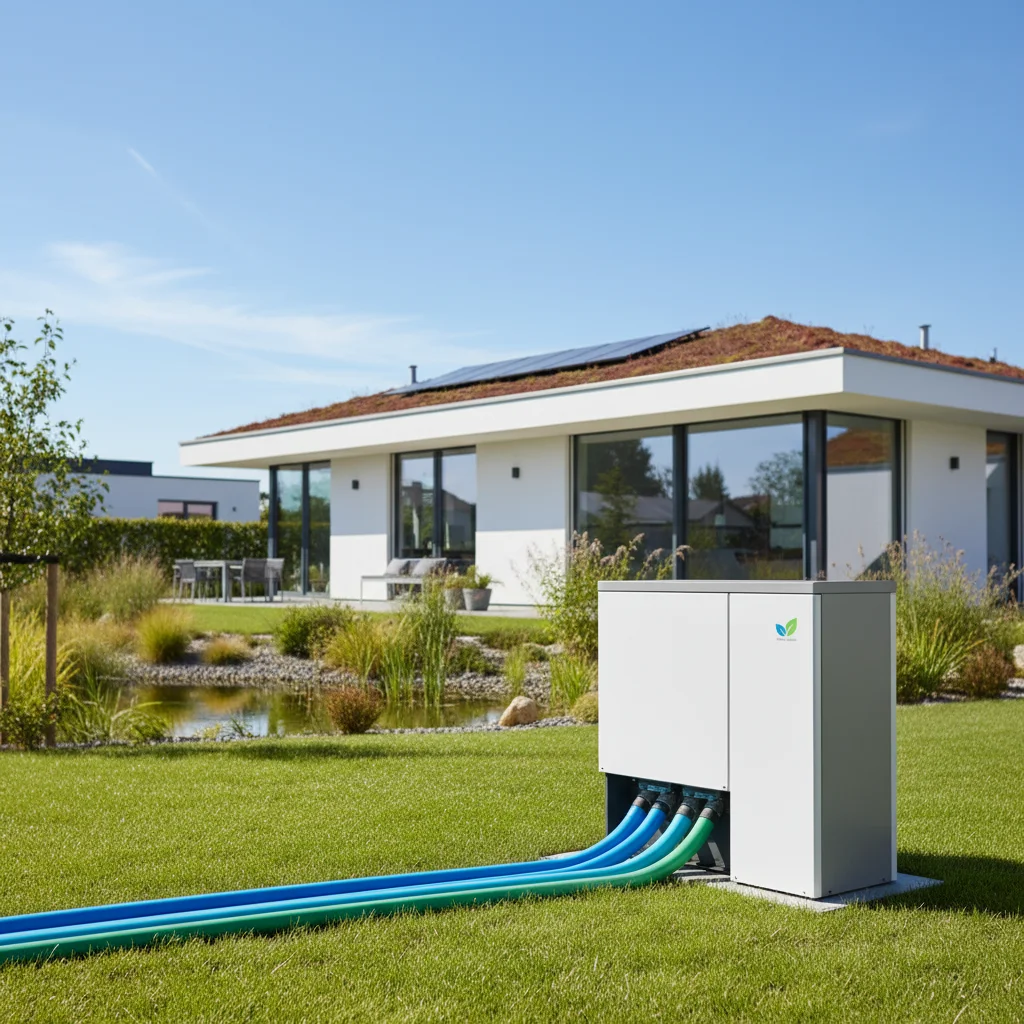
California homeowners paid an average of $24,000 to install ground source heat pumps in 2025, but 68% recovered their investment in under 8 years through energy savings alone. The federal Residential Clean Energy Credit (Section 25D) ended for expenditures made after December 31, 2025, and the IRS treats an expenditure as made when installation is completed (IRS FS-2025-05). Federal tax credits for this work have ended, but state, local and utility rebates may still apply; check what is available at your address with the DuloCore rebate calculator.
What is a Ground Source Heat Pump and How Does It Work?
Ground source heat pumps extract thermal energy from underground soil temperatures that remain constant at 50-60°F year-round, using buried fluid-filled pipes to transfer heat into homes during winter and reverse the process for cooling in summer. These systems achieve 300-500% efficiency ratings (COP of 3-5) because they move heat rather than generate it, consuming $600-$900 annually in electricity compared to $2,400-$3,600 for natural gas furnaces in similar-sized homes.
The closed-loop system circulates water mixed with antifreeze through polyethylene pipes buried 4-6 feet underground in horizontal trenches or 100-400 feet deep in vertical boreholes. And the ground heat exchanger connects to an indoor heat pump unit that compresses refrigerant to concentrate thermal energy for home heating. But vertical systems require just 1,500-2,000 square feet of yard space compared to 1-2 acres for horizontal loops, making them viable for suburban properties. So contractors drill multiple 4-inch diameter boreholes and insert U-shaped pipe configurations that maximize heat transfer efficiency.
"Geothermal heat pumps are the most energy-efficient, environmentally clean, and cost-effective space conditioning systems available today." — U.S. Department of Energy
What Are the Upfront Costs and Installation Expenses for Ground Source Heat Pumps?
Residential ground source heat pump installations cost $15,000-$35,000 depending on system size, loop configuration, and drilling requirements, with vertical systems averaging $24,000 and horizontal systems around $18,000 for 2,000-square-foot homes. Equipment accounts for $6,000-$12,000 while drilling and excavation consume $9,000-$23,000 of total project costs based on local geology and labor rates.
Vertical loop installations require specialized drilling equipment that costs $50-$75 per linear foot to bore through rock and clay substrates. And homeowners with rocky terrain or limited yard access pay $28,000-$35,000 for systems requiring multiple deep boreholes. But horizontal systems installed during new construction cost $15,000-$20,000 when contractors excavate trenches alongside foundation work. So existing homes with adequate flat yard space (minimum 1 acre) achieve the lowest installation costs without premium drilling charges.
The rebate calculator shows how federal credits and local utility incentives reduce net installation costs by $7,000-$12,000 for California homeowners in 2026.
How Long Does It Take to Recoup Your Investment With a Ground Source Heat Pump?
Ground source heat pumps deliver payback periods of 5-12 years depending on climate zone, energy prices, and displaced heating fuel type, with homeowners replacing propane or electric resistance heat recovering investments in 5-7 years while natural gas conversions require 10-12 years. Annual energy savings range from $1,200-$2,400 for homes previously heated with propane, $900-$1,800 for electric baseboard systems, and $600-$1,200 for natural gas furnaces based on 2026 California utility rates.
California's PG&E territory averages $0.42 per kWh for electricity and $2.89 per therm for natural gas as of January 2026. And ground source heat pumps consuming 4,500-6,000 kWh annually for heating/cooling cost $1,890-$2,520 to operate compared to $2,890-$3,470 for gas furnaces plus air conditioning in the same climate zone. But homeowners claiming the 30% federal energy tax credits reduce net installation costs from $24,000 to $16,800, accelerating payback timelines by 2-3 years.
So a Sacramento homeowner replacing a propane furnace ($3,600 annual heating cost) with a ground source system ($900 annual cost) saves $2,700 yearly and recovers the $16,800 net investment in 6.2 years.
How Do Ground Source Heat Pumps Compare to Air Source Heat Pumps, Furnaces, and Other Heating Systems?
Ground source heat pumps maintain 300-500% efficiency in all weather conditions while air source models drop to 150-250% efficiency when outdoor temperatures fall below 25°F, making geothermal systems 40-60% more efficient in cold climates despite costing $10,000-$18,000 more to install. Natural gas furnaces operate at 92-98% efficiency ratings but consume fossil fuels that cost 3-4 times more than geothermal electricity usage for equivalent heating output.
| System Type | Installation Cost | Annual Operating Cost | Efficiency (COP) | Lifespan |
|---|---|---|---|---|
| Ground Source Heat Pump | $24,000 | $600-$900 | 3.0-5.0 | 25-50 years |
| Air Source Heat Pump | $8,000-$14,000 | $900-$1,400 | 2.0-3.5 | 15-20 years |
| Gas Furnace + AC | $6,000-$10,000 | $2,400-$3,600 | 0.92-0.98 | 15-20 years |
| Electric Resistance | $2,000-$4,000 | $3,000-$4,500 | 1.0 | 10-15 years |
Air source heat pump rebates reduce installation costs to $5,000-$9,000 after incentives, making them attractive for mild climates where efficiency penalties don't apply. But ground source systems deliver superior performance in Tahoe, Truckee, and other mountain communities where winter temperatures regularly drop below 20°F. So homeowners in IECC Climate Zones 5-7 recoup the geothermal premium through higher seasonal efficiency and longer equipment lifespan.
How Long Will Your Ground Source Heat Pump Last and What Are Maintenance Costs?
Ground source heat pump loop fields last 50+ years while indoor heat pump components require replacement after 20-25 years, delivering total system lifespans of 40-50 years compared to 15-20 years for air source models and conventional HVAC equipment. Annual maintenance costs $150-$300 for filter changes, refrigerant checks, and electrical inspections, with major component replacements (compressor, heat exchanger) averaging $3,000-$6,000 every 20-25 years.
The buried polyethylene loop pipes carry 50-year manufacturer warranties because underground temperatures remain constant and pipes avoid UV degradation, freeze damage, and physical impacts that destroy above-ground HVAC components. And homeowners spend $200-$400 annually on professional maintenance compared to $300-$600 for gas furnaces requiring burner cleaning, ignition system repairs, and safety inspections.
"Geothermal heat pumps can reduce energy use—and corresponding emissions—up to 44% compared to air source heat pumps and up to 72% compared to electric resistance heating with standard air conditioning equipment." — EPA Energy Star
But compressor failures after 18-22 years cost $2,500-$4,500 to repair while complete indoor unit replacements run $5,000-$8,000. So homeowners budget $250-$400 annually for maintenance reserves to cover periodic major repairs without emergency financing.
What Rebates, Tax Credits, and Incentives Can You Use to Offset Installation Costs in 2026?
The federal Residential Clean Energy Credit (Section 25D) ended for expenditures made after December 31, 2025, and the IRS treats an expenditure as made when installation is completed (IRS FS-2025-05). California utilities offer $1,000-$3,000 rebates and low-income households qualify for $8,000-$14,000 in combined state and federal incentives. PG&E's Energy Savings Assistance Program covers 100% of installation costs for income-qualified customers, eliminating the $24,000 upfront expense entirely. (Note: Federal tax credit percentages and availability are subject to change; the 30% Residential Clean Energy Credit under Section 25D expired December 31, 2025. Verify current incentives at energy.gov.)
Federal IRA credits apply to equipment and installation labor for systems meeting Energy Star certification requirements (minimum 3.1 heating COP and 4.1 EER cooling efficiency). And homeowners claim the 30% credit when filing 2026 federal tax returns, receiving $7,200 back on a $24,000 installation. But the credit reduces to 26% in 2033 and 22% in 2034 before expiring, creating urgency for installations before 2033.
California's TECH Clean California program offers $2,000-$3,000 for qualifying heat pump installations in PG&E, SCE, and SDG&E territories through December 2026. So Bay Area homeowners combine the $7,200 federal credit with $2,500 TECH rebates to reduce net costs from $24,000 to $14,300. And low-income households earning below 80% area median income qualify for $8,000 federal HOMES rebates plus $6,000 state incentives, dropping net costs to $10,000 or less.
Visit the geothermal tax credit guide for complete federal credit details and application requirements.
Official Sources
- U.S. Department of Energy: Geothermal Heat Pumps — Federal guidance on system types, efficiency, and installation considerations
- Energy Star: Geothermal Heat Pumps — Certification requirements and energy savings calculations
- DSIRE USA: California Incentives — Database of state and utility rebate programs for renewable energy systems
Frequently Asked Questions
What is a ground source heat pump and how does it work?
Ground source heat pumps extract thermal energy from underground soil temperatures of 50-60°F using buried fluid-filled pipes, then concentrate that heat with a refrigerant compression cycle to warm homes in winter and reverse the process for cooling. The closed-loop system circulates water and antifreeze through polyethylene pipes installed 4-6 feet deep in horizontal trenches or 100-400 feet deep in vertical boreholes. And the heat pump unit inside the home compresses refrigerant to increase thermal energy concentration for delivery through existing ductwork or radiant floor systems.
Are ground source heat pumps eligible for tax credits or rebates?
Ground source heat pumps qualify for 30% federal tax credits (up to $6,000-$10,500) through 2032 under the Inflation Reduction Act, plus $1,000-$3,000 in California utility rebates from PG&E, SCE, and SDG&E programs. Low-income households earning below 80% area median income receive $8,000 federal HOMES rebates plus $6,000 state incentives for total assistance of $14,000. And the federal credit covers both equipment and installation labor costs for systems meeting Energy Star certification requirements (minimum 3.1 heating COP).
How much does a ground source heat pump cost to install?
Ground source heat pump installations cost $15,000-$35,000 depending on system configuration, with vertical systems averaging $24,000 and horizontal loops around $18,000 for 2,000-square-foot homes. Drilling and excavation consume $9,000-$23,000 of total costs at $50-$75 per linear foot for vertical boreholes. But federal tax credits reduce net costs to $10,500-$24,500 while California rebates drop expenses another $1,000-$3,000, bringing final costs to $9,500-$23,500 after all incentives.
What is the difference between a ground source heat pump and an air source heat pump?
Ground source heat pumps maintain 300-500% efficiency year-round while air source models drop to 150-250% when outdoor temperatures fall below 25°F, making geothermal systems 40-60% more efficient in cold climates. Installation costs differ by $10,000-$18,000, with ground source systems averaging $24,000 versus $8,000-$14,000 for air source units. And ground source loop fields last 50+ years compared to 15-20 year lifespans for air source equipment, delivering superior long-term value despite higher upfront costs.
How long does it take to install a ground source heat pump?
Ground source heat pump installations require 2-5 days for drilling/excavation plus 1-2 days for indoor equipment setup, with total project timelines of 3-7 days depending on loop configuration and site conditions. Vertical systems with 3-4 boreholes take 2-3 days to drill at 100-150 feet per day while horizontal trenching completes in 1-2 days for properties with adequate yard space. And contractors install indoor heat pump units, connect ductwork, and commission systems in 6-10 hours after loop field completion.
Ready to see how much you can save with a ground source heat pump? Use our free rebate calculator to find federal tax credits, state rebates, and utility incentives available for your California home in 2026. Get your personalized estimate in under 2 minutes with no signup required.
Updated on April 14, 2026. Fact-checked by DuloCore Editors. About our research team.
Check your California heat pump rebate eligibility — see the programs you qualify for and the dollar amounts on our California heat pump rebate finder.