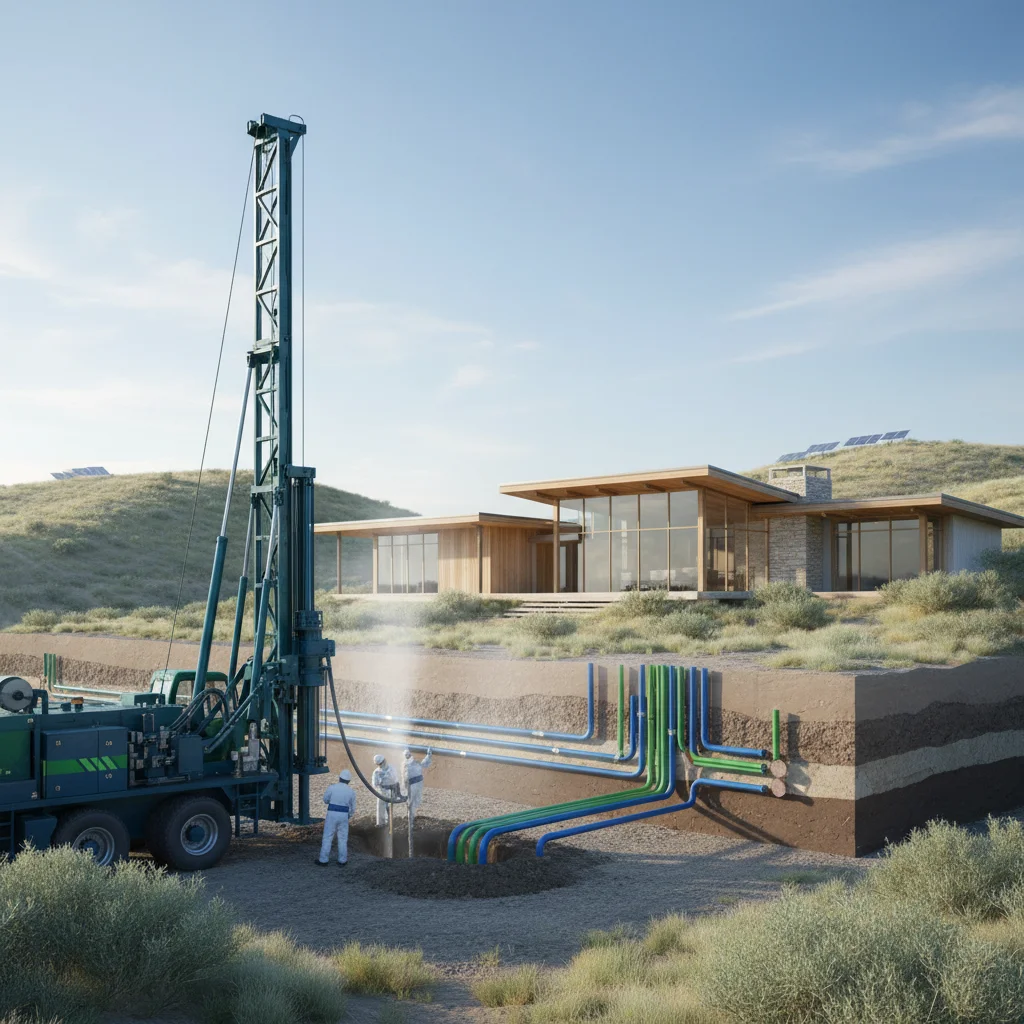
Drilling a geothermal well in California costs between $20,000 and $40,000 for a typical residential installation, with total system costs reaching $30,000 to $50,000 after adding heat pump equipment and loop installation. And that price varies dramatically based on geology: drilling through Northern California's volcanic bedrock costs 40% less per foot than cutting through Southern California's sedimentary layers.
How Much Does Geothermal Well Drilling Cost in California?
Geothermal well drilling in California ranges from $15 to $40 per linear foot, with residential systems requiring wells between 150 and 400 feet deep. Total drilling costs span $20,000 to $40,000, while complete system installation reaches $30,000 to $50,000 including heat pump equipment, ground loop piping, and indoor components for 2026 installations.
But geology determines your actual cost more than system size. Drilling through granite in the Sierra Nevada foothills costs $25 to $40 per foot. Sedimentary formations in the Central Valley cost $15 to $25 per foot. And coastal regions with mixed geology fall between $20 and $30 per foot.
So your 2,000-square-foot home requires three to five vertical wells drilled 200 to 400 feet deep, spaced 15 to 20 feet apart. Each well accommodates a closed-loop pipe system circulating water and antifreeze through underground rock formations that maintain 50°F to 60°F year-round.
Drilling contractors charge $3,000 to $5,000 for mobilization and site preparation. And permits add $500 to $2,000 depending on your county. The federal Residential Clean Energy Credit (Section 25D) ended for expenditures made after December 31, 2025, and the IRS treats an expenditure as made when installation is completed (IRS FS-2025-05). Federal tax credits for this work have ended, but state, local and utility rebates may still apply; check what is available at your address with the DuloCore rebate calculator.
California's Self-Generation Incentive Program (SGIP) doesn't currently cover geothermal systems, but utility-specific rebates through PG&E, SCE, and SDG&E can provide $1,000 to $3,000 for ENERGY STAR certified installations. Use our free rebate calculator to find your exact savings.
"Geothermal heat pumps are the most energy-efficient, environmentally clean, and cost-effective space conditioning systems available." — U.S. Department of Energy
What Specifications Make Your Geothermal System Rebate Eligible?
Geothermal systems qualify for federal IRA tax credits and California utility rebates when they meet ENERGY STAR certification requirements: minimum 3.3 COP (Coefficient of Performance) for heating and 16.2 EER (Energy Efficiency Ratio) for cooling in closed-loop ground-source configurations installed in 2026.
And certification requires third-party verification through AHRI (Air-Conditioning, Heating, and Refrigeration Institute). Your contractor must submit AHRI certificate numbers with your tax credit documentation.
But vertical closed-loop systems (the type requiring well drilling) automatically meet these minimums when installed by IGSHPA (International Ground Source Heat Pump Association) certified contractors. So certification focuses on equipment selection rather than well depth or geology.
Open-loop systems pulling groundwater directly from wells face stricter requirements: discharge permits, water quality testing, and municipal approval. And most California jurisdictions restrict open-loop installations due to drought concerns.
The federal Residential Clean Energy Credit (Section 25D) ended for expenditures made after December 31, 2025, and the IRS treats an expenditure as made when installation is completed (IRS FS-2025-05). But utility rebates through heat pump (this federal credit ended for property placed in service after December 31, 2025) rebate programs often require household income verification and pre-approval before installation begins. (Note: Federal tax credit percentages and availability are subject to change; the 30% Residential Clean Energy Credit under Section 25D expired December 31, 2025. Verify current incentives at energy.gov.)
What's the Efficiency Rating of Modern Geothermal Systems and Why Does It Matter?
Modern geothermal heat pumps achieve 300% to 600% efficiency, delivering three to six units of heating or cooling energy for every unit of electricity consumed. This translates to COP ratings between 3.0 and 6.0, compared to air-source heat pumps at 2.0 to 3.5 COP and gas furnaces at 0.95 to 0.98 efficiency.
So a geothermal system consuming 3 kW of electricity moves 15 kW to 18 kW of thermal energy. And that efficiency remains constant regardless of outdoor temperature, unlike air-source systems that lose 40% to 50% efficiency when ambient temperatures drop below 25°F.
California's mild climate maximizes cooling-mode efficiency. Summer EER ratings hit 25 to 30 for premium systems, compared to 13 to 18 for conventional air conditioners. And ground temperatures stay at 55°F to 60°F year-round in most regions, providing ideal heat exchange conditions.
But efficiency translates to operating costs: geothermal systems cost $600 to $1,200 annually to operate for a 2,000-square-foot home. Natural gas furnaces paired with air conditioning cost $1,800 to $2,400 annually. And all-electric air-source heat pumps cost $900 to $1,500 annually at 2026 California electricity rates averaging $0.28 per kWh.
"Ground source heat pumps can reduce energy consumption—and corresponding emissions—up to 44% compared to air-source heat pumps and up to 72% compared to electric resistance heating with standard air-conditioning equipment." — U.S. Environmental Protection Agency
How Long Until Your Geothermal Investment Pays for Itself?
Geothermal systems achieve payback in 5 to 10 years for California installations when factoring in 30% federal tax credits, utility rebates, and energy savings of $1,200 to $1,800 annually compared to conventional HVAC systems in 2026.
Your payback timeline depends on three variables: net installation cost after incentives, current heating and cooling costs, and electricity rates. So a $40,000 system costs $28,000 after the federal tax credit. And annual savings of $1,500 produce a 18.7-year simple payback.
But that calculation ignores avoided replacement costs. Traditional HVAC systems require replacement every 12 to 15 years at $8,000 to $12,000 per replacement. Geothermal ground loops last 50 years, and heat pump equipment lasts 20 to 25 years.
So lifecycle analysis shows $30,000 to $45,000 net savings over 25 years compared to conventional systems. And homes with electric resistance heating see payback in 4 to 6 years due to higher baseline costs.
Net metering amplifies savings when paired with solar panels. Excess solar generation offsets winter heating loads, and geothermal systems reduce summer cooling demand by 50% to 70% compared to air conditioning. This combination produces net-zero energy costs for thousands of California homeowners.
Geothermal vs. Heat Pumps vs. Traditional HVAC: Which System Offers the Best ROI in California?
Geothermal systems deliver the highest 25-year ROI at 180% to 220% for California installations, compared to air-source heat pumps at 140% to 170% and traditional gas furnace plus air conditioning at 95% to 105% when accounting for 2026 federal tax credits, energy costs, and equipment lifespan.
And upfront costs tell the story: geothermal requires $30,000 to $50,000 installed. Air-source heat pumps cost $12,000 to $18,000. Traditional systems cost $8,000 to $12,000. But operating costs reverse the equation.
So a 2,000-square-foot home in Sacramento running geothermal spends $800 annually on heating and cooling. The same home with an air-source heat pump spends $1,200 annually. And gas furnace plus air conditioning costs $2,000 annually at $2.50 per therm natural gas and $0.28 per kWh electricity.
But climate matters. Coastal regions with mild temperatures favor air-source heat pumps due to lower upfront costs and similar efficiency in moderate climates. Inland valleys with 100°F+ summers and 30°F winters favor geothermal due to consistent efficiency regardless of outdoor temperature.
Geothermal systems add $20,000 to $30,000 in home resale value according to National Association of Realtors data. And homes with geothermal sell 3% to 5% faster than comparable homes with conventional HVAC in California markets.
Calculate your specific ROI using our rebate calculator with your utility rates, home size, and current heating costs.
How Long Do Geothermal Wells Last and What's the Maintenance Reality?
Geothermal ground loops last 50 years or longer with zero maintenance, while heat pump equipment requires servicing every 3 to 5 years and replacement after 20 to 25 years. Total lifecycle maintenance costs average $3,000 to $5,000 over 25 years, compared to $8,000 to $12,000 for conventional HVAC systems.
And the ground loop represents 60% to 70% of installation cost but requires no maintenance once installed. High-density polyethylene piping carries a 50-year warranty and resists corrosion, freezing, and chemical degradation.
So maintenance focuses on the heat pump equipment: annual filter changes at $20 to $40, refrigerant checks every 3 years at $150 to $250, and compressor replacement after 15 to 20 years at $2,000 to $3,500. But no outdoor condensing units mean no exposure to weather, debris, or UV damage that reduces air-source equipment lifespan.
California's lack of extreme weather extends equipment life. Heat pumps in coastal climates often exceed 25 years, while units in the Central Valley average 20 to 22 years due to higher operating hours and temperature extremes.
And system monitoring prevents costly failures. Smart thermostats track COP in real-time, alerting homeowners to 10% to 15% efficiency drops that indicate refrigerant leaks or heat exchanger fouling before complete failures occur.
Official Sources
- U.S. Department of Energy: Geothermal Heat Pumps — Federal guidance on system types, efficiency ratings, and installation requirements
- ENERGY STAR Geothermal Heat Pump Specification — Minimum efficiency standards and certified product directory
- DSIRE: California Incentives — Comprehensive database of federal, state, and utility rebates for geothermal systems
Frequently Asked Questions
How much does geothermal well drilling cost in California?
Geothermal well drilling costs $15 to $40 per linear foot in California, with typical residential installations requiring $20,000 to $40,000 for drilling three to five vertical wells 200 to 400 feet deep. The federal Energy Efficient Home Improvement Credit (Section 25C) ended for property placed in service after December 31, 2025 (IRS FS-2025-05).
What rebates are available for geothermal system installation in California?
The federal Residential Clean Energy Credit (Section 25D) ended for expenditures made after December 31, 2025, and the IRS treats an expenditure as made when installation is completed (IRS FS-2025-05). Utility-specific rebates through PG&E, SCE, and SDG&E offer $1,000 to $3,000 for ENERGY STAR certified systems. And some municipalities provide additional incentives of $500 to $2,000 for residential geothermal installations in 2026.
How deep do geothermal wells need to be drilled?
California residential geothermal systems require wells drilled 150 to 400 feet deep, with most installations using 200 to 300 feet to reach stable ground temperatures of 55°F to 60°F. And well depth depends on soil type, available land area, and heating and cooling load: homes requiring 3 to 5 tons of capacity need three to five wells spaced 15 to 20 feet apart.
Is geothermal drilling eligible for California tax credits in 2026?
The federal Residential Clean Energy Credit (Section 25D) ended for expenditures made after December 31, 2025, and the IRS treats an expenditure as made when installation is completed (IRS FS-2025-05). But California doesn't offer state-level tax credits for geothermal installations in 2026. Form 5695 only covers qualifying work completed by December 31, 2025 and claimed on a 2025 return; the federal 25C and 25D credits ended after that date (IRS FS-2025-05).
How long does geothermal well drilling take in California?
Drilling three to five vertical geothermal wells takes 2 to 5 days, with complete system installation requiring 1 to 2 weeks from mobilization to final startup. But permit approval adds 4 to 8 weeks in most California counties. And geological surveys, soil testing, and site preparation add another 1 to 2 weeks before drilling begins, making total project timelines 8 to 12 weeks from contract signing to operation.
Ready to see how much you can save with geothermal? Use our free rebate calculator to calculate your exact incentives, payback period, and lifetime savings based on your home size, location, and current energy costs. Get your personalized geothermal cost analysis in under 2 minutes.
Updated: April 14, 2026 — fact-checked by DuloCore Research. About our editorial process.
Check your California heat pump rebate eligibility — see the programs you qualify for and the dollar amounts on our California heat pump rebate finder.