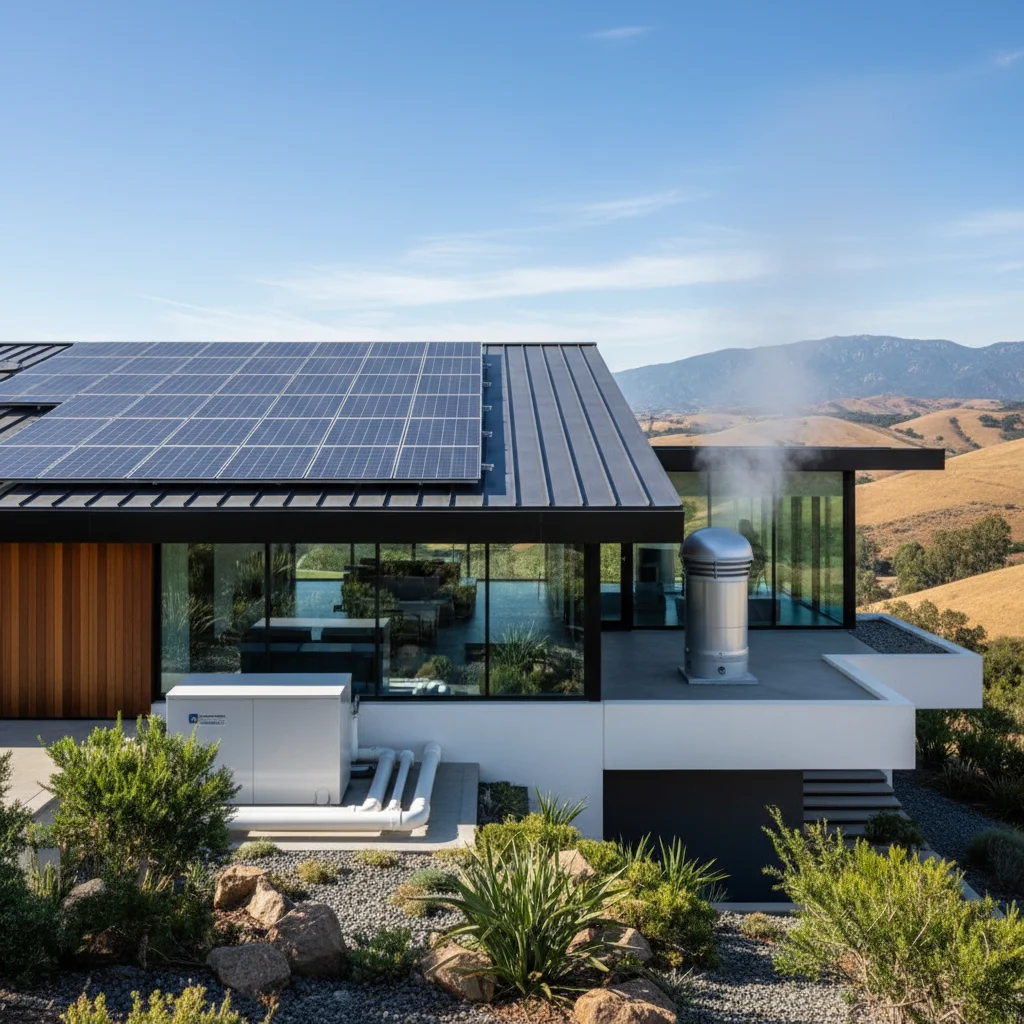
California homeowners face a decision that determines 25 years of energy bills: geothermal ground-source heat pumps or rooftop solar panels. In 2026, the average California household spends $2,340 annually on electricity and gas combined, and both technologies cut that bill by 40-80% depending on climate zone and home size. But geothermal systems cost $20,000-$40,000 installed while solar averages $15,000-$25,000 after federal credits, and the wrong choice locks homeowners into decades of suboptimal savings.
Which System Qualifies for California Rebates and What Are the Eligibility Requirements?
The federal Residential Clean Energy Credit (Section 25D) ended for expenditures made after December 31, 2025, and the IRS treats an expenditure as made when installation is completed (IRS FS-2025-05). Federal tax credits for this work have ended, but state, local and utility rebates may still apply; check what is available at your address with the DuloCore rebate calculator. California's TECH Clean California program offers point-of-sale rebates up to $3,000 for geothermal heat pump installations replacing gas furnaces in single-family homes, while the Self-Generation Incentive Program (SGIP) provides $200-$400 per kilowatt-hour for solar battery storage paired with solar panels. Geothermal systems must meet ENERGY STAR certification or AHRI 870 efficiency standards with an Energy Efficiency Ratio of 17.1 or higher for cooling and a Coefficient of Performance of 3.6 or higher for heating. Solar installations require inverters listed on the California Energy Commission's approved equipment list and interconnection approval from the local utility.
And both technologies face different timeline pressures. The federal Residential Clean Energy Credit (Section 25D) ended for expenditures made after December 31, 2025, and the IRS treats an expenditure as made when installation is completed (IRS FS-2025-05). Check current state, local and utility incentives for your address with the DuloCore rebate calculator. TECH Clean California operates on annual funding cycles that close when budgets deplete, often by mid-year.
So the rebate landscape favors geothermal for heating-focused homes and solar for homes with high daytime electricity use, but combining both captures maximum incentives.
| System | Federal Credit | California Incentive | Eligibility Requirement | 2026 Deadline |
|---|---|---|---|---|
| Geothermal Heat Pump | Ended Dec 31, 2025 | $3,000 TECH rebate | ENERGY STAR, gas replacement | Rolling (state) |
| Solar PV | Ended Dec 31, 2025 | $0 direct (SGIP for batteries) | CEC-approved inverter, utility interconnect | Ended Dec 31, 2025 (federal) |
| Solar + Battery | Ended Dec 31, 2025 | $200-$400/kWh SGIP | Fire risk area or equity program | Rolling (state) |
How Do Geothermal and Solar Systems Perform in Different California Climate Zones?
Geothermal heat pumps deliver consistent performance across all 16 California climate zones because ground temperatures remain 50-60°F year-round at 6-foot depth, eliminating the efficiency loss air-source heat pumps suffer in extreme heat or cold. In Climate Zone 1 (Arcata) where heating dominates 8 months annually, geothermal systems maintain a Coefficient of Performance above 4.0 even during January lows, while solar production drops 40% from June to December due to shorter days and cloud cover. But in Climate Zone 10 (Riverside) where cooling drives 70% of energy use, solar panels generate peak output during the same afternoon hours when air conditioning runs hardest, directly offsetting the grid at retail rates under net metering 3.0.
And desert regions create diverging economics. Climate Zone 15 (El Centro/Brawley) sees solar panels lose 10-15% efficiency when surface temperatures exceed 149°F during summer, while geothermal systems pull heat into stable 55°F ground for maximum efficiency. Coastal zones like Climate Zone 6 (Los Angeles) experience minimal heating or cooling loads, making solar's electricity offset more valuable than geothermal's thermal efficiency.
So geothermal dominates in heating-heavy northern and mountain zones (1, 16), solar wins in cooling-heavy inland valleys (10, 13), and coastal moderates favor solar for year-round electric loads like appliances and EV charging.
What's the Expected Lifespan of Geothermal vs Solar Systems in California?
Geothermal ground loops carry manufacturer warranties of 25-50 years and documented operational lifespans exceeding 100 years because the buried high-density polyethylene piping contains no moving parts and remains protected from UV exposure, temperature cycling, and physical damage. The indoor heat pump unit requires replacement every 20-25 years at a cost of $4,000-$8,000, but the ground loop remains functional indefinitely. Solar panels degrade at 0.5% annually under standard test conditions, retaining 87.5% of original output after 25 years, though California's intense UV exposure in zones 14-15 accelerates degradation to 0.7% annually in some installations.
But inverter lifespan creates hidden costs. String inverters fail after 10-15 years and cost $1,500-$3,000 to replace, while microinverters last 20-25 years but require individual replacement at $150-$300 per unit. Geothermal systems use a single compressor unit that fails predictably at year 20-25, allowing planned replacement.
And California's seismic activity poses negligible risk to either technology. Ground loops withstand soil shifts because polyethylene pipe flexes without breaking, and modern solar racking systems meet Zone 4 seismic requirements with engineered attachments rated for 1.0g lateral acceleration.
So geothermal delivers 50-100 year ground loop life with one major component replacement, while solar provides 25-30 years of panel life with 2-3 inverter replacements.
How Much Maintenance Do Geothermal and Solar Systems Require Over Their Lifetime?
Geothermal systems require annual HVAC filter changes at $30-$50 and professional inspection every 3-5 years at $150-$300 to check refrigerant levels, electrical connections, and thermostat calibration. The closed-loop system contains no exposed components, eliminating the condenser coil cleaning and outdoor unit maintenance that air-source heat pumps demand quarterly. Total maintenance costs average $100-$200 annually over the system's 25-year lifespan.
Solar panels require zero routine maintenance in most California installations because the state's dry climate prevents moss growth and rainfall occurs infrequently enough that dust accumulation remains minimal. And panels installed at a 15-degree tilt or greater self-clean during the 6-12 annual rain events in southern California. Coastal installations within 5 miles of the Pacific Ocean benefit from panel washing every 2-3 years to remove salt spray buildup at $150-$300 per service, but inland installations operate maintenance-free.
But inverter monitoring prevents silent failures. String inverter systems require monthly production checks through the manufacturer app to detect faults, while microinverter systems provide panel-level monitoring that alerts homeowners to individual panel failures within 24 hours. Ignoring a failed string inverter costs $50-$150 monthly in lost production until discovered.
So geothermal maintenance costs $2,500-$5,000 over 25 years while solar costs $0-$1,500 depending on location and monitoring diligence.
Geothermal vs Solar: Total Cost of Ownership Including Rebates and Maintenance
A 4-ton geothermal heat pump system costs $28,000-$42,000 installed in California, minus the 30% federal credit (this federal credit ended for expenditures made after December 31, 2025) ($8,400-$12,600) and $3,000 TECH rebate, resulting in a net cost of $16,600-$26,400. Annual energy savings average $1,800-$2,400 compared to a gas furnace and air conditioner, creating a simple payback period of 7-15 years depending on replaced equipment efficiency and climate zone. Over 25 years, total cost of ownership equals net installation cost plus $2,500-$5,000 maintenance minus $45,000-$60,000 in cumulative energy savings, yielding a net gain of $18,600-$36,900.
And solar economics shift by net metering status. A 7-kilowatt solar array costs $19,600-$24,500 installed, minus the 30% federal credit (this federal credit ended for expenditures made after December 31, 2025) ($5,880-$7,350), resulting in a net cost of $13,720-$17,150. But California's NEM 3.0 policy enacted April 2023 pays solar exports at wholesale rates 75% lower than retail, extending payback periods from 5-7 years under old net metering to 9-12 years for new installations. Homes adding a 13.5-kilowatt-hour battery at $10,000-$14,000 (minus 30% credit) restore economic viability by storing solar for evening use instead of exporting at wholesale rates.
So geothermal delivers $18,600-$36,900 net savings over 25 years while solar without batteries returns $8,000-$15,000 and solar with batteries returns $12,000-$22,000 depending on electricity rates and usage patterns.
Calculate your specific savings with our rebate calculator using your actual utility bills and home specifications.
How Do Installation Timelines and Complexity Compare Between the Two Systems?
Geothermal installations require 3-5 days of drilling or trenching to install ground loops, followed by 1-2 days of indoor equipment setup and ductwork connection if replacing forced-air systems. Horizontal ground loops need 500-600 linear feet of trench space for a 4-ton system, limiting installations to properties with 0.25 acres or more, while vertical boreholes require just 200 square feet of drilling space but cost $3,000-$6,000 more. Permit approval takes 2-4 weeks through county building departments, and California requires a C-20 HVAC contractor license for legal installation.
But solar permitting varies wildly by jurisdiction. Los Angeles County issues permits within 5-10 business days while Kern County takes 4-6 weeks, and coastal commission review adds 60-90 days for homes within the coastal zone. And roof condition determines feasibility. Roofs older than 10 years require inspection to confirm 25-year remaining lifespan before solar installation, and composition shingle roofs with 3+ layers need teardown to single-layer deck at $3,000-$8,000 before panels can mount.
So geothermal installations complete in 3-6 weeks from permit to operation while solar takes 6-12 weeks, with coastal and historic district homes facing 3-6 month timelines. Property size limits geothermal while roof condition limits solar.
Official Sources
- DOE Geothermal Heat Pumps — Federal technical specifications and efficiency standards for ground-source systems
- DOE Solar Tax Credit Guide — IRS Form 5695 instructions and qualifying equipment requirements for residential solar (note: the federal 25C and 25D credits ended for projects completed after December 31, 2025)
- DSIRE California — Comprehensive database of state and utility rebate programs with current funding status
Related Reading: Learn more about Solar Ppa Power Purchase Agreement and Solar Readiness Assessment Home.
Frequently Asked Questions
What are the eligibility requirements for geothermal and solar rebates in California?
Geothermal systems must meet ENERGY STAR certification with an EER of 17.1+ for cooling and COP of 3.6+ for heating to qualify for the federal 30% tax credit (this federal credit ended for expenditures made after December 31, 2025) and $3,000 TECH Clean California rebate when replacing gas heating. Solar installations require California Energy Commission-approved inverters and utility interconnection agreements to claim the federal 30% credit. Form 5695 only covers qualifying work completed by December 31, 2025 and claimed on a 2025 return; the federal 25C and 25D credits ended after that date (IRS FS-2025-05).
How much can I save with geothermal versus solar in California?
Geothermal systems save $1,800-$2,400 annually by replacing gas furnaces and electric air conditioners with a single efficient heat pump, accumulating $45,000-$60,000 over 25 years. Solar arrays save $1,200-$2,000 annually under NEM 3.0 wholesale export rates or $1,800-$2,800 annually when paired with batteries for self-consumption, totaling $30,000-$70,000 over 25 years depending on electricity rates and battery deployment. Actual savings vary by climate zone, with geothermal favoring heating-heavy zones 1-5 and solar favoring high-electricity zones 10-15.
What is the process for applying for geothermal or solar rebates in California?
The federal 30% tax credit (this federal credit ended for expenditures made after December 31, 2025) requires completing IRS Form 5695 and attaching it to Form 1040 when filing annual taxes, with no pre-approval process and no cap on qualifying costs. TECH Clean California rebates require contractors to apply at point-of-sale through the program portal before installation begins, with funding awarded first-come-first-served until annual budgets deplete. SGIP battery incentives follow a 5-step online application through the program administrator, typically taking 4-8 weeks for approval before installation can proceed.
Are there state deadlines for geothermal and solar rebate applications in California?
The federal Residential Clean Energy Credit (Section 25D) ended for expenditures made after December 31, 2025, and the IRS treats an expenditure as made when installation is completed (IRS FS-2025-05). TECH Clean California operates on annual budget cycles that close when funds run out, typically mid-year in high-demand regions, with no guaranteed funding beyond the current fiscal year. SGIP accepts applications on a rolling basis but operates under a waitlist in high-demand utilities like SCE and PG&E, with current wait times of 6-18 months before installation can begin.
Which is more cost-effective between geothermal and solar systems in California?
Geothermal delivers higher total savings ($18,600-$36,900 net over 25 years) for homes with gas heating and moderate cooling needs in climate zones 1-9, while solar provides better returns ($12,000-$22,000 with batteries) for high-electricity users in zones 10-16 or homes without gas service. And combining both technologies captures maximum federal credits and addresses thermal and electric loads separately, but the $40,000-$60,000 combined cost creates a 12-18 year payback period that exceeds single-system timelines of 7-12 years.
Ready to calculate your exact savings? Use our free rebate calculator to compare geothermal and solar incentives for your home's specific climate zone, energy usage, and utility rates. Get personalized estimates in 60 seconds.
Updated: April 14, 2026 — fact-checked by DuloCore Research. About our editorial process.
Check your California solar rebate eligibility — see the programs you qualify for and the dollar amounts on our California solar rebate finder.