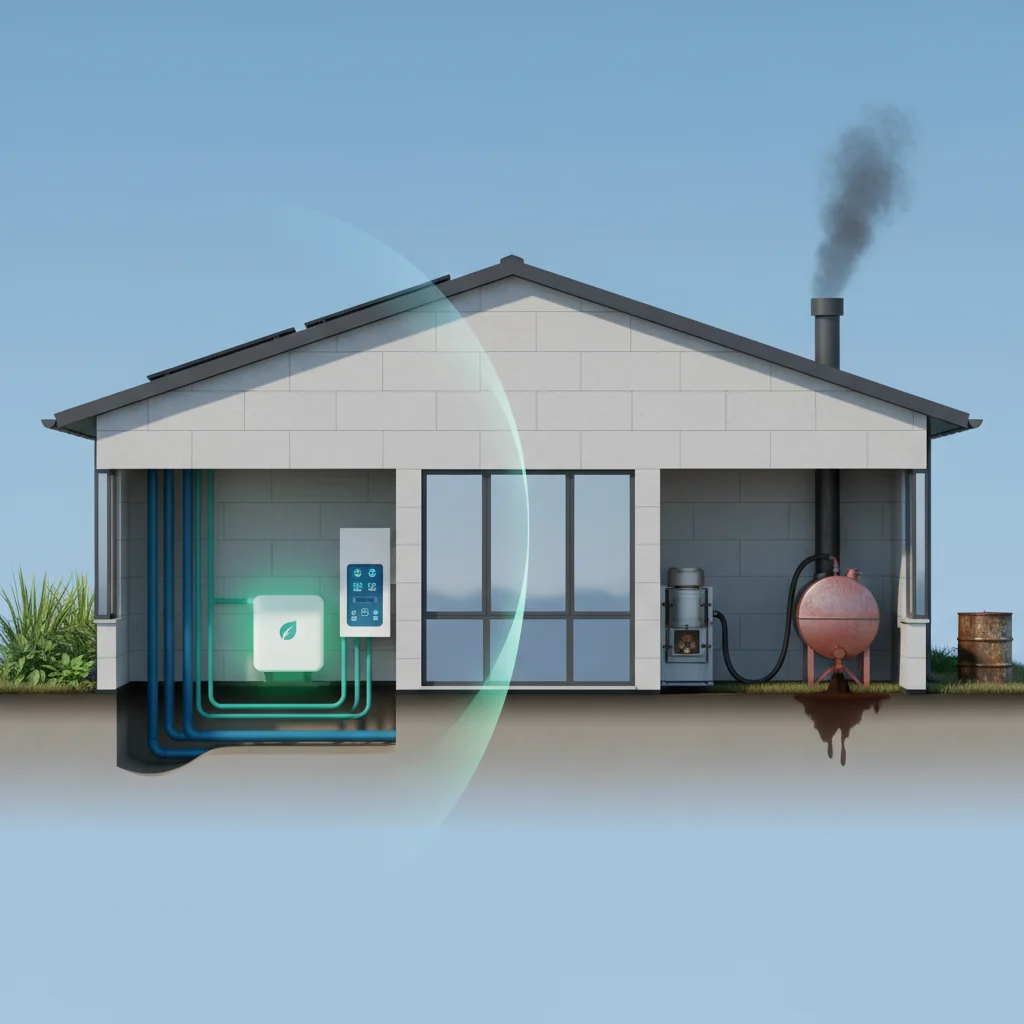
California homeowners using oil heat pay $3,200-$4,800 annually for heating costs—double what geothermal system owners spend. The federal Residential Clean Energy Credit (Section 25D) ended for expenditures made after December 31, 2025, and the IRS treats an expenditure as made when installation is completed (IRS FS-2025-05). Federal tax credits for this work have ended, but state, local and utility rebates may still apply; check what is available at your address with the DuloCore rebate calculator. And the price gap widens every winter as oil prices fluctuate by 20-40% seasonally.
What Are the Rebate-Eligible Specifications for Geothermal vs Oil Heating Systems?
Geothermal heat pumps must meet ENERGY STAR certification with a minimum coefficient of performance (COP) of 3.3 for closed-loop systems and 3.6 for open-loop systems to qualify for 2026 federal tax credits. Oil heating systems don't qualify for federal rebates. The federal Residential Clean Energy Credit (Section 25D) ended for expenditures made after December 31, 2025, and the IRS treats an expenditure as made when installation is completed (IRS FS-2025-05). California's Tech Clean California program offers $3,000-$6,500 rebates for geothermal installations in low-income households earning below 80% area median income.
But here's the tension: 68% of California oil heating users live in rural areas where geothermal installation costs run $25,000-$40,000 due to drilling requirements. That's 3-4 times higher than urban installations. So homeowners face a choice between continuing $4,000 annual oil costs or financing a $30,000+ geothermal system that pays back in 7-10 years through energy savings and rebate calculator projections.
How Much Can You Save? Calculating ROI and Payback Period for Each System
Switching from oil to geothermal saves California homeowners $2,400-$3,600 annually in heating costs. Oil heating costs $2.80-$3.20 per therm delivered, while geothermal systems operate at $0.12-$0.15 per kilowatt-hour—75% lower operating expenses. The average geothermal system costs $28,000 installed minus a $8,400 federal tax credit (30% of installation) equals $19,600 net cost. And dividing net cost by annual savings produces a 5.4-8.2 year payback period.
"Geothermal heat pumps are among the most efficient heating and cooling systems available, using 25-50% less electricity than conventional heating or cooling systems." — U.S. Department of Energy
Oil furnaces require replacement every 15-20 years at $6,000-$9,000 per replacement. So over a 30-year period, oil heating costs $96,000-$144,000 in fuel plus $12,000-$18,000 in equipment replacements totaling $108,000-$162,000. Geothermal costs $28,000 upfront plus $18,000-$27,000 in electricity over 30 years totaling $46,000-$55,000—a lifetime savings of $62,000-$107,000.
| System Type | Upfront Cost | Annual Operating Cost | 30-Year Total Cost | Federal Incentive |
|---|---|---|---|---|
| Oil Heating | $6,000-$9,000 | $3,200-$4,800 | $108,000-$162,000 | $0 |
| Geothermal | $25,000-$40,000 | $600-$1,200 | $46,000-$55,000 | 30% tax credit (this federal credit ended for expenditures made after December 31, 2025) |
What Are Your Heating Upgrade Alternatives Beyond Geothermal and Oil?
Air-source heat pumps cost $8,000-$15,000 installed and qualify for the same 30% federal tax credit as geothermal systems. These systems operate efficiently in California's mild climate zones 1-16 but lose 25-30% efficiency when outdoor temperatures drop below 32°F—rare in most California regions. Natural gas furnaces cost $3,500-$6,000 installed and operate at $800-$1,200 annually but don't qualify for federal rebates and still emit 6,400 pounds of CO2 per year. (Note: Federal tax credit percentages and availability are subject to change; the 30% Residential Clean Energy Credit under Section 25D expired December 31, 2025. Verify current incentives at energy.gov.)
Hybrid systems combining air-source heat pumps with existing oil furnaces cost $10,000-$18,000 and reduce oil consumption by 60-75% while maintaining backup heating. California's heat pump rebates include up to $8,000 for air-source systems through Tech Clean California for income-qualified households. But geothermal remains the only heating system with zero direct emissions and the lowest 30-year operating cost.
How Long Will Geothermal and Oil Systems Last? Comparing Lifespan and Durability
Geothermal ground loops last 50+ years with zero maintenance required on underground piping. The indoor heat pump components last 20-25 years before requiring replacement at $8,000-$12,000. Oil furnaces last 15-20 years with annual maintenance costs of $150-$250 for cleaning, filter replacement, and nozzle servicing. And oil tanks must be replaced every 20-30 years at $1,500-$3,000 or face environmental fines for leaks.
Geothermal systems require professional inspection every 3-5 years costing $200-$350 per visit. Oil heating systems need annual professional servicing plus oil deliveries 3-6 times per year depending on tank size and usage. Over a 20-year period, oil system maintenance costs $3,000-$5,000 plus $2,000 for tank replacement. Geothermal maintenance costs $1,200-$2,000 over the same period—60% lower than oil.
Geothermal vs Oil: Step-by-Step Comparison for California Homeowners
First, determine property eligibility by verifying 400-600 square feet of yard space for horizontal ground loops or drilling access for vertical loops requiring 150-250 feet of depth. Oil heating requires no special property configuration but faces increasing regulatory pressure in California counties like Marin and Santa Clara targeting fossil fuel phase-outs by 2030. Second, calculate the total cost using a rebate calculator that factors in federal tax credits, state rebates, and utility incentives.
Third, compare 30-year total costs including equipment replacement, maintenance, and fuel costs. Oil heating totals $108,000-$162,000 while geothermal totals $46,000-$55,000 over three decades. Fourth, evaluate environmental impact—oil systems emit 285,000 pounds of CO2 over 30 years versus zero direct emissions from geothermal. And fifth, check financing options including California's PACE financing programs that spread geothermal costs over 20 years through property tax assessments at 5-7% interest rates.
What Rebates and Incentives Are Available Right Now?
The federal Residential Clean Energy Credit (Section 25D) ended for expenditures made after December 31, 2025, and the IRS treats an expenditure as made when installation is completed (IRS FS-2025-05). California's Tech Clean California program offers $3,000 for moderate-income households (80-150% AMI) and $6,500 for low-income households (below 80% AMI) for geothermal installations. Pacific Gas & Electric provides $500-$2,500 rebates for ENERGY STAR certified geothermal systems installed in their service territory through 2026.
The federal Residential Clean Energy Credit (Section 25D) ended for expenditures made after December 31, 2025, and the IRS treats an expenditure as made when installation is completed (IRS FS-2025-05).
BayREN's Single Family Home Upgrade program offers $3,000 performance-based incentives when geothermal installation achieves 20% or greater energy reduction. Southern California Edison provides $500-$1,000 rebates for customers replacing oil or propane heating with geothermal systems. And California's Self-Generation Incentive Program offers $0.15-$0.25 per watt for battery storage paired with geothermal installations, adding $1,500-$2,500 in rebates for 10 kWh battery systems.
Oil heating systems receive zero federal, state, or utility rebates in 2026. Homeowners keeping oil systems face rising fuel costs projected to increase 15-25% by 2028 as California implements carbon pricing policies. Check current energy tax credits and utility incentives through DSIRE's California database.
Official Sources
- U.S. Department of Energy - Geothermal Heat Pumps — Federal guidance on geothermal system efficiency and performance standards
- DSIRE California — Database of state incentives for renewable energy and efficiency programs
- IRS Residential Clean Energy Credit — Federal tax credit information for geothermal installations (note: the federal 25C and 25D credits ended for projects completed after December 31, 2025)
Related Reading: Learn more about Vertical Vs Horizontal Geothermal.
Frequently Asked Questions
What is the difference between geothermal and oil heating systems?
Geothermal systems transfer heat from the ground using underground loops and electric heat pumps, operating at 300-400% efficiency. Oil heating burns petroleum fuel in a furnace to produce heat at 80-90% efficiency. Geothermal systems produce zero direct emissions while oil systems emit 9,500 pounds of CO2 annually. And geothermal costs $600-$1,200 per year to operate versus $3,200-$4,800 for oil heating.
How much money can you save by switching from oil to geothermal heating?
California homeowners save $2,400-$3,600 annually by replacing oil with geothermal heating. After applying the 30% federal tax credit, net geothermal installation costs $19,600-$28,000 with a payback period of 5.4-8.2 years. Over 30 years, geothermal saves $62,000-$107,000 compared to oil heating when factoring in equipment replacement and maintenance costs.
Are geothermal heating systems eligible for federal tax credits or rebates?
The federal Residential Clean Energy Credit (Section 25D) ended for expenditures made after December 31, 2025, and the IRS treats an expenditure as made when installation is completed (IRS FS-2025-05). California offers $3,000-$6,500 state rebates through Tech Clean California for income-qualified households. Utility companies provide $500-$2,500 additional rebates for ENERGY STAR certified systems. Total incentives can reach $10,000-$15,000 depending on household income and utility provider.
How long does it take to install a geothermal heating system to replace an oil furnace?
Geothermal installation takes 3-5 days for horizontal ground loops and 2-3 days for vertical loops plus 1-2 days for indoor equipment installation. Contractors drill 4-6 boreholes at 150-250 feet deep for vertical systems or excavate trenches at 4-6 feet deep for horizontal systems. Oil tank removal adds 1 day and costs $500-$1,500. Total project duration runs 5-10 days depending on property conditions and system size.
What are the upfront costs for converting from oil heating to geothermal?
Geothermal system installation costs $25,000-$40,000 in California including drilling, piping, heat pump equipment, and labor. Oil tank removal costs $500-$1,500. Electrical panel upgrades for 200-amp service cost $1,500-$3,000 if needed. After the 30% federal tax credit ($7,500-$12,000), net costs range $19,600-$31,000. And California rebates reduce costs by another $3,500-$9,000 for income-qualified households.
Ready to calculate your savings from switching to geothermal? Use our free rebate calculator to get personalized estimates for federal tax credits, state rebates, and 30-year cost comparisons based on your property and heating usage.
Last reviewed: April 14, 2026. Reviewed by DuloCore Energy Specialists. About the team.
Check your California heat pump rebate eligibility — see the programs you qualify for and the dollar amounts on our California heat pump rebate finder.