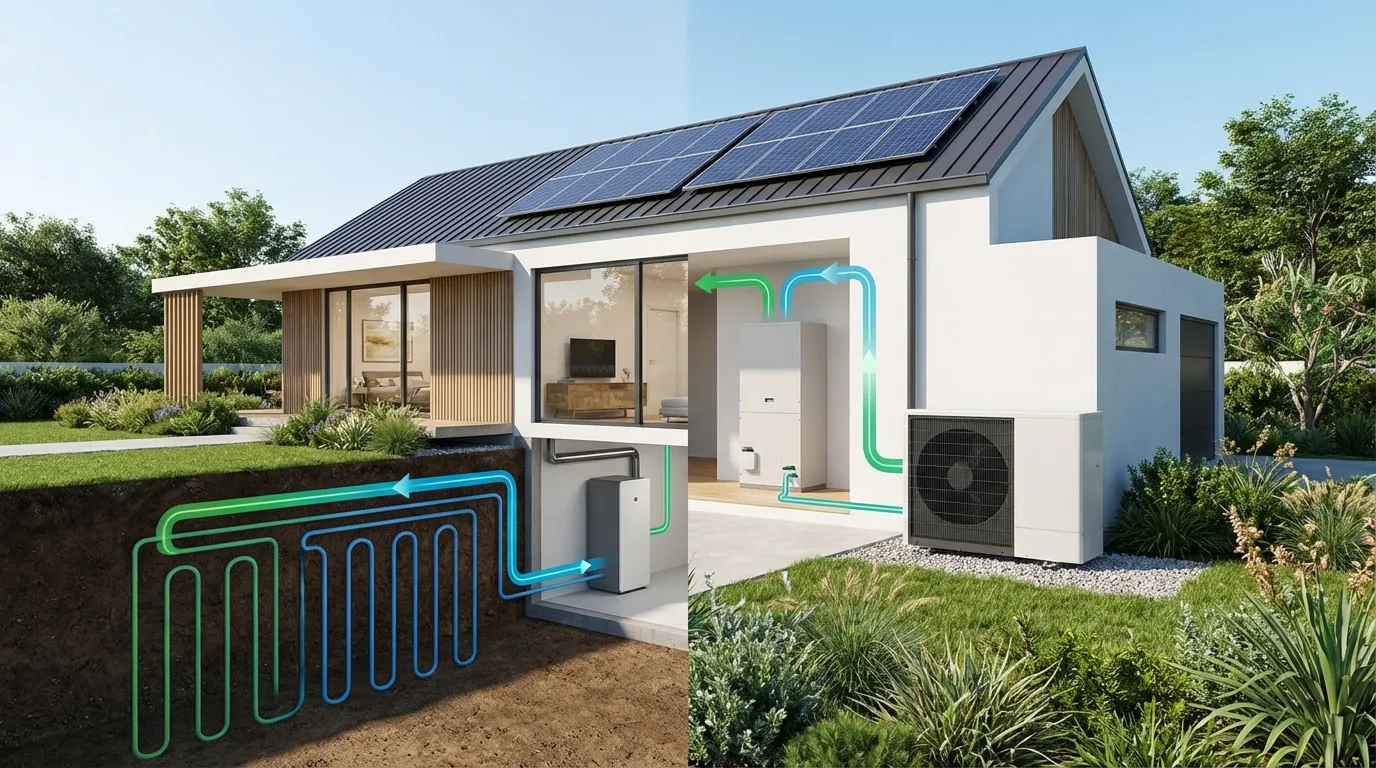
California homeowners who installed geothermal systems in 2025 paid $20,000 to $25,000 upfront but recovered costs in 5 to 7 years through reduced energy bills. And those same homeowners now qualify for 30% federal tax credits through 2032 under IRA provisions, dropping net costs to $14,000 to $17,500. Meanwhile, air-source heat pumps require $3,000 to $8,000 upfront and deliver payback periods of 3 to 5 years, but save less annually—$500 to $800 compared to $2,000 to $3,000 for geothermal. (Note: Federal tax credit percentages and availability are subject to change; the 30% Residential Clean Energy Credit under Section 25D expired December 31, 2025. Verify current incentives at energy.gov.)
What's the Real ROI and Payback Period for Geothermal vs Heat Pumps?
Geothermal heat pumps deliver ROI of 200% to 400% over 20 years with payback periods of 5 to 7 years, while air-source heat pumps return 150% to 250% with 3 to 5 year payback. California Climate Zone 3 homeowners save $2,800 annually with geothermal and $720 with air-source systems compared to natural gas furnaces.
The core tension: geothermal systems cost 3 to 4 times more upfront than air-source heat pumps, but deliver 2.5 to 3 times higher annual savings. So homeowners must calculate whether the $15,000 to $20,000 cost difference justifies the $1,500 to $2,200 extra savings per year. And the answer depends on how long they plan to stay in the home—breakeven occurs at year 7 for most installations.
Geothermal systems achieve 300% to 600% efficiency (COP of 3.0 to 6.0) compared to 200% to 400% for air-source units (COP of 2.0 to 4.0). But ground loops last 50 years while aboveground components require replacement every 15 to 20 years. Air-source systems need full replacement every 15 years. So lifecycle costs favor geothermal by $8,000 to $12,000 over 30 years despite higher initial investment.
"Geothermal heat pumps can reduce energy consumption—and corresponding emissions—up to 44% compared to air-source heat pumps and up to 72% compared to electric resistance heating with standard air-conditioning equipment." — DOE Geothermal Technologies Office
How Do Geothermal Systems and Heat Pumps Compare to Other Heating Alternatives?
Geothermal heat pumps use 25% to 50% less electricity than conventional heating and cooling systems, while air-source heat pumps consume 40% to 60% less than resistance heating. Natural gas furnaces cost $800 to $1,200 annually in California Climate Zone 10, electric resistance heating runs $2,400 to $3,200, air-source heat pumps drop to $600 to $900, and geothermal falls to $400 to $600.
Propane heating costs $2,000 to $2,800 annually in rural areas where natural gas lines don't reach. And oil furnaces require $2,200 to $3,000 per year at 2026 prices. So heat pumps eliminate fossil fuel dependency entirely while cutting operating costs by 50% to 75% compared to combustion systems.
Mini-split heat pumps occupy a middle ground—$1,500 to $4,000 per zone installed, $500 to $700 annual operating costs, and 250% to 350% efficiency. But multi-zone installations matching whole-home geothermal capacity cost $8,000 to $15,000. Central air-source systems deliver comparable performance at lower cost than multiple mini-splits for homes over 1,500 square feet.
Compare heating options and estimate your annual savings with our rebate calculator.
Which System Lasts Longer—Geothermal or Heat Pump Lifespan Explained
Geothermal ground loops carry 25 to 50 year warranties and function 50+ years without maintenance, while indoor components last 20 to 25 years. Air-source heat pumps deliver 15 to 20 year lifespans with annual maintenance. So geothermal systems outlast air-source units by 30 to 35 years on underground components and 5 to 10 years on indoor equipment.
Air-source compressors and fans wear faster because outdoor units endure temperature extremes from 10°F to 115°F in California. And coastal installations suffer accelerated corrosion from salt air, cutting lifespan to 12 to 15 years. Geothermal components operate in stable 45°F to 75°F underground temperatures and avoid weather exposure entirely.
Replacement costs differ substantially—new air-source systems cost $3,000 to $8,000 every 15 years, while geothermal indoor units run $3,500 to $6,000 every 20 years with ground loops functioning indefinitely. So geothermal owners save $8,000 to $12,000 on equipment replacement over 30 years. But annual maintenance costs $150 to $300 for geothermal versus $100 to $200 for air-source systems.
Learn about available heat pump rebates for replacement installations.
What Are the Upfront Costs and Long-Term Savings for Each System?
Geothermal installations cost $18,000 to $30,000 depending on loop configuration—horizontal systems run $18,000 to $25,000 for lots over 0.5 acres, vertical loops require $22,000 to $30,000 for smaller properties. Air-source heat pumps range from $3,000 to $8,000 installed, with 2-ton units at $3,500 to $5,500 and 5-ton systems reaching $6,000 to $8,000.
Annual operating costs separate the technologies decisively. Geothermal systems consume 6,000 to 10,000 kWh annually at $0.32/kWh average California residential rates, totaling $1,920 to $3,200. Air-source units use 8,000 to 14,000 kWh for $2,560 to $4,480 annually. Natural gas furnaces with central AC cost $1,800 to $2,400 per year at $2.50/therm.
So geothermal saves $640 to $1,280 annually versus air-source heat pumps and $0 to $480 versus natural gas. But the $15,000 to $22,000 cost premium over air-source systems requires 12 to 34 years to recover without tax credits. And federal IRA credits cut that premium to $10,500 to $15,400 net cost, reducing payback to 8 to 24 years.
Check current energy tax credits for both system types.
How Do Tax Credits and Rebates Affect Your Final Investment?
Federal IRA provisions deliver 30% tax credits on geothermal installations through 2032 with no dollar cap—$6,000 credit on a $20,000 system, $9,000 on $30,000. Air-source heat pumps qualify for $2,000 maximum under separate provisions. So net geothermal costs drop to $14,000 to $21,000 while air-source systems fall to $1,000 to $6,000.
California utility rebates add $500 to $3,000 for heat pump installations depending on efficiency ratings and income level. TECH Clean California offers $3,000 for moderate-income households replacing gas furnaces with heat pumps. But geothermal systems rarely qualify for utility incentives because they exceed budget caps designed for air-source equipment.
And local air quality districts contribute $1,000 to $2,500 for heat pump installations in disadvantaged communities. Bay Area AQMD provides $3,000 for low-income households, South Coast AQMD offers $1,500 to $3,000 based on SEER ratings. Combined federal and state incentives cut air-source costs to $0 to $3,000 net for eligible households versus $11,000 to $18,000 for geothermal.
Calculate your total incentives with available geothermal tax credits.
The federal Residential Clean Energy Credit (Section 25D) ended for expenditures made after December 31, 2025, and the IRS treats an expenditure as made when installation is completed (IRS FS-2025-05).
Geothermal vs Heat Pumps: Which Fits Your Home and Climate?
Geothermal systems require 0.25 to 0.5 acres for horizontal loops or access for vertical drilling to 150 to 400 feet depth. Lot size determines installation feasibility—properties under 0.25 acres pay $4,000 to $8,000 extra for vertical drilling. Air-source units need 2 to 4 feet clearance around outdoor equipment and operate on any lot size.
Climate Zone 16 in California's mountain regions challenges air-source heat pumps below 10°F when defrost cycles reduce capacity by 20% to 40%. And coastal Zone 3 homeowners face corrosion requiring replacement at year 12 versus year 18 inland. Geothermal performance stays constant across all California climates because underground temperatures remain 55°F to 65°F year-round.
Existing ductwork cuts installation costs $2,000 to $4,000 for both system types. But homes without ducts need $5,000 to $10,000 for new distribution, making mini-splits attractive at $1,500 per zone. Radiant floor heating pairs efficiently with geothermal's low-temperature output, while forced-air systems work equally well with both technologies.
Official Sources
- DOE Geothermal Heat Pumps — Federal efficiency data and installation guidelines
- ENERGY STAR Heat Pumps — Performance ratings and qualified product lists
- DSIRE California — State and local rebate program database
Related Reading: Learn more about Home Energy Assessment Vs Audit and Ira Geothermal Heat Pump Incentives.
Frequently Asked Questions
What is the difference between a geothermal heat pump and a regular heat pump?
Geothermal heat pumps exchange heat with 55°F ground via buried pipes, while air-source heat pumps use outdoor air ranging from 10°F to 115°F. And geothermal systems achieve 400% to 600% efficiency versus 250% to 400% for air-source units because ground temperature stays constant. Installation costs differ by $15,000 to $22,000 but geothermal saves $1,500 to $2,200 more annually.
How much can you save with a geothermal heat pump compared to a standard heat pump?
Geothermal systems save $640 to $1,280 annually compared to air-source heat pumps in California. A 2,000-square-foot home using geothermal consumes 6,000 to 10,000 kWh versus 8,000 to 14,000 kWh for air-source at $0.32/kWh rates. So geothermal cuts $1,920 to $3,200 energy costs to $1,280 to $1,920. Over 20 years that's $12,800 to $25,600 in additional savings.
Are geothermal heat pumps eligible for federal tax credits in 2026?
The federal Residential Clean Energy Credit (Section 25D) ended for expenditures made after December 31, 2025, and the IRS treats an expenditure as made when installation is completed (IRS FS-2025-05). A $20,000 system generates $6,000 credit, $30,000 installation receives $9,000. And the credit covers equipment and labor costs. Air-source heat pumps qualify for $2,000 maximum under separate Energy Efficient Home Improvement provisions.
What is the installation cost for a geothermal heat pump versus a conventional heat pump?
Geothermal installations cost $18,000 to $30,000 depending on loop type and property size. Horizontal systems run $18,000 to $25,000 on larger lots, vertical drilling reaches $22,000 to $30,000. Air-source heat pumps cost $3,000 to $8,000 installed. So geothermal requires $15,000 to $22,000 more upfront but federal tax credits reduce the gap to $9,000 to $16,000 net difference.
Do geothermal heat pumps work in cold climates?
Geothermal systems maintain full capacity in all California climates because ground temperature stays 55°F to 65°F year-round. Air-source heat pumps lose 20% to 40% capacity below 15°F when defrost cycles activate. Climate Zone 16 temperatures drop to 10°F, reducing air-source efficiency to 150% to 200%. But geothermal delivers consistent 400% to 600% efficiency regardless of outdoor temperature.
Ready to calculate your savings? Use our free rebate calculator to estimate federal tax credits, state incentives, and annual energy savings for both geothermal and air-source heat pump installations. Get personalized results based on your home size, location, and current heating system in under 2 minutes.
Last updated April 14, 2026 — reviewed by DuloCore Editorial. About our authors.
Check your California heat pump rebate eligibility — see the programs you qualify for and the dollar amounts on our California heat pump rebate finder.