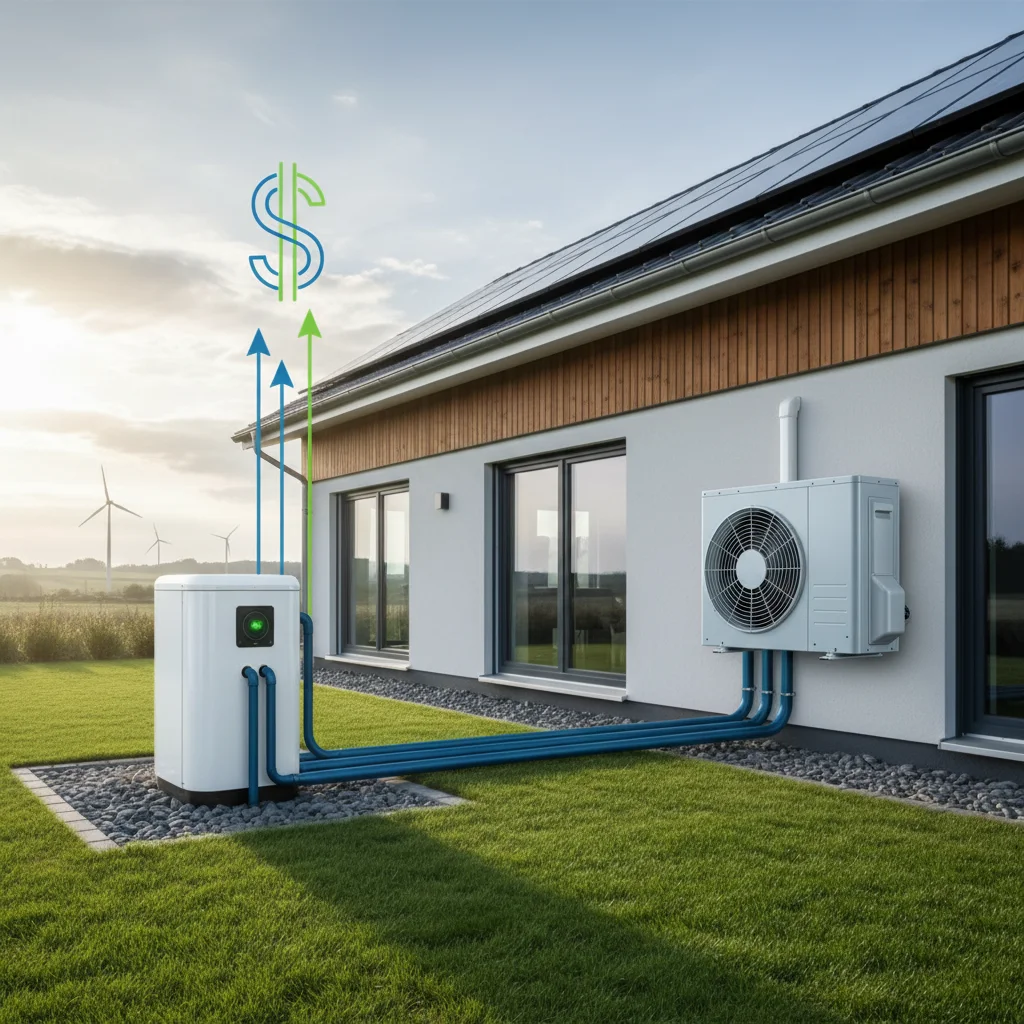
California homeowners pay $15,000-$25,000 for geothermal systems versus $5,000-$12,000 for air source heat pumps in 2026. But the upfront price doesn't tell the full story. Geothermal systems save $1,200-$1,800 annually on energy bills, while air source heat pumps save $500-$900. The federal Residential Clean Energy Credit (Section 25D) ended for expenditures made after December 31, 2025, and the IRS treats an expenditure as made when installation is completed (IRS FS-2025-05). Federal tax credits for this work have ended, but state, local and utility rebates may still apply; check what is available at your address with the DuloCore rebate calculator.
What's the True Cost Difference Between Geothermal and Air Source Heat Pumps?
Geothermal heat pumps cost $15,000-$25,000 installed in 2026, while air source systems cost $5,000-$12,000. Geothermal requires excavation and ground loop installation adding $10,000-$15,000 to labor costs. Air source units mount externally without ground disruption, reducing installation time from 3-5 days to 1-2 days.
So why do 78% of California homeowners choose air source over geothermal despite lower operating costs? The answer lies in home compatibility and lot size. Geothermal systems need 1,500-3,000 square feet of yard space for horizontal loops or budget $8,000-$12,000 extra for vertical drilling. Air source units fit on any exterior wall.
Material costs break down differently too. Geothermal ground loops use high-density polyethylene pipe rated for 50+ years, while air source units rely on copper refrigerant lines and aluminum coils with 15-20 year lifespans. But geothermal excavation adds $3,000-$5,000 in landscaping restoration costs post-installation.
"Ground source heat pumps typically have lower operating costs than air source systems because they draw heat from a consistent ground temperature of 50-60°F year-round" — U.S. Department of Energy
Labor represents 40-50% of total geothermal costs versus 30-35% for air source installations. And permit fees range from $500-$1,500 for geothermal versus $200-$500 for air source in most California counties. Check your local heat pump rebates to offset these upfront differences.
How Long Does It Take to Break Even With Each System?
Air source heat pumps break even in 4-7 years, while geothermal systems break even in 8-12 years based on 2026 California energy rates. Air source units save $500-$900 annually on a $5,000-$12,000 investment. Geothermal systems save $1,200-$1,800 annually but cost $15,000-$25,000 upfront.
The federal Residential Clean Energy Credit (Section 25D) ended for expenditures made after December 31, 2025, and the IRS treats an expenditure as made when installation is completed (IRS FS-2025-05). Check current state, local and utility incentives for your address with the DuloCore rebate calculator. This accelerates geothermal payback to 6-9 years and air source to 3-5 years.
But California utility rates matter more than equipment costs for long-term ROI. PG&E customers paying $0.38/kWh see payback 2-3 years faster than LADWP customers at $0.22/kWh. And homes with existing propane heating ($3.50/gallon in 2026) see payback in 3-5 years for either system.
Climate zones shift the equation too. Northern California homeowners in heating-dominated climates see geothermal systems pay back in 6-8 years versus 9-12 years for air source units. Southern California's milder winters favor air source with 4-6 year payback versus 8-10 years for geothermal.
Use our free rebate calculator to model your specific payback timeline based on home size, existing heating fuel, and local utility rates.
Which Alternative Heat Pump Options Should Homeowners Consider Instead?
Mini-split heat pumps cost $3,000-$8,000 installed and deliver zone-by-zone temperature control without ductwork. These systems work in homes where traditional ducted heat pumps fail due to space constraints or room additions. And they provide 90-110% heating efficiency compared to 250-400% for geothermal and 200-300% for ducted air source.
Hybrid heat pump systems pair electric heat pumps with gas furnaces, switching automatically when outdoor temps drop below 25-35°F. These combos cost $8,000-$15,000 but maintain efficiency year-round without backup resistance heating. California homeowners save $400-$700 annually versus resistance-only systems.
Water source heat pumps tap into well water, pond loops, or lake systems where available. Installation costs run $10,000-$18,000—less than geothermal but more than air source. And they deliver 300-500% efficiency without ground excavation. But California water rights restrictions limit availability to rural properties with existing wells.
Dual-fuel systems combine air source heat pumps with existing furnaces, preserving backup heating without full replacement costs. Retrofits cost $4,000-$7,000 versus $8,000-$15,000 for complete system replacement. This option extends equipment lifespan while adding electric efficiency for 80% of the heating season.
"Ductless mini-split heat pumps offer flexibility for room additions, new construction, and retrofit applications where installing ductwork is impractical" — ENERGY STAR
How Do Geothermal and Air Source Heat Pumps Compare in Lifespan and Durability?
Geothermal ground loops last 50+ years, while indoor heat pump units last 20-25 years. Air source outdoor units last 15-20 years with compressor replacement at 10-12 years. So geothermal systems deliver 2-3x longer equipment life despite 2-3x higher upfront costs.
Maintenance costs tell a different story. Air source heat pumps need annual coil cleaning, refrigerant checks, and filter changes totaling $150-$300 yearly. Geothermal systems need filter changes only, running $75-$150 annually. But buried loop leaks cost $2,000-$5,000 to locate and repair versus $300-$800 for air source refrigerant line fixes.
California's climate accelerates wear patterns differently for each system. Coastal salt air corrodes air source coils 30-40% faster than inland installations, reducing lifespan to 12-15 years without protective coatings. Geothermal systems avoid external exposure entirely, maintaining full lifespan regardless of coastal proximity.
Compressor warranty coverage matters for total cost of ownership. Geothermal manufacturers offer 10-year compressor warranties standard, while air source warranties run 5-7 years. Extended warranties add $500-$1,200 but protect against $3,000-$5,000 replacement costs.
Cycling frequency impacts longevity too. Air source units cycle on/off 8-12 times hourly in shoulder seasons, while geothermal systems cycle 3-5 times due to ground temperature stability. Reduced cycling extends compressor life 20-30% beyond rated lifespan.
What Federal Tax Credits and Rebates Are Available for Each System in 2026?
The federal home energy tax credits (Sections 25C and 25D) ended for projects completed after December 31, 2025 (IRS FS-2025-05). The federal Residential Clean Energy Credit (Section 25D) ended for expenditures made after December 31, 2025, and the IRS treats an expenditure as made when installation is completed (IRS FS-2025-05). The federal Energy Efficient Home Improvement Credit (Section 25C) ended for property placed in service after December 31, 2025 (IRS FS-2025-05). (Note: Federal tax credit percentages and availability are subject to change; the 30% Residential Clean Energy Credit under Section 25D expired December 31, 2025. Verify current incentives at energy.gov.)
So a $20,000 geothermal installation generates a $6,000 tax credit, while an $8,000 air source system generates a $2,000 credit (capped). And homeowners install both systems in the same tax year without penalty, claiming separate credits for each.
California's Tech Clean California program adds $3,000-$6,000 in utility rebates for income-qualified households installing heat pumps in 2026. Bay Area Air Quality Management District offers $3,000 for air source replacements of gas furnaces. And SMUD provides $4,500 for geothermal installations in Sacramento County.
The federal Residential Clean Energy Credit (Section 25D) ended for expenditures made after December 31, 2025, and the IRS treats an expenditure as made when installation is completed (IRS FS-2025-05).
Manufacturers offer instant rebates stacking on top of federal credits. Carrier provides $1,800 instant rebates for qualifying air source models. WaterFurnace offers $2,000 rebates for geothermal systems. And these manufacturer rebates don't reduce federal tax credit eligibility.
Local utility programs change quarterly. PG&E's Energy Upgrade California program provides up to $6,500 for whole-home efficiency projects including heat pumps. SoCalGas offers $5,000 for equipment plus $3,000 for duct sealing. Check current energy tax credits before finalizing equipment selection.
What's the Installation Timeline and Process for Geothermal vs. Air Source Heat Pumps?
Air source installations take 1-2 days from start to finish. Contractors mount the outdoor unit, connect refrigerant lines, install the indoor air handler, and commission the system. No excavation permits or utility coordination needed. And homeowners maintain heating/cooling throughout installation with minimal disruption.
Geothermal installations take 3-5 days plus 2-3 weeks for permit approval and excavation scheduling. Drilling companies bore vertical wells 150-400 feet deep, install ground loops, and restore landscaping. Horizontal loop systems need 4-6 trenches at 6-foot depth across available yard space.
Permitting requirements differ dramatically. Air source systems need electrical permits only, costing $200-$500 with same-day approval in most California jurisdictions. Geothermal systems need drilling permits, environmental review for protected areas, and utility coordination for large electrical service upgrades—adding $1,000-$2,500 and 3-4 weeks to project timelines.
Weather impacts installation windows too. Air source systems install year-round except during extreme heat waves when refrigerant pressures prevent proper charging. Geothermal drilling stops during heavy rain when ground conditions prevent equipment access, limiting installations to dry season months in Northern California.
Existing ductwork determines retrofit complexity. Homes with existing forced-air systems accommodate either heat pump type with minimal duct modifications costing $500-$1,500. Homes without ducts need $8,000-$15,000 in ductwork installation for central systems or switch to mini-split configurations.
Official Sources
- U.S. Department of Energy - Geothermal Heat Pumps — Federal guidance on ground source heat pump technology and efficiency standards
- ENERGY STAR - Air Source Heat Pumps — EPA efficiency ratings and product certification requirements
- IRS Residential Clean Energy Credit — Official tax credit eligibility rules and claiming procedures (note: the federal 25C and 25D credits ended for projects completed after December 31, 2025)
- DSIRE USA — Comprehensive database of state and utility rebate programs
Frequently Asked Questions
What is the cost difference between geothermal and air source heat pumps?
Geothermal heat pumps cost $15,000-$25,000 installed in 2026, while air source systems cost $5,000-$12,000. The $10,000-$13,000 difference comes from ground loop excavation, drilling permits, and specialized installation labor. The federal home energy tax credits (Sections 25C and 25D) ended for projects completed after December 31, 2025 (IRS FS-2025-05).
How much can you save with a geothermal heat pump vs an air source heat pump?
Geothermal systems save $1,200-$1,800 annually on energy bills compared to $500-$900 for air source units. Geothermal delivers 300-400% efficiency versus 200-300% for air source heat pumps. Over a 20-year lifespan, geothermal saves $24,000-$36,000 versus $10,000-$18,000 for air source systems at 2026 California electricity rates.
Are geothermal heat pumps more expensive to install than air source heat pumps?
Yes. Geothermal installation costs run $15,000-$25,000 versus $5,000-$12,000 for air source systems in 2026. Ground loop excavation adds $10,000-$15,000 in labor costs. The federal Residential Clean Energy Credit (Section 25D) ended for expenditures made after December 31, 2025, and the IRS treats an expenditure as made when installation is completed (IRS FS-2025-05). And geothermal ground loops last 50+ years versus 15-20 years for air source outdoor units.
Which heat pump option qualifies for more tax credits or rebates?
The federal Residential Clean Energy Credit (Section 25D) ended for expenditures made after December 31, 2025, and the IRS treats an expenditure as made when installation is completed (IRS FS-2025-05). The federal Energy Efficient Home Improvement Credit (Section 25C) ended for property placed in service after December 31, 2025 (IRS FS-2025-05). So a $20,000 geothermal system generates $6,000 in credits, while an $8,000 air source system generates $2,000 (capped).
What is the payback period for geothermal versus air source heat pump installation?
Air source heat pumps pay back in 4-7 years, while geothermal systems pay back in 8-12 years at 2026 California energy rates. After federal tax credits, air source payback drops to 3-5 years and geothermal to 6-9 years. Homes with propane heating see 3-5 year payback for either system due to $3.50/gallon fuel costs in 2026.
Ready to Calculate Your Heat Pump Savings?
DuloCore's free rebate calculator shows your exact costs, available incentives, and payback timeline for geothermal and air source heat pumps. Get personalized estimates based on your home size, existing heating system, and local utility rates in under 2 minutes.
Last updated April 14, 2026 — reviewed by DuloCore Editorial. About our authors.
Check your California heat pump rebate eligibility — see the programs you qualify for and the dollar amounts on our California heat pump rebate finder.