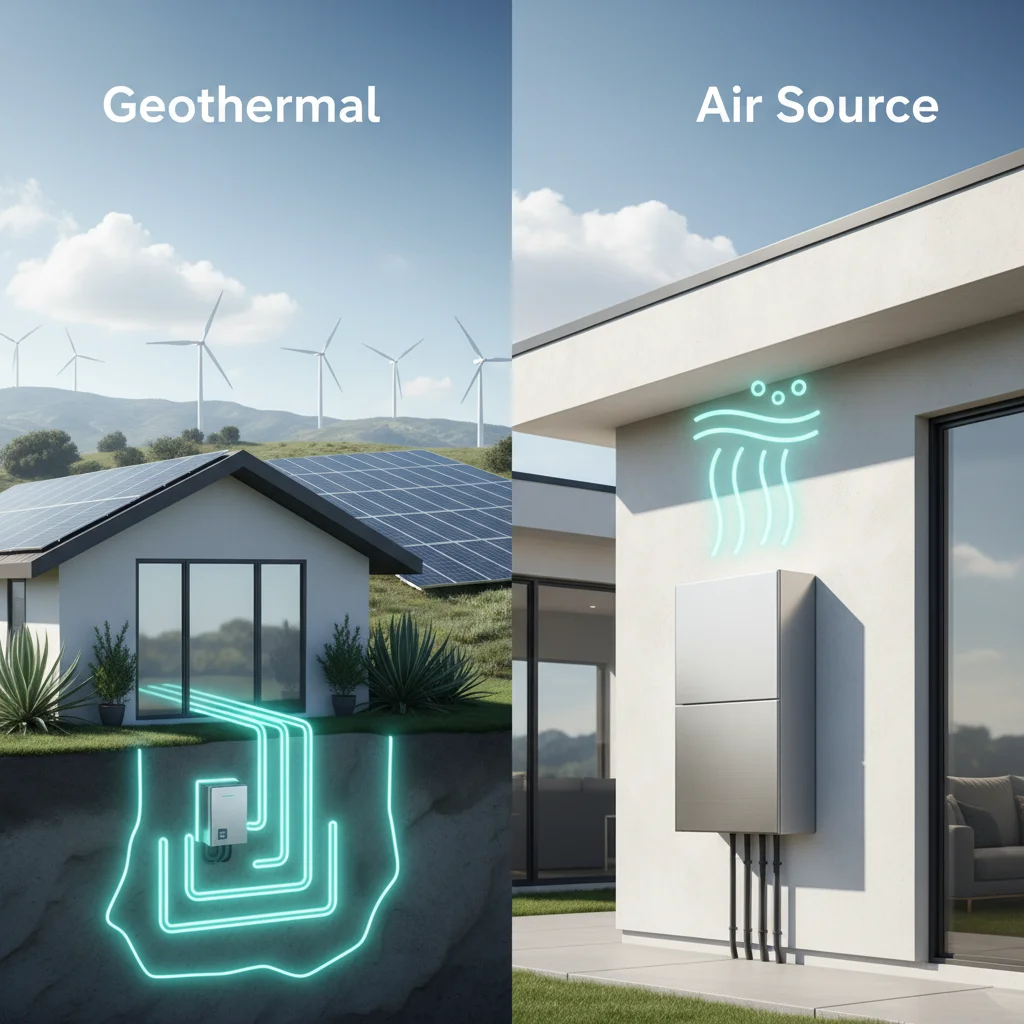
California homeowners installing heat pumps in 2026 face a $10,000-$20,000 price gap between air source and geothermal systems—but the wrong choice costs more than upfront dollars. The federal home energy tax credits (Sections 25C and 25D) ended for projects completed after December 31, 2025 (IRS FS-2025-05). Federal tax credits for this work have ended, but state, local and utility rebates may still apply; check what is available at your address with the DuloCore rebate calculator.
What's the Real Payback Period for Geothermal vs Air Source Heat Pumps in California?
Air source heat pumps in California deliver payback in 7-10 years against gas furnaces, while geothermal systems require 10-15 years despite 30-50% lower operating costs. Geothermal installations cost $15,000-$30,000 for ground loops and equipment. Air source systems run $8,000-$15,000 for complete installation. But California's climate zone determines which system breaks even faster—coastal homes with mild winters favor air source, while inland areas with 100°F+ summers and sub-40°F winters see geothermal paying back in 8-12 years through superior cooling efficiency.
So why does this matter? Because the average California homeowner stays in a home for 13 years according to the California Association of Realtors, putting geothermal's breakeven point at the edge of typical ownership duration. The federal Residential Clean Energy Credit (Section 25D) ended for expenditures made after December 31, 2025, and the IRS treats an expenditure as made when installation is completed (IRS FS-2025-05). Check current state, local and utility incentives for your address with the DuloCore rebate calculator.
Air source heat pumps in California climate zones 1-3 (coastal) save $800-$1,200 annually compared to gas furnaces. Geothermal systems save $1,400-$2,200 annually in the same zones. But in climate zones 10-16 (inland desert and mountain regions), geothermal systems save $2,000-$3,500 annually while air source systems struggle when temperatures hit 15-20°F, requiring backup resistance heat that costs $0.15-$0.20 per kWh.
"Geothermal heat pumps use 25% to 50% less electricity than conventional heating or cooling systems." — U.S. Department of Energy
The payback calculation changes when homeowners include the 30% federal tax credit and California's Tech Clean California program. A $25,000 geothermal system drops to $17,500 after federal credits, plus up to $3,000 in state rebates through participating utilities. Air source systems get the same 30% federal credit (this federal credit ended for expenditures made after December 31, 2025) but qualify for smaller state rebates of $1,000-$2,000. (Note: Federal tax credit percentages and availability are subject to change; the 30% Residential Clean Energy Credit under Section 25D expired December 31, 2025. Verify current incentives at energy.gov.)
How Much Will You Actually Save Each Year with Each System?
Geothermal heat pumps in California save $1,400-$3,500 annually on heating and cooling compared to gas furnaces and central AC combinations, while air source heat pumps save $800-$1,800 annually in the same comparison. The difference comes down to coefficient of performance—geothermal systems maintain 3.5-4.5 COP year-round, while air source systems drop to 2.0-2.5 COP when outdoor temperatures fall below 32°F or rise above 95°F.
A 2,000-square-foot home in Sacramento running a gas furnace and AC spends approximately $2,400 annually on heating and cooling at 2026 utility rates. Switching to an air source heat pump drops that to $1,600-$1,800 annually. And a geothermal system brings costs down to $900-$1,200 annually. But Sacramento's climate zone 12 sees summer temperatures above 95°F for 60-80 days per year, where geothermal's cooling efficiency creates a $500-$800 annual advantage over air source.
Coastal California homes in climate zones 3-6 see different math. A Santa Barbara home running heat 30 days per year and AC 15 days per year spends $600-$900 annually on climate control with gas heat and window AC. An air source heat pump drops that to $400-$600 annually. Geothermal brings it to $300-$450 annually—but the $10,000+ installation premium takes 20-25 years to recover through $200-$300 annual savings.
So the savings calculation requires three numbers: current annual energy costs, climate zone heating and cooling days, and current electricity rates. And California's tiered electricity pricing adds complexity—homes in baseline or Tier 1 usage see different economics than homes already in Tier 2 or CARE program rates.
What Are Your Other Heating Alternatives if Heat Pumps Don't Fit Your Budget?
California homeowners who can't afford $8,000-$30,000 heat pump installations have three alternatives: high-efficiency gas furnaces at $3,500-$6,000, ductless mini-split heat pumps at $2,000-$4,000 per zone, or hybrid heat pump systems that combine air source heat pumps with gas furnace backup at $6,000-$10,000. Each option delivers different payback periods and rebate eligibility.
High-efficiency gas furnaces with 95%+ AFUE ratings cost $3,500-$6,000 installed and qualify for $0 federal tax credits starting in 2026—the Section 25C credit covering furnaces expired December 31, 2025. But some California utilities offer $500-$1,000 rebates for replacing furnaces older than 15 years with 95%+ AFUE models. And gas furnaces in California homes save $200-$400 annually compared to older 80% AFUE models.
Ductless mini-split heat pumps offer room-by-room climate control at $2,000-$4,000 per indoor unit plus $1,500-$2,500 for the outdoor condenser. A three-zone system costs $8,000-$12,000 total. But mini-splits qualify for the same 30% federal tax credit as whole-home heat pump (this federal credit ended for property placed in service after December 31, 2025)s, dropping a $10,000 three-zone system to $7,000 after credits. And homeowners in older homes without existing ductwork save $5,000-$10,000 by avoiding duct installation costs.
Check your eligibility for heat pump rebates through California utility programs—some offer up to $3,000 for ductless systems. Or use our free rebate calculator to compare total installed costs across all system types.
Hybrid systems combine air source heat pumps with gas furnace backup, switching to gas when outdoor temperatures drop below 30-35°F. These systems cost $6,000-$10,000 installed and deliver 30-40% energy savings compared to gas-only systems. But hybrid systems qualify only for partial federal tax credits—homeowners claim credits on the heat pump component but not the furnace portion.
Which System Qualifies for California Rebates and Tax Credits in 2026?
The federal home energy tax credits (Sections 25C and 25D) ended for projects completed after December 31, 2025 (IRS FS-2025-05). Geothermal systems claim unlimited credits on total project costs, while air source heat pumps face a $2,000 annual credit cap per household. California's Tech Clean California program adds $1,000-$3,000 in rebates for heat pump installations, with exact amounts varying by utility territory and income level.
The federal home energy tax credits (Sections 25C and 25D) ended for projects completed after December 31, 2025 (IRS FS-2025-05).
The federal Residential Clean Energy Credit (Section 25D) ended for expenditures made after December 31, 2025, and the IRS treats an expenditure as made when installation is completed (IRS FS-2025-05).
PG&E offers $2,000-$3,000 for heat pump installations through the Energy Savings Assistance Program for income-qualified households. SCE provides $1,500-$2,500 through similar programs. And SMUD offers $3,000 for geothermal systems and $2,000 for air source heat pumps regardless of income. But rebate amounts change annually—verify current programs through DSIRE before finalizing system selection.
Low-income households qualify for additional support through the California Alternate Rates for Energy (CARE) program, which combines income-based utility discounts of 20-35% with enhanced rebate amounts. And the Energy Savings Assistance Program covers 100% of heat pump installation costs for qualifying households earning up to 200% of federal poverty guidelines.
What's the Installation Timeline and Process for Each System?
Air source heat pump installations take 1-3 days for homes with existing ductwork and 5-10 days for homes requiring new ducts, while geothermal installations require 3-5 days for drilling or trenching ground loops plus 1-2 days for equipment installation. Permitting adds 2-6 weeks for air source systems and 4-8 weeks for geothermal systems in most California jurisdictions. And contractor availability in 2026 stretches timelines by 3-8 weeks during peak summer and winter months.
Air source installation starts with duct inspection and load calculation. Contractors measure the home's heating and cooling requirements using Manual J calculations, then size equipment accordingly. And oversized systems waste energy while undersized systems fail to maintain comfort—proper sizing takes 2-4 hours for detailed calculation. Installation follows a standard sequence: outdoor unit placement, indoor air handler or furnace connection, refrigerant line installation, electrical connection, and system commissioning.
Geothermal installation adds ground loop complexity. Vertical loop systems require drilling 3-6 boreholes to 150-400 feet depth, taking 2-3 days with specialized equipment. Horizontal loop systems need 4-6 trenches at 6-10 feet depth across 0.25-0.5 acres, completing in 2-4 days. And pond or lake loops require 300-500 feet of coiled pipe submerged in water at least 8 feet deep. Each loop type connects to indoor equipment through underground piping filled with antifreeze solution.
California permitting requirements vary by jurisdiction. Most cities require mechanical permits for heat pump installations, taking 1-3 weeks for review and approval. But geothermal systems often trigger additional well permits or environmental reviews, extending timelines to 4-8 weeks. And some counties restrict geothermal drilling in earthquake fault zones or groundwater protection areas.
So homeowners planning installations should start permitting 6-10 weeks before desired completion dates. And scheduling during shoulder seasons (March-May or September-November) typically delivers faster contractor response than peak summer or winter months.
Geothermal vs Air Source vs Gas Furnace: Which is Right for Your Home?
Geothermal heat pumps suit California homes with 0.25+ acres of land, $15,000-$30,000 installation budgets, and 10-15 year ownership timelines in climate zones with temperature extremes above 95°F or below 40°F. Air source heat pumps work for homes with existing ductwork, $8,000-$15,000 budgets, and coastal or mild climate zones 1-6. Gas furnaces make sense for homes with $3,500-$6,000 budgets, existing gas lines, and no plans to transition away from fossil fuels.
The decision tree starts with land availability. Homes on lots smaller than 0.25 acres typically lack space for horizontal geothermal loops, forcing vertical drilling that adds $5,000-$10,000 to installation costs. And urban lots without drilling access eliminate geothermal as an option. But air source systems work on any lot size with outdoor space for a condenser unit measuring 3x3 feet.
Climate zone determines operating costs. California climate zones 10-16 (inland desert and mountain) see summer highs above 100°F and winter lows below 30°F, where geothermal's consistent efficiency saves $1,000-$2,000 annually compared to air source systems. But coastal climate zones 1-6 with year-round temperatures between 45-85°F deliver minimal efficiency advantages for geothermal systems, extending payback periods beyond 20 years.
Budget constraints matter. Households with $8,000-$15,000 available for installation can afford air source systems with full federal credits and state rebates. But geothermal systems requiring $15,000-$30,000 upfront—even with 30% federal credit (this federal credit ended for expenditures made after December 31, 2025)s bringing net costs to $10,500-$21,000—exceed many household budgets. And financing options carry 6-9% interest rates in 2026, adding $3,000-$8,000 in total costs over 10-year loan terms.
Explore energy tax credits for additional federal and state programs that reduce installation costs across all system types.
Official Sources
- U.S. Department of Energy - Geothermal Heat Pumps — Federal guidance on geothermal system efficiency, costs, and installation requirements
- ENERGY STAR Heat Pumps — Certification standards and efficiency ratings for air source and geothermal systems
- DSIRE California Programs — Comprehensive database of state and utility rebate programs for heat pumps and renewable energy systems
Frequently Asked Questions
What is the difference between a geothermal heat pump and an air source heat pump?
Geothermal heat pumps exchange heat with the ground using buried loops at 55-60°F constant temperatures, maintaining 400% efficiency year-round. Air source heat pumps exchange heat with outdoor air, losing 25-50% efficiency when outdoor temperatures drop below 40°F or rise above 95°F. Both systems move heat rather than generate it through combustion. The federal Residential Clean Energy Credit (Section 25D) ended for expenditures made after December 31, 2025, and the IRS treats an expenditure as made when installation is completed (IRS FS-2025-05). But geothermal systems cost $15,000-$30,000 installed compared to $8,000-$15,000 for air source systems.
How much can you save with a geothermal heat pump in California?
Geothermal heat pumps in California save $1,400-$3,500 annually compared to gas furnace and central AC combinations, depending on climate zone and home size. A 2,000-square-foot Sacramento home spending $2,400 annually on gas heat and electric AC drops to $900-$1,200 annually with geothermal. But coastal homes with minimal heating and cooling needs save only $200-$400 annually, extending payback periods beyond 20 years. And the 30% federal tax credit reduces a $25,000 geothermal installation to $17,500 net cost after credits.
Are geothermal heat pumps eligible for California rebates in 2026?
Geothermal heat pumps no longer qualify for a federal tax credit (the federal 25D credit ended for expenditures made after December 31, 2025, IRS FS-2025-05), but can earn $1,000-$3,000 in California utility rebates through programs like Tech Clean California. SMUD offers $3,000 rebates for geothermal installations. PG&E provides $2,000-$3,000 through income-qualified programs. And SCE delivers $1,500-$2,500 for heat pump installations. But rebate amounts and eligibility requirements change annually—verify current programs through participating utilities or DSIRE before installation.
Which is more efficient: geothermal or air source heat pump?
Geothermal heat pumps maintain 3.5-4.5 coefficient of performance year-round by exchanging heat with consistent 55-60°F underground temperatures. Air source heat pumps deliver 3.0-4.0 COP in mild weather but drop to 2.0-2.5 COP when outdoor temperatures fall below 32°F or exceed 95°F. So geothermal systems use 30-50% less electricity than air source systems in California climate zones with temperature extremes. But in coastal zones 1-6 with year-round 45-85°F temperatures, air source systems operate near peak efficiency and deliver comparable performance.
How long does it take to install a geothermal heat pump in California?
Geothermal heat pump installations in California take 3-5 days for ground loop drilling or trenching plus 1-2 days for indoor equipment installation. Vertical loop systems require drilling 3-6 boreholes to 150-400 feet depth over 2-3 days. Horizontal systems need 4-6 trenches across 0.25-0.5 acres completing in 2-4 days. And permitting adds 4-8 weeks in most jurisdictions. So total timelines from permit application to system commissioning run 6-12 weeks. But contractor availability stretches timelines by 3-8 weeks during peak summer and winter months.
Ready to compare your savings? Use our free rebate calculator to see exactly how much geothermal and air source heat pumps cost in your California zip code after federal credits and state rebates. Get personalized estimates based on your home size, climate zone, and current energy costs in under 2 minutes.
Updated: April 14, 2026 — fact-checked by DuloCore Research. About our editorial process.
Check your California heat pump rebate eligibility — see the programs you qualify for and the dollar amounts on our California heat pump rebate finder.