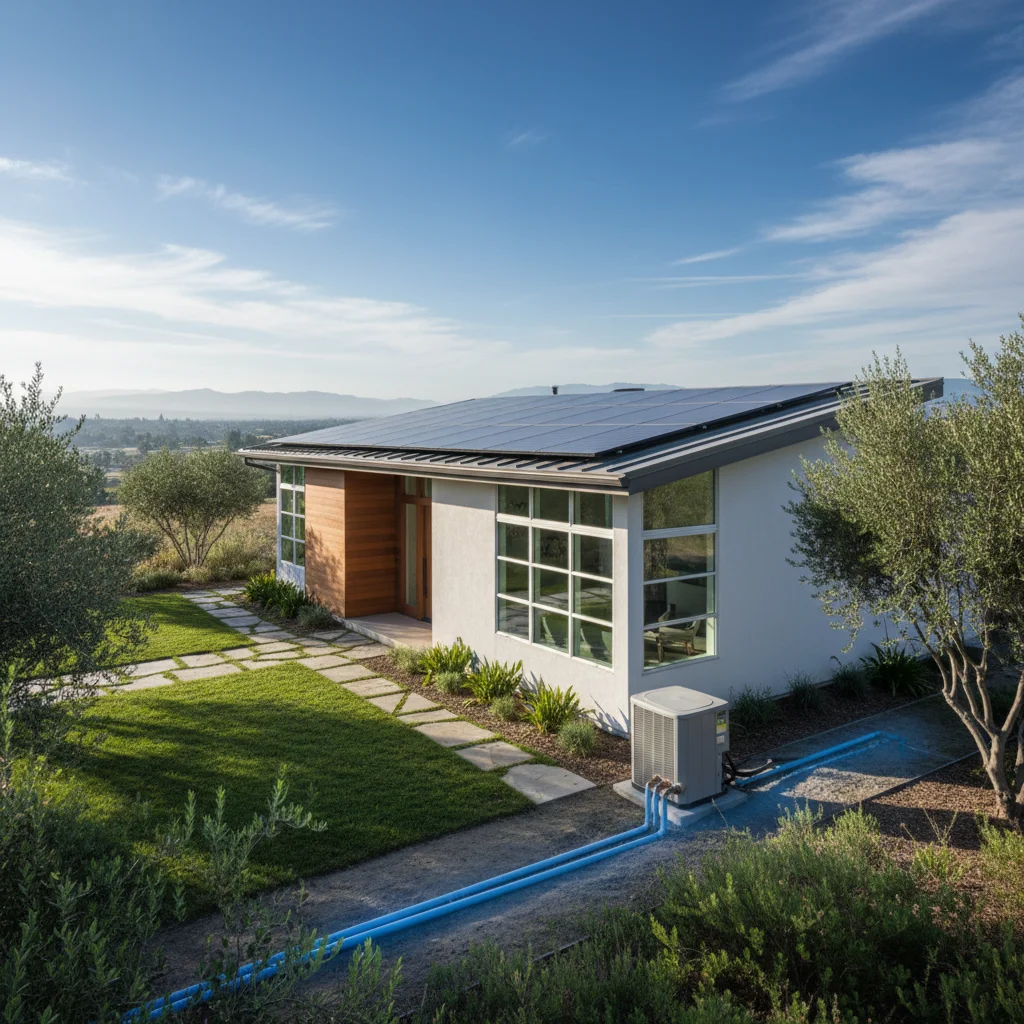
Fresno homeowners installing geothermal heat pumps in 2026 claim a 30% federal tax credit with no equipment cap, cutting typical $25,000 installations to $17,500 net cost. The federal Residential Clean Energy Credit (Section 25D) ended for expenditures made after December 31, 2025, and the IRS treats an expenditure as made when installation is completed (IRS FS-2025-05). Federal tax credits for this work have ended, but state, local and utility rebates may still apply; check what is available at your address with the DuloCore rebate calculator. But unlike solar water heaters capped at $2,000 annually, geothermal installations face no dollar ceiling, making them the highest-value residential clean energy investment under current IRA provisions.
The federal Residential Clean Energy Credit (Section 25D) ended for expenditures made after December 31, 2025, and the IRS treats an expenditure as made when installation is completed (IRS FS-2025-05). Typical $25,000 systems cost $17,500 after the credit. Qualifying systems must meet ENERGY STAR Most Efficient criteria.
So why does this matter now? Central Valley electricity rates climbed 34% from 2023 to 2026, pushing typical 2,400-square-foot homes to $3,200 annual cooling costs. The federal Residential Clean Energy Credit (Section 25D) ended for expenditures made after December 31, 2025, and the IRS treats an expenditure as made when installation is completed (IRS FS-2025-05).
What is the geothermal tax credit percentage for Fresno homeowners?
The federal Residential Clean Energy Credit (Section 25D) ended for expenditures made after December 31, 2025, and the IRS treats an expenditure as made when installation is completed (IRS FS-2025-05). Form 5695 only covers qualifying work completed by December 31, 2025 and claimed on a 2025 return; the federal 25C and 25D credits ended after that date (IRS FS-2025-05). And the percentage applies to all qualified expenses: equipment, ground loop installation, refrigerant piping, thermostats, electrical work, permitting fees, and site preparation. But the credit requires systems to meet ENERGY STAR Most Efficient certification and serve an existing residence, not new construction. So homeowners with insufficient tax liability in the installation year carry forward unused credit balances to subsequent tax years without expiration.
What are the annual and equipment caps for the geothermal tax credit?
The geothermal tax credit carries no annual dollar cap and no per-equipment ceiling. Fresno homeowners claim 30% of total costs regardless of system size, unlike the $2,000 annual limit on solar water heaters or the $1,200 cap on energy-efficient windows and insulation. And the credit applies once per residential property per installation, not per calendar year—homeowners replacing an existing geothermal system after 10-15 years qualify for a second credit. But the IRS defines "qualified geothermal heat pump property" as ground-source systems only, excluding air-source heat pumps that fall under separate $2,000 heat pump credit rules. So a $40,000 dual-zone geothermal installation generates a $12,000 credit with no reduction for exceeding equipment thresholds.
| Program | Credit Percentage | Annual Cap | Equipment Cap | Valid Through |
|---|---|---|---|---|
| Geothermal (Section 25D) | Ended Dec 31, 2025 | — | — | Ended Dec 31, 2025 |
| Solar Water Heater (Section 25D) | Ended Dec 31, 2025 | Ended Dec 31, 2025 | Ended Dec 31, 2025 | Ended Dec 31, 2025 |
| Heat Pump (HEEHRA) | 30% | $2,000 | $2,000 | Dec 31, 2032 |
Which geothermal equipment qualifies for the tax credit in Fresno?
Ground-source heat pump systems meeting ENERGY STAR Most Efficient criteria qualify for the full 30% credit. And eligible components include closed-loop horizontal or vertical ground heat exchangers, open-loop systems using well water, refrigerant lines connecting indoor and outdoor equipment, variable-speed air handlers, programmable thermostats with WiFi controls, backup electric resistance heating, and all labor for trenching, drilling, and system installation. But air-source heat pumps—even ENERGY STAR certified—fall under the $2,000 heat pump credit, not the uncapped geothermal credit. So Fresno homeowners installing hybrid systems with both geothermal and air-source components allocate costs separately, claiming 30% of ground-source expenses and a separate $2,000 for air-source equipment. And systems must serve an existing primary or secondary residence, excluding rental properties and new construction until occupancy.
What income limits apply to claim the geothermal tax credit?
The federal Residential Clean Energy Credit (Section 25D) ended for expenditures made after December 31, 2025, and the IRS treats an expenditure as made when installation is completed (IRS FS-2025-05). Fresno homeowners earning $50,000 or $500,000 claim the same percentage on qualified installations. But starting January 1, 2033, income phase-outs reduce credits to 26% for single filers earning above $150,000 and joint filers above $300,000. And homeowners with insufficient tax liability in the installation year carry forward unused credits indefinitely, allowing retirees or lower-income households to claim balances over multiple years. So a homeowner with $3,000 federal tax liability in 2026 and a $7,500 credit applies $3,000 immediately and carries $4,500 to the 2027 return. But the credit is nonrefundable—households with zero tax liability receive no payment, only liability reduction.
The federal Residential Clean Energy Credit (Section 25D) ended for expenditures made after December 31, 2025, and the IRS treats an expenditure as made when installation is completed (IRS FS-2025-05).
How do you apply for the geothermal tax credit and what form do you file?
Form 5695 only covers qualifying work completed by December 31, 2025 and claimed on a 2025 return; the federal 25C and 25D credits ended after that date (IRS FS-2025-05). And the process requires itemizing qualified expenses on Part I of the form, calculating the 30% credit, and transferring the result to Schedule 3 (Form 1040), line 5. But the IRS requires no pre-approval, no utility company verification, and no ENERGY STAR certification submission—homeowners self-certify equipment qualifications and retain manufacturer documentation for potential audits. So installation receipts, equipment model numbers, ENERGY STAR labels, and contractor invoices must remain on file for seven years. And homeowners filing jointly with a spouse claim a single combined credit, not separate credits per individual.
Use our free rebate calculator to estimate your geothermal tax credit and net installation cost.
When does the geothermal tax credit start and end in 2026?
The federal Residential Clean Energy Credit (Section 25D) ended for expenditures made after December 31, 2025, and the IRS treats an expenditure as made when installation is completed (IRS FS-2025-05). Fresno homeowners completing installations in 2026 claim the credit on their 2026 federal return filed by April 15, 2027. And the IRS defines "placed in service" as the date the system begins heating or cooling the home, not the contract signing date or equipment delivery date. So homeowners planning 2032 installations schedule completion by November to avoid year-end contractor delays.
Can you stack the geothermal tax credit with other energy rebates in Fresno?
Fresno homeowners stack the federal 30% credit with California state rebates and utility incentives without penalty. And typical combinations include PG&E Energy Upgrade California rebates ($500-$2,000), California Climate Credit offsets, and local SMUD rebates for all-electric conversions. But stacking rules require reducing the federal credit basis by the amount of state rebates received—a $25,000 installation with a $1,500 state rebate generates a 30% credit on $23,500 ($7,050), not $25,000. So homeowners maximize total incentives by applying for state and utility programs first, then calculating federal credits after subtracting cash rebates. And California Solar Initiative Thermal (CSI-T) rebates for solar water heating stack with geothermal credits because they fund separate equipment categories.
California Geothermal Stacking Example
Total installation cost: $25,000 PG&E Energy Upgrade rebate: -$1,500 Adjusted federal basis: $23,500 30% federal credit (this federal credit ended for expenditures made after December 31, 2025): $7,050 Net homeowner cost: $16,450 ($25,000 - $1,500 - $7,050)Official Sources
- U.S. Department of Energy Geothermal Heat Pumps — Federal guidance on ground-source heat pump technology and energy savings
- IRS Energy Efficient Home Improvement Credit — Official tax credit rules, filing instructions, and Form 5695 (note: the federal 25C and 25D credits ended for projects completed after December 31, 2025)
- ENERGY STAR Most Efficient Geothermal Heat Pumps — List of qualifying equipment models and efficiency criteria
Related Reading: Learn more about Geothermal Tax Credit History Timeline and Insulation Tax Credit.
Frequently Asked Questions
What is the geothermal tax credit for Fresno homeowners?
The federal Residential Clean Energy Credit (Section 25D) ended for expenditures made after December 31, 2025, and the IRS treats an expenditure as made when installation is completed (IRS FS-2025-05). Form 5695 only covers qualifying work completed by December 31, 2025 and claimed on a 2025 return; the federal 25C and 25D credits ended after that date (IRS FS-2025-05). And the credit applies to equipment, labor, permitting, and site preparation with no dollar cap.
Are geothermal systems eligible for the federal tax credit in Fresno?
Ground-source geothermal heat pumps meeting ENERGY STAR Most Efficient criteria qualify for the 30% federal credit (this federal credit ended for expenditures made after December 31, 2025). And eligible systems include closed-loop horizontal or vertical ground heat exchangers and open-loop well water configurations. But air-source heat pumps fall under a separate $2,000 credit cap, not the uncapped geothermal provision.
How much can you claim for a geothermal installation in Fresno?
Fresno homeowners claim 30% of total installation costs with no equipment or annual cap. Typical 2,400-square-foot home installations costing $25,000-$30,000 generate $7,500-$9,000 credits. And the credit amount equals 30% of all qualified expenses: equipment, labor, trenching, drilling, electrical work, permitting fees, and ENERGY STAR-certified thermostats.
What is the deadline to claim the geothermal tax credit in Fresno?
Homeowners claim the credit on the federal return for the year the system was placed in service. Form 5695 only covers qualifying work completed by December 31, 2025 and claimed on a 2025 return; the federal 25C and 25D credits ended after that date (IRS FS-2025-05). But unused credit balances carry forward indefinitely to future tax years with no expiration date.
Does Fresno offer additional state or local geothermal rebates?
California offers Energy Upgrade California rebates through PG&E ($500-$2,000) for comprehensive energy efficiency projects including geothermal installations. And homeowners stack these rebates with the federal 30% credit by reducing the federal basis by the rebate amount. So a $25,000 installation with a $1,500 state rebate generates a $7,050 federal credit (30% of $23,500), cutting net cost to $16,450.
Ready to calculate your geothermal tax credit and total savings? Use our free rebate calculator to estimate your federal credit, state rebates, and net installation cost based on your Fresno home's specifications and energy usage.
Last updated: April 14, 2026. Reviewed by the DuloCore Editorial Team. About our authors.
Check your California heat pump rebate eligibility — see the programs you qualify for and the dollar amounts on our California heat pump rebate finder.