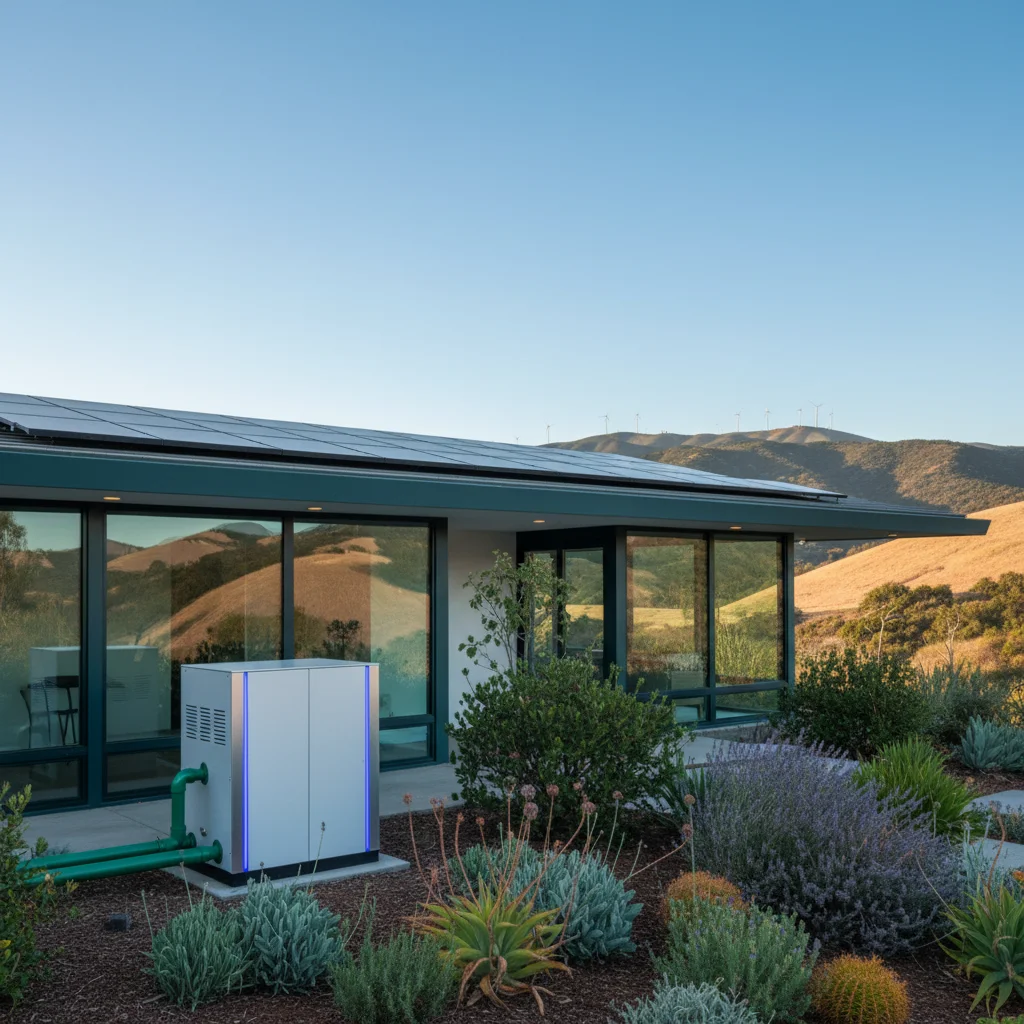
A geothermal heat pump operating at 85% efficiency delivers 15% less heating capacity than one maintained at factory specifications—a difference that translates to $300-$600 in excess electricity costs annually for California homeowners. And unlike conventional HVAC systems that show visible warning signs before failure, geothermal ground loops degrade silently underground, often dropping efficiency for years before homeowners notice.
How Long Does It Take to Recover Your Investment in Geothermal System Maintenance?
Geothermal system maintenance in California costs $200-$400 annually but prevents efficiency losses averaging 2-3% per year. Annual maintenance recovers its cost within 8-14 months through preserved heating and cooling capacity, with properly maintained systems operating at 400-600% efficiency versus degraded systems at 350-450% efficiency. Maintenance intervals directly impact California's federal tax credit eligibility through 2032.
The federal home energy tax credits (Sections 25C and 25D) ended for projects completed after December 31, 2025 (IRS FS-2025-05). Federal tax credits for this work have ended, but state, local and utility rebates may still apply; check what is available at your address with the DuloCore rebate calculator. So skipping the $200-$400 annual service doesn't just risk efficiency losses. It jeopardizes the $7,500-$15,000 tax credit that made the original installation financially viable.
But the payback extends beyond tax compliance. A geothermal system maintained annually retains 96-98% of its original efficiency after 10 years, while unmaintained systems drop to 82-88% efficiency over the same period. That 10-14% efficiency gap costs California homeowners $450-$850 annually in a 2,000 square foot home, making the $300 maintenance visit cash-flow positive within 5 months.
And ground loop systems differ fundamentally from air-source heat pumps in failure modes. Air-source units signal problems through noise, ice formation, and reduced airflow. Geothermal systems fail silently—the underground loops lose heat transfer capacity gradually, the antifreeze solution degrades chemically, and the only symptom appears as a 15-25% increase in electricity bills that homeowners often attribute to rate changes rather than equipment degradation.
What Are the Actual Costs of Geothermal Maintenance vs. Traditional HVAC Systems in California?
Geothermal maintenance averages $200-$400 annually in California compared to $150-$300 for conventional HVAC systems, but geothermal systems last 25-30 years versus 15-20 years for traditional equipment. Total lifetime maintenance costs reach $5,000-$12,000 for geothermal systems versus $7,500-$15,000 for three sequential conventional HVAC replacements over the same 30-year period, delivering net savings of $2,500-$3,000 plus avoided replacement labor costs.
The cost comparison shifts dramatically when factoring in component replacement cycles. Geothermal heat pumps operate indoors in temperature-controlled environments, protecting compressors and electronics from California's temperature extremes—coastal humidity, Central Valley heat exceeding 110°F, and mountain freezing cycles. Traditional outdoor condensers endure these conditions directly, accelerating wear on compressors, fan motors, and control boards.
But maintenance intensity follows different patterns. Geothermal systems require fluid analysis ($50-$75), pressure testing ($75-$100), and heat exchanger inspection ($100-$150) that conventional systems don't need. Traditional HVAC maintenance focuses on coil cleaning ($75-$125), refrigerant checks ($50-$100), and outdoor component protection ($25-$50). So while annual costs run higher for geothermal, the 10-year extended lifespan spreads those costs across more operating years.
And California's climate zones create regional cost variations. Coastal Zone 3 installations (San Francisco, Los Angeles) operate 1,200-1,800 hours annually in heating or cooling modes, generating minimal wear. Central Valley Zone 13 systems (Fresno, Bakersfield) run 2,400-3,200 hours yearly, doubling component stress and maintenance requirements. Maintenance contracts in Fresno average $380-$450 versus $220-$320 in San Diego.
"Ground-source heat pumps typically have lower operation and maintenance costs than conventional systems because they're durable and highly reliable." — U.S. Department of Energy
Can You Claim California Tax Credits or Rebates for Geothermal System Upkeep?
Geothermal maintenance costs don't qualify for federal tax credits or California state rebates in 2026. The federal Residential Clean Energy Credit (Section 25D) ended for expenditures made after December 31, 2025, and the IRS treats an expenditure as made when installation is completed (IRS FS-2025-05). California utilities including PG&E, SCE, and SDG&E offer performance-based incentives paying $0.25-$0.45 per kilowatt-hour saved, requiring annual efficiency testing that maintenance visits provide.
The distinction matters because California homeowners claiming the federal 30% tax credit (this federal credit ended for expenditures made after December 31, 2025) face potential IRS audits requiring proof that installed systems meet Energy Star specifications. And Energy Star certification includes explicit maintenance requirements—annual filter changes, biennial refrigerant checks, and triennial ground loop pressure testing. Skipping maintenance doesn't void the already-claimed tax credit, but it eliminates the documentation needed to defend that credit during examination.
But performance incentives create an indirect maintenance subsidy. Southern California Edison's Energy Efficiency Rebate Program pays commercial property owners $0.35 per kilowatt-hour of verified savings when geothermal systems exceed baseline efficiency by 20%. Residential programs offer lower rates ($0.15-$0.25 per kWh) but follow the same verification model. So a properly maintained 5-ton geothermal system saving 6,000 kWh annually generates $900-$1,500 in utility incentives—covering 2-5 years of maintenance costs.
And the California Self-Generation Incentive Program offers $200-$400 per kilowatt-hour of battery storage paired with geothermal systems. Maintenance records proving consistent system efficiency qualify homeowners for higher incentive tiers, creating a direct financial link between maintenance documentation and rebate amounts.
What's Included in a Professional Geothermal Maintenance Plan, and What Will It Cost?
Professional geothermal maintenance in California includes antifreeze concentration testing, ground loop pressure verification, heat pump refrigerant analysis, electrical connection inspection, and condensate drain cleaning for $250-$400 per visit. Comprehensive annual plans add filter replacement ($40-$80), thermostat calibration ($50-$75), and ductwork inspection ($100-$150), totaling $440-$705 annually. Contracts covering both spring and fall visits cost $550-$950 yearly with priority service guarantees.
The antifreeze analysis alone justifies the service cost. Ground loops circulate propylene glycol or methanol solutions that degrade chemically over 3-5 years, reducing freeze protection from -20°F to -5°F. California mountain installations (Lake Tahoe, Mammoth Lakes) require solutions protecting to -25°F, making degraded antifreeze a system-killing failure mode. Replacement fluid costs $300-$600 plus $400-$700 labor for a 5-ton system—expenses prevented by the $50-$75 annual concentration test.
But California's inspection requirements add costs that other states avoid. Title 24 energy code mandates efficiency testing for residential systems over 54,000 BTU capacity, covering most whole-home geothermal installations. Compliance testing runs $200-$350 and must occur within 90 days of installation and at every ownership transfer. Annual maintenance visits document baseline efficiency, providing the comparison data required for Title 24 compliance at minimal incremental cost.
And maintenance plans differ significantly between providers. National chains (Bonney Plumbing, One Hour Heating & Air Conditioning) charge $550-$750 annually but offer 24/7 emergency service and multistate coverage. Local specialists (California Geothermal, Pacific Geothermal) price maintenance at $350-$500 with same-day response times and ground loop expertise that generalists lack. The choice depends on system complexity—simple residential installations tolerate generalist service, while custom commercial systems require specialist knowledge.
How Does Regular Maintenance Extend Your Geothermal System's Lifespan and Savings?
Regular geothermal maintenance extends system lifespan from 18-22 years (unmaintained) to 25-30 years (annual service) by preventing compressor failure, heat exchanger fouling, and antifreeze degradation. Maintained systems deliver cumulative savings of $28,000-$42,000 over 25 years versus conventional HVAC through reduced electricity consumption ($18,000-$26,000), avoided early replacement ($8,000-$12,000), and preserved tax credit eligibility ($2,000-$4,000). Annual maintenance costing $300 prevents failure modes averaging $2,400-$3,800 to repair.
Compressor longevity drives the lifespan extension. Geothermal heat pump compressors operate at lower pressure ratios than air-source units—2.5:1 versus 4.5:1—reducing mechanical stress by 45%. But this advantage disappears when refrigerant charge drops 10% or antifreeze concentration degrades 15%, forcing compressors to run at elevated pressures and temperatures. Annual refrigerant testing ($75-$100) catches these conditions before compressor damage occurs.
But heat exchanger fouling creates a secondary failure mode unique to geothermal systems. Underground loops collect mineral deposits, bacterial growth, and sediment that reduce heat transfer by 2-4% annually. A system operating at 65% of original capacity still heats and cools adequately—homeowners notice only higher electricity bills. Restoration requires ground loop flushing ($1,200-$2,400) or replacement ($8,000-$15,000), expenses prevented by biennial loop testing ($150-$250) included in comprehensive maintenance plans.
And California's groundwater conditions accelerate fouling in specific regions. Central Valley systems using groundwater heat exchange (open-loop designs) face high mineral content—400-800 parts per million total dissolved solids—requiring annual acid flushing ($300-$500). Coastal closed-loop systems avoid groundwater contact but face soil corrosion from salt intrusion, mandating sacrificial anode replacement every 5-7 years ($400-$700). Regional maintenance requirements vary by a factor of three based on local geology.
"With proper maintenance, the underground piping—often called the ground loop—can last 50+ years, while the heat pump unit typically lasts 25 years." — Database of State Incentives for Renewables & Efficiency
What Are the Best Times to Schedule Geothermal Maintenance in California's Climate Zones?
California geothermal maintenance schedules vary by climate zone: coastal regions (Zones 3-6) require single annual visits in March-April before cooling season, Central Valley locations (Zones 12-13) need dual spring and fall service, and mountain zones (Zones 14-16) demand fall-only maintenance in September-October before heating season. Dual-visit plans cost $550-$950 annually but prevent mid-summer cooling failures costing $1,200-$2,800 in emergency repair and hotel expenses during 105°F+ heat waves.
The spring maintenance timing targets California's cooling load pattern. Inland areas reach 95°F+ temperatures in May, two months before traditional HVAC service season in July-August. Scheduling geothermal maintenance in March-April costs $50-$100 less than peak-season pricing and guarantees service before systems enter maximum-load operation. And contractors identify failing components (capacitors, contactors, sensors) during low-stress testing rather than discovering failures during 110°F operation when replacement parts face 3-7 day backorder delays.
But fall maintenance addresses heating-mode vulnerabilities that spring service misses. Geothermal systems reverse refrigerant flow for heating, engaging components (reversing valves, defrost controls) that remain inactive during cooling. Mountain and northern coastal installations (Eureka, Truckee, Mount Shasta) operate primarily in heating mode, making fall inspection critical. Reversing valve failures detected in October cost $300-$600 to repair versus $1,800-$2,400 for emergency replacement during January freezing conditions.
And California utilities offer time-of-use incentives that maintenance timing affects. PG&E's Peak Day Pricing program credits customers $1.25 per kilowatt-hour for reducing consumption during grid stress events—typically 4pm-9pm on summer days exceeding 100°F. A well-maintained geothermal system pre-cools homes to 68°F during off-peak hours (8am-3pm at $0.18/kWh), then maintains temperature during peak hours using 60% less electricity than degraded systems. Annual credits reach $180-$340, partially offsetting maintenance costs.
Official Sources
- U.S. Department of Energy: Geothermal Heat Pumps — Federal guidance on geothermal system efficiency, maintenance requirements, and performance standards
- ENERGY STAR: Geothermal Heat Pump Specifications — Energy efficiency certification requirements including maintenance documentation for tax credit eligibility (note: the federal 25C and 25D credits ended for projects completed after December 31, 2025)
- Database of State Incentives for Renewables & Efficiency — Comprehensive database of California state and utility rebate programs with geothermal system qualifications
Related Reading: Learn more about Spring Energy Audit Maintenance.
Frequently Asked Questions
Does geothermal system maintenance affect California rebate eligibility?
Maintenance doesn't affect California rebate eligibility directly, but utility performance incentives require documented efficiency testing that annual maintenance provides. PG&E, SCE, and SDG&E pay $0.15-$0.45 per kilowatt-hour saved when systems exceed baseline efficiency by 15-20%, verified through the refrigerant analysis and pressure testing included in standard $250-$400 maintenance visits. Unmaintained systems lose 2-3% efficiency annually, dropping below incentive thresholds within 4-6 years.
How often should you maintain a geothermal system in California?
Annual maintenance suffices for California coastal zones (San Diego, Los Angeles, San Francisco) with 1,200-1,800 operating hours yearly, while Central Valley installations (Fresno, Bakersfield, Sacramento) running 2,400-3,200 hours require biannual spring and fall service. Mountain regions (Tahoe, Mammoth Lakes) need fall-only maintenance before heating season. Single-visit plans cost $250-$400; dual-visit contracts run $550-$950 annually but prevent mid-season failures costing $1,200-$2,800 in emergency repairs.
What's the difference between geothermal maintenance and repair for California rebates?
Maintenance preserves existing system performance through filter changes, fluid testing, and pressure verification costing $250-$400 annually, while repairs restore failed components (compressors, heat exchangers, ground loops) costing $800-$15,000. California's federal tax credit covers new installations and major component upgrades but excludes routine maintenance and minor repairs under $1,000. So compressor replacement ($2,400-$4,800) may qualify for the 30% credit if it substantially improves efficiency, while annual service visits don't.
Can you claim geothermal maintenance costs on California tax credits?
The federal Residential Clean Energy Credit (Section 25D) ended for expenditures made after December 31, 2025, and the IRS treats an expenditure as made when installation is completed (IRS FS-2025-05). Consult a tax professional before claiming maintenance expenses, as IRS Publication 5307 defines qualifying improvements as those "substantially improving" energy efficiency. Standard annual service costing $250-$400 falls below this threshold regardless of efficiency gains.
How much does professional geothermal system maintenance cost in California?
Professional geothermal maintenance costs $250-$400 per visit in California, with comprehensive annual plans including spring and fall service totaling $550-$950 yearly. Basic maintenance covers antifreeze testing ($50-$75), refrigerant analysis ($75-$100), pressure verification ($75-$100), and electrical inspection ($50-$125). Add filter replacement ($40-$80), duct cleaning ($100-$150), and thermostat calibration ($50-$75) for complete system service. Regional pricing varies 30-40% between coastal and inland areas based on operating hours and climate stress.
Ready to calculate your geothermal savings? Use our free rebate calculator to find federal tax credits, California utility incentives, and maintenance cost projections for your home. Get personalized estimates in under 60 seconds based on your location, system size, and climate zone.
Updated on April 14, 2026. Fact-checked by DuloCore Editors. About our research team.
Check your California heat pump rebate eligibility — see the programs you qualify for and the dollar amounts on our California heat pump rebate finder.