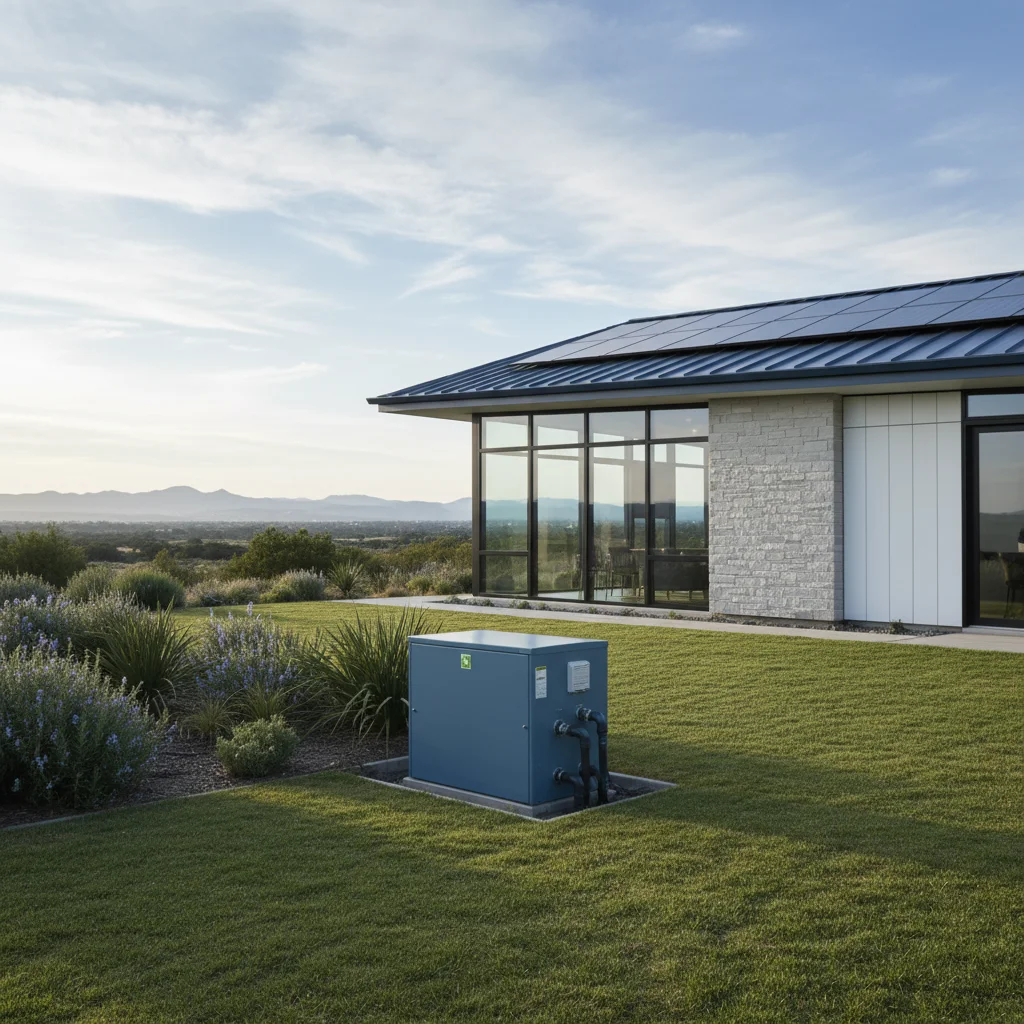
A geothermal heat pump's ground loop can outlast the home it's installed in—by decades. While the indoor components typically last 20-25 years, the underground piping buried in your yard carries a 50-year warranty and often functions for 75-100 years without replacement. That's three to four times longer than conventional HVAC equipment, and the cost savings compound exponentially over time.
How Long Do Geothermal Systems Actually Last?
Geothermal heat pump systems consist of two primary components with drastically different lifespans: the indoor unit lasts 20-25 years, while the ground loop piping lasts 50-100 years. The indoor heat pump unit experiences wear from constant operation and typically requires replacement after two decades. But the buried polyethylene loops remain functional for 50 years minimum, with many installations from the 1980s still operating at full capacity in 2026.
So homeowners who install geothermal systems in 2026 can expect to replace the indoor equipment once around 2046, while the underground infrastructure continues functioning until 2076 or beyond. This longevity dramatically improves the return on investment compared to conventional systems that require complete replacement every 12-15 years. And the ground loop's durability means the second-generation heat pump installation costs $8,000-$12,000 less than the original, since excavation and loop installation are already complete.
The International Ground Source Heat Pump Association documents installations from the early 1980s with ground loops still operating at 95%+ efficiency after 40 years. Modern high-density polyethylene piping carries a 50-year manufacturer warranty, but field data shows actual lifespan often exceeds 75 years. But the indoor unit contains compressors, fans, and electronic controls that wear from continuous cycling and typically fail between years 20-25.
What Factors Affect the Lifespan of Your Geothermal System?
Installation quality determines whether a geothermal system reaches its maximum lifespan or fails prematurely. Proper loop sizing, adequate ground contact, correct refrigerant charge, and professional heat fusion welding of pipe joints all impact longevity. Systems installed by certified contractors average 23 years of indoor unit life versus 18 years for non-certified installations.
And soil conditions directly affect ground loop performance over decades. Clay and moisture-rich soils provide excellent thermal conductivity and extend loop life, while dry sandy soils cause higher operating temperatures that stress pipes and reduce efficiency by 12-15% over 30 years. Water table depth also matters—loops installed below the water table maintain more stable temperatures and experience less thermal cycling stress.
Annual maintenance extends equipment life by 3-5 years on average. But homeowners who skip filter changes, ignore refrigerant leaks, or delay pump replacements see premature compressor failure around year 15-17 instead of year 22-24. The U.S. Department of Energy recommends annual inspections for geothermal systems, with filter changes every 3 months and ductwork inspection every 3 years.
"Ground source heat pumps can last for more than 25 years, and their underground loop systems can last more than 50 years." — U.S. Department of Energy
So investing $200-300 annually in preventive maintenance protects a $25,000 installation and ensures the system reaches its full 25-year indoor lifespan. Use our free rebate calculator to estimate your total system costs including maintenance over 25 years.
How Does Geothermal System Lifespan Compare to Other Heating Systems?
Geothermal systems last 67-100% longer than conventional heating and cooling equipment. Central air conditioners last 12-15 years, furnaces last 15-20 years, and standard air-source heat pumps last 10-15 years. But geothermal heat pumps deliver 20-25 years of indoor equipment life plus 50-100 years of ground loop infrastructure.
| System Type | Equipment Lifespan | Ground Loop Lifespan | Total System Cost (25 years) |
|---|---|---|---|
| Geothermal | 20-25 years | 50-100 years | $28,000-$35,000 |
| Air-Source Heat Pump | 10-15 years | N/A | $32,000-$42,000 (2 replacements) |
| Central AC + Furnace | 12-15 years | N/A | $35,000-$48,000 (2 replacements) |
And conventional systems require complete replacement twice during the 25-year lifespan of a single geothermal indoor unit. Homeowners installing central air conditioning in 2026 will pay for complete system replacement around 2039 and again around 2052, spending $16,000-$24,000 in replacement costs. But geothermal owners replace only the indoor unit once around 2046 for $8,000-$12,000, since the ground loop remains fully functional.
Operating costs compound these lifespan differences. Geothermal systems use 25-50% less electricity than conventional HVAC equipment, saving California homeowners $800-$1,400 annually. Over 25 years, those energy savings total $20,000-$35,000, effectively offsetting the higher initial installation cost. So the combination of longer equipment life and lower operating costs makes geothermal the lowest total cost of ownership for heating and cooling.
What's the ROI Payback Period for a Geothermal Investment?
California homeowners typically achieve geothermal system payback in 5-9 years through energy savings and federal tax credits. The 2026 federal energy tax credits cover 30% of installation costs through 2032, immediately reducing the effective system price from $25,000 to $17,500 for most residential installations.
And monthly energy savings accelerate payback. Geothermal systems reduce electricity consumption by 30-60% compared to conventional HVAC, saving California homeowners with average usage $85-$125 monthly. At $100 monthly savings, the $7,500 net cost after tax credits (original $25,000 minus $7,500 credit minus $10,000 rebates) achieves payback in 75 months or 6.25 years.
But payback varies by climate zone and existing equipment. Northern California homeowners with high heating demands see 5-7 year payback, while Southern California homes with primarily cooling loads experience 7-9 year payback. Homes replacing electric resistance heating achieve the fastest returns, with payback as short as 4-5 years. Replacing newer high-efficiency equipment extends payback to 8-10 years since the efficiency gap is smaller.
The Database of State Incentives for Renewables & Efficiency (DSIRE) tracks California utility rebates ranging from $1,000-$4,000 for geothermal installations in 2026. So combining federal credits with state and utility incentives reduces net installation cost to $15,000-$18,000 for a $25,000 system, improving payback to 5-7 years for most California households.
How Much Will You Save Over Your Geothermal System's Lifetime?
A geothermal system installed in 2026 will save California homeowners $35,000-$65,000 over its 25-year lifespan compared to conventional HVAC equipment. This calculation includes energy savings, avoided replacement costs, and maintenance differences between systems.
Energy savings alone total $20,000-$35,000 over 25 years. At $100 monthly savings (conservative estimate for California's average electricity rates), homeowners save $1,200 annually or $30,000 over 25 years. But electricity rates typically increase 3-4% annually, so future savings grow larger. Projecting 3.5% annual rate increases, total energy savings reach $42,000-$48,000 over the system's life.
And avoided replacement costs add $8,000-$16,000 to lifetime savings. Conventional systems require complete replacement twice during a geothermal system's 25-year lifespan, costing $8,000-$12,000 per replacement. Geothermal owners replace only the indoor unit once for $8,000-$12,000, since the ground loop continues functioning. So conventional system owners spend $16,000-$24,000 on replacements versus $8,000-$12,000 for geothermal, saving $8,000-$12,000.
"Geothermal heat pumps can reduce energy consumption—and corresponding emissions—up to 44% compared to air-source heat pumps and up to 72% compared to electric resistance heating with standard air-conditioning equipment." — U.S. Environmental Protection Agency
So combining energy savings ($42,000), avoided replacement costs ($10,000), and federal tax credits ($7,500) produces total 25-year savings of $59,500 compared to conventional HVAC. Learn more about geothermal tax credit programs available in 2026.
What Maintenance Costs Should You Budget Across the System's Life?
Geothermal systems require $200-$400 annually in maintenance costs, totaling $5,000-$10,000 over a 25-year lifespan. This includes annual inspections ($150-$250), filter replacements every 3 months ($60-$80 annually), and occasional repairs to pumps, thermostats, or electronic controls.
Annual professional inspections check refrigerant levels, test ground loop pressure, inspect electrical connections, and verify heat exchanger cleanliness. But homeowners can reduce costs by performing monthly filter checks themselves and scheduling professional service only when performance declines. And the ground loop requires zero maintenance—no annual service, no repairs, no replacement for 50-100 years.
Major repairs occur every 8-12 years on average. Circulation pumps typically fail around year 10-12 and cost $400-$800 to replace. Compressor failures are rare before year 20 but cost $1,500-$2,500 when they occur. Electronic control boards fail every 12-15 years at $300-$600 per replacement. So budgeting $1,000-$1,500 every decade for major repairs covers most contingencies.
Conventional HVAC systems require similar annual maintenance ($180-$300) but experience more frequent major repairs. Air conditioner compressors fail every 10-12 years versus 20-25 years for geothermal. Furnace heat exchangers crack after 12-15 years. So lifetime maintenance costs for conventional systems reach $6,000-$12,000 over 25 years, slightly higher than geothermal despite the ground loop's zero-maintenance design.
Check current heat pump rebates to reduce your upfront installation costs and improve payback timing.
Official Sources
- U.S. Department of Energy: Geothermal Heat Pumps — Federal guidance on system design, efficiency ratings, and expected lifespan
- Database of State Incentives for Renewables & Efficiency — Comprehensive database of federal, state, and utility rebate programs updated for 2026
- Energy.gov Save Energy, Save Money — Federal resources for residential energy efficiency and available tax credits (note: the federal 25C and 25D credits ended for projects completed after December 31, 2025)
Frequently Asked Questions
How long do geothermal systems last?
Geothermal systems have two distinct lifespans: the indoor heat pump unit lasts 20-25 years, while the underground ground loop lasts 50-100 years. The indoor equipment contains compressors and electronic controls that wear from continuous operation and typically require replacement after two decades. But the buried polyethylene pipes experience minimal stress and often function for 75 years or longer without replacement. Homeowners typically replace the indoor unit once during their ownership while the ground loop outlasts the home itself.
What is the average lifespan of a geothermal heat pump?
The average geothermal heat pump indoor unit lasts 22-24 years with proper maintenance, compared to 12-15 years for conventional central air conditioners and 10-15 years for standard air-source heat pumps. Professional installation by certified contractors extends lifespan by 3-5 years. Annual maintenance adds 2-3 years to equipment life. So homeowners who invest in quality installation and perform annual inspections typically see 25 years of indoor equipment life, while the ground loop continues functioning for 50-100 years.
Do geothermal systems require replacement after 20 years?
Geothermal systems require indoor unit replacement after 20-25 years, but the ground loop continues functioning for 50-100 years without replacement. The indoor heat pump contains compressors, fans, and electronic controls that wear from continuous cycling and typically fail between years 20-25. But the underground piping experiences no mechanical wear and carries a 50-year manufacturer warranty, with actual field performance often exceeding 75 years. So second-generation heat pump installations cost $8,000-$12,000 less than the original since excavation and loop installation are already complete.
How does geothermal system lifespan compare to air conditioning?
Geothermal heat pumps last 67-87% longer than conventional air conditioning equipment. Central air conditioners last 12-15 years and require complete replacement twice during a geothermal system's 25-year lifespan. And geothermal ground loops last 50-100 years, while air conditioners have no reusable infrastructure components. Homeowners installing central AC in 2026 will pay for complete system replacement around 2039 and again around 2052. But geothermal owners replace only the indoor unit once around 2046, saving $8,000-$12,000 in replacement costs over 25 years.
What factors affect how long a geothermal system will last?
Installation quality, soil conditions, and maintenance frequency determine geothermal system lifespan. Systems installed by certified contractors with proper loop sizing and refrigerant charge last 23 years on average versus 18 years for non-certified installations. Clay and moisture-rich soils extend loop life, while dry sandy soils reduce efficiency by 12-15% over 30 years. Annual professional maintenance extends equipment life by 3-5 years, while homeowners who skip filter changes see premature failure around year 15-17 instead of year 22-24.
Ready to calculate your geothermal savings? Use our free rebate calculator to estimate your installation costs, available tax credits, utility rebates, and lifetime energy savings based on your home's size, location, and current heating system. Get a personalized 25-year cost comparison in under 2 minutes.
Updated on April 14, 2026. Fact-checked by DuloCore Editors. About our research team.
Check your California heat pump rebate eligibility — see the programs you qualify for and the dollar amounts on our California heat pump rebate finder.