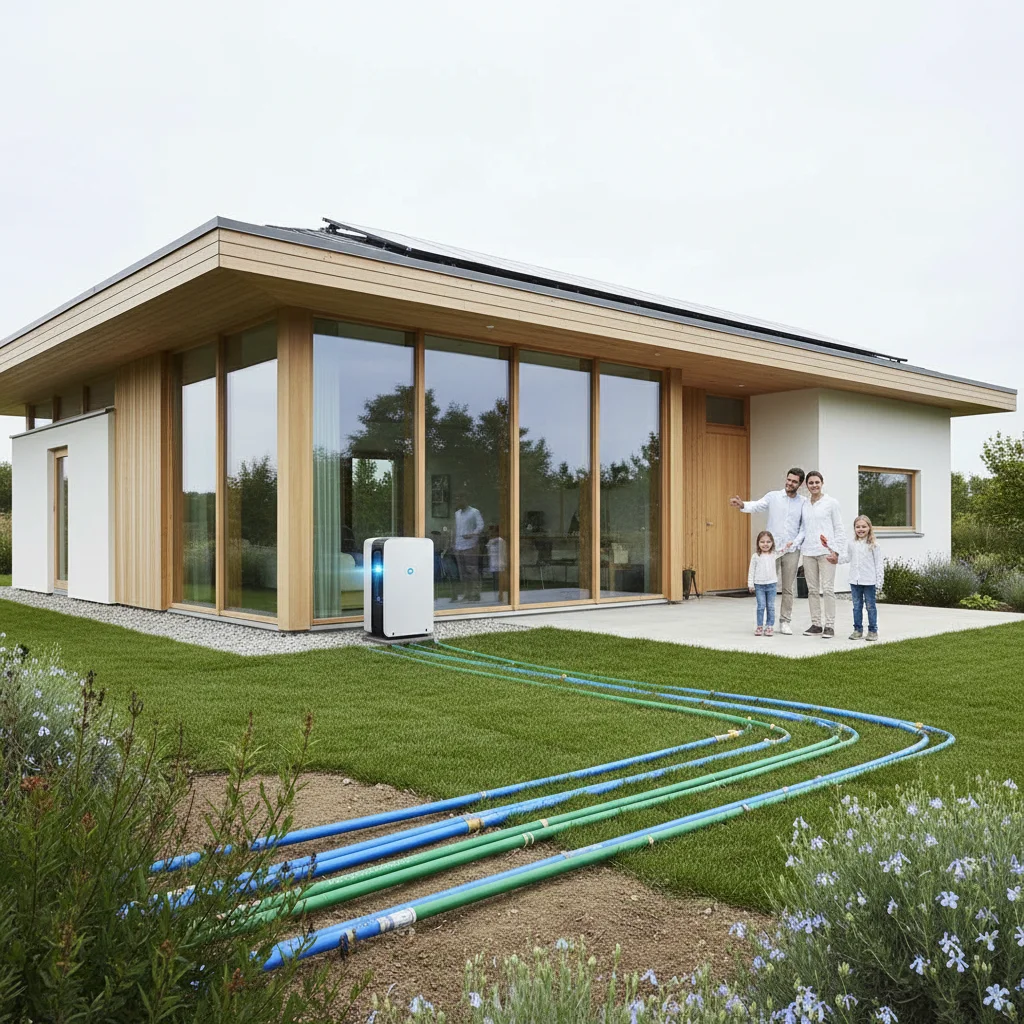
The federal home energy tax credits (Sections 25C and 25D) ended for projects completed after December 31, 2025 (IRS FS-2025-05). Federal tax credits for this work have ended, but state, local and utility rebates may still apply; check what is available at your address with the DuloCore rebate calculator. And the state's Tech Clean California program adds $4,000-$8,000 in rebates for qualifying systems.
Geothermal system installation costs $15,000-$35,000 in California depending on home size and loop configuration. The federal Residential Clean Energy Credit (Section 25D) ended for expenditures made after December 31, 2025, and the IRS treats an expenditure as made when installation is completed (IRS FS-2025-05). Tech Clean California rebates provide $4,000-$8,000 for qualifying systems. Installation takes 2-5 days for horizontal loops and 1-3 days for vertical loops.
But the upfront investment creates sticker shock for homeowners comparing geothermal to traditional air conditioning at $5,000-$8,000. So understanding which systems qualify for the combined $10,000-$15,000 in incentives determines whether payback happens in 5 years or 15 years.
How Much Does Geothermal System Installation Cost in California?
Geothermal system installation in California ranges from $15,000 to $35,000 depending on home square footage, loop type, and soil conditions. Horizontal loop systems cost $15,000-$25,000 for homes under 2,500 square feet. Vertical loop systems cost $20,000-$35,000 but require less land area. Open-loop systems using well water cost $10,000-$18,000 but require suitable aquifer access. And closed-loop pond systems cost $10,000-$20,000 when existing water bodies allow installation.
"Geothermal heat pumps are the most energy-efficient, environmentally clean, and cost-effective systems for heating and cooling buildings." — U.S. Department of Energy
Labor accounts for 30-40% of total costs at $4,500-$14,000. Equipment costs $6,000-$12,000 for the heat pump unit. Loop installation costs $4,500-$9,000 for horizontal systems and $10,000-$18,000 for vertical drilling. Calculate your total costs and available rebates using our rebate calculator.
Which Geothermal Systems Qualify for Tax Credits and Rebates?
The federal Residential Clean Energy Credit (Section 25D) ended for expenditures made after December 31, 2025, and the IRS treats an expenditure as made when installation is completed (IRS FS-2025-05). Tech Clean California rebates provide $4,000 for systems serving homes under 2,000 square feet and $8,000 for larger homes. Systems must be installed by licensed HVAC contractors with IGSHPA certification to qualify for state rebates.
But income limits apply for maximum rebate amounts. Households earning under 80% of Area Median Income receive full rebates. And households earning 80-150% of AMI receive partial rebates.
Check current geothermal tax credit details before installation.
What's the Energy Efficiency Rating of Modern Geothermal Systems?
Modern geothermal systems achieve COP ratings of 3.0-5.0 for heating mode and Energy Efficiency Ratios (EER) of 16-30 for cooling mode. Or systems with COP 4.0 deliver 4 units of heating for every 1 unit of electricity consumed. And EER 20 systems use 40% less electricity than minimum-efficiency air conditioners at EER 12.
Energy Star certified geothermal systems meet these minimum efficiency ratings:
| Loop Type | Heating COP | Cooling EER |
|---|---|---|
| Closed-loop | 3.6 | 17.1 |
| Open-loop | 4.1 | 21.1 |
| Direct exchange | 3.6 | 16.0 |
Annual electricity use for geothermal systems ranges from 3,000-6,000 kWh for typical California homes. So households pay $600-$1,200 annually at $0.20 per kWh electricity rates compared to $1,500-$2,500 for conventional HVAC.
Top Geothermal Brands That Meet California Installation Standards
WaterFurnace, ClimateMaster, and Trane manufacture geothermal heat pumps meeting Energy Star certification and California Title 24 building standards. WaterFurnace 7 Series systems achieve COP 4.7 and EER 41.2 in testing. ClimateMaster Tranquility systems deliver COP 4.2 and EER 30.0. And Trane Hyperion systems reach COP 4.3 and EER 28.5.
All three brands qualify for federal tax credits and Tech Clean California rebates when installed by certified contractors. WaterFurnace holds 25% market share in residential geothermal installations nationwide. But equipment availability varies by region and installer partnerships affect final pricing by $1,000-$3,000.
Review current heat pump rebates for additional qualifying models.
How Long Does Geothermal Installation Take and What's Involved?
Geothermal installation takes 2-5 days for horizontal loop systems and 1-3 days for vertical loop systems after permits are approved. Permit approval adds 2-6 weeks depending on local building department workload. Horizontal installations require excavating 100-400 feet of trenches 4-6 feet deep. Vertical installations drill 1-4 boreholes 150-400 feet deep using specialized drilling equipment.
Installation Timeline Breakdown
- Week 1: Site assessment and soil testing (1-2 days) - Weeks 2-7: Permit approval and utility coordination (2-6 weeks) - Installation day 1: Loop excavation or drilling - Installation day 2-3: Loop installation and pressure testing - Installation day 4: Heat pump installation and ductwork connection - Installation day 5: Startup, testing, and homeowner trainingSo total project timelines span 3-8 weeks from contract signing to system operation. Winter installation costs 10-15% less due to lower contractor demand but frozen ground increases drilling difficulty in mountain regions.
Geothermal vs. Heat Pumps vs. Traditional HVAC: Which Saves More Money?
Geothermal systems save $800-$1,500 annually compared to traditional HVAC and $300-$600 annually compared to air-source heat pumps based on typical California electricity rates. But geothermal installation costs $10,000-$20,000 more than air-source heat pumps at $5,000-$15,000 installed. And traditional HVAC systems cost $5,000-$8,000 installed.
| System Type | Installation Cost | Annual Operating Cost | Lifespan | 20-Year Total Cost |
|---|---|---|---|---|
| Geothermal | $25,000 | $900 | 25 years | $43,000 |
| Air-source heat pump | $10,000 | $1,400 | 15 years | $38,000* |
| Traditional HVAC | $6,500 | $2,200 | 15 years | $50,500* |
*Includes one replacement during 20-year period
Geothermal payback periods range from 5-10 years depending on utility rates and climate zone. So homes in hot inland valleys see faster payback than coastal homes with mild climates. And rising electricity rates accelerate payback by 6-12 months for every $0.05 per kWh rate increase.
Compare all available energy tax credits for HVAC upgrades.
How Long Do Geothermal Systems Last and What Maintenance Do They Need?
Geothermal heat pumps last 20-25 years for indoor components and 50+ years for underground loop systems. Annual maintenance costs $150-$300 for filter changes, refrigerant checks, and electrical inspections. Loop systems require no maintenance after installation due to sealed design. But heat pump components need professional service every 2-3 years at $200-$400 per visit.
Major component replacement costs include: - Compressor: $1,500-$2,500 (every 15-20 years) - Fan motor: $400-$800 (every 10-15 years) - Control boards: $300-$600 (every 12-18 years)
"Ground-source heat pumps are recognized as the most energy-efficient heating and cooling technology available today." — Environmental Protection Agency
So lifetime maintenance costs total $8,000-$12,000 over 25 years compared to $12,000-$18,000 for traditional HVAC systems requiring full replacement every 15 years.
Official Sources
- U.S. Department of Energy - Geothermal Heat Pumps — Federal guidance on geothermal technology, efficiency ratings, and installation best practices
- ENERGY STAR Geothermal Heat Pumps — Certification requirements and qualified product database for tax credit eligibility (note: the federal 25C and 25D credits ended for projects completed after December 31, 2025)
- DSIRE USA — Comprehensive database of state and federal rebate programs including current California incentives
Related Reading: Learn more about Geothermal System Lifespan.
Frequently Asked Questions
How much does a geothermal system installation cost?
Geothermal installation costs $15,000-$35,000 in California depending on system type and home size. Horizontal closed-loop systems cost $15,000-$25,000 for most homes. Vertical systems cost $20,000-$35,000 but work on smaller lots. Federal tax credits reduce costs by 30% while California rebates provide $4,000-$8,000 additional savings. So net costs after incentives range from $6,500-$20,500.
What rebates are available for geothermal system installation?
The federal Residential Clean Energy Credit (Section 25D) ended for expenditures made after December 31, 2025, and the IRS treats an expenditure as made when installation is completed (IRS FS-2025-05). Tech Clean California provides $4,000-$8,000 rebates based on home size and household income. And some utility companies offer additional $500-$2,000 incentives for Energy Star certified systems. Combined incentives total $10,000-$15,000 for qualifying installations.
Are geothermal systems eligible for tax credits in California?
The federal Residential Clean Energy Credit (Section 25D) ended for expenditures made after December 31, 2025, and the IRS treats an expenditure as made when installation is completed (IRS FS-2025-05). California doesn't offer state tax credits but Tech Clean California rebates provide $4,000-$8,000 based on system specifications. So homeowners claim federal credits on tax returns and receive state rebates directly from program administrators.
How long does it take to install a geothermal system?
Physical installation takes 2-5 days for horizontal systems and 1-3 days for vertical systems after permits are approved. Permit approval adds 2-6 weeks depending on local jurisdiction. So total project timelines span 3-8 weeks from contract signing to system startup. Winter installations may take 1-2 weeks longer due to frozen ground conditions in mountain regions.
How do geothermal systems compare to heat pumps?
Geothermal systems cost $10,000-$20,000 more than air-source heat pumps but save $300-$600 annually on electricity. Geothermal systems last 25 years compared to 15 years for air-source units. And geothermal maintains 100% efficiency in extreme temperatures while air-source efficiency drops 30-50% below 25°F. So geothermal offers lower lifetime costs in climates requiring both heating and cooling.
Calculate Your Geothermal Rebates in 60 Seconds
Find out exactly how much you'll save with federal tax credits and California rebates for your home.
Start Free Calculator →Last updated April 14, 2026 — reviewed by DuloCore Editorial. About our authors.
Check your California heat pump rebate eligibility — see the programs you qualify for and the dollar amounts on our California heat pump rebate finder.