Homeowners installing geothermal heat pumps in 2026 spend $18,000-$35,000 on average—but state rebates can reduce that figure, and federal tax credits no longer apply (IRS FS-2025-05). And the payback window? Five to ten years, depending on energy prices and regional climate.
How Much Does a Geothermal System Cost in California?
Geothermal systems cost $18,000-$35,000 for complete installation in California, with horizontal loops averaging $20,000-$28,000 and vertical systems reaching $25,000-$35,000. Installation complexity, soil conditions, and property size drive final pricing. The federal Residential Clean Energy Credit (Section 25D) ended for expenditures made after December 31, 2025, and the IRS treats an expenditure as made when installation is completed (IRS FS-2025-05).
But here's the core tension: geothermal delivers the lowest operating costs of any HVAC system—$1,200-$1,500 annually compared to $2,000-$3,000 for traditional gas furnaces—yet requires upfront capital most homeowners don't budget for. So the question isn't whether geothermal saves money. It's whether homeowners can afford the entry price and wait long enough to recoup it.
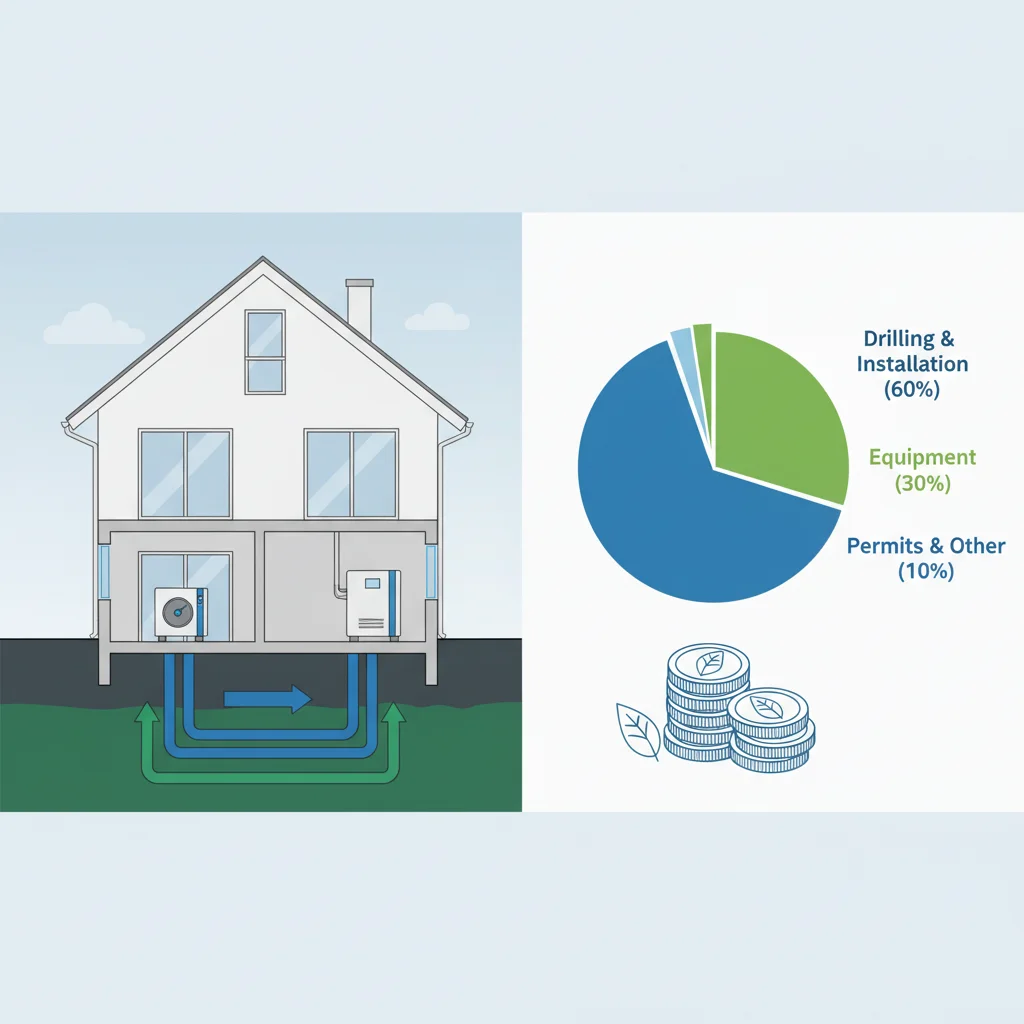
Geothermal installation costs break into three categories: equipment ($7,000-$12,000), loop field installation ($8,000-$20,000), and labor plus materials ($3,000-$5,000). Equipment costs vary by system capacity—3-ton units handle 1,500-2,000 square feet, while 5-ton systems cover 2,500-3,500 square feet. Loop field costs depend on soil type and available land. Horizontal loops require half an acre and cost $20-$30 per linear foot. Vertical loops work in smaller yards but drill 150-400 feet deep at $10,000-$20,000 for two boreholes.
California's rocky terrain and drought-resistant soil increase installation complexity in many regions. And contractors charge $15,000-$18,000 for horizontal loops in clay-heavy areas versus $12,000-$14,000 in sandy loam. Vertical systems bypass soil variability but demand specialized drilling equipment that fewer contractors own.
"Geothermal heat pumps are the most energy-efficient, environmentally clean, and cost-effective systems for heating and cooling buildings." — U.S. Department of Energy Geothermal Technologies Office
Desuperheaters add $800-$1,200 to equipment costs but generate free hot water year-round by capturing waste heat. Zone control systems add $1,500-$3,000 but allow independent temperature settings across multiple rooms, improving comfort and reducing energy waste in large homes.
What's the ROI and Payback Period for Geothermal Installation?
Geothermal systems deliver 8-12% annual ROI through energy savings, with payback periods of 5-10 years depending on local utility rates and climate. Homeowners in Northern California recoup costs in 5-7 years due to higher heating demand, while Southern California installations require 8-10 years. Energy savings range from $900-$1,800 annually compared to conventional HVAC.
Energy costs determine payback speed more than any other factor. Homeowners paying $0.30/kWh for electricity and $1.50/therm for natural gas recoup geothermal investments in 5-6 years. But areas with $0.18/kWh electricity and $0.90/therm gas extend payback to 9-10 years.
Geothermal systems operate at 300-600% efficiency—delivering 3-6 units of heat for every unit of electricity consumed—compared to 95-98% efficiency for high-performance gas furnaces and 200-250% for air source heat pumps. And that efficiency gap translates directly to lower monthly bills. A 2,000-square-foot home in Sacramento running a geothermal system spends $1,320 annually on heating and cooling versus $2,400 for a gas furnace and central air conditioner.
Property value increases add to ROI calculations. Appraisers add $20-$25 per square foot in property value for geothermal installations, meaning a 2,000-square-foot home gains $40,000-$50,000 in assessed value. So homeowners selling within the payback window still recover most installation costs through higher sale prices.
Or consider this: geothermal systems last 25 years for indoor components and 50+ years for ground loops. Traditional HVAC systems require replacement every 15-20 years at $8,000-$12,000 per cycle. Over 30 years, homeowners avoid one full replacement cycle worth $10,000-$15,000.
How Do Geothermal Costs Compare to Air Source Heat Pumps and Traditional HVAC?
Geothermal systems cost $18,000-$35,000 installed compared to $5,500-$12,000 for air source heat pumps and $6,000-$10,000 for gas furnace-plus-AC combinations. But geothermal delivers 30-40% lower operating costs than air source units and 50-60% savings versus conventional systems, erasing upfront premiums in 5-10 years through reduced energy bills.
Air source heat pumps cost $5,500-$12,000 for equipment and installation but lose efficiency when outdoor temperatures drop below 25°F. And Northern California mountain communities see winter lows of 15-20°F, forcing air source units to rely on expensive electric resistance backup heat. Geothermal systems maintain consistent efficiency year-round by exchanging heat with 50-60°F ground temperatures.
Traditional gas furnace and central air combinations cost $6,000-$10,000 installed but burn fossil fuels and operate at lower efficiency. A 95% AFUE furnace converts 95% of fuel to heat but still wastes 5% up the flue. Geothermal systems move heat instead of generating it, achieving 300-600% efficiency by extracting energy already stored in the ground.
Maintenance costs favor geothermal over both alternatives. Geothermal systems require filter changes every 3-6 months ($30-$60 annually) plus professional inspection every 2-3 years ($200-$300). Air source heat pumps need annual servicing ($150-$250) and coil cleaning ($100-$200). Gas furnaces demand annual safety inspections ($100-$150) plus periodic burner replacement ($300-$500).
| System Type | Upfront Cost | Annual Operating Cost | Efficiency | Lifespan |
|---|---|---|---|---|
| Geothermal | $18,000-$35,000 | $1,200-$1,500 | 300-600% | 25-50 years |
| Air Source Heat Pump | $5,500-$12,000 | $1,600-$2,200 | 200-250% | 15-20 years |
| Gas Furnace + AC | $6,000-$10,000 | $2,000-$3,000 | 95-98% / 13-16 SEER | 15-20 years |
Use our free rebate calculator to find your savings potential based on your home's current energy usage and local utility rates.
What Federal and State Rebates Can Reduce Your Geothermal Costs?
California's Tech Clean California program offers $3,000-$8,000 rebates for income-qualified households. (Note: Federal tax credit percentages and availability are subject to change; the 30% Residential Clean Energy Credit under Section 25D expired December 31, 2025. Verify current incentives at energy.gov.)
The federal Residential Clean Energy Credit (Section 25D) ended for expenditures made after December 31, 2025, and the IRS treats an expenditure as made when installation is completed (IRS FS-2025-05). Federal tax credits for this work have ended, but state, local and utility rebates may still apply; check what is available at your address with the DuloCore rebate calculator.
California's Tech Clean California program provides $3,000 for households earning 80-150% of area median income and $8,000 for those under 80% AMI. Los Angeles County AMI sits at $77,300 for a family of four, meaning households earning $61,840-$115,950 qualify for $3,000 rebates and those under $61,840 receive $8,000.
Utility rebates add another layer of savings. Pacific Gas & Electric offers $1,500-$3,000 for geothermal installations in existing homes. Southern California Edison provides $500-$2,000 depending on system efficiency ratings. And Sacramento Municipal Utility District pays $3,500 for ENERGY STAR certified geothermal systems.
Property Assessed Clean Energy (PACE) financing programs like CaliforniaFIRST allow homeowners to finance geothermal installations through property tax assessments with no upfront payment. Interest rates run 6-8% over 20-year terms, and payments transfer to new owners if the home sells.
For comprehensive details on energy tax credits, check current federal and state program listings.
What's Included in a Complete Geothermal System Installation?
Complete geothermal installations include ground loop fields, heat pump equipment, ductwork modifications, electrical upgrades, refrigerant lines, thermostats, and desuperheaters. Loop fields account for 40-60% of total costs, indoor equipment represents 25-35%, and labor plus materials comprise the remaining 20-30%. Horizontal systems require 1,500-2,500 linear feet of pipe, while vertical installations use 300-600 feet.
Ground loop systems circulate water-antifreeze solutions through underground pipes to exchange heat with the earth. Horizontal loops bury polyethylene pipes 4-6 feet deep in trenches 150-300 feet long. Vertical loops drill 150-400 feet deep in 6-inch diameter boreholes spaced 15-20 feet apart. Pond loops submerge coiled pipes 8-10 feet underwater when properties include ponds or lakes larger than half an acre.
Heat pump units sit indoors in basements, utility rooms, or garages and compress refrigerant to move heat between ground loops and living spaces. Three-ton units handle 36,000 BTU/hour cooling capacity for 1,500-2,000 square feet. Five-ton units deliver 60,000 BTU/hour for 2,500-3,500 square feet. Variable-speed compressors add $1,500-$2,500 to equipment costs but reduce energy consumption by 20-30% through precise capacity modulation.
Ductwork modifications cost $1,500-$3,000 when existing ducts don't match geothermal airflow requirements. Geothermal systems move air at lower temperatures for longer periods than conventional furnaces, requiring larger ducts to maintain comfort. And poorly sized ducts reduce system efficiency by 15-25%.
Electrical service upgrades add $800-$2,000 when existing panels lack capacity for geothermal heat pumps. Three-ton systems draw 10-15 amps during peak operation. Five-ton units require 15-20 amp circuits. Homes with 100-amp service panels need upgrades to 200-amp panels to accommodate geothermal equipment alongside existing loads.
Thermostats and zone controls cost $200-$1,500 depending on features. Basic programmable models handle single-zone systems. Multi-zone installations require communicating thermostats that coordinate dampers and airflow between rooms.
How Long Does Geothermal Installation Take and What's the Process?
Geothermal installations take 3-7 days for horizontal systems and 5-10 days for vertical installations, depending on property size, soil conditions, and drilling requirements. Loop field installation consumes 60-70% of project time, indoor equipment takes 1-2 days, and final testing requires 4-6 hours. Projects pause 24-48 hours between loop pressure testing and startup.
Day one starts with site assessment and utility location. Contractors mark underground gas, water, electric, and sewer lines to avoid drilling damage. Loop field excavation begins once utilities are flagged. Horizontal systems excavate trenches 4-6 feet deep using backhoes or trenchers. Vertical systems position drilling rigs and bore 150-400 foot deep holes.
Days two through four involve loop installation and pressure testing. Horizontal loops lay polyethylene pipe in trenches and backfill with sand or fine soil to ensure good thermal contact. Vertical systems insert U-bend pipes into boreholes and fill voids with thermally enhanced grout. Contractors pressure-test loops at 80-100 PSI for 24-48 hours to verify leak-free operation.
Indoor equipment installation happens on days three through five while loop pressure tests run. Technicians mount heat pump units, connect refrigerant lines, install desuperheaters, and wire thermostats. Ductwork modifications occur during this phase. Electrical panel upgrades add one day when required.
Final system startup and commissioning take place on the last day. Technicians charge refrigerant circuits, verify airflow rates, calibrate thermostats, and test heating and cooling modes. Energy monitoring equipment installs during startup to track system performance during the first 30 days.
Permitting adds 2-6 weeks to project timelines before installation begins. Building departments review mechanical, electrical, and plumbing plans. Environmental permits verify loop fields won't impact groundwater or wetlands. And utility interconnection agreements ensure grid compatibility.
For related information on similar incentives, see our guide to heat pump rebates.
Official Sources
- U.S. Department of Energy - Geothermal Heat Pumps — Federal guidance on geothermal technology, efficiency, and performance
- ENERGY STAR - Geothermal Heat Pumps — Efficiency standards, qualified product lists, and energy savings calculators
- DSIRE - California Incentives — Comprehensive database of state, local, and utility rebate programs
Related Reading: Learn more about Old Insulation Removal Cost and Spray Foam Insulation Cost.
Frequently Asked Questions
How much does a geothermal system cost?
Geothermal systems cost $18,000-$35,000 installed in California, with horizontal loop systems averaging $20,000-$28,000 and vertical installations reaching $25,000-$35,000. Equipment accounts for $7,000-$12,000, loop fields cost $8,000-$20,000, and labor adds $3,000-$5,000. The federal Residential Clean Energy Credit (Section 25D) ended for expenditures made after December 31, 2025, and the IRS treats an expenditure as made when installation is completed (IRS FS-2025-05).
What rebates are available for geothermal system installation?
The federal Residential Clean Energy Credit (Section 25D) ended for expenditures made after December 31, 2025, and the IRS treats an expenditure as made when installation is completed (IRS FS-2025-05). California's Tech Clean California program offers $3,000-$8,000 for income-qualified households. Pacific Gas & Electric provides $1,500-$3,000 rebates, and Southern California Edison pays $500-$2,000 depending on system efficiency. Combined incentives reduce net costs by $3,000-$8,500 on $25,000 installations.
Are geothermal systems eligible for federal tax credits?
The federal Residential Clean Energy Credit (Section 25D) ended for expenditures made after December 31, 2025, and the IRS treats an expenditure as made when installation is completed (IRS FS-2025-05).
How long does it take to recoup the cost of a geothermal system?
Geothermal systems deliver payback in 5-10 years depending on local energy costs and climate. Northern California homeowners recoup investments in 5-7 years due to higher heating demand. Southern California installations require 8-10 years. Annual energy savings range from $900-$1,800 compared to gas furnace and air conditioner combinations. Property value increases of $40,000-$50,000 provide additional ROI for homeowners selling early.
What is the difference between a geothermal heat pump and a traditional HVAC system?
Geothermal heat pumps exchange heat with stable 50-60°F ground temperatures year-round, achieving 300-600% efficiency. Traditional HVAC systems burn fossil fuels or exchange heat with outdoor air, operating at 95-98% efficiency for furnaces and 200-250% for air conditioners. Geothermal systems cost $18,000-$35,000 versus $6,000-$10,000 for conventional equipment but deliver 50-60% lower operating costs.
Ready to maximize your geothermal savings? Calculate your potential rebates with our free rebate calculator and discover how much you can save on installation costs.
Last reviewed: April 14, 2026. Reviewed by DuloCore Energy Specialists. About the team.
Check your California heat pump rebate eligibility — see the programs you qualify for and the dollar amounts on our California heat pump rebate finder.