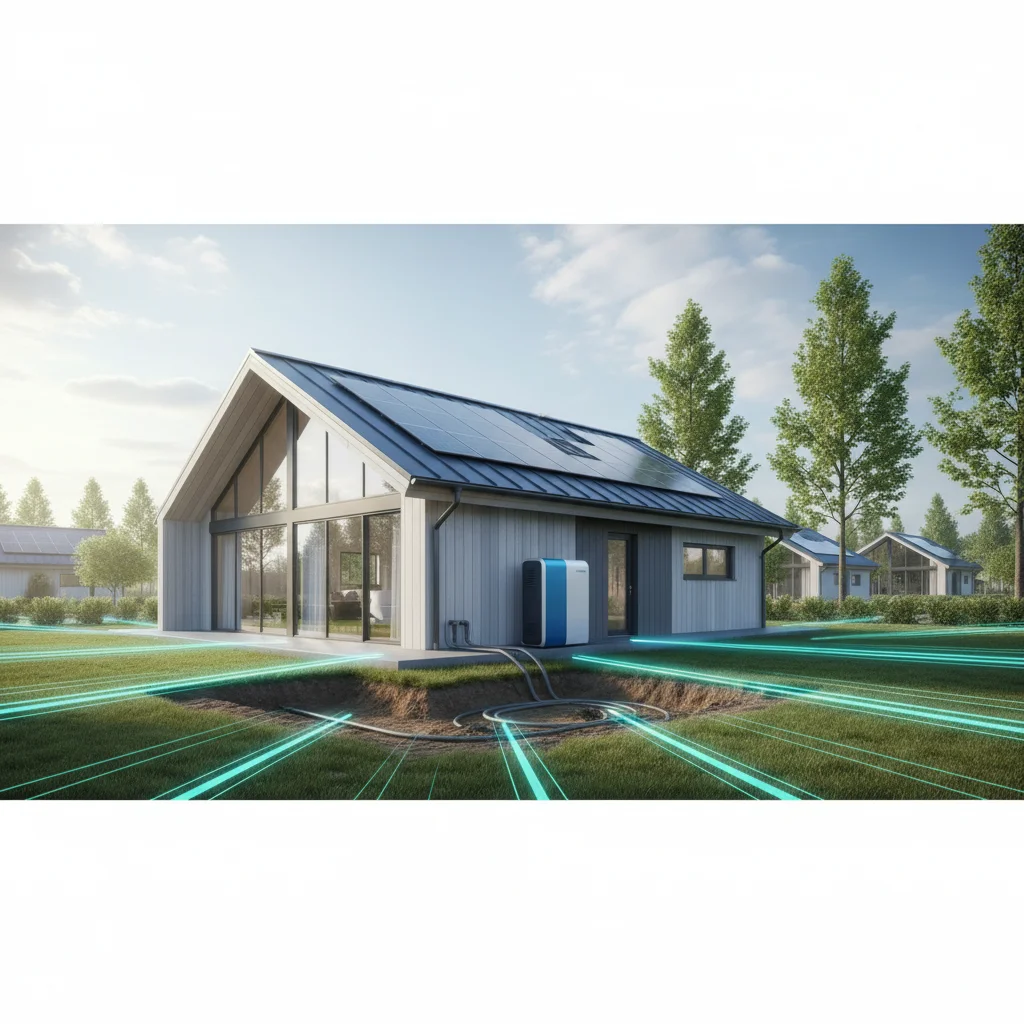
Homeowners who installed geothermal heat pumps in 2025 saved an average of $1,200 annually on heating and cooling costs, but spent $25,000 upfront. And that stark contrast—between immediate expense and long-term savings—defines the entire geothermal investment question. The 2026 federal tax credit covers 30% of installation costs through 2032, shortening the payback window from 20 years to 8-12 years for most residential systems. But actual payback timelines vary by 400% based on climate zone, existing HVAC efficiency, and local utility rates.
What Is the Average Payback Period for a Geothermal Heat Pump System?
Geothermal heat pump systems installed in 2026 achieve payback in 8-12 years for residential properties with moderate heating and cooling loads, declining to 5-7 years in cold-climate zones where annual energy costs exceed $3,000. The average installation cost ranges from $15,000 to $30,000 depending on loop configuration, property size, and soil conditions. And the annual energy savings typically fall between $800 and $2,400 compared to conventional forced-air systems. So a California homeowner replacing a 15-year-old gas furnace and central AC with a 5-ton geothermal system costing $22,000 saves approximately $1,400 annually, reaching break-even in 10 years after accounting for the geothermal tax credit of $6,600.
"Geothermal heat pumps are the most energy-efficient, environmentally clean, and cost-effective space conditioning systems available today." — U.S. Department of Energy
How Do Federal Tax Credits and Rebates Affect Your Payback Period?
The federal Residential Clean Energy Credit (Section 25D) ended for expenditures made after December 31, 2025, and the IRS treats an expenditure as made when installation is completed (IRS FS-2025-05). Federal tax credits for this work have ended, but state, local and utility rebates may still apply; check what is available at your address with the DuloCore rebate calculator. Homeowners who install a $25,000 system in 2026 claim $7,500 on their federal tax return, lowering the net investment to $17,500. California's TECH Clean California program offers up to $3,000 for qualifying heat pump installations. So a Sacramento homeowner combining the 30% federal credit with a $2,500 utility rebate reduces a $24,000 system cost to $14,300, cutting the payback period from 12 years to 7 years with $1,800 annual savings.
The IRS defines qualified geothermal heat pump property as equipment meeting Energy Star requirements or equivalent efficiency standards. And the credit applies to both new construction and retrofit installations on existing primary residences. Calculate your potential savings with the rebate calculator using your zip code and current energy bills.
What Rebate-Eligible Specifications Impact Your Total System Cost?
Energy Star-certified geothermal systems meeting COP (Coefficient of Performance) ratings of 3.1 or higher for heating and EER (Energy Efficiency Ratio) of 14.1 or higher for cooling qualify for maximum federal tax credits and most state rebate programs in 2026. Loop configuration drives 40-60% of total installation cost variance. Horizontal closed-loop systems cost $15,000-$20,000 for properties with adequate land area of 1,500-2,000 square feet per ton of capacity. But vertical closed-loop systems requiring 150-300 feet of drilling per ton cost $20,000-$30,000 on smaller urban lots.
And open-loop systems using well water or pond access reduce equipment costs by $3,000-$5,000 but require water quality testing and disposal permits. So a 4-ton vertical system with 800 feet of drilling at $25 per foot adds $20,000 in loop costs alone before equipment and labor. Homes with existing ductwork save $4,000-$6,000 compared to ducted installations requiring new air distribution systems. Reference current energy tax credits to verify rebate-eligible specifications before purchasing equipment.
How Does Your Climate Zone Determine Geothermal Efficiency and Payback Timeline?
California's diverse climate zones create payback period variations from 6 years in Redding (Zone 11) to 14 years in coastal San Diego (Zone 7). Heating-dominated climates in ASHRAE zones 4-7 achieve the fastest ROI because geothermal systems operate at 300-400% efficiency extracting heat from 50°F ground temperatures, compared to air-source heat pumps losing 50% efficiency below 32°F ambient air. And cooling-dominated zones reduce payback speed by 30-40% because conventional air conditioners achieve 95% of geothermal cooling efficiency at lower capital costs.
Sacramento homeowners replacing natural gas heating ($1,200 annually) and electric cooling ($800 annually) with a $23,000 geothermal system save $1,600 per year after the 30% federal credit (this federal credit ended for expenditures made after December 31, 2025), reaching payback in 9 years. But San Francisco properties with minimal heating loads of $600 annually extend payback to 15 years on the same system investment. So climate zone analysis determines whether geothermal delivers superior ROI compared to heat pump rebates for air-source alternatives.
"Ground source heat pumps can reduce energy consumption and emissions by 44% compared to air source heat pumps and 72% compared to electric resistance heating." — EPA Energy Star
What's the Expected Lifespan of a Geothermal System and Long-Term ROI?
Geothermal heat pump indoor components last 20-25 years while underground loop fields operate for 50+ years without replacement, doubling the lifespan of conventional HVAC systems rated at 10-15 years. The extended equipment life transforms total cost of ownership calculations. A homeowner installing a $25,000 system in 2026 ($17,500 after federal credit) with $1,500 annual savings reaches payback year 12 but accumulates $45,000 in total savings over 30 years. And the buried loop infrastructure retains value for future heat pump replacements, reducing the next system cost by $8,000-$12,000.
Maintenance costs average $150-$300 annually for filter changes and refrigerant checks compared to $400-$600 for gas furnace and AC tune-ups. So lifetime operating costs including electricity, maintenance, and equipment replacement favor geothermal by $60,000-$80,000 over 30 years for a typical 2,500-square-foot California home. But the upfront capital requirement of $15,000-$20,000 net investment after incentives creates a financing barrier for homeowners without equity access or cash reserves.
Geothermal vs. Air Source Heat Pumps: Which Has the Faster Payback?
Air-source heat pumps cost $8,000-$15,000 installed compared to $20,000-$30,000 for geothermal systems, creating a $10,000-$15,000 price gap that extends geothermal payback by 5-8 years in moderate climates. California homeowners in coastal zones (60-75°F annual temperatures) achieve break-even on air-source systems in 3-5 years with $1,000-$1,500 annual savings versus conventional gas and electric systems. The federal Residential Clean Energy Credit (Section 25D) ended for expenditures made after December 31, 2025, and the IRS treats an expenditure as made when installation is completed (IRS FS-2025-05). But cold-climate installations in zones with winter temperatures below 25°F for extended periods favor geothermal because efficiency remains constant at 300-400% COP regardless of outdoor conditions.
A Sacramento property with $2,000 annual heating and cooling costs comparing a $12,000 air-source system versus $24,000 geothermal investment (both after 30% federal credit (this federal credit ended for expenditures made after December 31, 2025)) sees payback timelines of 4 years for air-source and 10 years for geothermal with equivalent $1,800 annual savings. So air-source technology wins on pure payback speed. But the geothermal system delivers 10 additional years of ground loop life and 20% higher long-term efficiency, shifting total 30-year ROI in favor of geothermal by $25,000-$35,000 for properties with high energy usage and long ownership timelines.
Official Sources
- U.S. Department of Energy Geothermal Heat Pumps — Federal geothermal technology guidance and efficiency standards
- Energy Star Geothermal Heat Pumps — Certified product listings and performance requirements
- DSIRE USA — State and utility rebate program database with California-specific incentives
Frequently Asked Questions
How long does it take for a geothermal system to pay for itself?
Geothermal heat pump systems installed in 2026 achieve payback in 8-12 years for California homeowners after accounting for the 30% federal tax credit and state rebates. Cold-climate properties with annual heating costs exceeding $2,500 reach break-even in 5-7 years. But coastal moderate-climate zones with lower energy usage extend payback to 12-15 years compared to air-source alternatives.
What factors affect the geothermal payback period?
Installation cost ($15,000-$30,000), annual energy savings ($800-$2,400), climate zone heating and cooling loads, existing HVAC replacement timing, and available federal and state incentives determine geothermal payback timelines. And loop configuration choices between horizontal ($15,000-$20,000) and vertical ($20,000-$30,000) systems create 40% cost variance that directly impacts break-even calculations.
Is geothermal heat pump payback faster than solar panels?
Residential solar installations achieve payback in 6-9 years in California compared to 8-12 years for geothermal systems based on 2026 federal tax credit levels of 30% for both technologies. But solar systems generate measurable electricity bill reductions of $1,200-$2,000 annually while geothermal savings vary by baseline HVAC efficiency. And combining both technologies maximizes total energy independence and ROI for high-usage properties.
Can federal tax credits reduce the geothermal payback period?
The 2026 Residential Clean Energy Credit reduces geothermal payback periods by 30-40% by covering 30% of total installation costs with no dollar cap through 2032. A homeowner installing a $25,000 system claims $7,500 on federal taxes, lowering net investment to $17,500 and reducing payback from 16 years to 10 years with $1,500 annual savings. And the credit applies directly to tax liability, requiring sufficient income to capture full value.
What is the average geothermal system cost and ROI in California?
California geothermal installations cost $18,000-$28,000 for residential properties averaging 2,000-2,500 square feet, generating $1,200-$2,000 in annual energy savings compared to natural gas and electric HVAC systems. The 30-year total ROI ranges from $40,000 to $70,000 after accounting for installation costs, federal credits, and lifetime operational savings. And properties with high energy usage exceeding $3,000 annually maximize ROI potential with payback periods under 8 years.
Ready to calculate your geothermal payback period? Use our free rebate calculator to estimate installation costs, available incentives, and personalized ROI based on your property's energy usage and climate zone. Get started in 60 seconds.
Last updated April 14, 2026 — reviewed by DuloCore Editorial. About our authors.
Check your California heat pump rebate eligibility — see the programs you qualify for and the dollar amounts on our California heat pump rebate finder.