California homeowners installing geothermal heat pumps in 2026 face installation costs between $15,000 and $45,000 depending on loop system type. And yet most contractors pitch only one design—the one they're familiar with—leaving buyers overpaying by 40%.
What are the different types of geothermal loop systems for residential homes?
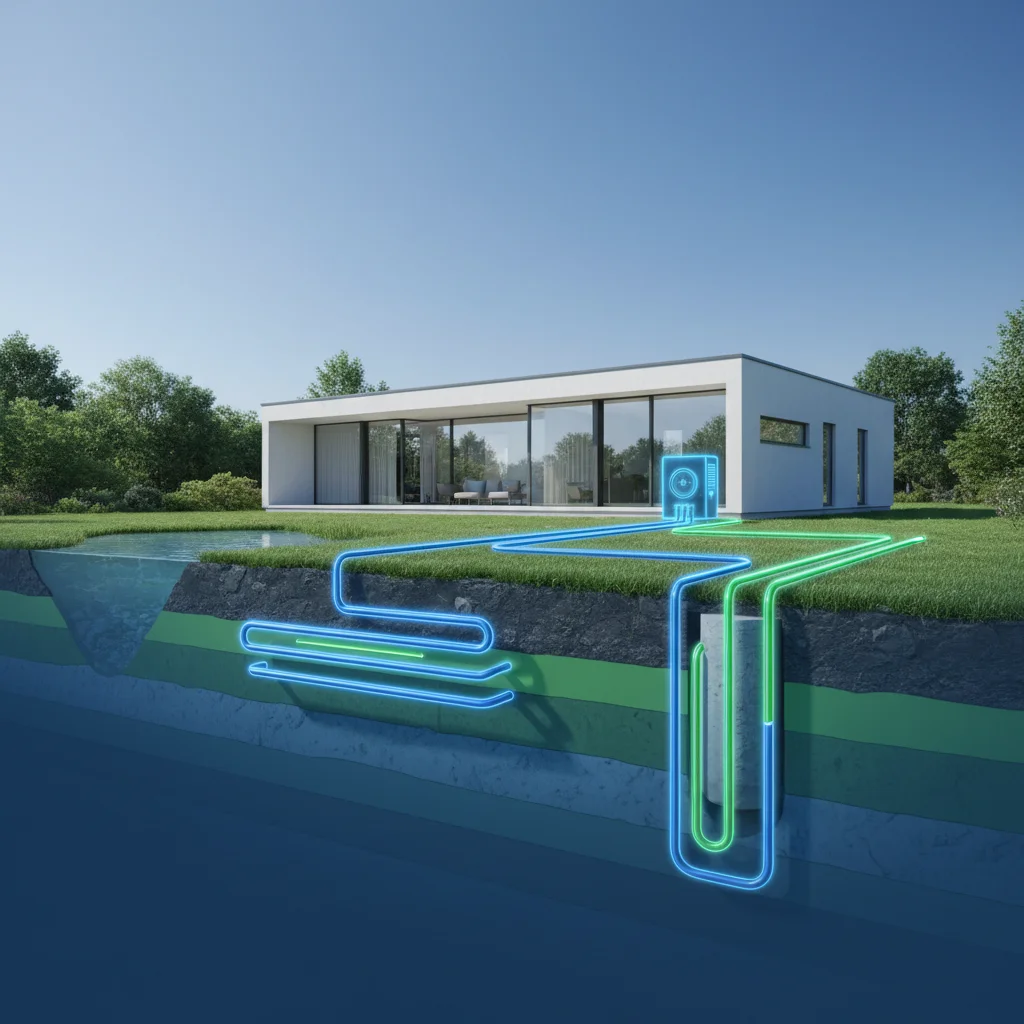
Residential geothermal loop systems fall into two categories: closed-loop systems (horizontal, vertical, pond/lake) and open-loop systems. Closed-loop horizontal installations cost $15,000-$25,000 and require 1,500-3,000 square feet of yard space at 4-6 feet deep. Vertical closed-loop systems drill 150-500 feet down and run $25,000-$45,000 but work on smaller lots. Pond/lake systems cost $10,000-$20,000 when suitable water exists within 300 feet. Open-loop systems pump groundwater directly through the heat pump and discharge it, costing $10,000-$18,000 where water quality and local codes permit.
So why does loop type matter beyond upfront cost? Installation method determines your system's 25-year operating cost and maintenance burden. Horizontal loops save $10,000 on installation but demand significant excavation. Vertical systems preserve landscaping but drill costs run $15-$40 per foot.
Closed-loop horizontal systems
Closed-loop horizontal geothermal systems bury 400-600 feet of high-density polyethylene pipe in trenches 4-6 feet deep. Installers lay pipes in parallel rows spaced 6-12 feet apart or coiled slinky patterns that reduce required land by 30%. And these systems dominate new construction installations because excavation costs drop to $3,000-$8,000 when coordinated with foundation work.
But retrofit installations face $8,000-$15,000 in landscaping restoration costs. Horizontal loops also deliver lower efficiency in extreme climates—ground temperatures at 4-6 feet fluctuate 15-20°F seasonally compared to just 5-8°F at vertical depths.
Closed-loop vertical systems
Vertical closed-loop systems drill one to six boreholes 150-500 feet deep with 4-inch diameter. Each borehole holds a U-bend pipe loop, and installers connect multiple holes in parallel or series configurations. Drilling costs account for 60% of total installation expense at $15-$40 per foot depending on rock hardness and contractor availability.
Or homeowners can cut drilling costs 25% by bundling multiple installations in neighborhoods—some California geothermal contractors offer group pricing when three or more homes commit simultaneously. Vertical systems maintain 55°F ground temperature year-round at depths below 30 feet, delivering 15-20% higher efficiency than horizontal installations in the same climate.
Pond and lake loop systems
Pond or lake loop systems submerge coiled pipe at least 8 feet deep in water bodies within 300 feet of the home. Installation costs drop to $10,000-$20,000 because excavation involves minimal drilling. But water bodies must maintain minimum volume—typically 0.5-1 acre surface area per ton of heating/cooling capacity—and stay unfrozen year-round.
California homeowners with qualifying ponds achieve installation in 2-3 days compared to 5-10 days for drilled systems. And maintenance costs run 30% lower because pump components remain accessible without excavation. So pond systems deliver the fastest payback period of 4-6 years when site conditions permit.
Open-loop systems
Open-loop geothermal systems pump groundwater from a well through the heat pump and discharge to a pond, drainage field, or second well. These systems require 1.5-3 gallons per minute water flow per ton of capacity. Installation costs stay below $18,000 when existing wells provide adequate flow and water quality.
But local regulations in many California counties prohibit open-loop discharge or require costly water quality permits. And well pumps consume 400-800 kWh annually, adding $60-$120 to operating costs. So open-loop systems make sense only where high-quality groundwater exists and discharge options meet environmental regulations.
How much does each geothermal loop system type cost to install?
Geothermal loop installation costs vary from $10,000 for pond systems to $45,000 for deep vertical drilling in rocky soil. Horizontal closed-loop systems average $18,000-$25,000 for 3-ton residential capacity. Vertical systems run $25,000-$45,000 depending on drilling depth and geology. Pond/lake installations cost $10,000-$20,000 when suitable water exists. Open-loop systems range $10,000-$18,000 plus well drilling if needed at $15-$30 per foot.
The federal Residential Clean Energy Credit (Section 25D) ended for expenditures made after December 31, 2025, and the IRS treats an expenditure as made when installation is completed (IRS FS-2025-05). Federal tax credits for this work have ended, but state, local and utility rebates may still apply; check what is available at your address with the DuloCore rebate calculator. And California's TECH Clean California program offers point-of-sale rebates up to $3,000 for qualifying heat pump installations through participating contractors. PG&E's Energy Efficiency Rebate Program pays $500-$1,500 for ENERGY STAR certified geothermal systems in 2026.
"Geothermal heat pumps are the most energy-efficient, environmentally clean, and cost-effective space conditioning systems available today." — U.S. Department of Energy
Installation quotes vary 40% between contractors—three competitive bids prevent overpayment.
What's the payback period and ROI for residential geothermal loop systems?
Residential geothermal systems achieve payback in 5-12 years depending on loop type, climate zone, and displaced heating fuel. Pond and horizontal systems in cold climates pay back in 5-7 years when replacing propane or electric resistance heat. Vertical systems in moderate climates show 8-12 year payback when replacing natural gas. Annual energy savings range $800-$2,400 per home based on DOE case studies.
And lifecycle ROI hits 300-500% over the system's 25-year lifespan. A $25,000 vertical system saving $1,500 annually returns $37,500 in energy cost avoidance plus home value appreciation of $15,000-$25,000 according to National Association of Realtors research. So total economic benefit reaches $52,500-$62,500 against $25,000 investment.
California homeowners in PG&E territory see faster payback because electricity rates average $0.34 per kWh in 2026—45% above national average. Or southern California Edison customers on time-of-use plans save $2,000+ annually by shifting cooling loads to off-peak hours with geothermal thermal storage.
Use our free rebate calculator to estimate your specific payback period based on current utility rates and available incentives.
How do geothermal loop systems compare to other heating and cooling alternatives?
Geothermal heat pumps deliver 300-500% efficiency (coefficient of performance 3.0-5.0) compared to 250-350% for air-source heat pumps and 78-98% for gas furnaces. Annual operating costs run $600-$1,200 for geothermal versus $1,200-$2,400 for air-source and $1,400-$3,000 for gas plus air conditioning. But geothermal installation costs 2-3 times more than air-source heat pumps at $8,000-$12,000 installed.
And maintenance costs favor geothermal at $100-$200 annually for filter changes and fluid checks versus $200-$400 for air-source systems with exposed outdoor equipment. So lifecycle cost of ownership over 20 years runs $30,000-$45,000 for geothermal, $45,000-$70,000 for air-source, and $55,000-$85,000 for gas heating plus central AC.
California's Title 24 energy code gives geothermal systems compliance credits that reduce solar panel requirements by 20-30% in new construction. Or existing homes can claim federal heat pump (this federal credit ended for property placed in service after December 31, 2025) rebates that make air-source installation cost-competitive with gas furnace replacement. (Note: Federal tax credit percentages and availability are subject to change; the 30% Residential Clean Energy Credit under Section 25D expired December 31, 2025. Verify current incentives at energy.gov.)
| System Type | Installed Cost | Annual Operating Cost | 20-Year Total Cost | Efficiency (COP/AFUE) |
|---|---|---|---|---|
| Geothermal (vertical) | $25,000-$35,000 | $600-$1,000 | $37,000-$55,000 | 3.5-5.0 COP |
| Air-source heat pump | $8,000-$15,000 | $1,200-$2,000 | $32,000-$55,000 | 2.5-3.5 COP |
| Gas furnace + AC | $9,000-$14,000 | $1,800-$3,000 | $45,000-$74,000 | 0.92-0.98 AFUE |
How long do residential geothermal loop systems last and what maintenance is required?
Geothermal ground loops last 50-100 years with zero maintenance because buried HDPE pipe carries a 50-year warranty and resists corrosion. Indoor heat pump components last 20-25 years—double the 10-12 year lifespan of conventional HVAC equipment. And replacement heat pump units cost $8,000-$12,000 while reusing existing ground loops, cutting future upgrade costs 60% versus complete system replacement.
Annual maintenance requires filter changes every 3-6 months at $20-$40 per filter and biennial fluid checks to verify antifreeze concentration. Professional maintenance visits cost $150-$250 annually and include compressor inspection, electrical connection testing, and airflow measurement. So total maintenance expense runs $200-$400 per year compared to $300-$600 for conventional HVAC with outdoor condenser coil cleaning and refrigerant charge verification.
But geothermal systems eliminate outdoor equipment exposure to weather, vandalism, and mechanical damage that causes 40% of air-source heat pump failures before year 15. California coastal installations avoid salt air corrosion that destroys conventional AC condensers in 8-12 years.
"The ground loop can last more than 50 years with proper installation. The heat pump equipment typically lasts about 25 years." — ENERGY STAR
Which geothermal loop system type is right for your home and budget?
Lot size dictates loop feasibility—horizontal systems need 1,500-3,000 square feet of open yard while vertical systems work on 0.25-acre lots. Budget constraints favor horizontal installations at $15,000-$25,000 when adequate land exists. And pond systems deliver lowest cost at $10,000-$20,000 but require qualifying water bodies within 300 feet.
Soil conditions determine drilling costs—vertical systems in rocky geology run $35,000-$45,000 versus $25,000-$32,000 in soft soil. California's Central Valley clay soils enable horizontal trenching at $12-$18 per linear foot while Sierra foothills granite demands vertical drilling at $25-$40 per foot. Or open-loop systems make sense only where groundwater flow exceeds 3 gallons per minute and discharge options meet county regulations.
Climate zone affects performance—vertical systems in moderate climates deliver just 10% efficiency gain over horizontal installations, making the $10,000 cost premium hard to justify. But cold-climate installations see 20% higher efficiency from vertical loops' stable deep-earth temperatures.
Official Sources
- U.S. Department of Energy Geothermal Heat Pumps — Federal guidance on system types, efficiency ratings, and installation best practices
- Database of State Incentives for Renewables & Efficiency — Comprehensive database of federal, state, and utility rebate programs updated monthly
- ENERGY STAR Geothermal Heat Pumps — Certification requirements, qualified product lists, and energy savings calculators
Related Reading: Learn more about Vertical Loop Geothermal System.
Frequently Asked Questions
What are the different types of geothermal loop systems for residential homes?
Residential geothermal systems use four main loop configurations: horizontal closed-loop (pipes buried 4-6 feet deep in trenches), vertical closed-loop (pipes in 150-500 foot deep boreholes), pond/lake loops (pipes submerged in water bodies), and open-loop systems (pumping groundwater directly through heat pumps). Closed-loop systems circulate antifreeze solution through sealed pipes. Open-loop systems discharge groundwater after heat exchange. Installation costs range $10,000-$45,000 depending on loop type and site conditions.
How much does a residential geothermal loop system cost?
Total installed cost runs $15,000-$45,000 for complete residential geothermal systems including loop, heat pump, ductwork modifications, and electrical upgrades. Horizontal systems average $18,000-$25,000, vertical systems $25,000-$45,000, and pond systems $10,000-$20,000. The federal Residential Clean Energy Credit (Section 25D) ended for expenditures made after December 31, 2025, and the IRS treats an expenditure as made when installation is completed (IRS FS-2025-05). California utility rebates add $500-$3,000 in point-of-sale discounts.
Are residential geothermal systems eligible for tax credits or rebates?
The federal Residential Clean Energy Credit (Section 25D) ended for expenditures made after December 31, 2025, and the IRS treats an expenditure as made when installation is completed (IRS FS-2025-05). California's TECH Clean California program offers $500-$3,000 point-of-sale rebates through participating contractors. And municipal utility districts provide additional incentives—SMUD pays $2,500 for ENERGY STAR certified systems, LADWP offers $2,000-$4,000 for qualifying heat pumps. Or homeowners can check the geothermal tax credit details.
What is the difference between open loop and closed loop geothermal systems?
Closed-loop systems circulate antifreeze through sealed underground pipes that never contact groundwater—the fluid absorbs earth heat through pipe walls. Open-loop systems pump groundwater from a well directly through the heat pump and discharge to a pond or second well. Closed loops cost more to install at $15,000-$45,000 but work anywhere and require minimal maintenance. Open loops run $10,000-$18,000 but demand high water quality, adequate flow rates of 3+ gallons per minute, and discharge permits that many California counties restrict.
How long does it take to install a residential geothermal loop system?
Horizontal loop installations take 3-5 days including excavation, pipe laying, backfilling, and heat pump connection. Vertical drilling requires 5-10 days depending on number of boreholes and rock hardness—each 300-foot borehole takes 8-16 hours to drill and complete. Pond systems install fastest at 2-3 days when water bodies exist within 300 feet. And indoor heat pump installation adds 1-2 days for ductwork modifications, electrical upgrades, and system commissioning regardless of loop type.
Ready to find out how much you can save with geothermal? Use our free rebate calculator to estimate your installation costs, available incentives, and annual energy savings based on your home's location and current heating system. Get your personalized geothermal analysis in under 60 seconds.
Updated on April 14, 2026. Fact-checked by DuloCore Editors. About our research team.
Check your California heat pump rebate eligibility — see the programs you qualify for and the dollar amounts on our California heat pump rebate finder.