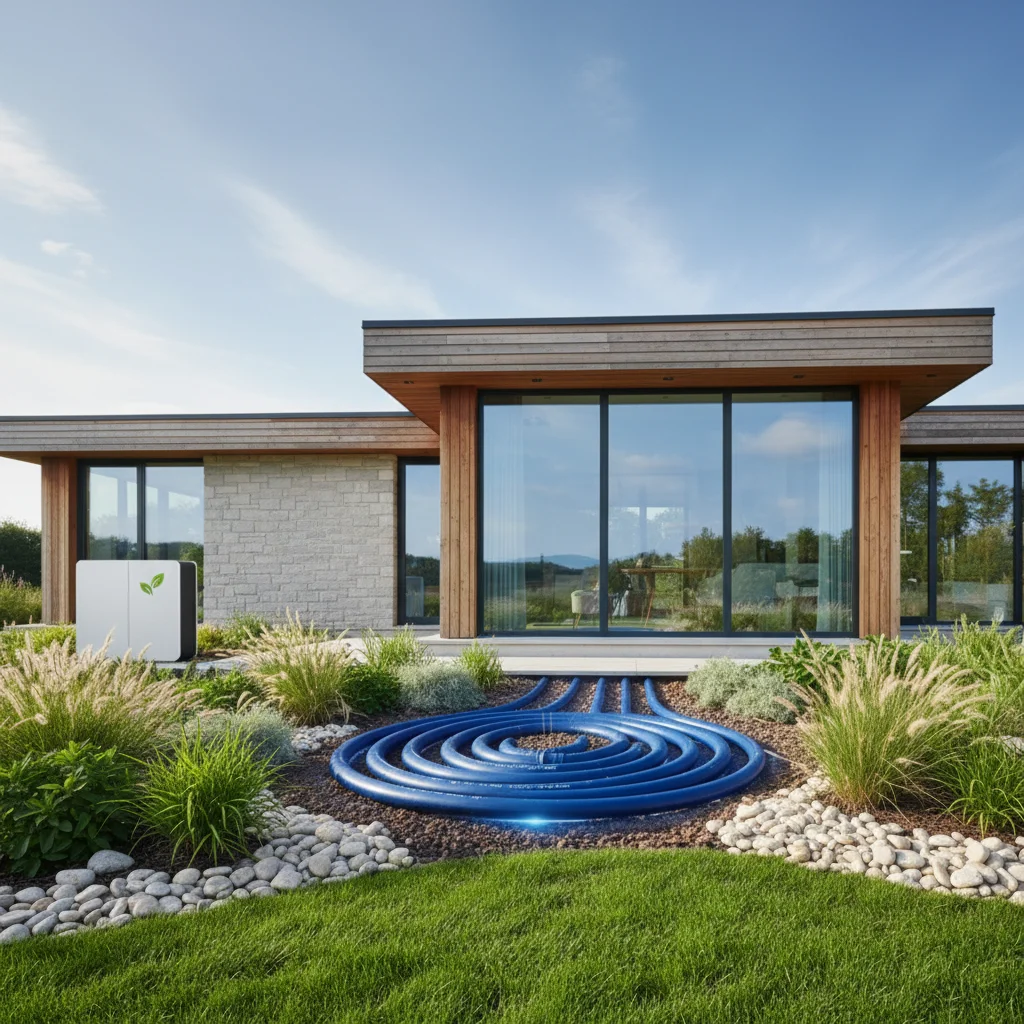
Homeowners in California paid between $18,000 and $45,000 for geothermal loop installations in 2025, yet federal tax credits and state rebates reduced net costs by 40-55% for qualifying systems—creating an energy upgrade that pays for itself in 7-12 years through eliminated heating bills.
Geothermal loop system costs range from $18,000 to $45,000 installed, with horizontal loops averaging $18,000-$28,000 and vertical loops costing $25,000-$45,000. The federal Residential Clean Energy Credit (Section 25D) ended for expenditures made after December 31, 2025, and the IRS treats an expenditure as made when installation is completed (IRS FS-2025-05). California rebates add $3,000-$6,000 for ENERGY STAR systems, reducing net investment to $10,000-$25,000 for most residential installations.
The federal Residential Clean Energy Credit (Section 25D) ended for expenditures made after December 31, 2025, and the IRS treats an expenditure as made when installation is completed (IRS FS-2025-05). Federal tax credits for this work have ended, but state, local and utility rebates may still apply; check what is available at your address with the DuloCore rebate calculator. And that shift turned a luxury energy system into a mainstream option for middle-income households facing $300-$500 monthly utility bills.
What Is the Average Cost of a Geothermal Loop System?
Residential geothermal loop systems cost $18,000-$45,000 installed in 2026, with horizontal loops averaging $18,000-$28,000 for properties with 0.5+ acres and vertical loops costing $25,000-$45,000 for smaller lots requiring 150-300 foot boreholes. Loop configuration accounts for 60-70% of total system cost, while heat pump equipment adds $8,000-$12,000 regardless of loop type.
Horizontal loops require excavating 4-6 foot trenches across 1,500-2,500 square feet, making them cost-effective for rural properties with open land. Vertical loops drill 3-6 boreholes 150-400 feet deep, adding $5,000-$15,000 in drilling costs but occupying just 50-100 square feet of yard space. Pond loops cost $10,000-$20,000 when homeowners own adjacent water bodies at least 8 feet deep and 0.5+ acres in size.
"Geothermal heat pump systems typically cost $18,000 to $30,000 to install, with larger homes requiring systems at the higher end of that range." — U.S. Department of Energy
So a 2,000 square foot home in Sacramento with a 0.25-acre lot pays $32,000 for vertical loop installation, while the same home on a 2-acre rural lot pays $22,000 for horizontal trenching. But both qualify for identical federal tax credits regardless of loop configuration.
Which Geothermal Loop Systems Qualify for Federal and State Rebates in 2026?
The federal Residential Clean Energy Credit (Section 25D) ended for expenditures made after December 31, 2025, and the IRS treats an expenditure as made when installation is completed (IRS FS-2025-05). California adds $3,000-$6,000 in utility rebates through programs like Tech Clean California for systems achieving 16+ EER cooling efficiency and 3.6+ COP heating efficiency.
The federal Residential Clean Energy Credit (Section 25D) ended for expenditures made after December 31, 2025, and the IRS treats an expenditure as made when installation is completed (IRS FS-2025-05). And the credit applies to both new construction and retrofit installations in existing homes. Form 5695 only covers qualifying work completed by December 31, 2025 and claimed on a 2025 return; the federal 25C and 25D credits ended after that date (IRS FS-2025-05).
| Program | Credit Amount | Eligibility Requirement | Application Deadline |
|---|---|---|---|
| Federal IRA Tax Credit | Ended Dec 31, 2025 | — | Ended Dec 31, 2025 |
| Tech Clean California | $3,000-$6,000 | 16+ EER, income-qualified | Funds exhausted 2026 |
| PG&E Energy Upgrade | $2,000-$4,000 | HERS verification required | Rolling enrollment |
California's TECH Clean California program exhausted 2026 funding by March, but PG&E and Southern California Edison maintain year-round rebate programs for ENERGY STAR systems. Income-qualified households earning below 80% area median income receive priority access and higher rebate amounts.
How Does Geothermal Loop System Efficiency Compare to Traditional HVAC?
Geothermal heat pumps achieve 400-600% efficiency by moving existing ground heat rather than generating heat through combustion, compared to 95-98% efficiency for high-efficiency gas furnaces and 250-350% for air-source heat pumps. Ground temperatures remain constant at 50-60°F year-round at depths below 10 feet, eliminating the 40-50% efficiency losses air-source systems experience during extreme weather.
A geothermal system consumes 25-50% less electricity than conventional air conditioning and reduces heating costs by 30-60% compared to natural gas furnaces. And systems deliver consistent performance in climates ranging from -20°F to 120°F ambient temperatures without auxiliary heating.
Systems rated at 16+ EER (Energy Efficiency Ratio) for cooling and 3.6+ COP (Coefficient of Performance) for heating qualify for maximum federal credits and California rebates. WaterFurnace 7 Series units achieve 41 EER and 5.0 COP ratings in closed-loop configurations, while ClimateMaster Tranquility systems reach 38 EER with variable-speed compressors.
Energy savings translate to $100-$250 monthly utility bill reductions for typical 2,000-2,500 square foot California homes. So a household paying $280 monthly for gas heating and electric cooling cuts costs to $120-$150 monthly with geothermal, saving $1,560-$1,920 annually.
What Top Brands Offer Geothermal Loop Systems That Qualify for Tax Credits?
The federal Residential Clean Energy Credit (Section 25D) ended for expenditures made after December 31, 2025, and the IRS treats an expenditure as made when installation is completed (IRS FS-2025-05). WaterFurnace 7 Series systems dominate California installations with 41 EER ratings and smart-grid integration, while ClimateMaster Tranquility models offer variable-speed operation reducing electricity consumption 25-40% compared to single-stage compressors.
WaterFurnace maintains the largest dealer network in California with 47 certified installers, and systems carry 10-year compressor warranties plus optional extended coverage to 15 years. ClimateMaster Tranquility 27 units feature Aurora controls enabling smartphone management and integration with Nest and Ecobee thermostats.
Bosch BPHP series combines European engineering with California-specific configurations for sandy soils and seismic zones. And Carrier GT-PX systems include built-in desuperheaters generating domestic hot water at no additional operating cost, adding $600-$1,200 annual value.
All four brands meet or exceed ENERGY STAR Most Efficient 2026 thresholds of 17+ EER and 3.8+ COP, qualifying for maximum state rebates. But equipment efficiency variations create minimal operational cost differences—a 38 EER system saves just $80-$120 annually compared to a 30 EER unit.
What's the Typical Installation Cost and ROI Payback Period for Geothermal Loops?
Installation costs for geothermal systems range from $18,000-$45,000 before incentives, dropping to $10,600-$28,500 after federal tax credits, with payback periods of 7-12 years based on replaced heating fuel and local utility rates. Northern California homeowners replacing electric resistance heating achieve 5-7 year payback, while those replacing high-efficiency gas furnaces see 10-14 year returns.
Labor accounts for 35-45% of installation costs at $6,300-$20,250 depending on loop type and site conditions. Drilling vertical loops in rocky soil adds $3,000-$8,000 compared to clay or sandy conditions. Horizontal installations on sloped terrain requiring grading increase costs 15-25%.
"Geothermal systems typically pay for themselves in energy savings within 5 to 10 years, then continue delivering savings for 25 to 50 years of operation." — Environmental Protection Agency
California homeowners replacing $280 monthly combined heating and cooling costs achieve break-even at year 9 on a $28,000 net investment after credits. But rising natural gas rates accelerate payback—PG&E residential gas rates increased 44% from 2022-2026, shortening ROI timelines by 18-24 months.
Systems generate additional value through increased home resale prices. Zillow data shows California homes with geothermal systems sell for 4-7% premiums over comparable properties, adding $20,000-$45,000 to typical sale prices. Use our free rebate calculator to find your specific savings and payback timeline.
How Long Do Geothermal Loop Systems Last and What Maintenance Do They Need?
Ground loops last 50-100 years when properly installed using high-density polyethylene piping resistant to corrosion and chemical degradation, while indoor heat pump components operate 20-25 years before replacement—double the 10-15 year lifespan of conventional furnaces and air conditioners. Systems require minimal maintenance consisting of annual filter changes costing $40-$80 and professional inspections every 3-5 years averaging $150-$300.
Closed-loop systems circulate sealed antifreeze solutions requiring zero maintenance beyond initial installation. Open-loop systems drawing groundwater need periodic well pump service every 8-12 years costing $400-$800. And pond loop systems require no subsurface maintenance but benefit from biannual water quality testing in algae-prone regions.
Heat pump compressors, circulation pumps, and electronic controls represent the only components requiring eventual replacement. Compressor failure rates average 2-3% annually after year 15, with replacement costs of $2,500-$4,000 including labor. But extended warranties from WaterFurnace and ClimateMaster cover compressor replacement through year 10-15.
Filter replacement every 3-6 months maintains airflow and efficiency. And annual thermostat calibration prevents temperature drift reducing comfort. So total maintenance costs average $100-$200 annually, compared to $300-$500 for traditional HVAC systems requiring seasonal tune-ups.
Official Sources
- U.S. Department of Energy: Geothermal Heat Pumps — Federal guidance on system efficiency, costs, and installation requirements
- ENERGY STAR Geothermal Heat Pump Specifications — Certification criteria and qualified product directory
- DSIRE: California Incentive Programs — Database of state rebates, utility programs, and federal tax credits (note: the federal 25C and 25D credits ended for projects completed after December 31, 2025)
Related Reading: Learn more about Vertical Loop Geothermal System.
Frequently Asked Questions
How much does a geothermal loop system cost?
Geothermal loop systems cost $18,000-$45,000 installed in 2026, with horizontal loops averaging $18,000-$28,000 and vertical loops costing $25,000-$45,000. Federal tax credits reduce net costs by 30%, dropping typical investments to $12,600-$31,500. California rebates add $3,000-$6,000 for qualifying systems, bringing final costs to $10,000-$25,000 for most residential installations. Loop type, property size, soil conditions, and regional labor rates create the widest price variations.
Are geothermal systems worth the upfront investment?
Geothermal systems deliver 7-12 year payback periods through $1,560-$1,920 annual energy savings for typical California homes, then continue generating value for 50-100 years. Systems replacing electric resistance heating achieve faster 5-7 year returns, while gas furnace replacements require 10-14 years. The federal Residential Clean Energy Credit (Section 25D) ended for expenditures made after December 31, 2025, and the IRS treats an expenditure as made when installation is completed (IRS FS-2025-05). And homes with geothermal systems sell for 4-7% premiums, adding $20,000-$45,000 to resale values.
What rebates are available for geothermal loop installation?
The federal Residential Clean Energy Credit (Section 25D) ended for expenditures made after December 31, 2025, and the IRS treats an expenditure as made when installation is completed (IRS FS-2025-05). California utilities offer $2,000-$6,000 rebates through programs like PG&E Energy Upgrade California and SCE's Energy Efficiency Rebate Program for ENERGY STAR certified systems. Income-qualified households earning below 80% area median income access higher rebate tiers. Stack federal credits with state rebates and local utility incentives to reduce net costs 40-55%. Check California energy tax credits for current program details.
How long does it take to install a geothermal loop system?
Geothermal installations require 3-7 days for complete system commissioning, with loop field installation consuming 1-3 days and indoor equipment setup taking 1-2 days. Vertical loop drilling completes in 6-12 hours per borehole, while horizontal trenching spans 1-2 days for typical residential properties. Permitting adds 2-6 weeks before installation begins in most California jurisdictions. And spring and fall installations avoid frozen ground and extreme heat, reducing complications and timeline extensions.
Can I get a tax credit for geothermal heating and cooling?
The federal Residential Clean Energy Credit (Section 25D) ended for expenditures made after December 31, 2025, and the IRS treats an expenditure as made when installation is completed (IRS FS-2025-05). Credits apply to both new construction and retrofit installations, with no maximum dollar cap for residential properties. Form 5695 only covers qualifying work completed by December 31, 2025 and claimed on a 2025 return; the federal 25C and 25D credits ended after that date (IRS FS-2025-05). And systems must meet ENERGY STAR certification to qualify. Review geothermal tax credit requirements and heat pump rebates for combined savings strategies. (Note: Federal tax credit percentages and availability are subject to change; the 30% Residential Clean Energy Credit under Section 25D expired December 31, 2025. Verify current incentives at energy.gov.)
Ready to calculate your geothermal system savings? Use DuloCore's free rebate calculator to find federal tax credits, California rebates, and utility incentives available for your property—plus estimated installation costs and ROI payback timelines based on your current energy bills and home specifications.
Last reviewed: April 14, 2026. Reviewed by DuloCore Energy Specialists. About the team.
Check your California heat pump rebate eligibility — see the programs you qualify for and the dollar amounts on our California heat pump rebate finder.