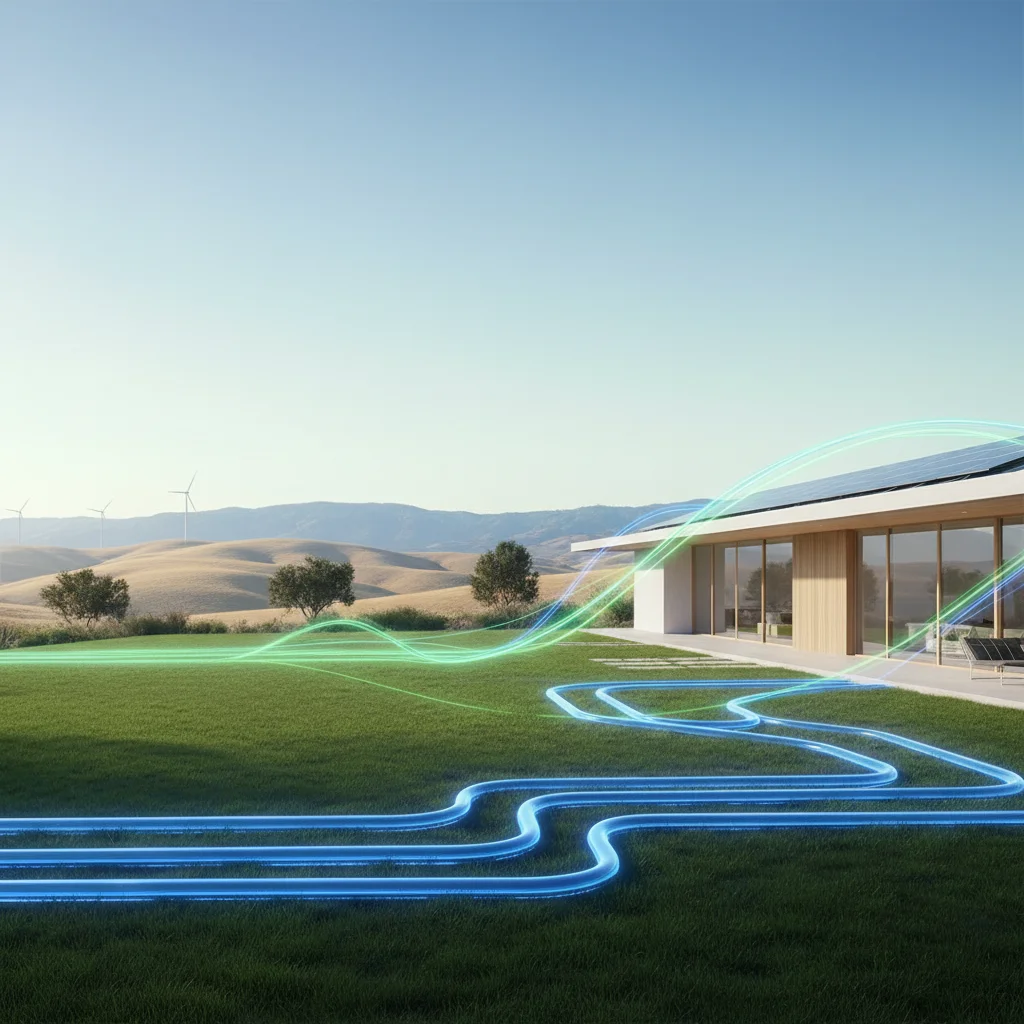
California homeowners installing geothermal systems in 2026 face a critical decision that determines efficiency for the next 50 years: loop field sizing. And undersizing by just 20% can slash system efficiency by 15-30%, while oversizing wastes $3,000-$8,000 in unnecessary excavation costs. The state's 16 climate zones—from Arcata's marine fog to Palm Springs' desert heat—create wildly different sizing requirements that standard calculators can't capture.
What Size Geothermal Loop Field Do I Need for My California Home?
California geothermal loop field sizing requires 150-250 feet of horizontal loop per ton of heating/cooling capacity in moderate climates (zones 3-6), 200-300 feet per ton in hot inland zones (10-15), and 120-180 feet per ton in coastal zones (1-2). Vertical loops need 150-200 feet of bore depth per ton across all California climate zones. A 2,000-square-foot home in Sacramento (zone 12) typically needs a 3-4 ton system with 600-1,000 feet of horizontal loop or 450-800 feet of vertical bore depth.
So what determines these ranges? Soil thermal conductivity varies dramatically across California—from 0.4 BTU/hr-ft-°F in dry San Joaquin Valley sand to 1.5 BTU/hr-ft-°F in saturated Sacramento clay. And moisture content matters more than soil type: wet soil transfers heat 3-4 times faster than dry soil. But California's multi-year drought cycles mean soil moisture fluctuates seasonally, requiring sizing calculations that account for worst-case dry conditions.
"Ground-source heat pump loop sizing must account for soil thermal properties, moisture content, and annual ground temperature variations to maintain efficiency over 25-50 year system lifespans." — U.S. Department of Energy Geothermal Technologies Office
Professional sizing uses IGSHPA software or Manual J load calculations combined with thermal conductivity tests. But DIY estimates work for preliminary planning: calculate home heating/cooling load in BTU/hr (typically 25-35 BTU/hr per square foot in California), divide by 12,000 to get tons, then multiply by footage factors above. A geothermal heat pump rebate calculator can estimate system costs and incentives based on your specific sizing needs.
How Much Can California Homeowners Save with Geothermal Loop Field Rebates and Tax Credits?
California homeowners installing geothermal systems in 2026 qualify for a 30% federal tax credit under the Inflation Reduction Act (uncapped, expires 2032), plus $2,000-$8,000 in state and utility rebates depending on location and income. The federal credit covers loop field installation, heat pump equipment, and labor costs—a $30,000 system generates a $9,000 tax credit. Low-income households in disadvantaged communities qualify for additional TECH Clean California rebates up to $8,000 for heat pump systems.
| Program | Amount | Eligibility | Expires |
|---|---|---|---|
| IRA Federal Tax Credit | Ended Dec 31, 2025 | — | Ended Dec 31, 2025 |
| TECH Clean California | $3,000-$8,000 | Income-qualified, disadvantaged communities | December 31, 2026 |
| PG&E Energy Efficiency Rebate | $2,000-$4,000 | PG&E territory, verified contractor | Ongoing (budget-limited) |
And utility rebates stack with federal credits—homeowners can't double-dip on the same dollar, but combining programs works. A $30,000 geothermal installation with a $4,000 PG&E rebate reduces the federal credit base to $26,000, generating $7,800 in tax credit for $11,800 total incentives. But rebate programs exhaust budgets mid-year, so early application matters. PG&E's 2025 geothermal rebate fund depleted by August.
Or consider PACE financing programs like CaliforniaFIRST, which fund upfront costs through property tax assessments repaid over 20 years at 6-8% interest. PACE loans don't require credit checks and transfer with property sales. But homeowners must verify their tax credit eligibility—passive income limitations and alternative minimum tax rules can reduce or eliminate the 30% credit for some filers.
The federal Residential Clean Energy Credit (Section 25D) ended for expenditures made after December 31, 2025, and the IRS treats an expenditure as made when installation is completed (IRS FS-2025-05).
What's the ROI and Payback Period for a Geothermal Loop Field Installation in California?
California geothermal systems deliver 7-12 year payback periods depending on climate zone and replaced system type, with ROI ranging from 8-15% annually after payback. Coastal homes replacing electric resistance heat see 5-7 year payback, while Central Valley homes replacing natural gas furnaces face 10-14 year payback due to low gas prices ($1.50-$2.00 per therm in 2026). Systems generate $1,500-$3,000 annual energy savings compared to conventional HVAC.
And payback calculations must include avoided replacement costs—a $6,000 furnace replacement in year 8 shortens effective payback by 1-2 years. Geothermal systems eliminate separate heating and cooling equipment, reducing future capital expenses. But California's tiered electricity rates create ROI variations: PG&E customers in Tier 3-4 usage (above 400% baseline) save $2,500-$4,000 annually, while Tier 1-2 users save $1,200-$2,000.
So ROI improves over time as energy prices rise—natural gas prices increased 45% from 2020-2025, while geothermal operating costs remained flat. And net metering with solar panels amplifies savings: homeowners generate daytime solar electricity, store excess in batteries or grid credits, then run geothermal systems on free solar power. Combined solar-geothermal systems achieve 4-8 year payback with current California energy tax credits.
But property value increases offset costs—homes with geothermal systems sell for 3-5% premiums in California markets, adding $15,000-$40,000 to appraised values on median-priced homes. Or think of it as buying 30 years of heating/cooling upfront at locked-in rates, hedging against energy price volatility. Use our free rebate calculator to model payback scenarios for your specific home and utility rates.
Which California Climate Zones Are Best Suited for Geothermal Loop Field Systems?
All 16 California climate zones support geothermal systems, but zones 10-16 (Central Valley, inland Southern California) deliver the fastest payback at 6-9 years due to extreme temperature swings and high cooling loads. Coastal zones 1-5 see 10-14 year payback with milder climates requiring less heating/cooling. Mountain zones 16 (alpine climates) require deeper vertical loops to reach stable ground temperatures below frost depth at 6-8 feet.
And ground temperature stability varies by zone—coastal areas maintain 55-60°F year-round at 10-foot depth, while inland zones swing 50-65°F seasonally at the same depth. Geothermal systems perform best with stable ground temps, making coastal installations more efficient per ton but less cost-effective due to lower energy loads. But desert zones (14-15) face dry soil challenges requiring glycol-filled loops or deeper bores to maintain thermal contact.
So zone-specific design matters: Sacramento (zone 12) homes need 30-40% more cooling capacity than heating, suggesting asymmetric loop sizing or hybrid systems. San Francisco (zone 3) homes need balanced heating/cooling with moisture management for foggy conditions. And high water table zones like the Central Valley enable more efficient horizontal loops, while rocky coastal areas require expensive vertical drilling.
Or consider microclimate variations within zones—homes in oak-shaded Sacramento neighborhoods need 20% less capacity than exposed new developments, even within the same climate zone. South-facing slopes in mountain zones require 15-25% more cooling capacity than north-facing properties. Professional site assessments capture these nuances that zip-code-level climate data misses.
How Does Geothermal Loop Field Sizing Compare to Air-Source Heat Pumps and Traditional HVAC?
Geothermal systems require 25-30% smaller capacity than air-source heat pumps for the same California home due to stable ground temperatures versus fluctuating air temps. A 3-ton geothermal system matches a 4-ton air-source heat pump in Sacramento's 105°F summer heat, saving $2,000-$3,000 in equipment costs. And geothermal systems maintain 300-500% efficiency year-round, while air-source efficiency drops to 150-250% in extreme temperatures.
But upfront costs tell a different story: geothermal installations run $20,000-$35,000 versus $8,000-$15,000 for air-source systems or $6,000-$12,000 for conventional furnace/AC combinations. So geothermal requires 2-3x the initial investment with 1.5-2x the annual savings, extending payback periods. And loop field installation disrupts landscaping with 400-1,200 square feet of excavation for horizontal systems or 3-6 drill pads for vertical bores.
Or compare operating costs directly: a 2,000-square-foot Sacramento home spends $1,800-$2,400 annually on natural gas furnace plus AC, $1,200-$1,800 on air-source heat pump, or $600-$1,200 on geothermal. So geothermal cuts energy costs 50-70% versus conventional systems and 30-50% versus air-source. But maintenance costs favor geothermal—no outdoor condensers exposed to weather, fewer moving parts, and 50-year loop warranties versus 10-15 year air-source lifespans.
And noise levels differ dramatically: geothermal systems operate at 40-50 decibels (refrigerator hum) versus 60-75 decibels for air-source outdoor units. Homeowners associations in noise-sensitive neighborhoods increasingly favor geothermal for this reason. But geothermal requires indoor mechanical room space for heat pump and buffer tanks, while air-source systems mount outside with minimal indoor footprint.
How Long Will My Geothermal Loop Field System Last and What's Required for Maintenance?
Geothermal loop fields last 50+ years with zero maintenance beyond periodic pressure checks, while heat pump equipment requires servicing every 1-2 years and lasts 20-25 years—double the 10-15 year lifespan of conventional HVAC. California installations from the 1980s continue operating with original loop fields and second or third-generation heat pumps. And closed-loop systems using high-density polyethylene pipes carry 50-year manufacturer warranties against leaks or degradation.
But annual maintenance costs run $150-$300 for professional inspection and filter changes, compared to $200-$400 for conventional HVAC or air-source systems. Geothermal systems need annual checks of refrigerant levels, electrical connections, and loop pressure, plus filter changes every 3-6 months. And buffer tank flush every 5-10 years prevents mineral buildup in open-loop or hybrid systems using well water.
So total 25-year cost of ownership includes one heat pump replacement ($8,000-$12,000) plus $3,750-$7,500 in maintenance, versus 2-3 conventional system replacements ($12,000-$36,000) plus $5,000-$10,000 maintenance. And California's stable ground temperatures reduce system cycling and wear compared to air-source heat pumps battling 40-110°F temperature swings. But failed components in geothermal systems require IGSHPA-certified technicians, limiting service provider options in rural areas.
Or think long-term: a 2026 installation operates until 2076+ with minimal intervention, hedging against future HVAC replacement costs and supply chain disruptions. And many California utilities offer extended warranties and service plans for geothermal systems to encourage adoption. Check current heat pump rebate programs for maintenance cost offsets.
Official Sources
- U.S. Department of Energy Geothermal Heat Pumps — Federal guidance on system design, efficiency, and installation standards
- IRS Residential Clean Energy Credit — Official tax credit eligibility, limits, and filing requirements (note: the federal 25D credit ended for expenditures made after December 31, 2025)
- DSIRE California Incentives Database — Comprehensive state and utility rebate program tracker updated monthly
Frequently Asked Questions
What size geothermal loop field do I need for my California home?
California homes need 150-250 feet of horizontal loop per ton of capacity in moderate climates, 200-300 feet per ton in hot inland zones, or 150-200 feet of vertical bore depth per ton statewide. A typical 2,000-square-foot home requires a 3-4 ton system with 600-1,000 feet of horizontal loop or 450-800 feet of vertical drilling. But sizing depends on soil type, moisture content, and climate zone—professional load calculations using Manual J and thermal conductivity tests ensure accurate sizing for 50-year system lifespans.
How much does a geothermal loop field installation cost in California?
California geothermal installations cost $20,000-$35,000 depending on system size, loop type, and site conditions in 2026. Vertical loop systems run $25,000-$35,000 due to drilling costs at $15-$25 per foot, while horizontal loops cost $20,000-$28,000 with excavation at $8-$15 per linear foot. But the 30% federal tax credit reduces net costs to $14,000-$24,500, and stacking state rebates ($2,000-$8,000) brings final costs to $12,000-$22,500 for most homeowners.
Is my California home eligible for geothermal rebates in 2026?
The federal Residential Clean Energy Credit (Section 25D) ended for expenditures made after December 31, 2025, and the IRS treats an expenditure as made when installation is completed (IRS FS-2025-05). Income-qualified households in disadvantaged communities access additional TECH Clean California rebates worth $3,000-$8,000. And utility rebates vary by territory—PG&E offers $2,000-$4,000, SCE provides $1,500-$3,500, and SDG&E runs $1,000-$3,000 programs with budget limitations. But rebate funds exhaust mid-year, so early application in January-March maximizes approval odds. Check current eligibility using our rebate calculator.
What's the difference between horizontal and vertical loop field sizing?
Horizontal loops require 150-250 feet of trench per ton at 6-10 foot depth, needing 400-1,200 square feet of yard space, while vertical loops use 150-200 feet of bore depth per ton with 3-6 drill sites occupying just 50-100 square feet. Horizontal systems cost $8-$15 per linear foot versus $15-$25 per vertical foot, but vertical loops work on small lots and rocky terrain where trenching fails. And horizontal loops install faster in 2-4 days versus 3-7 days for vertical drilling.
How long does it take to install a geothermal loop field in California?
California geothermal installations take 3-7 days for loop field work plus 2-3 days for heat pump installation and startup, totaling 5-10 days from excavation to operation. Horizontal loop systems complete faster at 3-5 days total, while vertical drilling extends timelines to 6-10 days depending on bore depth and soil conditions. But permitting adds 2-8 weeks before installation—California building departments require mechanical, electrical, and sometimes well permits depending on system type and jurisdiction.
Ready to size your geothermal system and calculate available rebates? Use our free rebate calculator to get personalized estimates for your California home's climate zone, soil conditions, and utility territory. Get instant estimates for federal tax credits, state rebates, and 25-year energy savings based on your specific installation.
Updated: April 14, 2026 — fact-checked by DuloCore Research. About our editorial process.
Check your California heat pump rebate eligibility — see the programs you qualify for and the dollar amounts on our California heat pump rebate finder.