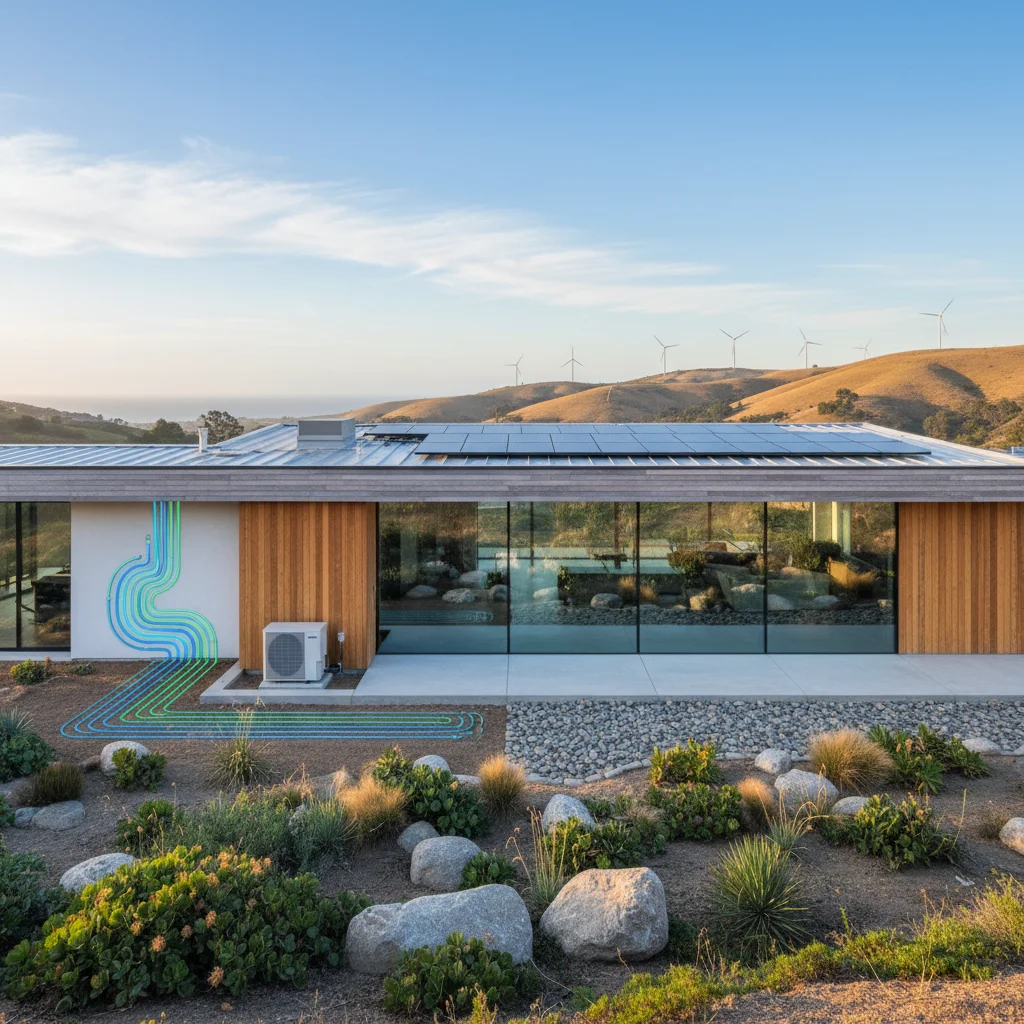
The federal Residential Clean Energy Credit (Section 25D) ended for expenditures made after December 31, 2025, and the IRS treats an expenditure as made when installation is completed (IRS FS-2025-05). Federal tax credits for this work have ended, but state, local and utility rebates may still apply; check what is available at your address with the DuloCore rebate calculator. And the state's Self-Generation Incentive Program adds $1,000 to $3,000 in rebates for qualifying ground-source heat pump systems. With electricity rates hitting $0.32 per kilowatt-hour in some California utility territories, geothermal systems reduce heating costs by 50% to 70% compared to natural gas furnaces.
How much does geothermal heating cost in California?
Geothermal heating systems in California cost $15,000 to $45,000 installed, with vertical closed-loop systems averaging $25,000 to $35,000 for a 2,000-square-foot home. Horizontal loop installations run $15,000 to $25,000 where land allows, while open-loop systems cost $10,000 to $20,000 but require suitable groundwater access.
The price gap between geothermal and traditional HVAC matters more now than it did three years ago. California's building electrification mandates push new construction toward electric heating, and ground-source heat pumps deliver coefficient of performance ratings between 3.0 and 5.0—meaning every dollar spent on electricity produces three to five dollars worth of heating or cooling.
Installation costs break down into four components: drilling or excavation ($6,000 to $20,000), heat pump equipment ($4,000 to $8,000), ground loop piping ($3,000 to $10,000), and interior installation labor ($2,000 to $7,000). Vertical drilling costs $15 to $30 per linear foot, with most California homes requiring 300 to 500 feet of borehole depth. But horizontal trenching runs just $10 to $20 per linear foot and works for properties with 1,500 square feet or more of available land.
"Geothermal heat pumps are the most energy-efficient, environmentally clean, and cost-effective space conditioning systems available." — U.S. Department of Energy
Soil conditions drive regional price variations. Sacramento Valley's clay-heavy soil costs less to excavate than the rocky terrain in foothill counties. And coastal areas with high water tables favor open-loop systems where regulations permit groundwater extraction.
What is the ROI and payback period for geothermal heating systems?
Geothermal heating systems in California deliver payback periods between 5 and 12 years depending on climate zone and existing HVAC replacement costs. Systems installed in Climate Zone 16 (Southern California mountains) achieve 5- to 7-year payback through high heating demand, while coastal Zone 6 installations extend payback to 10 to 12 years.
Annual operating costs average $600 to $1,200 for geothermal systems compared to $1,800 to $3,500 for natural gas furnaces with central air conditioning. The $1,200 to $2,300 yearly savings compounds over the system's 25- to 50-year lifespan—ground loops last 50 years while heat pump components run 20 to 25 years. So a homeowner saving $1,800 annually accumulates $45,000 in energy cost avoidance over 25 years.
The math shifts when factoring federal tax credits. A $30,000 system drops to $21,000 after the 30% IRA credit, cutting payback time by 3 to 4 years. And utility rebates through programs like Pacific Gas & Electric's Energy Efficiency rebate add another $1,500 to $2,000, further reducing net costs.
Property value increases offset initial investment. The Appraisal Institute reports that geothermal systems add $20 for every $1 reduction in annual energy bills, translating to $24,000 to $46,000 in added home value for California installations. But this valuation depends on appraiser familiarity with geothermal technology and regional market demand for energy-efficient homes.
How does geothermal heating compare to air source heat pumps and traditional HVAC?
Geothermal systems cost $15,000 to $45,000 installed versus $8,000 to $18,000 for air-source heat pumps and $6,000 to $12,000 for conventional gas furnace and air conditioner combinations. Operating costs tell a different story: geothermal heating runs $0.03 to $0.05 per square foot annually compared to $0.06 to $0.09 for air-source heat pumps and $0.10 to $0.15 for gas heating.
| System Type | Installation Cost | Annual Operating Cost (2,000 sq ft) | Efficiency Rating | Lifespan |
|---|---|---|---|---|
| Geothermal Heat Pump | $15,000-$45,000 | $600-$1,200 | COP 3.0-5.0 | 25-50 years |
| Air-Source Heat Pump | $8,000-$18,000 | $1,200-$1,800 | HSPF 10-13 | 15-20 years |
| Gas Furnace + AC | $6,000-$12,000 | $2,000-$3,000 | AFUE 95-98% | 15-20 years |
Performance differs across California's climate zones. Air-source heat pumps lose 25% to 40% efficiency when outdoor temperatures drop below 40°F, but geothermal systems maintain consistent performance by drawing heat from 55°F ground temperatures year-round. So mountain communities in Climate Zones 14 through 16 see larger performance gaps favoring geothermal.
Maintenance costs run $150 to $300 annually for geothermal systems—mostly filter changes and fluid checks—compared to $200 to $400 for air-source units and $300 to $500 for dual gas-electric systems. And geothermal installations eliminate combustion safety risks and carbon monoxide concerns present in natural gas systems.
Check our heat pump rebates guide for air-source alternatives. Or use our rebate calculator to compare total costs across system types.
What rebates and tax credits can reduce geothermal heating costs in California?
The federal Residential Clean Energy Credit (Section 25D) ended for expenditures made after December 31, 2025, and the IRS treats an expenditure as made when installation is completed (IRS FS-2025-05). California's Self-Generation Incentive Program offers $1,000 to $3,000 for ground-source heat pumps installed with battery storage, and individual utilities add efficiency rebates ranging from $500 to $2,500. (Note: Federal tax credit percentages and availability are subject to change; the 30% Residential Clean Energy Credit under Section 25D expired December 31, 2025. Verify current incentives at energy.gov.)
| Program | Amount | Eligibility | Application Deadline |
|---|---|---|---|
| IRA Federal Tax Credit | Ended Dec 31, 2025 | — | Ended Dec 31, 2025 |
| SGIP | $1,000-$3,000 | Systems paired with storage | Rolling, subject to funding |
| PG&E Energy Efficiency | $1,500-$2,000 | Service territory only | Annual budget cycles |
| SoCal Gas | $750-$1,500 | Gas customer displacement | June 30, 2026 |
Pacific Gas & Electric's Energy Efficiency program targets homeowners replacing natural gas heating with electric geothermal systems, offering $1,500 for systems serving homes under 2,500 square feet and $2,000 for larger installations. But applications close when annual budget allocations deplete, typically in Q3 of each fiscal year.
Southern California Edison's Home Upgrade program provides $500 to $1,000 for qualifying geothermal installations in disadvantaged communities identified by CalEnviroScreen 4.0. And the California Alternative Rates for Energy program reduces electricity rates by 30% to 35% for income-qualified households, amplifying geothermal operating cost savings.
Local programs stack on top of state and federal incentives. Sacramento Municipal Utility District offers $4,000 to $6,000 for geothermal installations replacing gas heating, while Bay Area Air Quality Management District provides $3,000 grants for heat pump upgrades in eight-county regions.
Explore all available energy tax credits for California homeowners in 2026.
What eligibility requirements must homeowners meet for geothermal installation?
California homeowners need 300 to 1,500 square feet of land area for horizontal loop systems or soil conditions permitting vertical drilling to 300- to 500-foot depths. Properties require adequate electrical service—most installations demand 200-amp panels—and local building permits obtained through city or county planning departments before excavation begins.
Federal tax credit eligibility requires Energy Star certification on installed heat pumps and original installation in the taxpayer's primary residence. The federal Residential Clean Energy Credit (Section 25D) ended for expenditures made after December 31, 2025, and the IRS treats an expenditure as made when installation is completed (IRS FS-2025-05).
SGIP participation mandates installation by certified contractors listed in the program's approved installer database. Systems must connect to California investor-owned utility grids—PG&E, SCE, SoCal Gas, or SDG&E—and pair with battery storage systems sized to 10 kilowatt-hours minimum capacity. But single-family homes qualify for reduced storage requirements under equity resiliency provisions.
Groundwater regulations affect open-loop system eligibility. The Sustainable Groundwater Management Act restricts new groundwater extraction in 21 critically overdrafted basins, including parts of San Joaquin Valley and Southern California. So homeowners in these areas default to closed-loop installations requiring no water rights permits.
Local zoning codes impose setback requirements for ground loop installations, typically 5 to 10 feet from property lines and 25 to 50 feet from wells or septic systems. And homeowner association approval may add architectural review timelines of 30 to 90 days in planned communities.
What is the installation timeline and process for geothermal heating systems?
Geothermal heating installations in California take 3 to 8 weeks from permit application to system commissioning. Site assessment and system design consume 1 to 2 weeks, permit approval runs 2 to 6 weeks depending on jurisdiction, and physical installation spans 3 to 7 days for drilling, piping, and equipment setup.
The process starts with a Manual J load calculation determining heating and cooling requirements based on home size, insulation levels, window area, and local climate data. Contractors then conduct soil thermal conductivity testing—costing $500 to $1,500—to optimize loop sizing and depth. So a 2,000-square-foot home in Climate Zone 12 might need 400 feet of vertical loop, while the same house in Zone 6 requires just 300 feet.
Drilling or trenching follows permit issuance. Vertical installations drill 4- to 6-inch diameter boreholes using truck-mounted rigs that complete 300 to 500 feet in 1 to 2 days. Horizontal trenches require excavators digging 4- to 6-foot-deep channels across available land, finishing in 1 to 3 days. And installers pressure-test all ground loops to 100 PSI for 24 hours before backfilling to ensure leak-free operation.
Interior installation connects the heat pump unit to existing ductwork or new distribution systems, installs the desuperheater for water heating integration, and commissions control systems. Electrical work upgrades service panels and installs disconnect switches meeting National Electrical Code requirements. But homes with existing forced-air systems cut installation time by 1 to 2 days compared to properties needing new duct installation.
Final inspections verify loop integrity, refrigerant charge, electrical connections, and system performance. California Title 24 compliance testing measures airflow rates and temperature differentials to confirm installation meets energy code standards. And contractors provide system operation training covering thermostat programming, filter maintenance schedules, and seasonal optimization settings.
Official Sources
- U.S. Department of Energy: Geothermal Heat Pumps — Federal guidance on geothermal technology, efficiency ratings, and system types
- ENERGY STAR: Federal Tax Credits — Official IRA tax credit requirements and claiming procedures (note: the federal 25C and 25D credits ended for projects completed after December 31, 2025)
- Database of State Incentives for Renewables & Efficiency — Comprehensive California rebate and incentive program database
Related Reading: Learn more about Home Energy Audit Cost By State and Most Cost Effective Energy Upgrades.
Related Reading: Learn more about Geothermal Heating Cost Per Month.
Frequently Asked Questions
How much does a geothermal heating system cost in California?
Geothermal heating systems cost $15,000 to $45,000 installed in California, with vertical closed-loop systems averaging $25,000 to $35,000 for 2,000-square-foot homes. Horizontal installations run $15,000 to $25,000 where land permits trenching. Costs include drilling or excavation ($6,000 to $20,000), heat pump equipment ($4,000 to $8,000), ground loop piping ($3,000 to $10,000), and labor ($2,000 to $7,000). The federal IRA tax credit reduces net costs by 30%.
Are geothermal heating systems eligible for California rebates in 2026?
Geothermal systems qualify for the federal 30% IRA tax credit through 2032, California SGIP rebates of $1,000 to $3,000 when paired with battery storage, and utility-specific programs offering $500 to $2,500. Pacific Gas & Electric provides $1,500 to $2,000 for gas heating displacement. Southern California Edison offers $500 to $1,000 in disadvantaged communities. And SMUD grants $4,000 to $6,000 for geothermal installations in Sacramento service areas.
What is the process to apply for geothermal heating rebates in California?
Form 5695 only covers qualifying work completed by December 31, 2025 and claimed on a 2025 return; the federal 25C and 25D credits ended after that date (IRS FS-2025-05). SGIP applications submit through program online portals within 30 days of installation, including contractor licensing verification and equipment specifications. Utility rebates demand pre-installation approval—applications filed 2 to 6 weeks before work begins—and post-installation inspection confirmation. And local programs like SMUD process applications through designated HVAC contractors enrolled in utility rebate networks.
How long does it take to recoup geothermal heating costs with California incentives?
Geothermal systems achieve 5- to 12-year payback periods in California depending on climate zone and heating demand. Mountain regions with high heating loads see 5- to 7-year payback through $1,800 to $2,300 annual energy savings. Coastal areas extend payback to 10 to 12 years with lower heating requirements. The 30% federal tax credit cuts 3 to 4 years from payback periods. And utility rebates reduce net costs by another $1,500 to $3,000, accelerating return timelines.
What is the difference between geothermal heating and traditional HVAC systems in terms of California rebate eligibility?
The federal Residential Clean Energy Credit (Section 25D) ended for expenditures made after December 31, 2025, and the IRS treats an expenditure as made when installation is completed (IRS FS-2025-05). Air-source heat pumps qualify for the same 30% credit as geothermal but with different efficiency thresholds—HSPF 10 minimum versus COP 3.0 for ground-source. California SGIP requires battery storage pairing for geothermal rebates but excludes gas systems entirely. And utility programs prioritize electric heating replacements, offering $1,500 to $6,000 for geothermal versus $0 to $500 for gas furnace upgrades.
Ready to calculate your geothermal savings? Use our free rebate calculator to estimate federal tax credits, state rebates, and energy cost savings for your California home. Get personalized incentive amounts and payback timelines in under 60 seconds.
Last updated April 14, 2026 — reviewed by DuloCore Editorial. About our authors.
Check your California heat pump rebate eligibility — see the programs you qualify for and the dollar amounts on our California heat pump rebate finder.