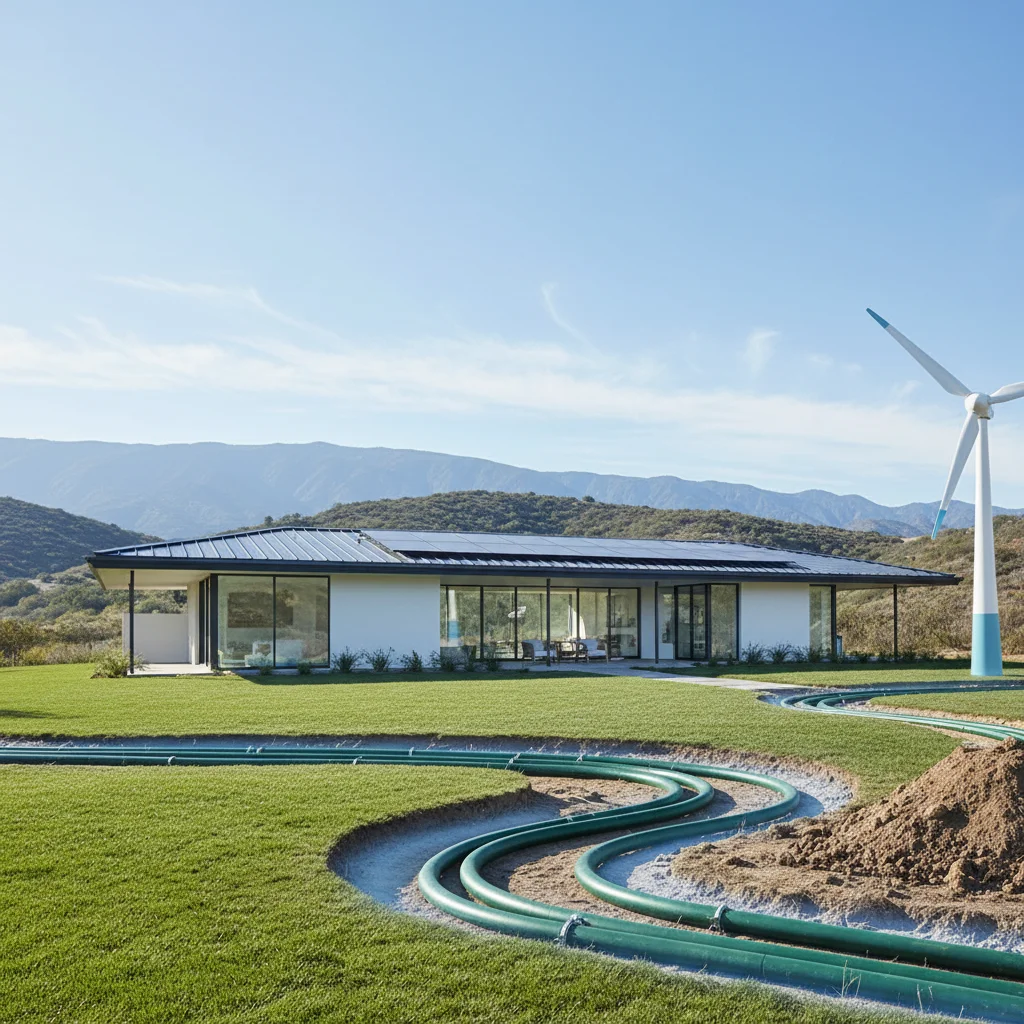
California homeowners installing geothermal ground loops in 2026 face upfront costs between $18,000 and $45,000—but federal tax credits now cover 30% of that total through 2032, and the California Energy Commission offers rebates up to $8,000 for qualifying low-income households. And those numbers don't account for the 40-70% reduction in annual heating and cooling bills that geothermal systems deliver compared to conventional HVAC equipment.
How Much Does a Geothermal Ground Loop Cost in California?
Geothermal ground loop installation in California costs $18,000 to $45,000 in 2026, with horizontal loops averaging $20,000 to $28,000 for systems serving 1,500 to 2,500 square feet. Vertical loop systems cost $25,000 to $45,000 due to drilling requirements reaching 150 to 400 feet deep. Total cost varies by soil type, property size, system capacity measured in tons, and regional labor rates.
The ground loop accounts for 40-60% of total system cost. So a 4-ton system with horizontal loops costs roughly $8,000 to $12,000 for the ground loop itself, while vertical loops add $12,000 to $20,000. But vertical systems work on smaller lots where horizontal trenching isn't feasible.
California's rocky soil conditions in foothill regions increase drilling costs by 15-25% compared to Central Valley properties with softer sediment. And coastal counties with higher labor rates see total installed costs at the upper end of the range. Permitting fees add $500 to $2,500 depending on county jurisdiction.
Labor represents 30-40% of total project cost. Installation takes 2 to 5 days depending on loop configuration and site conditions. Excavation for horizontal loops requires 400 to 600 linear feet of trenching 4 to 6 feet deep for typical residential systems.
"Geothermal heat pumps are the most energy-efficient, environmentally clean, and cost-effective systems for heating and cooling buildings." — U.S. Department of Energy
What's the ROI and Payback Period for Geothermal Ground Loop Installation?
Geothermal ground loops deliver 7-12 year payback periods in California's climate zones, with coastal regions seeing slower returns of 10-12 years and inland areas achieving 7-9 years due to higher cooling loads. Annual energy savings range from $1,200 to $3,500 depending on replaced system type and household usage patterns. After-tax ROI reaches 8-14% when accounting for federal credits and utility rebates.
Systems replacing electric resistance heat see the fastest payback—often 5 to 7 years. But replacing natural gas furnaces extends payback to 10-15 years unless gas prices rise above $2.50 per therm. California's tiered electricity rates accelerate savings for households in higher baseline tiers.
And ground loops last 50+ years compared to 15-year lifespans for conventional HVAC equipment. So lifecycle cost analysis shows geothermal systems save $25,000 to $60,000 over 30 years when factoring replacement costs for traditional systems. Monthly energy bills drop 40-70% after installation.
Property value increases by $15 to $25 per square foot of conditioned space according to studies from the National Renewable Energy Laboratory. A 2,000-square-foot home gains $30,000 to $50,000 in resale value. Use our free rebate calculator to estimate your specific savings and payback timeline.
What Financial Incentives and Tax Credits Are Available for Geothermal Systems in California?
The federal Residential Clean Energy Credit (Section 25D) ended for expenditures made after December 31, 2025, and the IRS treats an expenditure as made when installation is completed (IRS FS-2025-05). Federal tax credits for this work have ended, but state, local and utility rebates may still apply; check what is available at your address with the DuloCore rebate calculator. California Energy Commission rebates provide $3,000 for moderate-income households and $8,000 for low-income households through the Equitable Building Decarbonization program. Utility companies offer incentives ranging from $500 to $4,000 depending on service territory.
The federal credit applies to all costs including equipment, labor, ground loop installation, and permitting fees. So a $30,000 system generates a $9,000 tax credit claimed on Form 5695. And the credit has no lifetime limit—homeowners can claim it for multiple properties.
California's TECH Clean California initiative provides point-of-sale rebates for heat pump installations, reducing upfront costs by $1,500 to $3,000 for qualifying systems. But geothermal systems must meet ENERGY STAR certification and AHRI 13256-1 performance standards.
Pacific Gas & Electric offers $2,500 rebates for customers replacing natural gas heating systems with electric heat pumps. Southern California Edison provides $1,000 to $3,000 through its Advanced Home Upgrade program. Check the DSIRE database for current utility programs in your service area.
Who Qualifies for Geothermal Rebates and Incentive Programs?
The federal Residential Clean Energy Credit (Section 25D) ended for expenditures made after December 31, 2025, and the IRS treats an expenditure as made when installation is completed (IRS FS-2025-05). State rebates through Equitable Building Decarbonization require household income at or below 80% of area median income for the $8,000 tier and 80-120% AMI for the $3,000 tier. Property owners must hold title and file California state taxes.
Rental property owners don't qualify for federal residential credits but can claim commercial tax incentives under Section 179D. And new construction projects must meet Title 24 energy code requirements to qualify for state rebates. Systems installed in condominiums qualify when the individual unit owner pays for and owns the equipment.
Utility rebates vary by program. Southern California Edison requires customers to replace existing cooling systems, not install geothermal as supplemental equipment. PG&E restricts rebates to single-family homes and doesn't cover multifamily properties with more than 4 units. Documentation requirements include contractor licenses, building permits, and AHRI certification numbers.
Moderate-income qualifications for California rebates use 2026 AMI data by county. In Los Angeles County, 80% AMI equals $75,200 for a family of four. In San Francisco County, that threshold reaches $98,400. Income verification requires tax returns or pay stubs from the past 12 months.
How Does the Geothermal Installation Process Work in California?
Geothermal installation in California takes 2 to 5 days and requires building permits, HVAC contractor licenses (C-20), and well-drilling permits for vertical loops. The process starts with a site assessment measuring available land, soil composition, and heating/cooling loads calculated using ACCA Manual J protocols. Contractors then design loop fields specifying trench depth or drilling depth, pipe diameter, and total linear feet of ground loop piping.
Excavation begins with horizontal trenching at 4 to 6 feet deep or vertical drilling at 150 to 400 feet depending on lot size and soil conditions. High-density polyethylene pipes circulate water-glycol solution through the ground loop. And installers pressure-test loops at 100 PSI for 24 hours before backfilling.
Heat pump equipment connects to the ground loop through a manifold system inside the home. Ductwork modifications cost $1,500 to $4,000 when upgrading from baseboard heating. Final inspections verify proper refrigerant charge, airflow rates, and glycol concentration.
California requires Title 24 compliance verification through HERS testing. Contractors must register systems with ENERGY STAR and provide AHRI certification to qualify for rebates. Permits cost $500 to $2,500 depending on county jurisdiction and whether well permits apply.
"Geothermal heat pump systems can reduce energy use by 30% to 60% compared to conventional heating and cooling systems." — EPA Geothermal Heat Pumps
Geothermal Ground Loop Costs vs. Traditional HVAC Systems: Which Saves More Money?
Geothermal systems cost $18,000 to $45,000 installed compared to $5,000 to $12,000 for conventional central air conditioning and furnace combinations in California. But geothermal systems save $1,200 to $3,500 annually on energy bills—delivering total savings of $36,000 to $105,000 over 30 years when accounting for equipment replacement cycles. Traditional HVAC systems require replacement every 12-15 years at $6,000 to $10,000 per replacement.
Electricity costs for geothermal systems run $600 to $1,200 annually compared to $2,000 to $4,500 for conventional electric heat pumps or gas furnaces paired with AC. Geothermal coefficient of performance (COP) reaches 3.5 to 5.0, meaning systems deliver 3.5 to 5 units of heating or cooling per unit of electricity consumed. Air-source heat pumps achieve COP of 2.0 to 3.5.
Maintenance costs favor geothermal with annual service running $150 to $300 compared to $250 to $500 for traditional systems. Ground loops carry 50-year warranties while heat pump equipment lasts 20-25 years. Traditional furnaces and AC units require filter changes every 1-3 months versus semi-annual for geothermal systems.
And geothermal systems eliminate combustion risks and carbon monoxide concerns inherent in gas furnaces. California's building decarbonization goals incentivize all-electric systems, making geothermal installations future-proof against potential natural gas restrictions. Learn more about available incentives on our energy tax credits page.
Official Sources
- U.S. Department of Energy - Geothermal Heat Pumps — Federal guidance on geothermal technology and efficiency standards
- DSIRE - Database of State Incentives for Renewables & Efficiency — Comprehensive database of federal, state, and utility rebate programs
- IRS Residential Clean Energy Credit — Official tax credit information and filing requirements (note: the federal 25C and 25D credits ended for projects completed after December 31, 2025)
Frequently Asked Questions
How much does a geothermal ground loop cost in California?
Geothermal ground loops cost $18,000 to $45,000 installed in California for residential systems, with horizontal loops averaging $20,000 to $28,000 and vertical loops costing $25,000 to $45,000. The ground loop itself accounts for 40-60% of total system cost. Final price depends on soil conditions, property size, system capacity in tons, and regional labor rates which vary significantly between coastal and inland counties.
What rebates are available for geothermal ground loop installation in California?
California offers $3,000 to $8,000 in state rebates through the Equitable Building Decarbonization program based on household income, with utility companies providing an additional $500 to $4,000 depending on service territory. The federal Residential Clean Energy Credit (Section 25D) ended for expenditures made after December 31, 2025, and the IRS treats an expenditure as made when installation is completed (IRS FS-2025-05). Combined incentives reduce upfront costs by $8,000 to $18,000 for a typical $30,000 system when all programs stack.
Are geothermal ground loops eligible for federal tax credits in California?
The federal Residential Clean Energy Credit (Section 25D) ended for expenditures made after December 31, 2025, and the IRS treats an expenditure as made when installation is completed (IRS FS-2025-05). The credit applies to all costs including equipment, labor, ground loop installation, and permitting fees. Form 5695 only covers qualifying work completed by December 31, 2025 and claimed on a 2025 return; the federal 25C and 25D credits ended after that date (IRS FS-2025-05). Visit our heat pump rebates guide for complete program details.
How long does it take to install a geothermal ground loop system?
Geothermal ground loop installation takes 2 to 5 days depending on loop configuration and site conditions. Horizontal loop systems require 2-3 days for excavation and installation on properties with adequate land area. Vertical loop systems take 3-5 days due to drilling requirements reaching 150 to 400 feet deep. Permitting adds 2 to 6 weeks before work begins depending on county jurisdiction and inspection schedules.
What is the difference between geothermal ground loops and air source heat pumps?
Geothermal systems use underground loops circulating fluid at constant 50-60°F ground temperature, achieving efficiency ratings (COP) of 3.5 to 5.0 compared to air-source heat pumps at 2.0 to 3.5 COP. Geothermal costs $18,000 to $45,000 installed versus $8,000 to $18,000 for air-source systems, but geothermal delivers 30-50% lower operating costs annually. Ground loops last 50+ years while air-source outdoor units require replacement every 12-15 years.
Ready to maximize your geothermal savings? Use our free rebate calculator to discover exactly how much you can save with federal tax credits, California state rebates, and utility incentives. Get your personalized estimate in under 60 seconds and connect with certified geothermal installers in your area.
Updated on April 14, 2026. Fact-checked by DuloCore Editors. About our research team.
Check your California heat pump rebate eligibility — see the programs you qualify for and the dollar amounts on our California heat pump rebate finder.