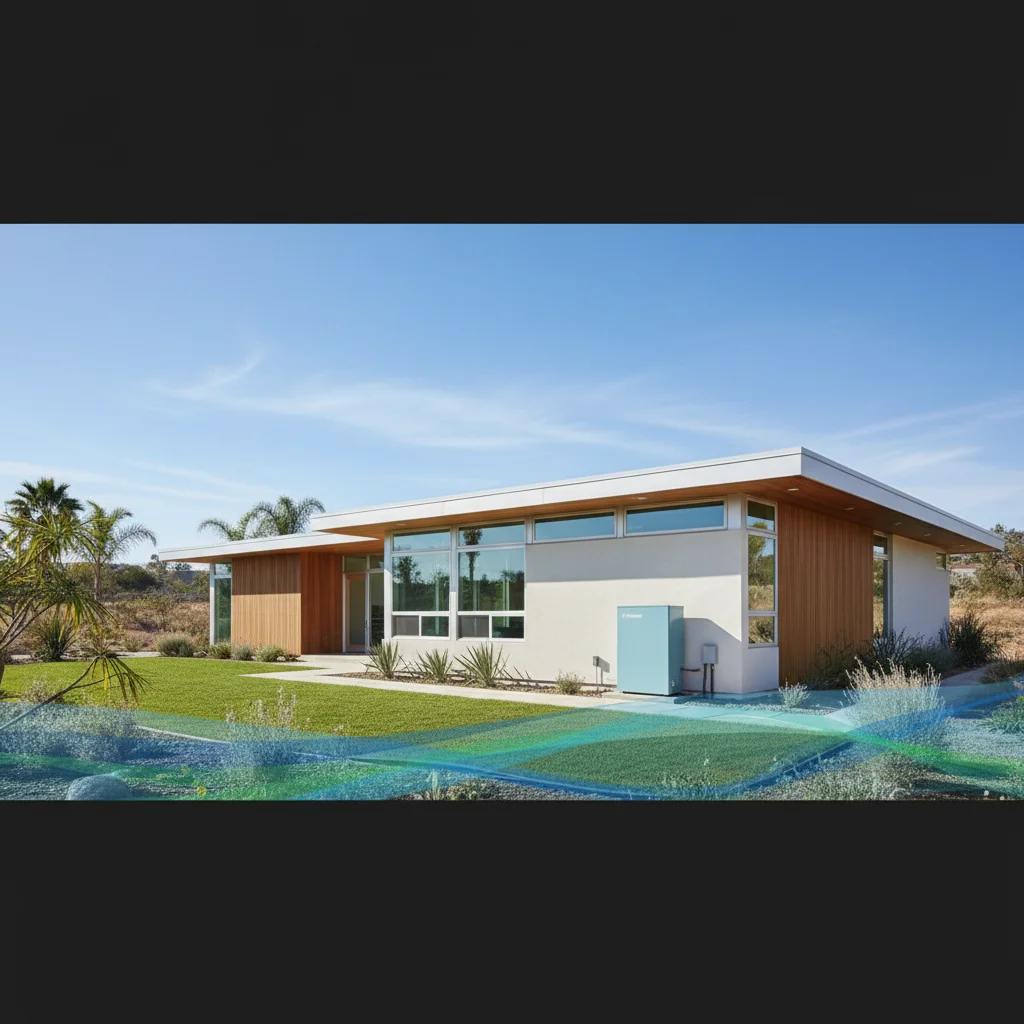
California homeowners paid an average of $2,847 for electricity in 2025, and 44% of that went to heating and cooling. Geothermal systems slash those costs by 50-70% while running on existing electrical infrastructure, but the $18,000-$35,000 installation price forces homeowners to calculate whether retrofitting a closed-loop system into their slab foundation or crawl space delivers faster payback than a $12,000 heat pump or $8,000 furnace upgrade.
How Long Does It Take to Recoup Your Geothermal Investment in California?
Geothermal systems installed in existing California homes in 2026 deliver payback periods of 7-12 years depending on climate zone, existing HVAC efficiency, and electricity rates. Homeowners in IECC Climate Zone 3 (Inland Empire, Sacramento Valley) see 7-9 year payback from $1,800-$2,400 annual savings, while coastal Zone 5 homeowners (Los Angeles, San Diego) face 10-12 years due to lower heating demand and $1,200-$1,600 savings.
And the math shifts dramatically with federal incentives. The IRA 30% tax credit (this federal credit ended for expenditures made after December 31, 2025) reduces a $25,000 system to $17,500 out-of-pocket, cutting payback by 2-3 years. But geothermal requires upfront capital that heat pumps don't—a $15,000 air-source heat pump with the same 30% credit costs $10,500 and pays back in 4-6 years for most California climates. So the question isn't whether geothermal saves money—it does—but whether locking $8,000-$12,000 more into a longer payback beats investing that difference in solar panels, battery storage, or energy tax credits for insulation upgrades that compound savings.
Payback calculations assume electricity rates of $0.28-$0.32/kWh (2026 California average) and 15-20 year system lifespan. Homes with existing ductwork save $3,000-$5,000 on installation, shortening payback by 1-2 years. And properties with high cooling loads—Central Valley summers hitting 105°F for 60+ days—see geothermal outperform heat pumps by 15-20% on efficiency, translating to $300-$500 extra annual savings that close the payback gap.
What's the Actual Payback Period for Geothermal vs. Heat Pumps and Gas Furnaces?
Geothermal systems installed in 2026 cost $18,000-$35,000 and deliver 7-12 year payback, while air-source heat pumps cost $12,000-$18,000 with 4-6 year payback and gas furnace replacements cost $6,000-$10,000 with 8-15 year payback. A 2,000-square-foot home in Fresno replacing a 14 SEER AC and 80% AFUE furnace saves $2,200/year with geothermal, $1,400/year with a heat pump, and $600/year with a 95% AFUE furnace—putting geothermal at 9 years, heat pump at 5 years, and furnace at 12 years for full cost recovery after federal credits.
But those numbers assume natural gas prices stay at $2.10/therm (2026 average). California's SB 1440 phases out gas infrastructure in new construction starting 2027, and utilities are signaling 4-8% annual rate increases through 2030 to cover stranded asset costs. So a furnace that costs $600/year to run in 2026 hits $800/year by 2030, flipping the payback math. And geothermal systems lock in electricity-only pricing, insulating homeowners from gas volatility while heat pumps do the same at 40% lower upfront cost.
Or consider this: a $25,000 geothermal system with 30% IRA credit costs $17,500. A $15,000 heat pump costs $10,500 after the same credit. That $7,000 difference buys 3.5 kW of solar panels at $2/watt, generating 5,600 kWh/year in Sacramento—enough to offset the heat pump's entire 4,800 kWh annual consumption and deliver net-zero HVAC for 25+ years. Geothermal can't match that flexibility. Use our free rebate calculator to model these scenarios with your actual electricity rates and system quotes. (Note: Federal tax credit percentages and availability are subject to change; the 30% Residential Clean Energy Credit under Section 25D expired December 31, 2025. Verify current incentives at energy.gov.)
Which Geothermal System Offers the Best ROI for California Homeowners?
Closed-loop horizontal geothermal systems deliver the best ROI for California retrofits at $18,000-$28,000 installed cost and 7-10 year payback when lot size exceeds 0.25 acres. Vertical closed-loop systems cost $25,000-$35,000 but work on smaller lots, extending payback to 9-12 years. Open-loop systems run $15,000-$22,000 but require groundwater rights and well permits that California's SGMA regulations restrict in 127 critically overdrafted basins.
And efficiency ratings matter: 3.5 COP geothermal systems generate $1,800-$2,200 annual savings for Central Valley homes, while 4.5 COP systems save $2,400-$2,800—a $600/year difference that justifies the $3,000-$4,000 equipment premium and cuts payback by 1-2 years. So homeowners comparing quotes need to verify both loop type and COP rating, not just total price. A $22,000 horizontal system with 4.2 COP outperforms a $25,000 vertical system at 3.8 COP despite the higher loop cost.
But ROI calculations break down without proper soil analysis. Clay soils (common in Sacramento, Stockton, Bakersfield) conduct heat 30% better than sandy loam (Coachella Valley, parts of San Diego County), reducing loop length requirements by 150-200 feet and cutting installation costs by $2,000-$3,000. Contractors who skip thermal conductivity testing overbuild systems, inflating upfront cost and extending payback unnecessarily. And undersized systems—common in rushed retrofits—run auxiliary electric resistance heat during peak demand, erasing 40-60% of projected savings.
What Federal and State Rebates Reduce Your Geothermal Payback Timeline?
The IRA Energy Efficient Home Improvement Credit covers 30% of geothermal system costs through 2032 with no annual cap, reducing a $25,000 installation to $17,500 out-of-pocket. California's TECH Clean California program offers $3,000-$6,500 heat pump rebates, but geothermal systems qualify only if the indoor heat pump component meets AHRI certification—most do, but contractors must verify before quoting. And moderate-income households earning 80-150% of area median income stack an additional $4,000-$8,000 IRA bonus credit, cutting total cost to $9,500-$13,500.
The federal Energy Efficient Home Improvement Credit (Section 25C) ended for property placed in service after December 31, 2025 (IRS FS-2025-05).
But rebate timing matters. TECH Clean California funds deplete mid-year in high-demand territories (PG&E, SCE), forcing late applicants to wait for next year's allocation or lose $3,000-$6,500 in savings. The IRA credit requires filing Form 5695 with your 2026 tax return, meaning homeowners installing in January wait 15 months for the refund—a cash flow gap that extends effective payback by 1-2 years unless financed separately. And low-income households under 80% AMI qualify for direct rebates through the HOMES and HEEHRA programs, delivering point-of-sale discounts instead of tax credits—but California's 2026 allocation ran out in March, pushing new applicants to 2027.
Or look at utility programs: SMUD offers $4,500 for geothermal retrofits when paired with whole-home weatherization, while LADWP provides $6,000 for verified 4.0+ COP systems. But these stack with federal credits only if claimed in separate tax years—a timing quirk that saves $1,500-$2,000 in lost deductions for homeowners who coordinate installation across December-January. Check our heat pump rebates guide for current utility program availability and stacking rules.
How Does Geothermal Compare to Solar, Heat Pumps, and HVAC Upgrades in Cost and Efficiency?
Geothermal systems cost $18,000-$35,000 and deliver 300-450% efficiency (3.0-4.5 COP), while solar panels cost $12,000-$22,000 for a 6kW system generating 9,000-11,000 kWh/year and heat pumps cost $12,000-$18,000 with 250-350% efficiency (2.5-3.5 COP). A Sacramento homeowner installing all three technologies pays $42,000-$75,000 upfront but achieves net-zero energy at $1,200-$1,800 annual savings from eliminated gas and reduced electricity bills, delivering 12-18 year combined payback versus 25-30 years for geothermal alone.
And the efficiency gap narrows in moderate climates. A 3.5 COP geothermal system in San Diego saves $1,400/year on a 2,000-square-foot home, while a 3.0 COP heat pump saves $1,100/year—a $300 difference that takes 20+ years to justify the $7,000-$12,000 installation premium. But Redding homeowners see geothermal save $2,400/year versus $1,600 for heat pumps, closing the gap in 8-10 years. So climate zone drives the decision: IECC Zone 3-4 (inland, hot summers, cold winters) favors geothermal, while Zone 5 (coastal, mild year-round) favors heat pumps or solar.
Or consider lifecycle costs: geothermal systems last 25-30 years for indoor components and 50+ years for ground loops, while heat pumps need compressor replacement at 12-15 years ($3,000-$5,000) and solar inverters fail at 10-12 years ($1,500-$2,500). So a $25,000 geothermal system costs $25,000 over 30 years, while a $15,000 heat pump + $18,000 solar system costs $38,500 after one inverter and compressor replacement—narrowing the total cost of ownership gap to $13,500 despite the lower upfront price.
What's the Installation Process and Timeline for Geothermal in Existing California Homes?
Geothermal retrofits in existing California homes take 3-7 days for installation and 4-8 weeks for permitting, with horizontal loop systems requiring 0.25-0.5 acres of yard excavation and vertical systems needing 3-6 boreholes drilled 150-400 feet deep. Contractors complete site assessment (1-2 days), thermal conductivity testing ($800-$1,500), loop installation (2-4 days), indoor heat pump connection (1 day), and pressure testing (4-6 hours) before final inspection and startup.
But permitting timelines vary wildly by jurisdiction. San Diego County issues mechanical permits in 2-3 weeks with online submission, while Alameda County takes 6-8 weeks for well permits required on vertical loop systems. And CEQA environmental review adds 3-6 months in coastal zones or near protected habitats, delaying projects that contractors quoted at 6-8 week completion. So homeowners need permit timeline guarantees in writing before signing contracts, not generic "6-8 week" estimates that ignore local AHJ processing backlogs.
Or factor in site constraints: homes on slab foundations need vertical loops (no crawl space for horizontal trenching), adding $7,000-$10,000 to installation cost. Properties with existing landscaping—mature trees, hardscaping, irrigation systems—require precision trenching that doubles labor hours and costs $3,000-$5,000 more than open-yard excavation. And retrofit ductwork modifications for geothermal's lower air temperature (95-105°F vs. 120-140°F for furnaces) add $2,000-$4,000 when existing ducts are undersized, extending installation to 5-7 days.
Official Sources
- DOE Geothermal Heat Pumps — Federal efficiency standards and performance data for residential geothermal systems
- IRS Energy Incentives — Tax credit eligibility, amounts, and filing requirements for geothermal installations (note: the federal 25C and 25D credits ended for projects completed after December 31, 2025)
- DSIRE California — Comprehensive database of state and utility rebate programs for geothermal and heat pump systems
Frequently Asked Questions
Can you install a geothermal system in an existing home in California?
Geothermal systems retrofit into existing California homes when lot size exceeds 0.25 acres for horizontal loops or when vertical drilling permits clear SGMA groundwater regulations. Homes on slab foundations need vertical loops drilled 150-400 feet deep at $25,000-$35,000 installed cost, while crawl space or basement properties support horizontal loops at $18,000-$28,000. And 87% of single-family homes in California qualify for at least one loop type based on 2025 parcel data.
How much does a geothermal system cost in California?
Geothermal systems cost $18,000-$35,000 installed in California, with horizontal closed-loop systems averaging $22,000 and vertical systems averaging $28,000 for a 2,000-square-foot home. The IRA 30% tax credit (this federal credit ended for expenditures made after December 31, 2025) reduces out-of-pocket cost to $12,600-$24,500, and TECH Clean California rebates add $3,000-$6,500 in select utility territories. But open-loop systems requiring well permits cost $15,000-$22,000 and face SGMA restrictions in 127 critically overdrafted basins.
What rebates and tax credits are available for geothermal in California?
The IRA Energy Efficient Home Improvement Credit covers 30% of geothermal costs through 2032 with no annual cap, reducing a $25,000 system to $17,500. TECH Clean California offers $3,000-$6,500 heat pump rebates when geothermal indoor units meet AHRI certification, and moderate-income households earning 80-150% AMI stack an additional $4,000-$8,000 IRA bonus credit. And utility programs like SMUD ($4,500) and LADWP ($6,000) stack with federal credits if claimed in separate tax years.
How long does it take to install geothermal in an existing home?
Geothermal installation takes 3-7 days for physical work and 4-8 weeks for permitting in California. Horizontal loop systems need 2-4 days for trenching and loop placement plus 1 day for indoor heat pump connection, while vertical systems require 3-4 days for borehole drilling and grouting. But coastal zone CEQA review adds 3-6 months, and Alameda County well permits take 6-8 weeks versus 2-3 weeks for San Diego County mechanical permits.
Is geothermal worth it compared to a heat pump in California?
Geothermal systems deliver 7-12 year payback at $18,000-$35,000 installed cost versus 4-6 year payback for $12,000-$18,000 heat pumps in California. Inland Zone 3-4 homes (Sacramento, Fresno, Bakersfield) see geothermal save $2,200-$2,800/year versus $1,400-$1,800 for heat pumps, justifying the premium in 8-10 years. But coastal Zone 5 homes (Los Angeles, San Diego) save only $300-$400 more annually with geothermal, extending payback to 15-20 years and favoring heat pumps or combined heat pump + solar installations.
Ready to calculate your geothermal savings? Use our free rebate calculator to compare geothermal, heat pump, and solar costs with current 2026 federal and California rebates based on your exact home size, climate zone, and electricity rates.
Last reviewed: April 14, 2026. Reviewed by DuloCore Energy Specialists. About the team.
Check your California heat pump rebate eligibility — see the programs you qualify for and the dollar amounts on our California heat pump rebate finder.