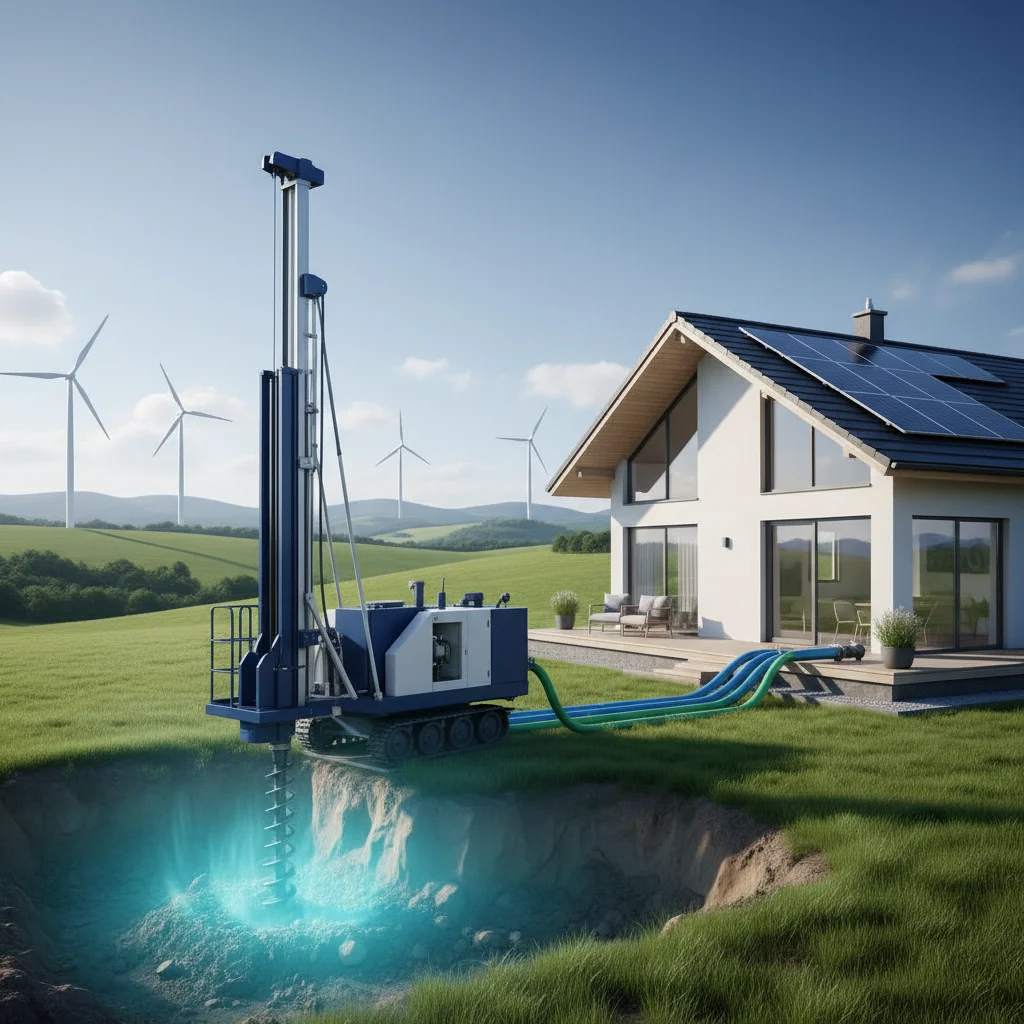
Drilling a single geothermal well costs between $12,000 and $45,000 in California, and most systems require two to six wells depending on property size and heating load. The federal Residential Clean Energy Credit (Section 25D) ended for expenditures made after December 31, 2025, and the IRS treats an expenditure as made when installation is completed (IRS FS-2025-05). Federal tax credits for this work have ended, but state, local and utility rebates may still apply; check what is available at your address with the DuloCore rebate calculator.
Geothermal drilling costs in California range from $12,000 to $45,000 per well, with most residential installations requiring two to six wells. The federal Residential Clean Energy Credit (Section 25D) ended for expenditures made after December 31, 2025, and the IRS treats an expenditure as made when installation is completed (IRS FS-2025-05).
But homeowners who skip geothermal because of drilling costs pay $2,400-$3,600 more annually for heating and cooling with conventional systems. Over a 25-year system lifespan, that gap compounds to $60,000-$90,000 in lost savings—five times the initial drilling investment.
How Much Does Geothermal Drilling Cost in California?
Geothermal drilling in California costs $20-$45 per linear foot for vertical closed-loop systems, with total well depths ranging from 150 to 500 feet depending on soil composition and system capacity. A 3-ton residential system typically requires 600-900 feet of total drilling across two to three wells, translating to $12,000-$40,500 in drilling costs alone. Horizontal loop systems cost less per foot ($15-$30) but require larger properties with at least 0.25 acres of excavatable land. And Northern California properties with rocky soil pay 15-25% more than Central Valley installations due to slower drilling rates and specialized equipment requirements.
"Ground-source heat pumps require vertical boreholes of 150-500 feet depth or horizontal trenches of 4-6 feet depth, with installation costs varying significantly based on soil conditions and local drilling rates." — U.S. Department of Energy
What Geothermal Systems Qualify for Federal and State Rebates?
The federal Residential Clean Energy Credit (Section 25D) ended for expenditures made after December 31, 2025, and the IRS treats an expenditure as made when installation is completed (IRS FS-2025-05). Closed-loop ground-source heat pumps with EER ratings of 17.1 or higher and COP ratings of 3.6 or higher meet federal requirements. California's TECH Clean California program offers additional rebates of $1,000-$3,000 for low-income households installing qualifying heat pump systems, though drilling costs specifically don't receive separate state subsidies beyond the federal credit. So a $35,000 total installation including $18,000 in drilling costs qualifies for $10,500 federal credit plus potential state rebates on equipment.
| Program | Coverage | Eligibility | Maximum Benefit |
|---|---|---|---|
| Federal Tax Credit (IRA) | Ended Dec 31, 2025 | — | Ended Dec 31, 2025 |
| TECH Clean California | Equipment rebates | Income-qualified households | $3,000 |
| Local Utility Incentives | Per-ton capacity rebates | Varies by utility territory | $500-$2,000 |
How Do Geothermal Efficiency Ratings Affect Your Energy Savings?
Systems with EER ratings above 20 and COP above 4.0 deliver 25-35% greater energy savings than minimum-qualifying 17.1 EER models, translating to $600-$900 additional annual savings on a 2,000-square-foot California home. A WaterFurnace 7 Series system rated at 41.0 EER costs $8,000-$12,000 more than baseline models but saves $875 annually compared to $650 for standard 17.1 EER units. But higher-efficiency models recoup premium costs within 8-12 years through utility savings, while also qualifying for maximum federal credits on the higher purchase price. For more details on federal incentives, see our guide on geothermal tax credits.
Which Geothermal Brands Offer the Best ROI for California Homes?
ClimateMaster, WaterFurnace, and Bosch offer the highest-rated systems for California installations, with ClimateMaster Tranquility 30 models delivering 30.0 EER and 25-year warranties that match typical system lifespans. WaterFurnace 7 Series units cost $18,000-$28,000 for equipment alone but qualify for maximum federal credits and save $800-$1,100 annually in Climate Zone 3 (coastal California). Bosch Greensource CDi series provides mid-tier pricing at $14,000-$22,000 with 22.6 EER ratings suitable for moderate climates. The federal Residential Clean Energy Credit (Section 25D) ended for expenditures made after December 31, 2025, and the IRS treats an expenditure as made when installation is completed (IRS FS-2025-05).
What's the Total Installation Cost Including Labor and Permits?
Total geothermal installation costs in California range from $22,000 to $55,000, with drilling representing $12,000-$40,500, equipment $8,000-$18,000, labor $4,000-$8,000, and permits $500-$2,000. A typical 3-ton system for a 1,800-square-foot home costs $32,000-$42,000 before incentives. Use our free rebate calculator to estimate your net costs after federal credits. And complex installations requiring multiple drilling locations or challenging soil conditions add $5,000-$12,000 to baseline estimates. But federal tax credits reduce net costs to $15,400-$29,400 for systems installed in 2026, with additional state and utility rebates lowering final homeowner investment by another $1,000-$5,000.
"Residential geothermal heat pump systems typically cost $22,000-$55,000 for complete installation, including drilling, equipment, labor, and permitting, with costs varying by system size, loop type, and site conditions." — ENERGY STAR
How Long Until Geothermal Pays for Itself?
Geothermal systems in California achieve payback in 8-14 years depending on utility rates, system efficiency, and replaced heating fuel type. Homeowners replacing propane furnaces see 6-8 year payback with annual savings of $2,800-$3,600, while natural gas replacements extend payback to 10-14 years with $1,800-$2,400 annual savings. Systems installed in 2026 with 30% federal credit (this federal credit ended for expenditures made after December 31, 2025)s reduce payback periods by 3-5 years compared to pre-IRA installations. So a $35,000 system costs $24,500 net after credits, and with $2,400 annual savings reaches breakeven in 10.2 years—well within the 25-year equipment lifespan.
Is Geothermal Right for Your Climate Zone in California?
Geothermal systems perform optimally in Climate Zones 1-4 (coastal and inland valley regions) where moderate heating and cooling loads maximize efficiency gains over conventional systems. Zone 16 (mountains and high desert) installations require deeper drilling to reach stable ground temperatures, increasing costs by 20-35% but delivering higher heating savings that justify premium investment. And properties with limited land for horizontal loops or challenging drilling conditions like bedrock within 100 feet of surface pay $8,000-$15,000 more for specialized vertical drilling equipment. For broader context on energy incentives, see our overview of energy tax credits.
Official Sources
- U.S. Department of Energy Geothermal Heat Pumps — Federal technical specifications and efficiency requirements for qualifying systems
- ENERGY STAR Geothermal Heat Pump Information — Current efficiency ratings and Most Efficient 2026 criteria
- DSIRE Database California Incentives — Comprehensive state and utility rebate program listings
Related Reading: Learn more about Energy Audit Zero Cost Improvements and High Impact Low Cost Energy Fixes.
Frequently Asked Questions
How much does geothermal drilling cost?
Geothermal drilling costs $12,000-$45,000 for residential systems in California, with costs of $20-$45 per linear foot for vertical wells. Most homes require 600-900 feet of total drilling depth across two to six wells depending on heating capacity needs and property soil conditions. Rocky terrain increases costs by 15-25% over standard installations.
What factors affect geothermal drilling costs?
Soil composition, drilling depth, number of wells required, and regional labor rates determine total drilling costs. Rocky or clay-heavy soils slow drilling rates and require specialized equipment, increasing costs by $5,000-$12,000. Properties requiring deeper wells to reach stable ground temperatures (300-500 feet) pay $8,000-$15,000 more than shallow installations of 150-250 feet.
Can you get a rebate for geothermal drilling installation?
The federal Residential Clean Energy Credit (Section 25D) ended for expenditures made after December 31, 2025, and the IRS treats an expenditure as made when installation is completed (IRS FS-2025-05). California's TECH Clean California program provides $1,000-$3,000 additional rebates for income-qualified households. And local utilities offer $500-$2,000 capacity-based incentives for systems meeting ENERGY STAR specifications. Combined incentives reduce net drilling costs by 35-45%.
How deep do geothermal wells need to be drilled?
Vertical geothermal wells in California range from 150 to 500 feet deep depending on climate zone and system capacity requirements. Coastal regions (Climate Zones 1-4) typically require 150-300 feet per well, while inland and mountain areas need 300-500 feet to reach stable ground temperatures of 50-60°F. Systems use multiple wells to distribute thermal load efficiently.
Is geothermal drilling more expensive than other heating systems?
Geothermal drilling costs $12,000-$40,500 compared to $0 drilling costs for air-source heat pump systems, but geothermal delivers 35-45% greater efficiency and $800-$1,200 higher annual savings. Over 25-year system lifespans, geothermal saves $20,000-$30,000 more than air-source heat pumps despite higher upfront drilling investment. The federal Residential Clean Energy Credit (Section 25D) ended for expenditures made after December 31, 2025, and the IRS treats an expenditure as made when installation is completed (IRS FS-2025-05).
Ready to calculate your geothermal savings? Use our rebate calculator to estimate total installation costs, federal tax credits, and annual energy savings for your California property. Get personalized results based on your climate zone, current heating system, and home size in under 60 seconds.
Last updated: April 14, 2026. Reviewed by the DuloCore Editorial Team. About our authors.
Check your California heat pump rebate eligibility — see the programs you qualify for and the dollar amounts on our California heat pump rebate finder.