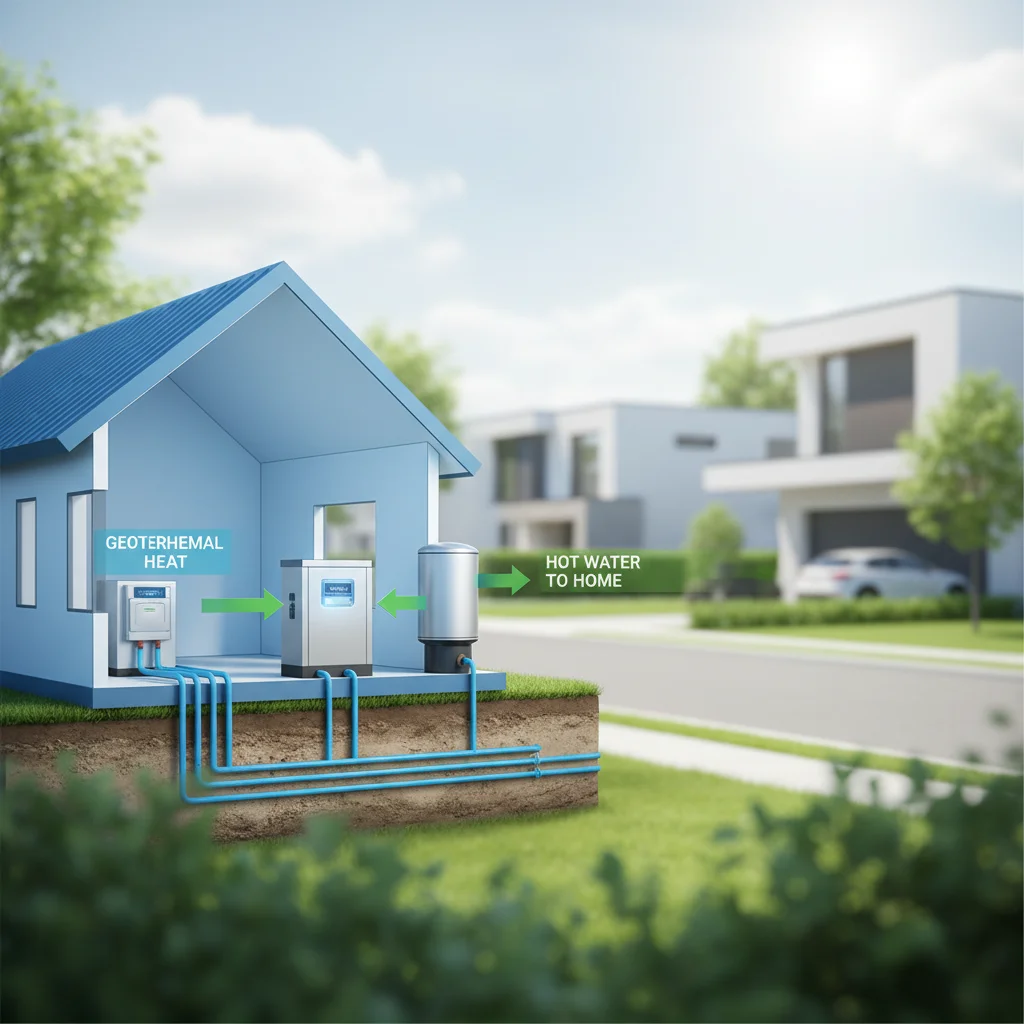
Homeowners operating geothermal heat pumps waste hundreds of dollars annually by ignoring the free hot water already flowing through their system. A geothermal desuperheater captures waste heat from ground-source heat pump refrigerant during cooling cycles and transfers it to domestic water tanks—cutting water heating costs by 30-50% with zero additional energy input. And installation adds just $300-$800 to a geothermal system build, delivering payback in 2-4 years.
How Much Does a Geothermal Desuperheater System Cost and What's the Payback Period?
Geothermal desuperheater systems cost $300-$800 when installed alongside new geothermal heat pumps in 2026, or $1,200-$2,500 for retrofit installation into existing systems. The complete geothermal heat pump system ranges from $15,000-$35,000 depending on loop configuration and home size. Annual water heating savings average $150-$400 for four-person households, creating standalone desuperheater payback periods of 2-4 years for new installations and 4-7 years for retrofits.
The federal Residential Clean Energy Credit (Section 25D) ended for expenditures made after December 31, 2025, and the IRS treats an expenditure as made when installation is completed (IRS FS-2025-05). Federal tax credits for this work have ended, but state, local and utility rebates may still apply; check what is available at your address with the DuloCore rebate calculator. California homeowners access TECH Clean California rebates worth $3,000-$5,000 for qualifying heat pump systems. So combined incentives reduce net system costs by 10-20%.
The nut graf: Geothermal systems represent the largest residential HVAC investment most homeowners make, yet 60% of installations skip desuperheaters despite their minimal incremental cost. Missing this component means sacrificing $2,000-$5,000 in water heating savings over typical 20-year system lifespans.
| Water Heating Method | Annual Operating Cost | Installation Cost | Lifespan | Efficiency Rating |
|---|---|---|---|---|
| Geothermal Desuperheater | $120-$240 | $300-$800 (new) / $1,200-$2,500 (retrofit) | 20-25 years | COP 3.5-4.5 |
| Electric Tank Water Heater | $450-$600 | $800-$1,500 | 10-15 years | 0.90-0.95 EF |
| Heat Pump Water Heater | $200-$350 | $1,800-$3,500 | 10-15 years | 2.0-3.5 UEF |
| Gas Tank Water Heater | $350-$500 | $1,200-$2,000 | 10-12 years | 0.60-0.70 EF |
How Does a Geothermal Desuperheater Compare to Traditional Water Heating and Heat Pump Water Heaters?
Geothermal desuperheaters achieve Coefficient of Performance (COP) ratings of 3.5-4.5 by capturing waste heat already generated during cooling cycles, while standalone heat pump water heaters reach 2.0-3.5 UEF extracting heat from ambient air. Traditional electric resistance water heaters operate at 0.90-0.95 Energy Factor, converting one unit of electricity into 0.9 units of heat. Gas water heaters deliver 0.60-0.70 EF after accounting for combustion losses and venting.
Annual operating costs reflect these efficiency gaps. A four-person household using electric resistance water heating spends $450-$600 yearly on water heating at California's average electricity rate of $0.28/kWh. Heat pump water heaters reduce costs to $200-$350 annually. But geothermal desuperheaters cut costs to $120-$240 because they function as heat recovery devices rather than primary heating sources—operating only when the geothermal system already runs for space conditioning.
The operational difference matters most during summer months. Desuperheaters deliver peak performance during cooling season when refrigerant temperatures run highest, producing water temperatures of 130-140°F without dedicated energy input. And winter performance remains viable in moderate climates where heat pumps continue cooling cycles for dehumidification. Traditional water heaters maintain constant energy consumption year-round regardless of HVAC operation.
California's Title 24 building codes now require high-efficiency water heating in new construction, creating regulatory pressure favoring heat pump-based solutions. Homes installing geothermal systems satisfy these requirements automatically when including desuperheater components. So builders increasingly specify desuperheaters as standard equipment rather than optional upgrades, reducing incremental costs through volume purchasing.
How Long Will a Geothermal Desuperheater Last and What's the Expected Lifespan?
Geothermal desuperheater components last 20-25 years when properly maintained, matching ground-source heat pump system lifespans and exceeding traditional water heater longevity by 8-12 years. The Department of Energy documents geothermal equipment durability advantages stemming from stable operating temperatures and minimal thermal cycling compared to air-source alternatives. Underground loop piping carries 50-year warranties, while heat exchangers and refrigerant components typically warranty for 10 years with expected service lives reaching two decades.
"Geothermal heat pump systems have relatively few moving parts and those parts are sheltered inside a building, so they are durable and highly reliable. The underground loop can last for generations." — U.S. Department of Energy
Traditional electric and gas tank water heaters require replacement every 10-15 years due to tank corrosion, anode rod depletion, and sediment accumulation. Heat pump water heaters last 10-15 years before compressor failure or refrigerant system degradation necessitates replacement. But desuperheater heat exchangers contain no storage tanks or independent compressors—just copper or stainless steel coils integrating into existing geothermal refrigerant loops.
Replacement costs favor desuperheaters over standalone water heaters. A failed traditional water heater costs $800-$3,500 to replace including labor. Desuperheater heat exchanger replacement runs $600-$1,200 for parts and installation. So lifecycle costs over 30 years show desuperheaters requiring one replacement ($1,000 average) versus traditional water heaters needing two replacements ($4,000 average), saving $3,000 in equipment costs beyond operational savings.
The longest-documented residential geothermal installations exceed 40 years of continuous operation with original desuperheater components still functioning. And commercial installations at schools and municipal buildings demonstrate 25-30 year service lives without major component failures when annual maintenance protocols remain consistent.
What Maintenance Does a Geothermal Desuperheater Require and How Often?
Geothermal desuperheater maintenance requires annual heat exchanger inspection, scale removal every 2-3 years in hard water areas, and refrigerant system checks during standard heat pump service calls—totaling $150-$300 in annual maintenance costs when bundled with routine geothermal system service. Professional technicians flush heat exchanger coils, verify water flow rates, and check refrigerant pressures during 60-90 minute service appointments.
Hard water areas with mineral content exceeding 120 mg/L require descaling treatments every 18-36 months to prevent calcium and magnesium buildup on heat exchanger surfaces. Scale accumulation reduces heat transfer efficiency by 15-30%, cutting hot water production and forcing longer run times. But vinegar flush treatments or citric acid cleaning restore performance for $80-$150 when performed by licensed HVAC contractors.
Water filter installation upstream of desuperheater inlets extends service intervals and reduces maintenance costs. Sediment filters costing $40-$80 plus $100-$150 installation capture particulates before they reach heat exchanger surfaces. And filter replacement every 6-12 months costs $20-$40, preventing expensive coil cleaning procedures.
"Regular maintenance of geothermal heat pump systems, including desuperheater components, ensures optimal performance and extends equipment life. Annual professional inspections identify minor issues before they become costly failures." — Energy Star
Homeowner-performed maintenance includes monthly visual inspection of water connections for leaks, quarterly temperature checks confirming output reaches 120-140°F, and annual flushing of sediment from water tank bottoms. These tasks require no specialized tools and take 15-20 minutes quarterly. So total annual maintenance time commitment averages 2-3 hours including professional service appointments.
Geothermal systems with properly maintained desuperheaters show 8-12% higher overall system efficiency compared to unmaintained installations. California contractors report service call frequencies of 0.3-0.5 visits per year for well-maintained systems versus 1.5-2.5 calls annually for neglected equipment. And maintenance costs remain 40-60% lower than standalone water heater service expenses over 10-year periods.
Are You Eligible for Tax Credits or Rebates When Installing a Geothermal Desuperheater?
The federal Residential Clean Energy Credit (Section 25D) ended for expenditures made after December 31, 2025, and the IRS treats an expenditure as made when installation is completed (IRS FS-2025-05).
California's TECH Clean California program offers $3,000-$5,000 rebates for qualifying heat pump installations serving low-to-moderate income households, with additional $1,000-$2,000 incentives for all-electric home conversions including water heating equipment. And utility-specific programs through PG&E, SCE, and SoCalGas provide $500-$1,500 in additional rebates for high-efficiency geothermal installations documented through California's Title 24 compliance forms.
Local air quality management districts add $500-$2,000 incentives for electrification projects replacing gas water heaters with heat pump-based systems including desuperheaters. Bay Area AQMD and South Coast AQMD lead these programs targeting natural gas reduction in residential applications. So combined state, utility, and local incentives total $3,500-$10,500 for qualifying installations.
Use our free rebate calculator to find your specific savings based on location, income, and system specifications. The calculator aggregates current 2026 state and local incentive programs and confirms eligibility requirements before installation begins.
Income limits apply to several California programs. TECH Clean California restricts participation to households earning below 80% of Area Median Income—$96,000 for four-person households in most California counties. But utility rebates typically remain available across all income brackets. So higher-income homeowners still access $500-$3,500 in incentives through utility channels.
What's the Installation Process and Timeline for a Geothermal Desuperheater System?
Geothermal desuperheater installation adds 2-4 hours to standard heat pump installation timelines when specified during new system builds, or requires 6-12 hours for retrofit integration into existing geothermal systems. Complete new installations span 3-5 days for drilling, loop placement, equipment setup, and water heating integration. Contractors install desuperheater heat exchangers between refrigerant discharge lines and domestic water storage tanks, requiring copper refrigerant line connections, water piping modifications, and electrical controls.
New construction installations follow this sequence: geothermal bore drilling (1-2 days), underground loop installation (1 day), heat pump equipment setup (1 day), desuperheater integration (4-6 hours), and system commissioning (4-6 hours). And retrofit installations skip drilling phases but require careful refrigerant line modifications and pressure testing, extending labor time for heat exchanger integration to 8-12 hours.
California contractors require C-20 HVAC licenses for geothermal installations plus Title 24 compliance documentation and building permits. Permit approval timelines range from 1-3 weeks in most jurisdictions. But expedited permitting programs in San Diego, Sacramento, and selected Bay Area cities reduce approval times to 3-5 business days for pre-approved geothermal equipment models.
System commissioning includes refrigerant charge verification, water flow testing, temperature sensor calibration, and control sequence programming. Technicians verify desuperheater output temperatures reach 130-140°F during cooling cycles and confirm backup electric resistance elements activate when geothermal systems idle. And final inspections ensure installations meet Title 24 energy efficiency standards and safety codes before utility interconnection approval.
Seasonal timing affects installation scheduling. California contractors report 4-8 week lead times during peak spring installation season (March-May) versus 1-2 week availability during winter months (November-February). So homeowners scheduling installations during off-peak periods secure faster completion and sometimes negotiate 5-10% cost reductions for winter installations.
Official Sources
- U.S. Department of Energy - Geothermal Heat Pumps — Federal technical guidance on ground-source heat pump systems including desuperheater integration
- Energy Saver — DOE water heating efficiency information and federal rebate program details
- DSIRE USA — Database of state incentives for renewables and efficiency including California geothermal rebates
Related Reading: Learn more about Water Heating Energy Consumption Guide.
Frequently Asked Questions
What is a geothermal desuperheater and how does it work?
A geothermal desuperheater captures waste heat from refrigerant exiting the compressor in ground-source heat pump systems and transfers it to domestic water storage tanks through heat exchanger coils. The refrigerant enters the desuperheater at 140-160°F after compression, releasing heat to incoming cold water before continuing to ground loops. And this process occurs automatically during cooling cycles without requiring additional energy input beyond the heat pump's normal operation.
How much can you save with a geothermal desuperheater water heater?
Geothermal desuperheaters reduce water heating costs by 30-50% compared to electric resistance water heaters, saving four-person households $150-$400 annually based on California's average electricity rates of $0.28/kWh. Homes using 250-300 kWh monthly for water heating drop consumption to 100-150 kWh with desuperheater operation. And 20-year lifecycle savings reach $3,000-$8,000 including avoided replacement costs for traditional water heaters.
Are geothermal desuperheater systems eligible for tax credits or rebates?
The federal Residential Clean Energy Credit (Section 25D) ended for expenditures made after December 31, 2025, and the IRS treats an expenditure as made when installation is completed (IRS FS-2025-05). California TECH Clean California rebates provide $3,000-$5,000 for qualifying installations. Combined incentives total $3,500-$10,500 for comprehensive installations meeting program requirements. (Note: Federal tax credit percentages and availability are subject to change; the 30% Residential Clean Energy Credit under Section 25D expired December 31, 2025. Verify current incentives at energy.gov.)
How much does it cost to install a geothermal desuperheater water heating system?
Geothermal desuperheater components cost $300-$800 when added to new heat pump installations, or $1,200-$2,500 for retrofit integration into existing systems. Complete geothermal heat pump systems range from $15,000-$35,000 depending on loop configuration and home size. The federal Residential Clean Energy Credit (Section 25D) ended for expenditures made after December 31, 2025, and the IRS treats an expenditure as made when installation is completed (IRS FS-2025-05). California rebates add $3,000-$8,000 in additional savings for qualifying households.
What's the difference between a desuperheater and a traditional heat pump water heater?
Desuperheaters capture waste heat from geothermal heat pump refrigerant during cooling cycles without dedicated energy input, while heat pump water heaters operate independent compressors extracting heat from ambient air. Desuperheaters cost $300-$2,500 installed and achieve COP ratings of 3.5-4.5. Heat pump water heaters cost $1,800-$3,500 and reach 2.0-3.5 UEF efficiency ratings. And desuperheaters function only when geothermal systems run, requiring backup water heating, while heat pump water heaters operate year-round as primary water heating sources.
Ready to calculate your geothermal savings? Use our rebate calculator to find California rebates and utility incentives available for your home. Get personalized estimates based on your location, system size, and household income in under 2 minutes.
Last updated April 14, 2026 — reviewed by DuloCore Editorial. About our authors.
Check your California heat pump rebate eligibility — see the programs you qualify for and the dollar amounts on our California heat pump rebate finder.