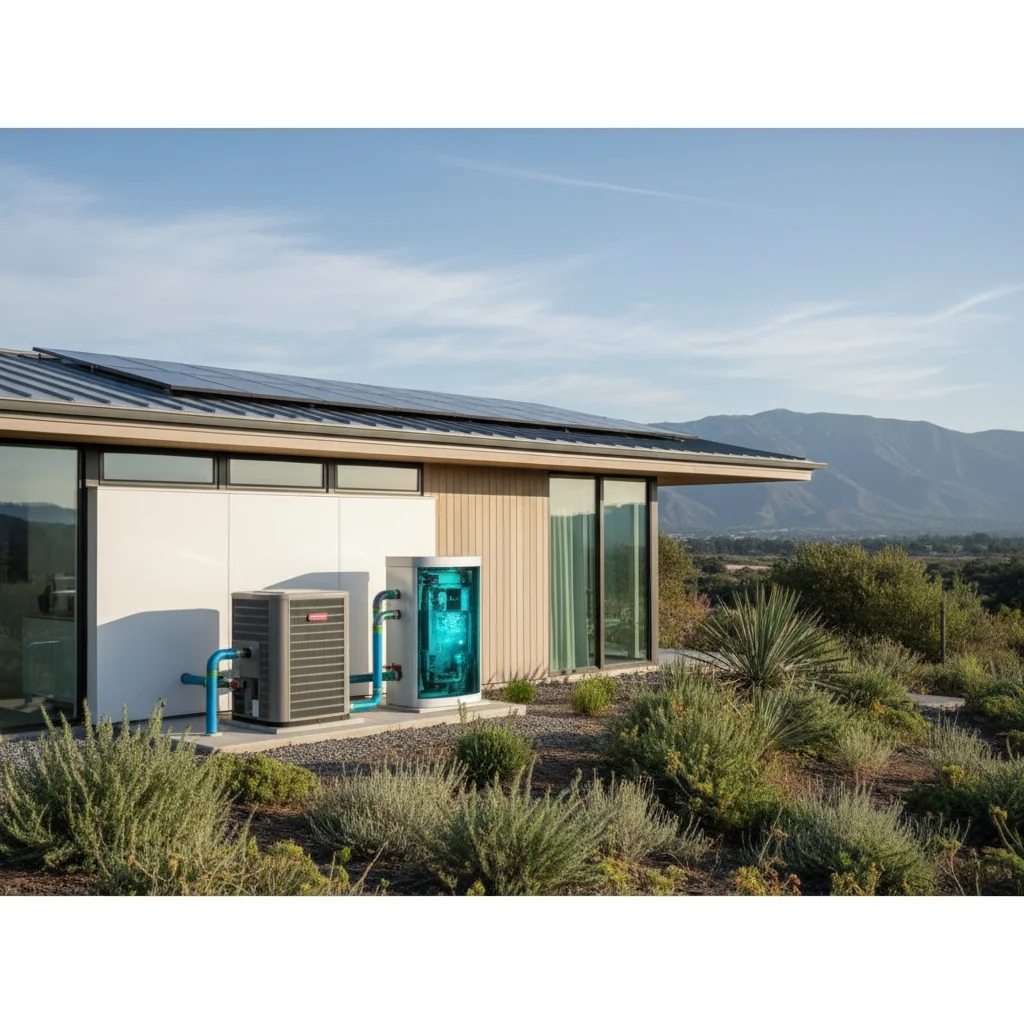
California homeowners installing geothermal heat pumps in 2026 get free hot water through a $1,200 component most contractors forget to mention. The federal Residential Clean Energy Credit (Section 25D) ended for expenditures made after December 31, 2025, and the IRS treats an expenditure as made when installation is completed (IRS FS-2025-05). Federal tax credits for this work have ended, but state, local and utility rebates may still apply; check what is available at your address with the DuloCore rebate calculator.
What is a Geothermal Desuperheater and How Does It Work in California Homes?
A geothermal desuperheater captures waste heat from ground-source heat pump refrigerant during cooling cycles and transfers it to domestic water heaters. The system routes superheated refrigerant through a heat exchanger coiled inside or alongside the home's water heater tank before the refrigerant reaches the outdoor condenser. California homes with geothermal systems equipped with desuperheaters reduce water heating energy consumption by 25-50% during cooling season.
But California's climate creates a payback problem. The state's cooling season runs roughly May through October in most regions—only 6 months annually. So desuperheaters produce free hot water just half the year, extending payback periods to 8-12 years compared to 4-6 years in year-round cooling climates like Arizona.
The technology isn't new. Geothermal contractors have installed desuperheaters since the 1980s as standard equipment on commercial ground-source heat pump systems. And residential adoption accelerated after the 2022 Inflation Reduction Act created 30% tax credit (this federal credit ended for expenditures made after December 31, 2025)s for complete geothermal installations including desuperheater components.
Which California Rebate Programs Cover Geothermal Desuperheater Installation and What Are the Eligibility Requirements?
California's 2026 Tech Clean California program provides up to $8,000 for ground-source heat pump installations including integrated desuperheater systems for households earning below 80% area median income. Desuperheaters qualify as eligible components when installed as part of complete ENERGY STAR-certified geothermal systems rated 3.3 COP or higher. The federal Residential Clean Energy Credit (Section 25D) ended for expenditures made after December 31, 2025, and the IRS treats an expenditure as made when installation is completed (IRS FS-2025-05). Check current state, local and utility incentives for your address with the DuloCore rebate calculator.
"Geothermal heat pumps with desuperheaters represent one of the most efficient space conditioning and water heating solutions available, achieving combined efficiencies above 400% in optimal conditions." — U.S. Department of Energy
But California's Bay Area Air Quality Management District offers zero direct rebates for desuperheater installations in 2026. Southern California Edison provides $3,000-$5,000 rebates for complete geothermal heat pump systems but doesn't itemize desuperheater components separately. And Pacific Gas & Electric discontinued standalone water heating efficiency rebates in 2025, folding them into whole-home electrification packages.
Most California programs require systems to meet AHRI 870 certification standards with minimum 3.3 COP heating and 16.2 EER cooling ratings. Desuperheaters must connect to ENERGY STAR water heaters with minimum 0.67 Uniform Energy Factor ratings. And installations require licensed contractors with C-20 HVAC certifications to qualify for rebates.
What's the ROI and Payback Period for Installing a Geothermal Desuperheater in California?
Desuperheater installations add $1,200-$2,500 to base geothermal heat pump costs but reduce annual water heating expenses by $180-$340 in California's mixed climate zones. The standalone payback period ranges 7-13 years without incentives, dropping to 5-9 years after applying 30% federal tax credits. Sacramento homeowners see faster payback at 5-7 years due to 110+ cooling days annually, while coastal San Francisco installations stretch to 10-13 years with minimal cooling demand.
California's tiered electricity rates accelerate ROI calculations. PG&E customers paying $0.52/kWh in Tier 3 save $340 annually with desuperheater installations compared to $180 for baseline tier users. And net metering arrangements further improve economics—homeowners with solar systems effectively get free hot water by offsetting grid exports during peak cooling hours.
But maintenance costs reduce net savings. Desuperheater heat exchangers require professional descaling every 3-5 years at $250-$400 per service in California's hard water regions. Annual inspection costs average $120-$180. So lifetime ownership costs over 15 years total $2,800-$3,600 in maintenance against $5,100-$7,650 in energy savings.
The math changes dramatically for new construction. Adding a desuperheater during initial geothermal installation costs $800-$1,200 compared to $1,800-$2,500 for retrofit installations. And new builds avoid the $600-$900 cost of integrating the system with existing water heater infrastructure.
How Does a Geothermal Desuperheater Compare to Other Water Heating Alternatives in California?
Heat pump water heaters cost $1,200-$2,800 installed and save $250-$380 annually with 3-7 year payback periods, faster than desuperheater systems in California's moderate climate. Gas tankless water heaters run $2,500-$4,500 installed but save just $120-$180 annually compared to standard tank heaters. Solar water heating systems cost $4,000-$7,000 installed with 8-15 year payback periods, slower than desuperheaters in northern California's foggy coastal zones.
| Technology | Installed Cost | Annual Savings | Payback Period | 2026 Federal Credit |
|---|---|---|---|---|
| Desuperheater | $1,200-$2,500 | $180-$340 | 7-13 years | 30% (part of geothermal system) |
| Heat Pump Water Heater | $1,200-$2,800 | $250-$380 | 3-7 years | $2,000 |
| Solar Water Heating | $4,000-$7,000 | $300-$450 | 8-15 years | 30% |
| Gas Tankless | $2,500-$4,500 | $120-$180 | 14-25 years | $0 |
But desuperheaters deliver zero-carbon water heating when paired with geothermal systems, matching California's 2045 carbon neutrality goals. Heat pump water heaters achieve similar emissions reductions at lower upfront costs. And solar thermal systems outperform both in southern California's high-insolation regions with 300+ sunny days annually.
The comparison shifts for homeowners already installing geothermal systems. Adding a desuperheater costs just $1,200-$2,500 marginal expense compared to $3,000-$5,000 for standalone heat pump water heaters. So the incremental economics favor desuperheaters for planned geothermal installations.
How Long Do Geothermal Desuperheaters Last and What's the Maintenance Timeline?
Geothermal desuperheaters last 15-20 years when properly maintained, matching the lifespan of the host heat pump system. The heat exchanger coil represents the primary failure point, degrading from mineral buildup in hard water regions after 8-12 years without descaling treatments. California's Central Valley water hardness levels of 180-250 mg/L calcium carbonate accelerate scaling compared to coastal regions at 50-100 mg/L.
Maintenance schedules require annual inspections at $120-$180 covering refrigerant pressure checks, heat exchanger cleaning, and circulation pump testing. Desuperheater systems need professional descaling every 3-5 years at $250-$400 in hard water zones. And heat exchanger replacement costs $600-$1,200 after 12-15 years of operation.
But maintenance costs remain lower than standalone water heaters over 15-year lifespans. Heat pump water heaters require $2,400-$3,600 in maintenance and component replacements. Solar thermal systems run $3,000-$4,500 for pump replacements, controller upgrades, and panel cleaning. And desuperheaters benefit from shared maintenance visits with the primary geothermal system, reducing service call fees.
California's Contractors State License Board requires C-20 HVAC or C-36 plumbing licenses for desuperheater service work. Homeowners attempting DIY descaling void manufacturer warranties on most systems. And refrigerant work requires EPA Section 608 certification, limiting maintenance options to licensed professionals.
What Are the Installation Costs and Available Incentives for California Homeowners in 2026?
Complete geothermal heat pump installations with integrated desuperheaters cost $18,000-$28,000 in California depending on system size, loop configuration, and excavation requirements. The desuperheater component adds $1,200-$2,500 to base system costs. The federal Residential Clean Energy Credit (Section 25D) ended for expenditures made after December 31, 2025, and the IRS treats an expenditure as made when installation is completed (IRS FS-2025-05).
The federal Residential Clean Energy Credit (Section 25D) ended for expenditures made after December 31, 2025, and the IRS treats an expenditure as made when installation is completed (IRS FS-2025-05).
California's Tech Clean California program adds $3,000-$8,000 for income-qualified households. And utility rebates from Southern California Edison, Pacific Gas & Electric, and San Diego Gas & Electric range $2,000-$5,000 for complete systems. So total available incentives reach $11,000-$16,500, covering 45-60% of installation costs for qualifying homeowners.
But rebate stacking rules limit combined benefits. The federal tax credit applies to post-rebate costs, not gross installation amounts. So a $25,000 system with $8,000 in state and utility rebates qualifies for 30% credit on the remaining $17,000—a $5,100 federal benefit, not $7,500. And California's SGIP battery (this federal credit ended for expenditures made after December 31, 2025) storage incentive excludes homes receiving Tech Clean California geothermal rebates. (Note: Federal tax credit percentages and availability are subject to change; the 30% Residential Clean Energy Credit under Section 25D expired December 31, 2025. Verify current incentives at energy.gov.)
Installation timelines run 3-6 months from application to operation in California due to permit backlogs and utility interconnection queues. San Francisco and Los Angeles require geothermal loop permits through Department of Building Inspection, adding 4-8 weeks to timelines. And HVAC permit inspections take 2-4 weeks in most jurisdictions.
Calculate your combined federal, state, and utility incentives with our free rebate calculator to see total savings potential.
Official Sources
- U.S. Department of Energy: Geothermal Heat Pumps — Federal technical specifications and efficiency data for ground-source systems
- ENERGY STAR Geothermal Tax Credits — Federal credit eligibility reference (note: the federal 25D credit ended for expenditures made after December 31, 2025)
- DSIRE California Incentives — Comprehensive database of state and utility rebate programs updated quarterly
Frequently Asked Questions
What is a geothermal desuperheater and how does it work?
A geothermal desuperheater captures waste heat from heat pump refrigerant during cooling cycles and transfers it to domestic water through a heat exchanger. The system intercepts superheated refrigerant between the compressor and condenser, routing it through coils submerged in or wrapped around the water heater tank. This process heats water to 120-140°F while improving overall heat pump efficiency by 8-12% during cooling operation.
How much can you save with a geothermal desuperheater in California?
California homeowners save $180-$340 annually on water heating costs with desuperheater systems depending on household size and local electricity rates. Sacramento region homeowners see higher savings at $280-$340 due to extended cooling seasons of 110+ days annually. Coastal regions save $180-$240 with shorter cooling periods. And PG&E Tier 3 customers paying $0.52/kWh save 40-60% more than baseline tier users.
Are geothermal desuperheaters eligible for California rebates in 2026?
Desuperheaters qualify for incentives when installed as components of complete geothermal heat pump systems meeting ENERGY STAR certification standards. The federal Residential Clean Energy Credit (Section 25D) ended for expenditures made after December 31, 2025, and the IRS treats an expenditure as made when installation is completed (IRS FS-2025-05). California's Tech Clean California program provides $3,000-$8,000 for qualifying low-income households. But utilities like PG&E and SCE don't offer separate desuperheater rebates—incentives cover complete geothermal installations only.
How long does it take to install a geothermal desuperheater system?
Desuperheater installation adds 4-6 hours to standard geothermal heat pump installation timelines when performed simultaneously. Retrofit installations on existing geothermal systems take 6-8 hours including water heater integration and refrigerant line modifications. Complete geothermal system installations with desuperheaters require 3-5 days for excavation, loop installation, and equipment setup. And California permit processing adds 4-12 weeks to total project timelines depending on jurisdiction.
What is the difference between a desuperheater and a heat pump water heater?
Desuperheaters recycle waste heat from existing geothermal cooling systems while heat pump water heaters actively extract heat from ambient air using dedicated compressors. Desuperheaters produce hot water only during cooling cycles—roughly 6 months annually in California—while heat pump water heaters operate year-round. Heat pump water heaters cost less at $1,200-$2,800 installed compared to $1,200-$2,500 for desuperheaters plus $15,000-$25,000 for required geothermal systems. But desuperheaters achieve higher combined efficiencies above 400% when integrated with geothermal heat pumps.
Ready to calculate your savings? Use our rebate calculator to find available federal, state, and utility incentives for geothermal systems with desuperheaters in your California zip code. Get personalized estimates in under 60 seconds.
Last updated April 14, 2026 — reviewed by DuloCore Editorial. About our authors.
Check your California heat pump rebate eligibility — see the programs you qualify for and the dollar amounts on our California heat pump rebate finder.