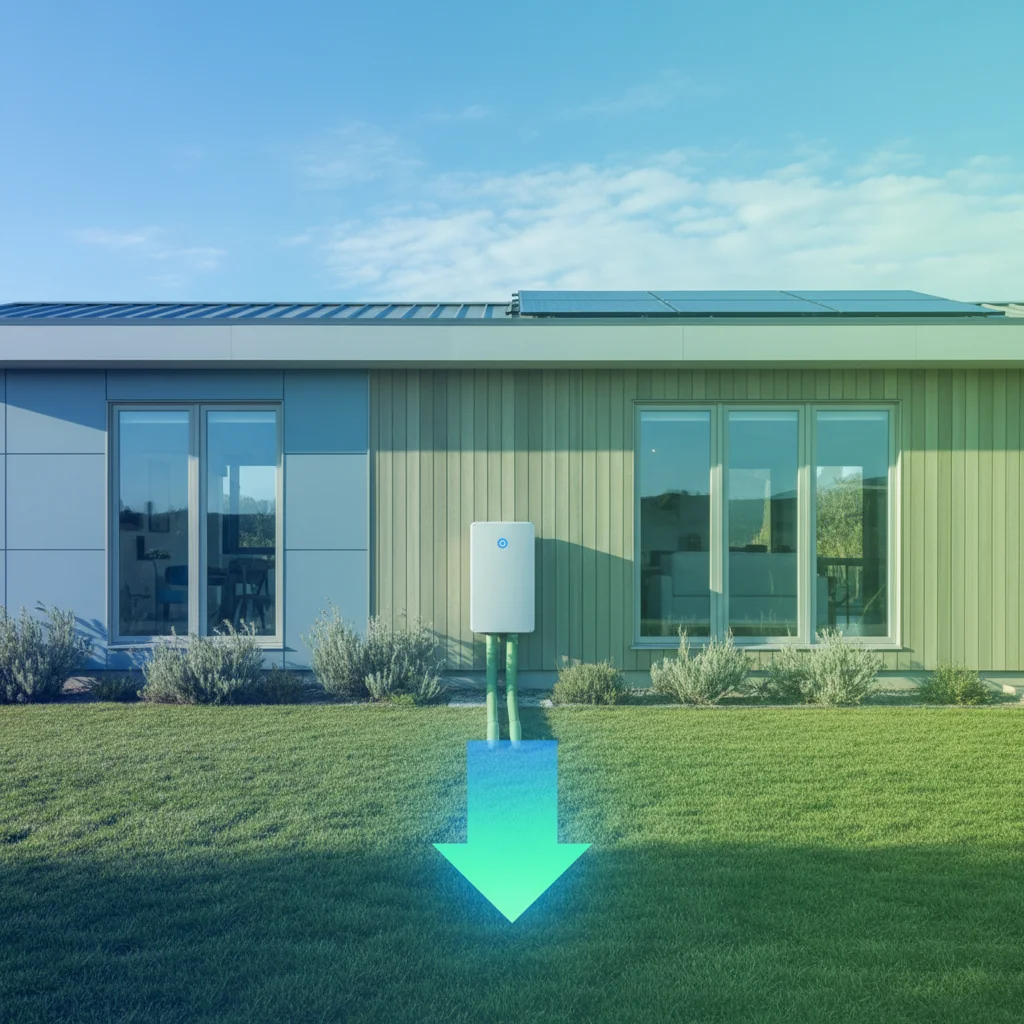
A geothermal heat pump system that costs $25,000 upfront can drop to $12,500 after federal tax credits in 2026—and that's before state rebates, utility incentives, and local programs stack on top. California homeowners installing qualifying systems now access the deepest incentive pool in geothermal history, with combined savings reaching 60% of total project costs in some counties.
How Much Can You Actually Save on Geothermal Installation After All Rebates and Credits?
Geothermal heat pump installations in California averaged $22,000 to $30,000 in 2026 before incentives. The federal IRA tax credit covers 30% of total project costs through 2032, immediately reducing a $25,000 system to $17,500. California's TECH Clean California program adds $3,000 to $5,000 for ground-source heat pump installations, and utility providers like PG&E offer an additional $2,000 to $4,000 through demand response programs. So a homeowner installing a $25,000 system receives $7,500 from federal credits, $4,000 from state programs, and $3,000 from utility rebates—bringing net cost down to $10,500. And that's a 58% reduction from sticker price. But actual savings vary by county, installer certification, and system efficiency rating.
The federal Residential Clean Energy Credit (Section 25D) ended for expenditures made after December 31, 2025, and the IRS treats an expenditure as made when installation is completed (IRS FS-2025-05).
What Are the Stacking Rules for Federal, State, and Local Incentives?
Federal IRA credits apply to total project costs before other rebates reduce the base amount. California's TECH Clean California rebates stack on top of federal credits because they're processed as post-installation payments, not purchase price reductions. Utility rebates from PG&E, SCE, and SDG&E also stack because they're performance-based incentives rather than point-of-sale discounts. But local municipal programs sometimes conflict with state rebates—homeowners can't double-dip between TECH Clean California and city-specific heat pump programs offering equipment subsidies for the same system. And county-level programs funded by Air Quality Management Districts typically stack with all other incentives because they target air quality improvement rather than energy efficiency specifically. So the optimal stacking strategy combines federal credits, state performance rebates, utility demand response payments, and air quality grants.
| Program Type | Amount | Eligibility | Stacking Rule |
|---|---|---|---|
| Federal IRA Tax Credit | Ended Dec 31, 2025 | — | — |
| TECH Clean California | $3,000-$5,000 | Installer must be BayREN certified | Stacks with federal and utility |
| Utility Demand Response | $2,000-$4,000 | Smart thermostat required | Stacks with all programs |
| AQMD Air Quality Grants | $1,000-$2,500 | Replacing fossil fuel systems | Conflicts with city equipment subsidies |
What Documentation Do You Need to Claim Geothermal Rebates and Credits?
Form 5695 only covers qualifying work completed by December 31, 2025 and claimed on a 2025 return; the federal 25C and 25D credits ended after that date (IRS FS-2025-05). Federal tax credits for this work have ended, but state, local and utility rebates may still apply; check what is available at your address with the DuloCore rebate calculator. Installers must provide itemized invoices separating labor costs from equipment expenses because the federal credit covers both. TECH Clean California requires pre-installation reservation through the BayREN portal, installer W-9 forms, and post-installation performance verification photos showing ground loop connections. Utility rebate programs demand smart thermostat installation proof, Wi-Fi connectivity screenshots, and enrollment confirmation in demand response programs. And county air quality grants require baseline energy bills from the prior 12 months, contractor license verification, and building permit closeout documents. So homeowners filing for maximum incentives submit five separate application packets across four different agencies—federal tax forms by April 15, state rebate claims within 60 days of installation, utility program enrollment within 30 days, and air quality grants within 90 days of project completion.
Use our free rebate calculator to estimate your total savings and generate a personalized documentation checklist for every program you qualify for.
Which Rebates and Credits Can You Combine, and Which Ones Conflict?
California's TECH Clean California rebates combine with utility programs because state funding comes from ratepayer surcharges while utility rebates come from shareholder earnings. But city-level equipment subsidies conflict with TECH Clean California when both programs fund the same system component—homeowners choosing between a $5,000 state rebate and a $3,500 city subsidy always take the higher amount. And some utility programs require exclusive enrollment, blocking participation in competing demand response offerings from third-party aggregators. So the conflict zone centers on overlapping equipment subsidies and competing grid service agreements. Federal and state programs never conflict. Utility and air quality programs stack cleanly. Only city subsidies and utility exclusivity clauses create either-or choices.
What's the Step-by-Step Process to Apply for Geothermal Incentives?
Start by reserving TECH Clean California funding through the BayREN portal 30 days before installation—reservations expire after 180 days. Then enroll in utility demand response programs during the reservation period because some utilities require pre-installation enrollment for rebate eligibility. Schedule installation with a BayREN-certified contractor who provides manufacturer certification statements for federal tax credit documentation. After installation, submit utility rebate applications within 30 days with smart thermostat proof and performance data. File TECH Clean California completion paperwork within 60 days, including installer invoices and ground loop verification photos. Submit county air quality grant applications within 90 days if replacing fossil fuel heating systems. Form 5695 only covers qualifying work completed by December 31, 2025 and claimed on a 2025 return; the federal 25C and 25D credits ended after that date (IRS FS-2025-05). So the timeline spans nine months from reservation to final tax filing, with four critical deadlines triggering forfeiture of unclaimed incentives.
Learn more about the federal geothermal tax credit application process and required documentation.
How Do Geothermal Costs After Rebates Compare to Heat Pumps and Traditional HVAC?
Air-source heat pump rebates reduce $12,000 systems to $7,000 after incentives—a 42% reduction compared to geothermal's 58% savings. Traditional gas furnace installations cost $8,000 with zero rebates in 2026 because California's building decarbonization policies exclude fossil fuel systems from all incentive programs. So the net cost hierarchy places gas furnaces at $8,000, air-source heat pumps at $7,000, and geothermal systems at $10,500 after maximum incentives. But operating costs reverse that ranking—geothermal systems cost $600 annually to run, air-source heat pumps cost $900, and gas furnaces cost $1,400 including utility bills and carbon fees. And payback periods favor geothermal in cold climates where air-source efficiency drops below 200% COP in winter—geothermal maintains 400% COP year-round, recovering the $3,500 cost premium over air-source heat pumps within four years. Explore all available energy tax credits to maximize your home efficiency upgrade savings.
Official Sources
- IRS Residential Clean Energy Credit — Federal tax credit guidance for geothermal heat pump installations (note: the federal 25C and 25D credits ended for projects completed after December 31, 2025)
- U.S. Department of Energy: Energy Saver — Federal rebate programs and energy efficiency resources
- DSIRE USA: California Programs — Database of state and local renewable energy incentives
Related Reading: Learn more about Geothermal Rebates.
Frequently Asked Questions
What is the average cost of a geothermal heat pump after federal tax credits?
The average geothermal heat pump system costs $22,000 to $30,000 before incentives in California during 2026. The federal IRA tax credit reduces that amount by 30%, bringing a $25,000 system down to $17,500 after the credit. Final costs drop further with state and utility rebates—most California homeowners pay $10,500 to $15,000 net after combining all available programs.
How much can you save with state and local geothermal rebates?
California's TECH Clean California program provides $3,000 to $5,000 for ground-source heat pump installations, while utility companies offer $2,000 to $4,000 through demand response enrollment. County air quality management districts add $1,000 to $2,500 for systems replacing fossil fuel heating. Combined state and local rebates total $6,000 to $11,500 on top of federal tax credits, reducing a $25,000 system to as low as $10,500.
Are geothermal systems eligible for the 30% federal tax credit in 2026?
Yes. The federal Residential Clean Energy Credit (Section 25D) ended for expenditures made after December 31, 2025, and the IRS treats an expenditure as made when installation is completed (IRS FS-2025-05). The credit covers 30% of total project costs including equipment, labor, and ground loop installation with no maximum dollar limit. ENERGY STAR certified systems installed before December 31, 2032, receive the full 30% credit, dropping to 26% in 2033 and 22% in 2034. (Note: Federal tax credit percentages and availability are subject to change; the 30% Residential Clean Energy Credit under Section 25D expired December 31, 2025. Verify current incentives at energy.gov.)
What is the geothermal rebate application process and timeline?
Reserve TECH Clean California funding 30 days before installation through the BayREN portal. Enroll in utility demand response programs during the reservation window. Complete installation with a certified contractor within 180 days. Submit utility rebate applications within 30 days post-installation, state rebate paperwork within 60 days, and air quality grants within 90 days. Form 5695 only covers qualifying work completed by December 31, 2025 and claimed on a 2025 return; the federal 25C and 25D credits ended after that date (IRS FS-2025-05). The full incentive claim process spans nine months from reservation to tax filing.
How do geothermal costs compare to traditional HVAC after incentives?
After incentives, geothermal systems cost $10,500 net compared to $7,000 for air-source heat pumps and $8,000 for gas furnaces. But annual operating costs favor geothermal at $600 per year versus $900 for air-source and $1,400 for gas systems. Geothermal recovers the higher upfront cost within four to six years through lower utility bills, and the 400% year-round efficiency rating outperforms air-source heat pumps in cold weather climates.
Ready to calculate your exact savings? Our rebate calculator shows your personalized incentive stack for every program you qualify for—federal credits, state rebates, utility payments, and local grants combined into one net cost estimate. Get your custom report in 60 seconds.
Updated on April 14, 2026. Fact-checked by DuloCore Editors. About our research team.
Check your California heat pump rebate eligibility — see the programs you qualify for and the dollar amounts on our California heat pump rebate finder.