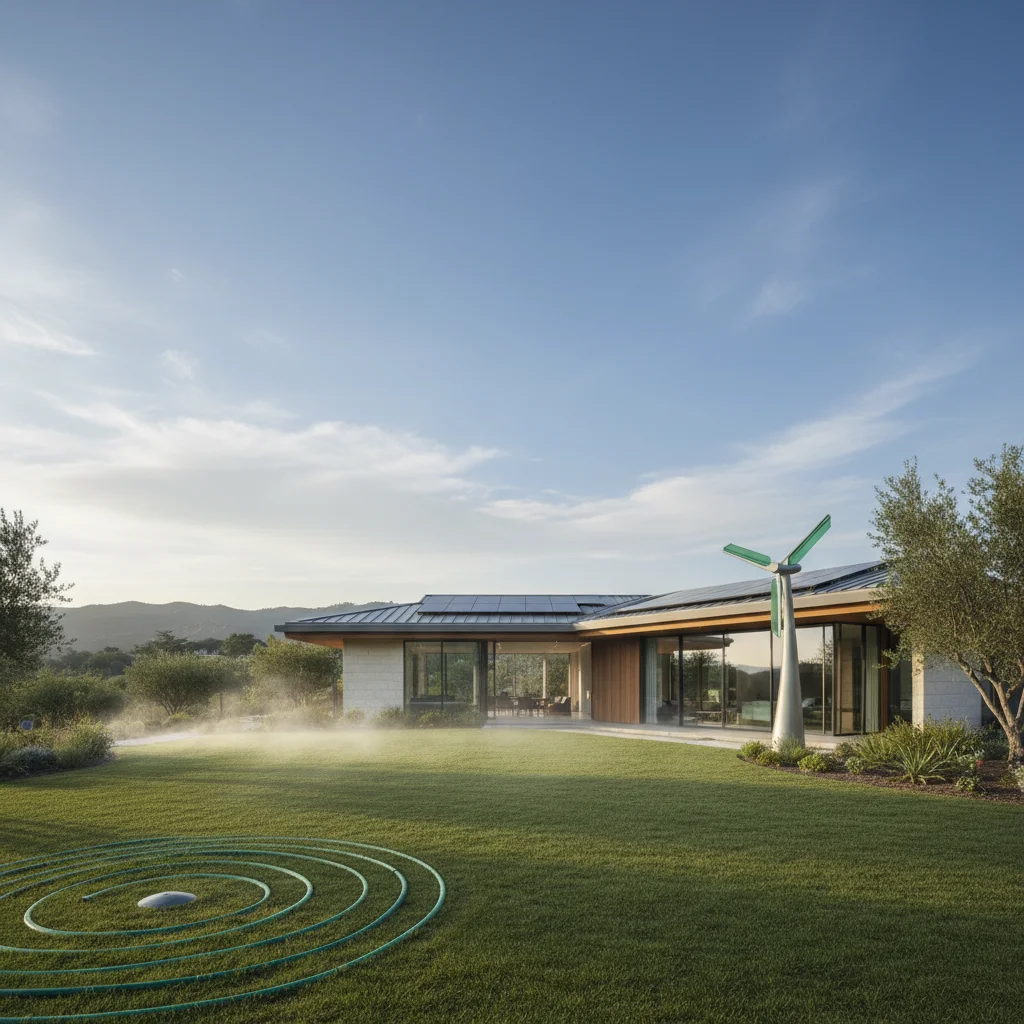
California homeowners paid an average $2,340 for summer cooling in 2025—triple the national average—while geothermal systems cut those costs by 50-70% using stable underground temperatures between 50-60°F year-round. And with California's grid strain pushing electricity rates to $0.38 per kWh in peak hours, the 3.5-4.5 COP (coefficient of performance) efficiency of geothermal cooling delivers immediate relief from escalating utility bills.
What is the ROI and payback period for geothermal cooling systems in California?
Geothermal cooling systems in California deliver 8-12 year payback periods with 30% federal tax credits and utility rebates reducing upfront costs from $25,000-$45,000 to $15,000-$28,000 for typical 2,000-square-foot homes. Annual cooling savings average $1,200-$2,800 depending on climate zone, with desert regions seeing faster returns. The systems last 25 years for indoor components and 50+ years for ground loops.
So here's the tension: California's aggressive decarbonization targets and utility incentive programs accelerate geothermal adoption, but the $20,000-$30,000 net installation cost after rebates still represents 3-5x the price of conventional air conditioning. The 25-50 year lifespan, zero refrigerant leaks, and 400-600% efficiency ratings tip the lifetime economics heavily toward geothermal for homeowners planning to stay 10+ years.
But payback timelines compress dramatically in California's high-cost energy markets. Coastal homes with moderate cooling needs hit break-even in 10-12 years, while inland valley properties running AC 120+ days annually recover costs in 8-9 years. Desert communities with extreme summer heat see 6-8 year returns.
The federal Residential Clean Energy Credit (Section 25D) ended for expenditures made after December 31, 2025, and the IRS treats an expenditure as made when installation is completed (IRS FS-2025-05). Check current state, local and utility incentives for your address with the DuloCore rebate calculator. California utility programs add $1,000-$4,000 in cash rebates depending on efficiency ratings and income qualifications. Property value increases of 3-5% partially offset installation costs in the first year.
So the ROI calculation hinges on electricity rates, cooling demand, and financing terms. Homeowners financing at 6% APR over 15 years pay $175-$245 monthly while saving $100-$230 on utilities—narrowing the gap to $45-$145 net monthly cost during the payback window. Cash buyers see immediate positive cash flow from energy savings.
How does geothermal cooling compare to air conditioning, evaporative cooling, and other alternatives?
Geothermal systems move heat rather than generate cooling, achieving 400-600% efficiency compared to air conditioning's 250-400% efficiency and evaporative cooling's 70-100% effectiveness in California's diverse climates. Central AC units cost $5,000-$12,000 installed but consume 3,000-5,000 kWh annually for cooling, while geothermal uses 1,200-2,000 kWh for the same output. Evaporative coolers work only in dry climates and add indoor humidity.
| System Type | Installation Cost | Annual Cooling kWh | Lifespan | Best Climate Zones |
|---|---|---|---|---|
| Geothermal | $25,000-$45,000 | 1,200-2,000 | 25-50 years | All California zones |
| Central AC (18 SEER) | $6,000-$12,000 | 3,000-5,000 | 12-15 years | All zones |
| Ductless Mini-Split | $4,000-$8,000 | 2,400-3,800 | 15-20 years | Coastal, mild climates |
| Evaporative Cooler | $2,500-$5,500 | 600-1,200 | 8-12 years | Desert, inland valleys |
And geothermal eliminates outdoor condenser noise, refrigerant leaks, and compressor failures common in traditional AC systems. But the technology requires sufficient land area for horizontal loops (400-600 feet of trenching per ton of cooling) or budget for vertical drilling ($8,000-$15,000 for 150-300 foot boreholes in compact lots).
So the comparison shifts by region. Coastal California's mild 65-85°F summers make ductless mini-splits competitive at one-third the upfront cost. Inland valleys with 95-110°F heat and 90+ cooling days favor geothermal's superior efficiency. Desert climates see evaporative cooling fail above 15% humidity, leaving geothermal and high-SEER AC as viable options.
Or consider hybrid approaches: pairing geothermal with solar panels creates net-zero cooling systems, with California's NEM 3.0 net metering covering daytime ground-source heat pump loads. The energy tax credits stack for combined installations, reaching 30% federal coverage plus utility incentives for both technologies.
What are the upfront installation costs and available rebates for geothermal systems in California?
Geothermal cooling installation costs $25,000-$45,000 in California before incentives, breaking down to $10,000-$18,000 for equipment, $8,000-$15,000 for ground loop drilling or trenching, $4,000-$8,000 for ductwork modifications, and $3,000-$4,000 for electrical upgrades and permits. Federal IRA tax credits reduce costs by 30% ($7,500-$13,500), while California utility rebates add $1,000-$4,000 depending on system efficiency and household income.
"Geothermal heat pumps are the most efficient heating and cooling systems available, using 25-50% less electricity than conventional systems." — U.S. Department of Energy
And the cost variables multiply across installation methods. Horizontal loops require 0.25-0.5 acres of yard space with $6,000-$10,000 trenching costs, while vertical boreholes fit compact lots but add $8,000-$15,000 for specialized drilling equipment. Pond loops slash installation to $4,000-$7,000 where suitable water bodies exist within 300 feet of the home.
But California's Title 24 building codes require whole-home efficiency upgrades when installing new HVAC systems in existing homes, adding $2,000-$5,000 for attic insulation, duct sealing, and air barrier improvements. The costs yield additional 10-20% energy savings beyond geothermal efficiency alone.
So total project costs range from $20,000 net (small home, horizontal loop, DIY landscaping restoration) to $35,000 net (large home, vertical boreholes, full duct replacement) after all federal and state incentives. Financing options through PACE (Property Assessed Clean Energy) programs spread payments over 15-20 years with no upfront costs and repayment through property tax assessments.
And income-qualified households earning below 80% area median income access enhanced rebates of $6,000-$8,000 through California utility programs, dropping net costs to $12,000-$22,000. The heat pump rebates documentation covers specific utility territory incentive amounts and application processes.
Are you eligible for geothermal cooling incentives in California?
California homeowners qualify for 30% federal IRA tax credits (up to $2,000 annual cap removed in 2023) on geothermal heat pump (this federal credit ended for expenditures made after December 31, 2025) installations meeting ENERGY STAR certification and 16+ EER cooling efficiency ratings. State rebates require existing homes, replacement of fossil fuel or electric resistance heating/cooling, and installation by HERS-certified contractors. Income limits of 80% area median income unlock additional $4,000-$6,000 incentives through utility-specific programs. (Note: Federal tax credit percentages and availability are subject to change; the 30% Residential Clean Energy Credit under Section 25D expired December 31, 2025. Verify current incentives at energy.gov.)
And eligibility expands through stacked incentive programs. Federal tax credits apply regardless of income, while California's TECH Clean California initiative targets low-to-moderate income households with $3,000-$5,000 contractor-applied instant discounts at point-of-sale. Renters qualify when property owners approve installation and agree to split incentive benefits.
But program requirements vary by utility territory. PG&E, SCE, SoCalGas, and SDG&E each administer separate rebate applications with different deadlines, efficiency tiers, and processing timelines of 60-120 days. The Database of State Incentives for Renewables & Efficiency maintains current program listings by zip code.
So documentation requirements include contractor license verification, HERS rating certificates, proof of existing system removal, manufacturer specification sheets showing EER/COP ratings, and itemized invoices separating equipment, labor, and materials. Form 5695 only covers qualifying work completed by December 31, 2025 and claimed on a 2025 return; the federal 25C and 25D credits ended after that date (IRS FS-2025-05). Utility rebates require pre-approval applications submitted before installation begins.
Or combine federal credits with local municipal rebate programs in cities like Los Angeles ($1,500), San Diego ($1,000), and Sacramento ($2,000) offering additional heat pump incentives. Total incentive stacking reaches $15,000-$20,000 for comprehensive whole-home electrification projects pairing geothermal with induction cooktops and heat pump water heaters.
What is the installation timeline and process for a geothermal cooling system?
Geothermal cooling installations take 3-7 days after permitting (2-6 weeks) and site assessment (1-2 weeks), breaking into four phases: loop field installation (1-3 days for drilling/trenching), indoor heat pump equipment mounting (1 day), ductwork modifications (1-2 days), and system commissioning with HERS verification (0.5 days). Horizontal loop projects finish faster than vertical drilling, while existing duct systems eliminate 1-2 days of labor.
And the process starts with soil thermal conductivity testing, water table depth analysis, and load calculations determining required tonnage (typically 2-5 tons for 1,500-3,000 square foot homes). Contractors submit permit applications to county building departments with sealed mechanical engineering plans, receiving approval in 14-42 days depending on jurisdiction backlog.
But installation disrupts yards for horizontal loops, requiring landscape restoration adding $1,500-$3,000 for sod replacement, irrigation repairs, and hardscape patching. Vertical drilling minimizes surface impact to 3x3 foot equipment pads but creates noise for 8-12 hours per borehole (typically 2-4 boreholes for residential systems).
So scheduling flexibility matters. Spring and fall shoulder seasons see 4-8 week contractor wait times, while summer and winter peak demand extends booking to 10-16 weeks. The rebate calculator estimates project timelines based on current installer availability and permit processing speeds by county.
And post-installation, HERS raters conduct blower door tests, duct leakage measurements, and airflow verification to confirm Title 24 compliance and unlock utility rebate payments. Homeowners receive commissioning reports showing actual COP performance, baseline energy modeling, and projected annual savings based on first-month operating data.
How much can you save on energy bills with geothermal cooling in California?
California homeowners save $1,200-$2,800 annually on cooling costs switching from conventional AC to geothermal systems, with savings varying by climate zone from $900 in coastal regions to $3,200 in desert areas running AC 120+ days per year. Geothermal reduces cooling electricity consumption by 50-70%, translating to 1,800-3,000 kWh annual savings at California's average $0.32 per kWh residential rate (climbing to $0.38 per kWh in peak summer tiers).
And the savings multiply through time-of-use rate optimization. Geothermal systems with thermal storage tanks shift cooling loads to off-peak hours (9 PM-4 PM weekdays), cutting per-kWh costs from $0.48 peak to $0.28 off-peak—adding $300-$600 in annual savings beyond efficiency gains alone.
"Ground source heat pumps use the constant temperature of the earth as the exchange medium instead of the outside air temperature, making them more efficient than traditional heating and cooling systems." — EPA Energy Star Program
But savings calculations require baseline consumption data. Homes with inefficient 10 SEER AC units see larger absolute savings than those replacing 18 SEER equipment. Proper home sealing and insulation amplify geothermal efficiency—leaky 1970s construction saves $1,800-$2,400 annually, while tight 2010+ homes save $900-$1,400.
So lifetime savings over 25 years reach $30,000-$70,000 in avoided utility costs, assuming 3% annual electricity rate inflation matching California's 2015-2025 trend. The savings cover 100-200% of net installation costs (after incentives) depending on usage patterns and regional electricity pricing.
And geothermal cooling produces zero emissions, avoiding 3-5 tons of CO2 annually compared to fossil fuel-powered grid electricity. California's carbon pricing mechanisms and potential future HVAC efficiency mandates create financial upside beyond direct utility savings through compliance with tightening building performance standards.
Official Sources
- U.S. Department of Energy - Geothermal Heat Pumps — Federal guidance on ground-source heat pump technology and efficiency ratings
- Database of State Incentives for Renewables & Efficiency — Comprehensive California rebate program listings by utility territory and income level
- ENERGY STAR Heat Pumps — Certification requirements and efficiency specifications for federal tax credit eligibility (note: the federal 25C and 25D credits ended for projects completed after December 31, 2025)
Related Reading: Learn more about Summer Energy Audit Cooling Focus.
Frequently Asked Questions
What are the California rebates available for geothermal cooling systems?
California utility rebates for geothermal cooling range from $1,000-$4,000 through programs administered by PG&E, SCE, SoCalGas, and SDG&E. Income-qualified households earning below 80% area median income access enhanced incentives of $6,000-$8,000 through TECH Clean California. Municipal programs in Los Angeles, San Diego, and Sacramento add $1,000-$2,000 in local rebates. All programs require ENERGY STAR certified equipment, HERS-verified installation, and pre-approval applications submitted before work begins.
How much can you save with a geothermal cooling system in California?
Geothermal cooling systems save California homeowners $1,200-$2,800 annually depending on climate zone and baseline AC efficiency. Coastal regions with 60-80 cooling days save $900-$1,400, while inland valleys and desert areas with 90-120 cooling days save $2,000-$3,200. Systems reduce cooling electricity consumption by 50-70%, translating to 1,800-3,000 kWh annual savings. Time-of-use rate optimization with thermal storage adds $300-$600 in additional savings through off-peak load shifting.
Are geothermal cooling systems eligible for federal tax credits in 2026?
The federal Residential Clean Energy Credit (Section 25D) ended for expenditures made after December 31, 2025, and the IRS treats an expenditure as made when installation is completed (IRS FS-2025-05). Systems must meet ENERGY STAR certification, achieve 16+ EER cooling efficiency, and be installed in existing or new primary residences.
What is the process for claiming geothermal cooling rebates in California?
California geothermal rebate applications require pre-approval submission to utility program administrators before installation, including contractor license verification, HERS rating projections, and existing system documentation. After installation, homeowners submit final invoices, manufacturer specification sheets, HERS verification reports, and proof of old equipment removal. Processing takes 60-120 days with rebate checks mailed directly or applied as bill credits. Form 5695 only covers qualifying work completed by December 31, 2025 and claimed on a 2025 return; the federal 25C and 25D credits ended after that date (IRS FS-2025-05).
How does a geothermal cooling system compare to traditional air conditioning in California?
Geothermal systems achieve 400-600% efficiency (4.0-6.0 COP) compared to traditional air conditioning's 250-400% efficiency (2.5-4.0 COP), reducing cooling electricity consumption by 50-70%. Installation costs $25,000-$45,000 versus $6,000-$12,000 for central AC, but geothermal lasts 25-50 years compared to AC's 12-15 years. Annual cooling costs drop from $1,800-$3,600 with AC to $600-$1,200 with geothermal. Geothermal eliminates outdoor condenser noise, refrigerant leaks, and compressor failures while providing heating in winter at identical efficiency levels.
Ready to calculate your geothermal cooling savings? Use our free rebate calculator to get personalized estimates of installation costs, federal tax credits, California utility rebates, and lifetime energy savings based on your home size, location, and current cooling system. Get your custom analysis in 60 seconds.
Last reviewed: April 14, 2026. Reviewed by DuloCore Energy Specialists. About the team.
Check your California heat pump rebate eligibility — see the programs you qualify for and the dollar amounts on our California heat pump rebate finder.