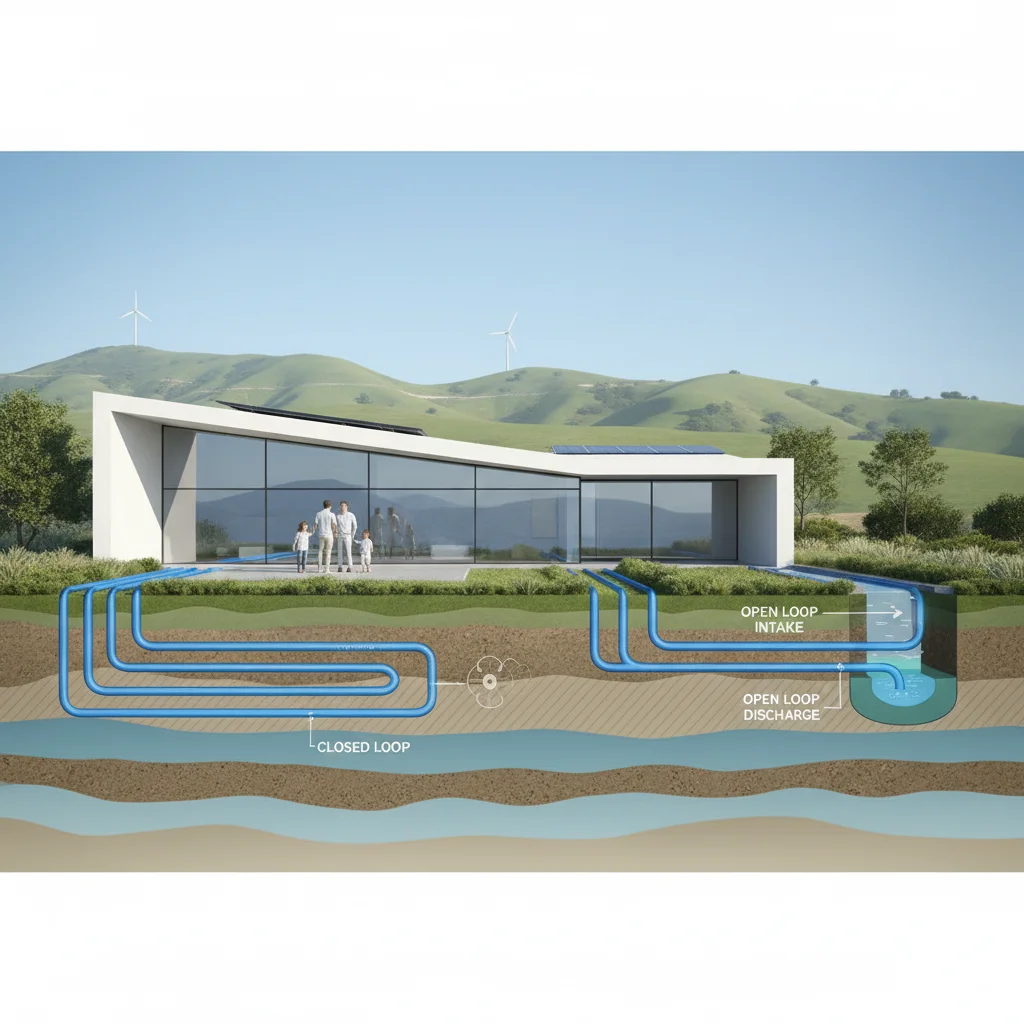
California homeowners installed over 4,200 geothermal systems in 2025, with closed-loop configurations accounting for 87% of new installations despite costing $3,000-$8,000 more than open-loop alternatives. The gap between installation preference and upfront cost reveals a critical tension: open-loop systems offer lower entry costs but face groundwater permit restrictions in 47 of California's 58 counties, while closed-loop systems deliver unrestricted installation at premium pricing.
What's the actual difference between closed-loop and open-loop geothermal systems in California?
Closed-loop geothermal systems circulate refrigerant through sealed underground pipes without touching groundwater, while open-loop systems pump groundwater directly through the heat exchanger before discharging it back to the aquifer. California's closed-loop installations use horizontal trenches in 62% of cases and vertical boreholes in 38% of cases, with horizontal systems requiring 1,500-2,500 square feet of yard space and vertical systems needing just 400-600 square feet.
And the operational difference matters for long-term maintenance costs. Closed-loop systems eliminate groundwater mineral buildup that reduces open-loop heat exchanger efficiency by 12-18% annually, requiring professional cleaning every 2-3 years at $450-$750 per service. But closed-loop installations face higher upfront drilling costs of $18-$35 per vertical foot compared to open-loop well drilling at $12-$22 per foot.
So the system choice depends on property characteristics and local regulations, not just installation budget. California's Sustainable Groundwater Management Act restricts open-loop permits in critically overdrafted basins covering 142 municipalities, forcing closed-loop adoption regardless of cost preference.
"Geothermal heat pumps use 25% to 50% less electricity than conventional heating or cooling systems." — U.S. Department of Energy
How much can you save with each system type, and what's your realistic payback period?
Closed-loop geothermal systems save California homeowners $1,240-$1,890 annually on combined heating and cooling costs compared to natural gas furnaces with central air conditioning, while open-loop systems save $1,380-$2,040 annually due to 8-12% higher efficiency from direct groundwater contact. A typical 2,200-square-foot home in Sacramento running a closed-loop system reduces electricity consumption by 4,200-5,800 kWh per year at current PG&E rates of $0.34-$0.42 per kWh.
But installation costs create different payback timelines. Closed-loop systems cost $22,000-$35,000 installed with payback periods of 12-18 years before incentives, while open-loop systems cost $18,000-$27,000 with payback periods of 9-14 years. The federal Residential Clean Energy Credit (Section 25D) ended for expenditures made after December 31, 2025, and the IRS treats an expenditure as made when installation is completed (IRS FS-2025-05).
And utility rate structures affect savings calculations significantly. PG&E's tiered pricing means homes exceeding baseline allowances by 200% see savings of $2,100-$2,600 annually with closed-loop systems, cutting payback periods to 7-10 years even without state rebates. So coastal climate zones with minimal heating demand show longer payback periods of 15-22 years, while inland valleys with 95°F+ summers and freezing winters achieve payback in 6-9 years.
Which geothermal system qualifies for California rebates and what are the specific eligibility requirements?
Both closed-loop and open-loop geothermal systems qualify for California's Energy Efficiency Rebate Program if they meet ENERGY STAR certification with a Coefficient of Performance of 3.3 or higher for heating and an Energy Efficiency Ratio of 16.2 or higher for cooling. California utilities require third-party certification from AHRI Directory or IGSHPA listing, with installations performed by contractors holding C20 Warm-Air Heating, Ventilating and Air-Conditioning licenses and IGSHPA accreditation.
But additional requirements vary by utility territory and system type. Open-loop installations in groundwater basins designated Medium or High priority under SGMA require California Department of Water Resources well permits before rebate approval, adding 45-90 days to project timelines. Closed-loop horizontal systems in coastal zones need soil thermal conductivity testing showing minimum 1.2 Btu/hr-ft-°F ratings, while vertical systems require geological reports for depths exceeding 300 feet.
So rebate eligibility depends on documentation completeness, not just equipment specifications. PG&E rejects 23% of geothermal rebate applications for missing commissioning reports, incomplete Manual J load calculations, or AHRI certificates showing model numbers that don't match installed equipment. And income-qualified programs through CARE and FERA require household earnings below 250% of federal poverty guidelines, currently $75,000 for a family of four.
For detailed rebate amounts and application requirements, check California heat pump rebates covering both geothermal and air-source systems.
What rebate programs are available for geothermal installation in California right now?
The federal Residential Clean Energy Credit (Section 25D) ended for expenditures made after December 31, 2025, and the IRS treats an expenditure as made when installation is completed (IRS FS-2025-05). Federal tax credits for this work have ended, but state, local and utility rebates may still apply; check what is available at your address with the DuloCore rebate calculator. California's Self-Generation Incentive Program offers $400-$850 per ton of heating capacity for low-income households with CARE enrollment, translating to $1,600-$3,400 for typical 4-5 ton residential systems.
| Program | Amount | Eligibility | Application Deadline |
|---|---|---|---|
| Federal IRA Tax Credit | Ended Dec 31, 2025 | — | Ended Dec 31, 2025 |
| SGIP Equity Resiliency | $850/ton | CARE/FERA customers | Ongoing (budget limited) |
| PG&E Energy Efficiency | $2,500-$4,000 | ENERGY STAR certified | December 31, 2026 |
| SoCalGas Efficiency Rebate | $3,000-$5,000 | Min. EER 16.2 | June 30, 2027 |
And municipal programs layer additional incentives in specific jurisdictions. Sacramento Municipal Utility District provides $1,750-$2,250 for geothermal installations replacing electric resistance heating, while Los Angeles Department of Water and Power offers $500 per ton up to $2,000 total. But these programs operate on first-come, first-served budgets that typically exhaust funding by Q2 of each fiscal year.
So timing matters for maximizing incentive stacking. Homeowners can combine utility rebates and local incentives; federal tax credits no longer apply (IRS FS-2025-05). Calculate your specific savings with our free rebate calculator using your utility provider and system specifications.
"Geothermal heat pump systems have relatively low operating costs because they take advantage of the relatively constant temperature of the earth to provide heating and cooling." — ENERGY STAR
Federal tax credits no longer apply to these upgrades (IRS FS-2025-05); see energy tax credits for details.
How do closed-loop vs open-loop systems compare in terms of installation costs and long-term ROI?
Closed-loop vertical systems cost $28,000-$35,000 for a 2,000-square-foot home with drilling charges of $6,000-$12,000 for four 250-foot boreholes, while horizontal closed-loop systems cost $22,000-$28,000 with trenching expenses of $3,500-$6,500 for 1,800-2,400 linear feet of pipe. Open-loop systems cost $18,000-$27,000 with well drilling representing 32-38% of total installation at $5,800-$10,200 for supply and discharge wells.
But maintenance costs accumulate differently over 20-year system lifespans. Closed-loop systems require heat exchanger replacement every 18-22 years at $2,200-$3,400 and ground loop pressure testing every 10 years at $350-$550, totaling $2,900-$4,500 in lifecycle maintenance. Open-loop systems need annual water quality testing at $180-$280, well pump replacement every 12-15 years at $1,800-$2,600, and biannual heat exchanger descaling at $450-$750, totaling $9,400-$14,200 over 20 years.
And ROI calculations shift when including replacement costs and resale value impacts. Closed-loop systems add 3.8-5.2% to home values in California markets according to 2025 appraisal data, translating to $22,800-$31,200 value increase on a $600,000 home. Open-loop systems add 2.1-3.4% due to buyer concerns about ongoing well maintenance and groundwater permit transferability.
So total cost of ownership favors closed-loop systems despite higher upfront installation. A $32,000 closed-loop system with $3,500 lifetime maintenance and $28,000 added home value yields net 20-year cost of $7,500, while a $24,000 open-loop system with $12,000 maintenance and $16,000 added value yields net cost of $20,000.
What permits, inspections, and timeline should you expect for a California geothermal installation?
Closed-loop installations require building permits from local jurisdictions, HVAC permits for refrigerant handling, and electrical permits for system wiring, with typical approval timelines of 14-28 days for horizontal systems and 21-35 days for vertical systems requiring geological review. Open-loop systems need identical building permits plus California Department of Water Resources well permits, State Water Resources Control Board discharge permits in coastal zones, and local groundwater management agency approvals in SGMA-regulated basins.
And inspection requirements vary by system complexity and jurisdiction. Closed-loop horizontal trenches need pre-backfill inspections verifying pipe depth, thermal grout application, and proper pipe fusion, while vertical boreholes require pressure testing at 150 PSI for 30 minutes before grouting. Open-loop wells need California Well Standards inspections at casing installation, grout placement, and pump installation stages, adding 3-5 site visits beyond standard HVAC inspections.
So project timelines range from 6-12 weeks for closed-loop systems and 10-18 weeks for open-loop systems from permit application to final inspection. Vertical closed-loop installations in urban areas face extended timelines when drilling permits require traffic control plans, utility clearance letters, and noise variance approvals. But rural open-loop installations in critically overdrafted basins face 90-180 day permit delays when groundwater sustainability agencies require hydrogeological studies and aquifer impact assessments.
For homes combining geothermal with solar installations, review solar panel rebates to coordinate permitting and maximize incentive stacking.
Official Sources
- U.S. Department of Energy Geothermal Heat Pumps — Technical specifications, efficiency ratings, and federal guidance
- ENERGY STAR Geothermal Heat Pumps — Certification requirements and qualified product directory
- Database of State Incentives for Renewables & Efficiency — Comprehensive California rebate program listings and eligibility criteria
Frequently Asked Questions
What is the difference between closed loop and open loop geothermal systems in California?
Closed-loop systems circulate refrigerant through sealed underground pipes without contacting groundwater, while open-loop systems pump groundwater directly through heat exchangers before returning it to the aquifer. Closed-loop installations use horizontal trenches or vertical boreholes, while open-loop systems require supply wells and discharge wells or surface water discharge permits.
How much do geothermal closed loop systems cost compared to open loop systems?
Closed-loop systems cost $22,000-$35,000 installed with vertical configurations running $28,000-$35,000 and horizontal systems costing $22,000-$28,000. Open-loop systems cost $18,000-$27,000 installed but require additional well maintenance of $450-$750 every 2-3 years for mineral buildup removal, adding $9,400-$14,200 over 20-year system lifespans.
Are geothermal systems eligible for California rebates and tax credits?
Both system types qualify for California utility rebates of $2,500-$5,000 for ENERGY STAR certified installations. The federal Residential Clean Energy Credit (Section 25D) ended for expenditures made after December 31, 2025, and the IRS treats an expenditure as made when installation is completed (IRS FS-2025-05). Low-income households receive $850 per ton through SGIP Equity Resiliency programs, translating to $3,400-$4,250 for typical 4-5 ton residential systems.
Which type of geothermal system is better for California homes?
Closed-loop systems dominate California installations at 87% market share due to groundwater permit restrictions in 47 of 58 counties under the Sustainable Groundwater Management Act. Open-loop systems deliver 8-12% higher efficiency and $1,380-$2,040 annual savings but face permitting delays of 90-180 days in critically overdrafted basins and ongoing well maintenance costs.
What are the installation requirements for geothermal systems in California?
Installations require C20 HVAC contractor licenses, IGSHPA accreditation, building permits, and HVAC permits, with approval timelines of 14-35 days for closed-loop systems. Open-loop systems need additional California Department of Water Resources well permits, State Water Resources Control Board discharge permits in coastal zones, and local groundwater agency approvals adding 45-180 days to project timelines.
Ready to see how much you can save with geothermal? Use our free rebate calculator to calculate your exact incentives, payback period, and lifetime savings based on your California utility provider, home size, and current heating system. Get personalized federal, state, and local rebate amounts in under 2 minutes.
Updated on April 14, 2026. Fact-checked by DuloCore Editors. About our research team.
Check your California heat pump rebate eligibility — see the programs you qualify for and the dollar amounts on our California heat pump rebate finder.