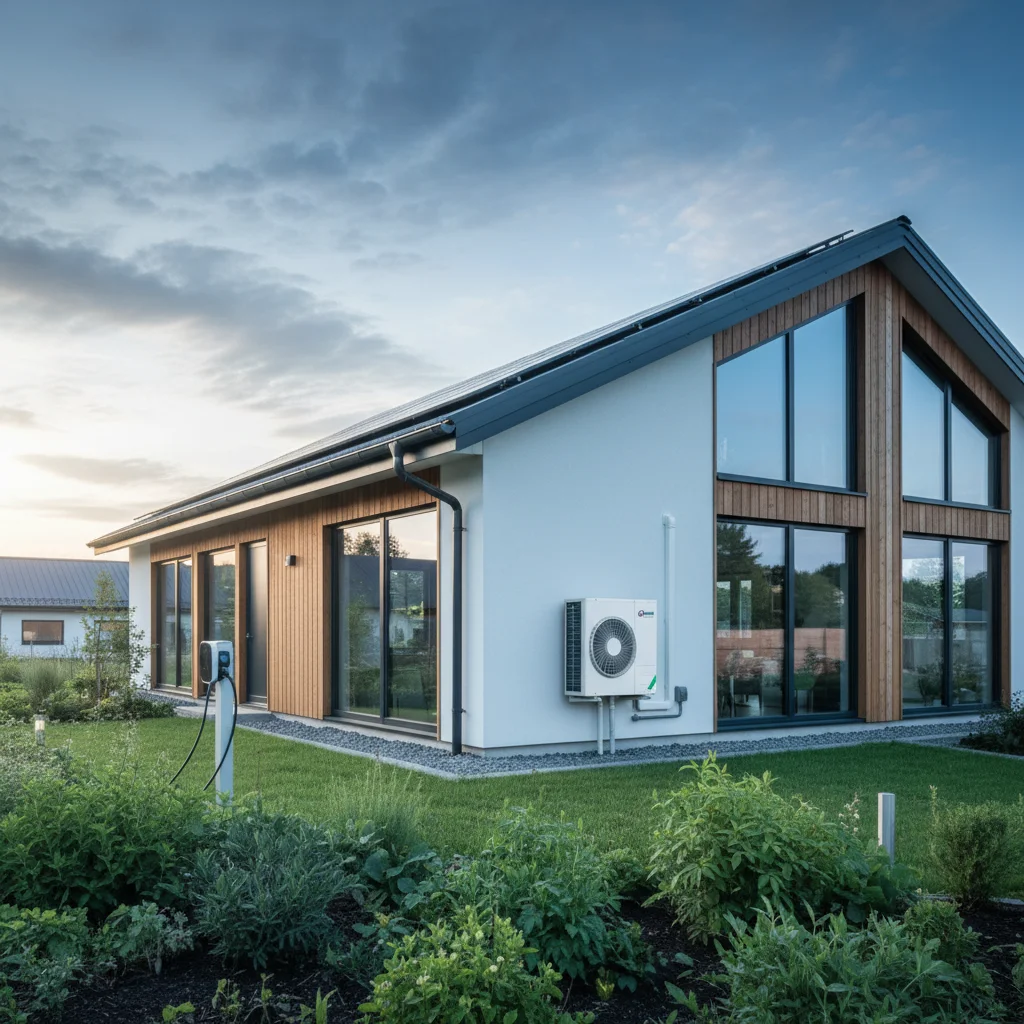
American homeowners left $4.3 billion in federal energy rebates unclaimed in 2025. And in 2026, the stakes just got higher. The federal government allocated $8.8 billion for home electrification rebates through the Inflation Reduction Act, with heat pump installations eligible for up to $8,000 in direct rebates—plus an additional 30% tax credit (this federal credit ended for property placed in service after December 31, 2025) on top of that.
How Much Can You Save With the Federal Heat Pump Rebate?
The federal heat pump rebate provides $8,000 for heat pump installations through the Home Electrification and Appliance Rebates (HEAR) program in 2026. Low-income households earning below 80% of area median income receive the full $8,000. Moderate-income households earning 80-150% of area median income receive $4,000. This rebate stacks with the 30% federal tax credit under Section 25(C) of the IRA, which remains active through 2032.
So a household installing a $12,000 heat pump system can claim $8,000 in direct rebates plus $3,600 in tax credits for total federal support of $11,600. But funding is limited. The Department of Energy reports that 23 states have already exhausted their initial HEAR allocations. And reimbursements are processed on a first-come, first-served basis, making timing critical for homeowners planning upgrades in 2026. (Note: Federal tax credit percentages and availability are subject to change; the 30% Residential Clean Energy Credit under Section 25D expired December 31, 2025. Verify current incentives at energy.gov.)
Are You Eligible for the Federal Heat Pump Rebate?
Eligibility for the federal heat pump rebate depends on household income relative to area median income (AMI) in 2026. Households earning below 80% of AMI qualify for $8,000 rebates. Households earning 80-150% of AMI qualify for $4,000 rebates. Households exceeding 150% of AMI don't qualify for HEAR rebates but can still claim the 30% federal tax credit. The property must be a primary residence, not a rental or second home.
But AMI varies dramatically by location. A four-person household in San Francisco qualifies for the full $8,000 rebate with income up to $91,200, while the same household in rural Mississippi qualifies with income up to $52,800. And state energy offices determine final income thresholds, so homeowners must verify their specific AMI limits before applying. Use a rebate calculator to check your exact eligibility based on your zip code and household size.
What Equipment Qualifies for the Federal Heat Pump Rebate?
Qualifying heat pump equipment must meet ENERGY STAR 8.5 HSPF2 efficiency standards for 2026. Air-source heat pumps, ground-source (geothermal) heat pumps, and heat pump water heaters all qualify. Ductless mini-split systems qualify if they meet efficiency thresholds. Central air-source systems require SEER2 ratings of 16 or higher. The rebate covers equipment and installation labor, but not ductwork modifications or electrical panel upgrades unless bundled in a whole-home electrification project.
"Heat pumps must be ENERGY STAR certified and professionally installed by a qualified contractor to receive HEAR rebates." — U.S. Department of Energy
So homeowners planning upgrades must verify equipment specifications before purchase. And only licensed HVAC contractors certified under state HEAR programs can perform qualifying installations. The heat pump rebates page lists approved contractors by state and eligible equipment models updated for 2026 program requirements.
What's the Income Limit for the Federal Heat Pump Rebate?
Income limits for the federal heat pump rebate are set at 150% of area median income (AMI) for 2026. Households below 80% AMI receive $8,000 rebates. Households between 80-150% AMI receive $4,000 rebates. The U.S. Department of Housing and Urban Development (HUD) publishes AMI tables annually, and state energy offices apply these thresholds to HEAR program eligibility. A two-person household in Denver qualifies for full rebates with income up to $64,400 in 2026.
But income verification requirements vary by state. Most states require tax returns from the prior year, while some accept alternative documentation like pay stubs or Social Security statements. And income is calculated as modified adjusted gross income (MAGI), the same measure used for IRS tax credits. Homeowners must provide documentation at the time of application, and rebates are denied if income exceeds thresholds or documentation is incomplete.
How Do You Apply for the Federal Heat Pump Rebate?
Applications for the federal heat pump rebate are processed through state energy offices, not directly through the IRS or Department of Energy. Homeowners must complete work with a qualified contractor, submit invoices and equipment specifications, and provide income verification documents. Most states require pre-approval before installation begins. Applications submitted after work is completed are often denied. Processing times range from 30 days to 120 days depending on state capacity and application volume in 2026.
"HEAR rebates are administered by state energy offices with funding distributed in waves based on Congressional appropriations." — ENERGY STAR
And contractors often handle the application process on behalf of homeowners, deducting the rebate amount from the installation invoice. But homeowners remain responsible for income verification and final approval. The Database of State Incentives for Renewables & Efficiency (DSIRE) provides state-by-state application portals and contact information for local energy offices managing HEAR programs.
When Is the Deadline, and Is Funding Still Available?
The federal heat pump rebate program runs through 2031, but state-level funding allocates on a rolling basis. The initial $8.8 billion appropriation was distributed to states in 2023-2024, and 23 states exhausted their allocations by March 2026. Congress approved an additional $4.2 billion supplement in February 2026, with funds distributed by April 2026. But states process applications first-come, first-served, so funding can run out mid-year even with replenishment.
So homeowners planning heat pump installations must check current funding status with their state energy office before beginning work. And states with high demand—California, New York, Texas—are prioritizing pre-approved applications with signed contracts. The energy tax credits page tracks real-time funding availability by state and updates weekly based on state energy office reports for 2026.
Can You Stack the Federal Heat Pump Rebate With Other Incentives?
The federal heat pump rebate stacks with the 30% IRA tax credit, state rebates, and utility incentives in 2026. A homeowner installing a $15,000 heat pump can claim $8,000 in HEAR rebates, $4,500 in federal tax credits (30% of remaining cost after rebate), $2,000 in state rebates, and $500 in utility incentives for total support of $15,000—covering the entire installation cost. But stacking rules vary by state, and some programs prohibit combining state and federal rebates on the same equipment.
Form 5695 only covers qualifying work completed by December 31, 2025 and claimed on a 2025 return; the federal 25C and 25D credits ended after that date (IRS FS-2025-05). HEAR rebates are paid directly to contractors or homeowners at the time of installation. So timing matters. Homeowners must coordinate rebate applications, tax credit documentation, and utility incentive claims to maximize savings. The rebate calculator estimates combined federal, state, and utility incentives based on location, income, and equipment specifications.
Official Sources
- U.S. Department of Energy Save Energy, Save Money — Federal guidance on HEAR rebates, tax credits, and energy efficiency programs (note: the federal 25C and 25D credits ended for projects completed after December 31, 2025)
- ENERGY STAR Heat Pumps — Equipment specifications, efficiency ratings, and qualified product lists for 2026
- DSIRE USA — Comprehensive database of state, local, and utility energy incentives with application portals
Federal Heat Pump Rebate Comparison Table
| Program | Rebate Amount | Income Limit | Equipment Requirement | Deadline |
|---|---|---|---|---|
| HEAR (Low-Income) | $8,000 | <80% AMI | ENERGY STAR 8.5 HSPF2 | 2031 (funding limited) |
| HEAR (Moderate-Income) | $4,000 | 80-150% AMI | ENERGY STAR 8.5 HSPF2 | 2031 (funding limited) |
| IRA Tax Credit | Ended Dec 31, 2025 | — | — | Ended Dec 31, 2025 |
| State Rebates (avg) | $500-$3,000 | Varies by state | Varies by state | Varies by state |
Frequently Asked Questions
Who is eligible for the federal heat pump rebate?
Homeowners earning below 150% of area median income (AMI) qualify for the federal heat pump rebate in 2026. Households earning below 80% AMI receive $8,000 rebates, while those earning 80-150% AMI receive $4,000. The property must be a primary residence. Renters don't qualify unless the landlord applies on their behalf. And income is verified through tax returns or alternative documentation at the time of application.
What is the maximum amount of the federal heat pump rebate?
The maximum federal heat pump rebate is $8,000 for low-income households earning below 80% of area median income. Moderate-income households earning 80-150% AMI receive $4,000. The rebate covers equipment and installation labor but not electrical upgrades or ductwork unless part of a whole-home electrification project. And the rebate stacks with the 30% IRA tax credit, which has no dollar cap through 2032.
How do I apply for the federal heat pump rebate?
Applications are submitted through state energy offices after work is completed by a qualified contractor. Most states require pre-approval before installation begins. Homeowners must provide invoices, equipment specifications, and income verification documents. Contractors often handle the application process and deduct the rebate from the installation invoice. Processing times range from 30 days to 120 days depending on state capacity in 2026.
When is the deadline to claim the federal heat pump rebate?
The HEAR program runs through 2031, but state-level funding allocates on a first-come, first-served basis. And 23 states exhausted their initial allocations by March 2026. Congress approved an additional $4.2 billion supplement in February 2026, with funds distributed by April 2026. Homeowners must check current funding status with their state energy office before beginning work to ensure rebates are still available.
What is the difference between the federal heat pump rebate and tax credit?
The federal heat pump rebate is a direct payment of $4,000-$8,000 issued by state energy offices at the time of installation. Form 5695 only covers qualifying work completed by December 31, 2025 and claimed on a 2025 return; the federal 25C and 25D credits ended after that date (IRS FS-2025-05). The rebate is income-limited, while the tax credit has no income cap. The federal Energy Efficient Home Improvement Credit (Section 25C) ended for property placed in service after December 31, 2025 (IRS FS-2025-05).
Ready to maximize your heat pump savings? Use our free rebate calculator to estimate your combined federal, state, and utility incentives based on your exact location and income. Get personalized results in under 60 seconds and find qualified contractors in your area.
Updated on April 14, 2026. Fact-checked by DuloCore Editors. About our research team.
Check your California heat pump rebate eligibility — see the programs you qualify for and the dollar amounts on our California heat pump rebate finder.