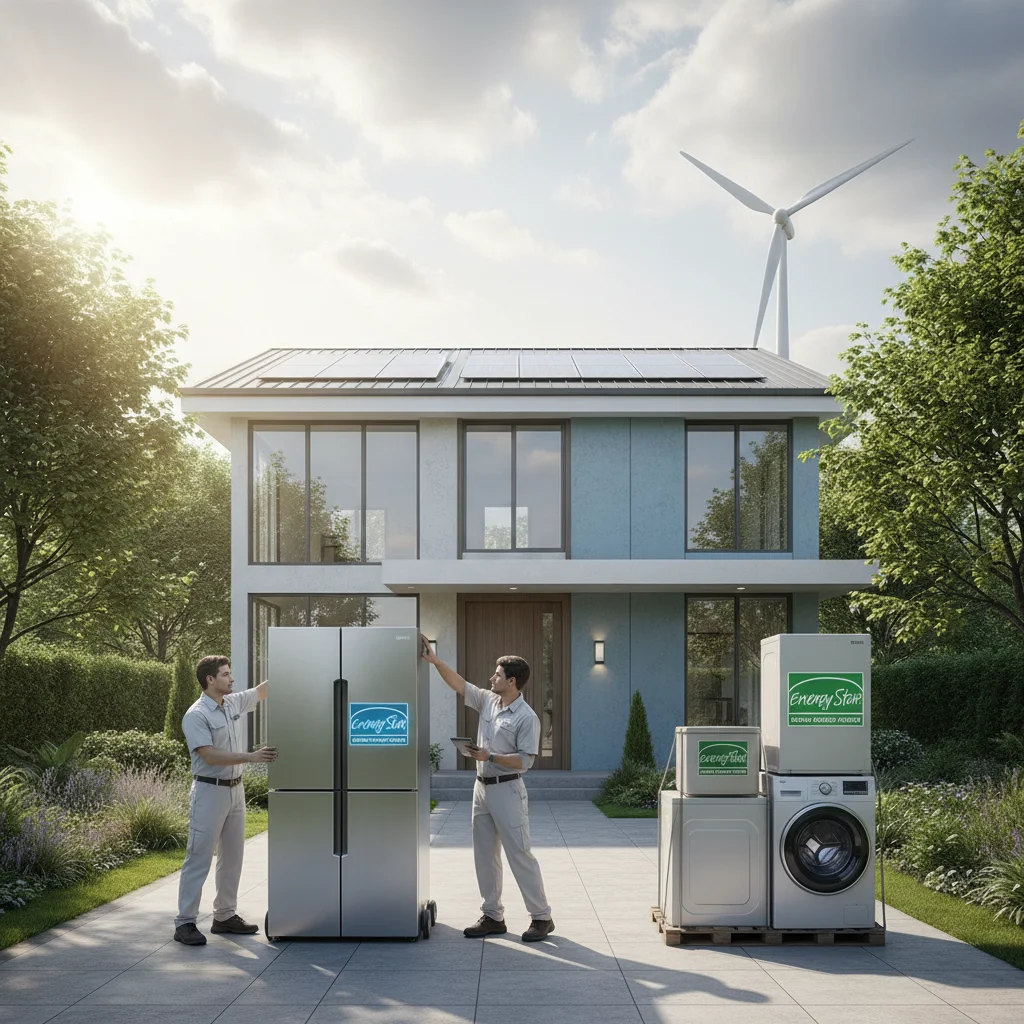
American households spent $139 billion on energy bills in 2025, with appliances accounting for 30% of that total. But federal and state programs now offer up to $14,000 in combined rebates for homeowners who upgrade to Energy Star-certified equipment. And most of these programs prioritize low- and moderate-income households, with some requiring no upfront payment at all.
How Much Can You Save With Energy Star Appliance Rebates?
Energy Star appliance rebates in 2026 range from $840 for a refrigerator to $1,750 for an electric heat pump water heater under the federal Home Efficiency Rebates program. State and utility programs add $50-$500 per appliance. Homeowners earning below 150% of area median income qualify for the maximum federal amounts, while those earning 150%-225% receive 50% of listed rebate values.
Federal rebate amounts depend on household income and equipment type. The Home Efficiency Rebates program, funded by the Inflation Reduction Act through 2032, covers major appliances including heat pump water heaters ($1,750), heat pump clothes dryers ($840), and electric stoves ($840). And state energy offices administer these federal dollars alongside their own incentive programs.
California's Tech Clean California initiative adds $750-$2,000 for heat pump water heaters on top of federal amounts. New York's Clean Heat program offers $500-$1,000 for cold climate heat pumps. But funding depletes quickly—New York's 2025 allocation ran out in 7 months.
So homeowners who stack federal rebates with state programs and utility incentives save $2,000-$5,000 per major appliance upgrade. The largest combined savings occur with heat pump water heaters and whole-home electrification projects.
"The Home Efficiency Rebates program provides up to $8,000 for whole-home energy upgrades, with an additional $4,000 available for electrical panel upgrades and wiring improvements." — U.S. Department of Energy
Which Appliances and Equipment Qualify for Rebates in Your Area?
Qualifying appliances must carry the Energy Star certification label and meet program-specific efficiency tiers. Federal Home Efficiency Rebates cover heat pump water heaters, heat pump clothes dryers, electric ranges and cooktops, and Energy Star-certified refrigerators purchased after January 1, 2023. State programs add dishwashers, clothes washers, and smart thermostats to eligible equipment lists.
Not all Energy Star appliances qualify for every rebate program. Heat pump water heaters must achieve a Uniform Energy Factor (UEF) of 3.3 or higher for federal rebates. Refrigerators need to exceed Energy Star standards by 10%-20% depending on the state program. And combination programs require whole-home energy assessments before approving individual appliance rebates.
Utility companies often restrict rebates to specific models from pre-approved manufacturer lists. Check your rebate calculator to verify equipment eligibility before purchasing. Oregon's Energy Trust, for example, maintains a database of 847 qualified heat pump water heater models but excludes hybrid units under 50 gallons.
But the highest rebate amounts go to homeowners who replace gas appliances with electric alternatives. Massachusetts offers $10,000 for full home electrification projects that eliminate all fossil fuel equipment, including furnaces, water heaters, and cooking appliances.
Do You Meet the Income Requirements for Energy Star Rebate Programs?
Federal Home Efficiency Rebates require household income below 225% of area median income (AMI) to qualify. Households earning 0%-80% AMI receive 100% of rebate amounts with no cost-sharing. Those earning 80%-150% AMI get 100% of rebates but may need to cover contractor costs upfront. And families earning 150%-225% AMI receive 50% of listed rebate values.
Area median income varies by county and household size. A family of four in San Francisco qualifies for full federal rebates with income below $211,950 (150% AMI), while the same family in rural Mississippi qualifies below $105,000. State energy offices publish AMI tables updated annually. So energy tax credits often work better for households above the 225% threshold.
Some state and utility programs impose no income restrictions at all. Florida's utility rebates remain available to all residential customers regardless of earnings. But these programs offer smaller amounts—typically $50-$200 per appliance compared to $840-$1,750 from income-restricted federal rebates.
And tribal households on federally recognized reservation land qualify for special carve-outs under the Home Efficiency Rebates program, with relaxed documentation requirements and expedited processing. The program allocated $225 million specifically for tribal energy programs through 2029.
"Income-qualified households can receive rebates covering 100% of project costs for energy efficiency upgrades, with no out-of-pocket expenses required." — Database of State Incentives for Renewables & Efficiency
What's the Step-by-Step Process to Apply for Energy Star Rebates?
Homeowners apply through their state energy office or designated rebate aggregator, not directly to the federal government. The process starts with a home energy assessment (required for federal rebates over $2,000), followed by contractor selection, equipment installation, and final rebate claim submission. Processing takes 6-12 weeks after claim approval, with payments issued via check, direct deposit, or instant rebate at point of sale.
Step one requires verifying household income eligibility through tax returns or other documentation specified by your state program. Step two involves scheduling a Home Energy Score assessment or equivalent audit—49 states now offer these for free to income-qualified households. And step three means selecting a contractor from your state's approved installer network.
Some states offer instant rebates where the contractor deducts the rebate amount from your invoice at installation. New York's Heat Pump Program uses this model for 100% of eligible projects. Other states require homeowners to pay the full cost upfront and wait for reimbursement, creating a cash flow barrier for low-income applicants.
But point-of-sale rebates eliminate upfront costs entirely. Colorado and Maryland now process 80% of rebate applications through instant discount systems integrated with contractor invoicing. So households avoid the need to finance equipment purchases while waiting for rebate checks.
And documentation requirements include photos of old equipment with serial numbers visible, receipts showing Energy Star certification, and contractor invoices itemizing all work performed. Applications missing any required documentation get rejected without review.
What Are the Deadlines and Current Funding Status for Available Rebates?
Federal Home Efficiency Rebates funding extends through December 31, 2031, but individual state allocations deplete on a first-come, first-served basis. As of March 2026, 18 states have opened their rebate portals with $7.2 billion in remaining federal funds. Arizona, Colorado, New Mexico, and Wisconsin expect to exhaust their 2026 allocations by June 2026 based on current application rates.
State deadlines vary dramatically. California's program remains open through 2029 with $361 million in unallocated funds. But Michigan's rebate portal closed for new applications on February 14, 2026, after receiving requests totaling 340% of available funding. And New Jersey operates quarterly funding rounds with application windows closing 6 weeks before each round begins.
Utility rebates operate on annual budget cycles, with many programs closing in Q3 after summer installation demand peaks. ConEd in New York typically exhausts its heat pump water heater rebates by August each year. So homeowners who wait until fall miss opportunities worth $500-$1,000 per appliance.
But some states maintain year-round rolling applications with guaranteed processing for projects submitted within 90 days of installation. Oregon and Washington use this model, providing predictable rebate access regardless of seasonal demand spikes. Check your rebate calculator for real-time funding availability in your ZIP code.
Can You Stack Energy Star Rebates With Other Incentives and Tax Credits?
Federal law allows stacking Home Efficiency Rebates with federal tax credits, state rebates, and utility incentives in 2026. Homeowners can combine up to $14,000 in federal rebates with the federal Energy Efficient Home Improvement Credit (up to $3,200 annually) and unlimited state or utility incentives. But total combined benefits cannot exceed the actual project cost, and some state programs reduce rebate amounts when other incentives are claimed.
The federal Energy Efficient Home Improvement Credit (Section 25C) ended for property placed in service after December 31, 2025 (IRS FS-2025-05). Federal tax credits for this work have ended, but state, local and utility rebates may still apply; check what is available at your address with the DuloCore rebate calculator. And this credit applies to the net cost after rebates are deducted. So a $5,000 heat pump water heater with a $1,750 rebate generates a $975 tax credit (30% of $3,250), creating total savings of $2,725.
But state stacking rules vary. Massachusetts prohibits combining its Mass Save heat pump rebates with federal Home Efficiency Rebates for the same equipment. Vermont allows full stacking of all available programs. And utility companies impose separate restrictions—some require homeowners to choose between utility rebates and state programs.
So the optimal stacking strategy depends on your specific location and income level. Households above 225% AMI maximize savings through federal tax credits plus utility rebates, since they don't qualify for income-restricted federal rebates. Those below 150% AMI should prioritize federal Home Efficiency Rebates first, then add state and utility programs if allowed.
| Program Type | Maximum Amount | Income Limit | Stackable |
|---|---|---|---|
| Federal Home Efficiency Rebates | $14,000 | 225% AMI | Yes |
| Federal Energy Efficient Home Improvement Credit | Ended Dec 31, 2025 | — | Ended Dec 31, 2025 |
| State Rebates (varies by state) | $500-$5,000 | Varies | Sometimes |
| Utility Incentives | $50-$1,000 | Usually none | Usually yes |
Do You Need a Certified Contractor to Qualify for Rebates?
Federal Home Efficiency Rebates require installation by contractors enrolled in your state's rebate program, but national certifications like NATE or BPI are not mandatory. Contractors must complete state-specific training covering rebate program rules, proper equipment sizing, and installation quality standards. And homeowners who self-install equipment forfeit eligibility for federal rebates, though some utility programs allow DIY installations for smaller appliances.
Each state maintains its own contractor network with 50-500 approved installers depending on population. New York's approved contractor list includes 287 companies, while Wyoming's network has 12 participating contractors as of March 2026. But homeowners can request that their preferred contractor join the program—most states allow new contractor applications year-round with approval in 2-4 weeks.
Contractor certification requirements protect against common installation mistakes that reduce equipment efficiency. Heat pump water heaters, for example, lose 15%-25% of rated efficiency when installed in unventilated spaces or with undersized electrical circuits. And certified contractors carry insurance covering rebate clawbacks if installations fail post-installation inspections.
So using an uncertified contractor voids your rebate eligibility even if the equipment qualifies. Some states audit 5%-10% of completed projects with home inspections. Failed audits trigger rebate denial or clawback of already-paid funds. But certified contractors guarantee installation quality and handle all audit documentation, eliminating homeowner liability.
Official Sources
- U.S. Department of Energy - Save Energy, Save Money — Federal rebate program information and state contact directories
- Database of State Incentives for Renewables & Efficiency — Comprehensive database of federal, state, and utility incentive programs
- Energy Star Rebate Finder — Official tool for locating available rebates by ZIP code
Frequently Asked Questions
What qualifies as an Energy Star appliance for rebate eligibility?
Energy Star appliances must carry the blue Energy Star label and meet EPA efficiency standards that exceed federal minimums by 10%-50% depending on product category. For federal Home Efficiency Rebates, qualifying equipment includes heat pump water heaters (UEF ≥3.3), heat pump clothes dryers, electric ranges, and refrigerators. State programs add dishwashers, clothes washers, and dehumidifiers to eligible lists. And equipment must be new—used or refurbished appliances don't qualify for any rebate programs in 2026.
How much can I save with Energy Star appliance rebates?
Federal Home Efficiency Rebates offer $840-$1,750 per appliance for income-qualified households, with heat pump water heaters receiving the maximum $1,750. State programs add $50-$2,000 depending on equipment type and location. And utility incentives contribute another $50-$500 per appliance. Total combined savings range from $1,000 for a single refrigerator upgrade to $14,000 for comprehensive whole-home electrification projects. But households earning above 150% of area median income receive 50% of federal amounts.
Where can I find Energy Star rebate programs in my area?
Check your state energy office website first—47 states now operate federal Home Efficiency Rebates programs as of March 2026. Use the rebate calculator to search by ZIP code for federal, state, and utility programs combined. And contact your electric and gas utility companies directly since many operate separate incentive programs with different eligibility rules. The Database of State Incentives for Renewables & Efficiency maintains the most comprehensive nationwide rebate directory updated weekly.
What is the application process for Energy Star appliance rebates?
Start with a home energy assessment if your project exceeds $2,000 in rebates—49 states offer free assessments to income-qualified households. Select a contractor from your state's approved network and obtain installation quotes. Submit your rebate application through your state's portal with income documentation, contractor invoices, equipment serial numbers, and installation photos. And processing takes 6-12 weeks for direct payment, though 15 states now offer instant point-of-sale rebates where contractors deduct amounts at installation.
Do Energy Star rebates apply to all appliance types or just specific models?
Federal Home Efficiency Rebates cover only electric heat pump appliances and select Energy Star equipment—heat pump water heaters, heat pump clothes dryers, electric stoves, and refrigerators. State and utility programs expand eligibility to dishwashers, clothes washers, air purifiers, and smart thermostats. But not all Energy Star models qualify—equipment must meet program-specific efficiency tiers that exceed base Energy Star standards. And your state maintains a pre-approved models list, so verify eligibility before purchasing to avoid rebate denial.
Ready to find out how much you can save? Use our free rebate calculator to discover all available Energy Star appliance rebates in your area. Get personalized estimates based on your income, location, and planned upgrades—plus step-by-step guidance on maximizing your total savings through stacked incentives.
Updated on April 14, 2026. Fact-checked by DuloCore Editors. About our research team.