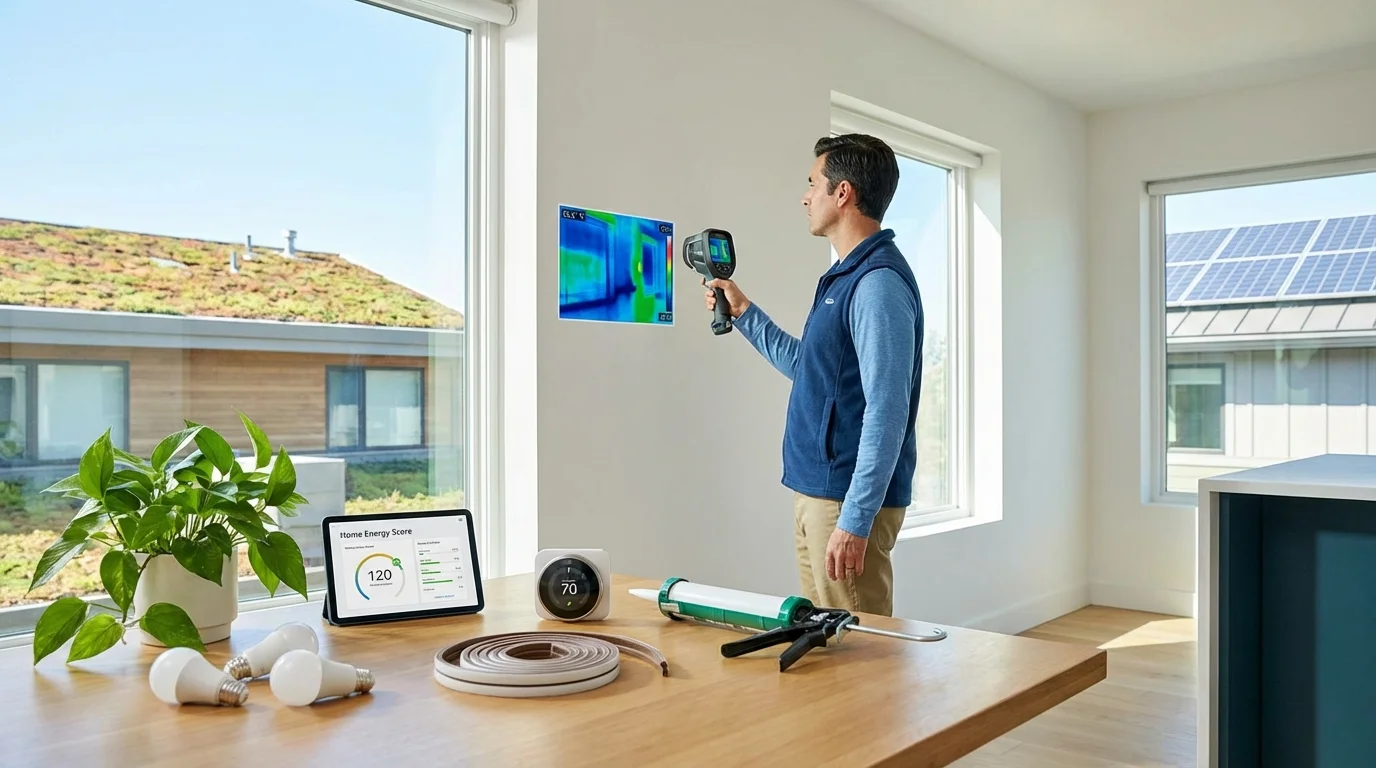
The average U.S. household loses 20% to 30% of the energy it pays for through drafts, air leaks around openings, and outdated equipment. For a home with a $200 monthly energy bill, that's up to $720 wasted each year—money that vanishes through cracks and inefficient technology. So making targeted upgrades isn't just about comfort; it's a direct financial countermeasure against this constant, invisible drain on your budget.
What Energy Improvements Under $500 Can I Make for My Home?
Affordable energy improvements under $500 for 2026 include installing a smart thermostat, adding attic insulation, air sealing gaps with caulk and weatherstripping, and replacing incandescent bulbs with ENERGY STAR LEDs. So these projects target the primary sources of energy loss, delivering a high return on a minimal investment.
The core tension for homeowners is the belief that meaningful energy savings require a 4-figure investment in solar panels or new windows. But the reality is different. Data from the Department of Energy shows that strategic air sealing and insulation improvements alone can reduce heating and cooling costs by an average of 15%. So for a small upfront cost, often under $500, these targeted fixes deliver immediate and recurring savings every month. Performing a home energy audit first helps identify the most impactful areas to address.
How Much Can I Save with Rebates, and What Equipment Qualifies?
Utility rebates for 2026 reduce the cost of sub-$500 energy upgrades by $50 to $250. And common qualifying equipment includes ENERGY STAR certified smart thermostats, which fetch rebates of $50-$100, and attic insulation, which often qualifies for incentives up to $0.75 per square foot.
Rebates directly lower the net cost of high-impact, affordable upgrades. For example, a $200 smart thermostat becomes a $100 investment after a typical $100 utility rebate. And insulation for a small attic space costing $450 receives a rebate of $150, bringing the final cost to just $300. So these incentives are specifically designed to accelerate the adoption of proven energy-saving technologies by making them financially accessible. Many homeowners use a rebate calculator to find exact savings for their zip code. The goal is to remove the cost barrier for equipment that provides a payback period of under two years.
Am I Eligible? Understanding Income Limits and Local Programs by State and Utility
Eligibility for 2026 energy improvement rebates under $500 is determined by your geographic location, your specific utility provider, and sometimes your household income. And many programs offer enhanced rebates, up to 100% of the cost, for households earning at or below 80% of the Area Median Income (AMI).
Your utility company (e.g., PG&E, Duke Energy, Con Edison) is the primary source for these rebates. But state energy offices also administer programs, often with different criteria. So homeowners must verify eligibility through their utility's online portal or state's energy website. For income-qualified programs, expect to provide documentation like a recent tax return or proof of enrollment in other assistance programs. These programs are separate from federal energy tax credits, which typically cover more expensive installations like new windows or doors.
"DSIRE is the most comprehensive source of information on incentives and policies that support renewables and energy efficiency in the United States." — DSIRE
What's the Application Process, Deadlines, and Current Funding Status for These Incentives?
The 2026 application process for sub-$500 rebates typically requires submitting a dated purchase receipt and the product's model number through an online utility portal. And most programs have a firm deadline of December 31, 2026, but funding is often depleted before then, making early application critical.
Homeowners purchase a qualifying product from a retail store or online, then navigate to their utility's rebate portal to fill out a digital form. So it's essential to save all receipts and packaging with model numbers. Funding is allocated annually and operates on a first-come, first-served basis. And once the program's budget for the year is exhausted, no more applications are accepted. Therefore, checking the program's funding status online before purchase is a necessary step. The process is much simpler than applying for larger incentives like heat pump rebates.
Can I Stack Incentives, and Do I Need a Contractor for These Affordable Upgrades?
Homeowners can stack utility rebates with manufacturer discounts for sub-$500 upgrades in 2026, but not typically with federal credits on the same equipment. And the majority of these affordable improvements, such as installing a smart thermostat or weatherstripping, are designed for DIY installation and don't require a contractor.
Combining a $100 utility rebate with a $50 manufacturer's sale price on a smart thermostat is a common strategy. So this stacking reduces a $250 device to a net cost of just $100. Most of these projects are intentionally DIY-friendly to eliminate labor costs. But some insulation rebates have rules that require installation by a licensed contractor to ensure proper R-value and air sealing, so always check program guidelines.
"Save money and energy at home with guidance from the U.S. Department of Energy." — DOE Energy Saver
Comparison of Sub-$500 Energy Improvements
| Improvement | Typical Cost (2026) | Potential Rebate Amount | DIY Feasibility |
|---|---|---|---|
| Smart Thermostat | $150 - $250 | $50 - $100 | High (30-60 min install) |
| Air Sealing Kit | $50 - $100 | $25 - $75 | High (weekend project) |
| Attic Insulation | $300 - $500 | $100 - $250 | Medium (requires safety gear) |
Official Sources
- ENERGY STAR Rebate Finder — A tool from the U.S. Environmental Protection Agency to find local rebates by zip code.
- Database of State Incentives for Renewables & Efficiency (DSIRE) — The most comprehensive national database of energy incentives, managed by the N.C. Clean Energy Technology Center.
Frequently Asked Questions
What specific energy improvements under $500 are eligible for rebates?
In 2026, eligible improvements typically include ENERGY STAR certified smart thermostats, attic insulation (up to a certain R-value), air sealing materials like caulk and weatherstripping, and LED light bulbs. Some utilities also offer rebates for hot water pipe insulation and smart power strips. The key is that the product must meet specific efficiency standards set by the program.
How much can I typically save with rebates on energy upgrades costing less than $500?
Savings on sub-$500 projects range from $50 to $250. A smart thermostat costing $200 often qualifies for a $75 rebate. Air sealing and insulation projects costing $400 can receive rebates covering up to 50% of the material cost, translating to a $200 savings. These amounts vary by utility and state program for 2026.
What is the process to apply for rebates on small home energy improvements?
The process involves three steps. First, purchase a qualifying product and save the full, itemized receipt. Second, visit your local utility's website and locate their rebate application portal. Third, fill out the online form, upload a digital copy of your receipt, and enter the product's model number. Approval and payment typically take 4-8 weeks.
Unlock Your Home's Savings Potential
Don't guess what rebates you qualify for. Our free, up-to-date tool instantly finds every local, state, and federal incentive available for your home.
Calculate Your Savings NowLast updated: April 14, 2026. Reviewed by the DuloCore Editorial Team. About our authors.