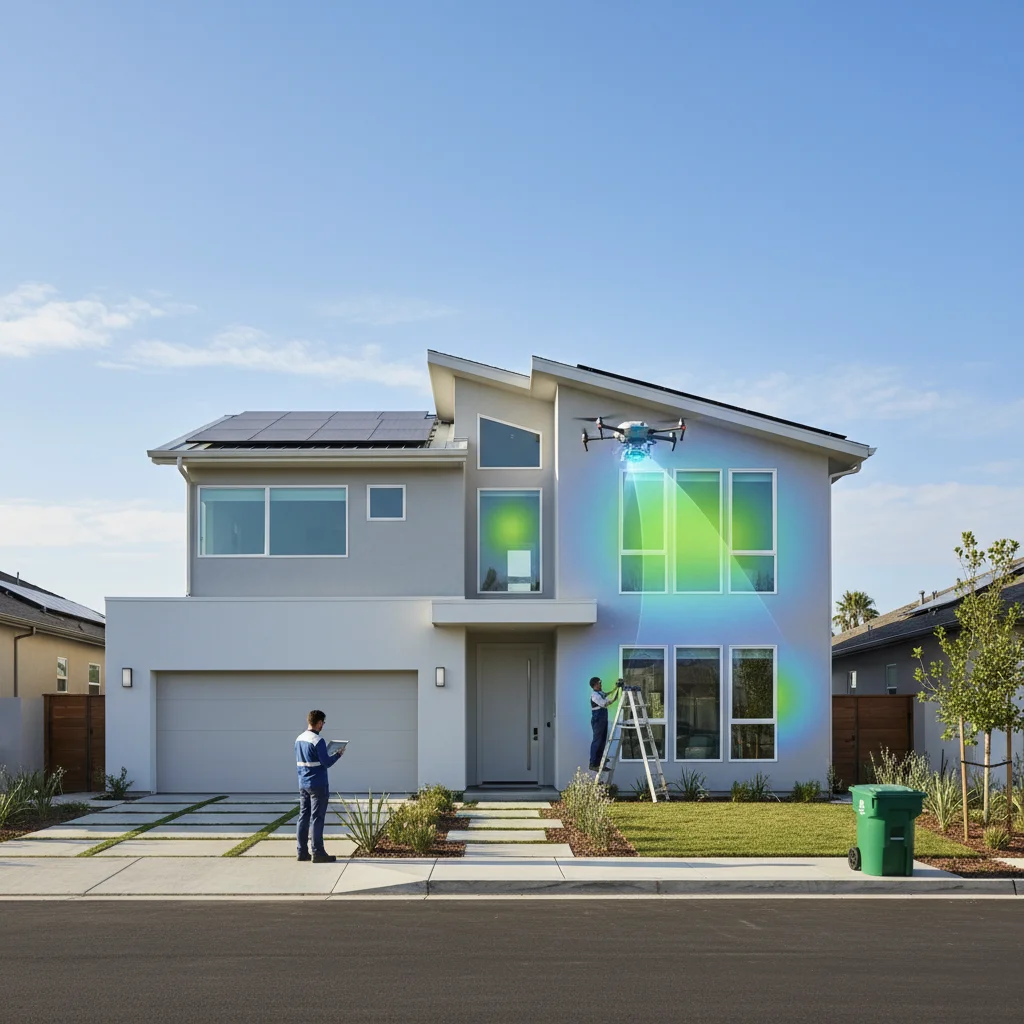
Two-story homes lose 35% more energy through the top floor ceiling than single-story homes, and most homeowners never realize they're paying $800-$1,200 extra per year until a professional energy audit reveals the leak points. Thermal imaging shows heat streaming out through second-floor walls, attic bypasses, and cathedral ceilings that builders never properly sealed. And federal rebate programs now cover 100% of audit costs for households earning under 80% of area median income.
How Much Can You Save With Energy Audit Rebates for Two Story Homes?
Energy audit rebates for two-story homes in 2026 range from $150-$500 depending on state and utility programs, with federal IRA Home Efficiency Rebates covering 100% of audit costs (up to $500) for households under 80% AMI and 50% of costs for households 80-150% AMI. State programs like California's Energy Upgrade California add $200-$300 per audit. And utility companies such as PG&E, SoCal Edison, and SDG&E reimburse $150-$400 for completed professional assessments.
The typical two-story energy audit costs $300-$600 before rebates. But post-rebate out-of-pocket expenses drop to $0-$150 for most California homeowners. And households that implement audit recommendations save $600-$1,400 annually on energy bills through air sealing, insulation upgrades, and HVAC improvements identified during the assessment.
Use our free rebate calculator to find your exact savings potential based on your home's square footage and current utility bills.
What Equipment Qualifies for Energy Audit Rebates in Your State?
Energy audit rebates in California qualify for comprehensive professional assessments including blower door testing, thermal imaging, duct leakage testing, combustion safety testing, and insulation depth measurements. The 2026 IRA Home Efficiency Rebates cover Type II audits that meet ANSI/RESNET/ICC 301 standards. And participating contractors must use HERS-certified raters or BPI-certified energy auditors.
Two-story homes require additional testing protocols not needed for single-story properties. So auditors test second-floor rim joists, attic bypasses around chimneys and plumbing stacks, cathedral ceiling insulation coverage, and air leakage between floors. And thermal cameras identify missing insulation in two-story wall cavities where settling creates gaps over time.
California's Energy Upgrade California program requires audits to include a detailed report showing current HERS score, recommended upgrades prioritized by ROI, estimated energy savings per improvement, and projected rebate amounts for each qualifying measure. Learn more about qualifying improvements in our guide to home energy audits.
Do You Meet the Income Requirements for Energy Audit Funding?
Income requirements for federal energy audit rebates in 2026 set 100% reimbursement for households earning under 80% of area median income (AMI) and 50% reimbursement for households 80-150% AMI. California's 80% AMI threshold equals $79,200 for a family of four in Sacramento, $112,000 in San Francisco, and $89,600 in Los Angeles based on HUD's 2026 income limits.
"Households at or below 80% of area median income qualify for up to $8,000 in home efficiency rebates plus full coverage of energy audit costs" — U.S. Department of Energy
But households above 150% AMI don't qualify for federal audit rebates through the IRA program. So these homeowners rely on state and utility rebates that don't include income restrictions. And California utilities like PG&E offer $150-$400 audit rebates regardless of income level.
Income verification requires pay stubs, tax returns, or participation in qualifying assistance programs like LIHEAP, SNAP, or Medicaid. Or homeowners can use the IRS 4506-C form to authorize direct income verification from tax records.
What's the Step-by-Step Application Process for Energy Audits?
The energy audit application process in 2026 starts with income pre-qualification through your state's rebate portal, followed by contractor selection from the approved HERS rater directory, audit scheduling within 14-21 days, on-site assessment lasting 2-4 hours, and rebate claim submission within 90 days of audit completion.
California homeowners apply through the Energy Upgrade California portal by entering household income, property address, and square footage. And the system instantly confirms rebate eligibility and displays approved contractors within 25 miles. So homeowners schedule directly with BPI-certified auditors who complete blower door testing, thermal imaging, and duct leakage testing during the same visit.
Auditors submit rebate claims electronically the same day as the audit. But homeowners receive reimbursement checks 4-6 weeks after claim approval. And the detailed audit report arrives within 5-7 business days showing specific upgrade recommendations prioritized by payback period.
Rebates stack with energy tax credits for implemented improvements, allowing homeowners to combine federal, state, and utility incentives for maximum savings.
When Are Energy Audit Rebate Deadlines and How's the Funding Status?
Energy audit rebate deadlines for California's 2026 programs run through December 31, 2026, with federal IRA Home Efficiency Rebates funded through 2032. But state funding operates on a first-come, first-served basis with $300 million allocated for 2026. And California's budget released in January 2026 shows $187 million still available as of April 2.
PG&E's audit rebate program shows 72% of 2026 funds remaining. So homeowners in PG&E territory see average 6-week wait times for audit appointments. But SoCal Edison reports 89% funding availability with 2-3 week scheduling windows.
"The Home Efficiency Rebate Program provides point-of-sale rebates for whole-house energy efficiency retrofits, with funding available through September 30, 2031" — Database of State Incentives for Renewables & Efficiency
Federal rebate deadlines don't expire until September 2031. But individual states exhaust annual allocations at different rates. So California homeowners who complete audits before June 2026 access the full range of state and utility incentives before high-demand summer months deplete available funds.
Can You Stack Energy Audit Rebates With Other State and Federal Programs?
Energy audit rebates stack with federal tax credits, state weatherization programs, and utility efficiency incentives in 2026, allowing California homeowners to combine four separate funding sources for the same improvements. The IRA framework permits rebate stacking as long as the total reimbursement doesn't exceed 100% of project costs. And audit rebates don't count toward the stacking cap because they reimburse assessment costs rather than equipment installation.
California homeowners layer federal audit rebates with Energy Upgrade California's $200-$300 state rebates plus utility company incentives of $150-$400. So total audit reimbursement reaches $500-$1,200 before any equipment upgrades. And implemented improvements qualify for separate rebates like heat pump rebates worth $8,000 for qualifying households.
| Program | Audit Rebate | Income Limit | Stacking Allowed |
|---|---|---|---|
| Federal IRA Home Efficiency | $500 (100% under 80% AMI) | 150% AMI | Yes |
| Energy Upgrade California | $200-$300 | None | Yes |
| California Utilities (PG&E, SCE, SDG&E) | $150-$400 | None | Yes |
The stacking process requires submitting separate applications to each program. But contractors familiar with California's rebate landscape handle multi-program submissions simultaneously. The federal Energy Efficient Home Improvement Credit (Section 25C) ended for property placed in service after December 31, 2025 (IRS FS-2025-05). Federal tax credits for this work have ended, but state, local and utility rebates may still apply; check what is available at your address with the DuloCore rebate calculator.
How Do You Find a Qualified Contractor for Your Energy Audit?
Qualified energy audit contractors in California hold BPI (Building Performance Institute) certification or HERS (Home Energy Rating System) rater credentials required for rebate eligibility. The 2026 IRA Home Efficiency Rebates mandate ANSI/RESNET/ICC 301-compliant audits performed by certified professionals. And California's Energy Upgrade California maintains a searchable directory of 340+ approved contractors statewide.
Homeowners verify contractor credentials through the BPI contractor locator or RESNET's HERS rater directory showing certification number, expiration date, and complaint history. And qualified contractors carry $2 million general liability insurance plus errors and omissions coverage specific to energy auditing services.
Two-story homes require contractors experienced with multi-level testing protocols including attic bypass identification, second-floor rim joist sealing, and cathedral ceiling diagnostics. So homeowners request references from at least three recent two-story audits and verify that contractors use calibrated blower door equipment and FLIR thermal imaging cameras with temperature resolution under 0.1°C.
California contractors charge $300-$600 for comprehensive two-story audits before rebates. But quotes vary based on home square footage, HVAC system complexity, and number of thermal zones. And most contractors offer same-day scheduling for homes under 3,000 square feet.
Official Sources
- U.S. Department of Energy Save Energy, Save Money — Federal rebate programs and energy efficiency guidance for homeowners
- Database of State Incentives for Renewables & Efficiency — Comprehensive database of state and utility rebate programs with current funding status
Frequently Asked Questions
How much does an energy audit cost for a two story home?
Professional energy audits for two-story homes cost $300-$600 before rebates depending on square footage, HVAC complexity, and geographic location. California homeowners pay $350-$550 on average for comprehensive assessments including blower door testing, thermal imaging, and duct leakage diagnostics. But federal and state rebates reduce out-of-pocket costs to $0-$150 for most households. And homes over 3,000 square feet see costs reach $600-$800 due to extended testing time.
What should I expect during a professional energy audit?
Professional energy audits for two-story homes take 2-4 hours and include visual inspection, blower door testing to measure air leakage, thermal imaging to identify insulation gaps, duct leakage testing, combustion safety testing for gas appliances, and insulation depth measurements in attics and walls. Auditors test for second-floor specific issues like rim joist air leaks, attic bypasses around chimneys and plumbing penetrations, and cathedral ceiling insulation settlement. The final report shows current HERS score, prioritized upgrade recommendations, estimated energy savings per improvement, and rebate amounts for qualifying measures.
Are energy audits required to qualify for rebates?
Energy audits are required to qualify for federal IRA Home Efficiency Rebates and California's Energy Upgrade California whole-house rebates worth up to $8,000 for qualifying households. But individual equipment rebates like heat pump or water heater incentives don't require pre-installation audits. And post-installation audits verify that improvements achieved projected energy savings to unlock final rebate disbursement. So homeowners pursuing maximum rebate stacking complete audits before any equipment upgrades to identify the highest-ROI improvements first.
How long does an energy audit take for a two story house?
Energy audits for two-story houses take 2-4 hours depending on home size, HVAC system complexity, and number of thermal zones. Homes under 2,500 square feet with single HVAC systems require 2-3 hours. But properties over 3,000 square feet with multiple heating zones, cathedral ceilings, and complex ductwork extend to 4-5 hours. And auditors spend 45-60 additional minutes testing second-floor specific issues like attic bypasses, rim joist air leaks, and insulation settlement in two-story wall cavities.
What's the difference between a DIY energy audit and a professional one?
DIY energy audits identify obvious issues like drafty windows and missing weatherstripping but can't measure whole-home air leakage, detect hidden insulation gaps with thermal imaging, or quantify duct system efficiency losses. Professional audits use calibrated blower door equipment showing precise air changes per hour, FLIR thermal cameras revealing temperature differentials under 0.1°F, and duct blaster testing measuring leakage in cubic feet per minute. And only professional HERS-certified audits qualify for federal and state rebates worth $500-$1,200.
Ready to find your energy savings? Use our free rebate calculator to discover exactly how much you can save with energy efficiency upgrades identified through a professional audit. Get your personalized rebate estimate in under 2 minutes.
Last reviewed: April 14, 2026. Reviewed by DuloCore Energy Specialists. About the team.