Update (2026): The federal Energy Efficient Home Improvement Credit (Section 25C) expired December 31, 2025, following the passage of the OBBBA. Check state and local programs for current incentives.
Homes with high-performance energy efficiency features sell for up to 30% more than their un-upgraded counterparts. Yet, the average U.S. household wastes over $400 annually on energy leaks that a simple audit can identify. So this isn't just about saving on monthly bills; it's about unlocking thousands in untapped equity before you sell. And the key to accessing that value starts with a professional assessment.
How Does an Energy Audit Directly Boost Your Home's Market Value?
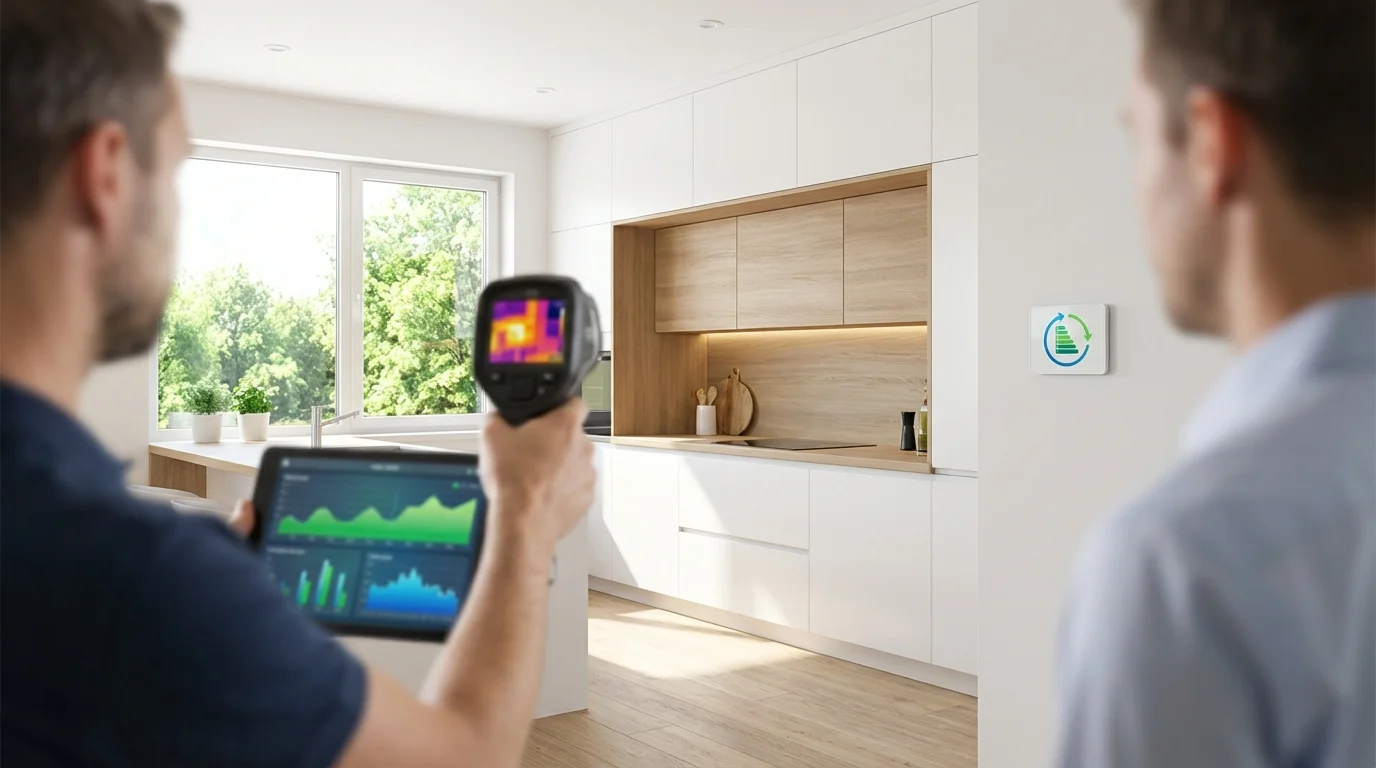
A professional home energy audit serves as a certified roadmap for improvements that directly increase a property's market value in 2026. The audit generates a HERS (Home Energy Rating System) Index score, providing a quantifiable metric that appraisers and buyers use to assess efficiency. Lower scores translate to higher value.
So, completing the recommended upgrades, such as air sealing or adding insulation, provides documented proof of enhanced performance. And this documentation justifies a higher listing price, with studies showing certified energy-efficient homes sell for 2.7% to 5% more than non-certified homes. But the audit itself is the first step, identifying the highest-impact upgrades. A detailed home energy audit pinpoints specific areas like attic insulation R-value deficiencies or air leakage rates measured in CFM (cubic feet per minute), turning invisible problems into a tangible action plan.
What Rebates and Incentives Can Increase Your Home's Energy Efficiency Value?
Federal and state rebates directly subsidize the cost of energy upgrades, amplifying the return on investment and boosting home value. The Inflation Reduction Act (IRA) offers two primary rebate programs for 2026: the Home Electrification and Appliance Rebate (HEEHRA) program, which provides up to $14,000 for low-to-moderate-income households, and the HOMES Rebate program.
But these programs are state-administered, meaning funding is limited. And the HEEHRA program covers 100% of electrification project costs up to the cap for households earning less than 80% of the Area Median Income (AMI). So, a homeowner can install a $8,000 heat pump with zero out-of-pocket cost, adding immediate value. In addition to rebates, federal energy tax credits cover 30% of the cost for qualifying projects like solar panels or geothermal systems, further reducing the net investment required to achieve a higher home valuation.
Am I Eligible for Energy Efficiency Programs, and What's the Application Process?
Eligibility for 2026 energy efficiency programs primarily depends on household income and location. The HEEHRA program, for instance, sets strict income caps: households earning below 80% of the Area Median Income (AMI) qualify for 100% of costs covered (up to $14,000), while those between 80-150% AMI qualify for 50% coverage.
So the application process typically involves four steps. First, schedule a professional energy audit to identify qualifying upgrades. Second, obtain quotes from certified contractors for the recommended work. Third, submit the application through your state's energy office portal, including the audit report and contractor bids. But applications are often processed on a first-come, first-served basis until annual funds are depleted. And many states require pre-approval before work begins, so starting the project without it risks disqualification.
"The HOMES Rebate Program provides performance-based rebates for whole-house energy saving retrofits. The more energy you save, the more money you get back." — U.S. Department of Energy
What Are the Deadlines and Funding Status for Key Energy Efficiency Programs?
Federal IRA rebate funding extends through September 30, 2031, but the state-administered programs operate with annual budgets that can be exhausted well before year-end. For 2026, many state energy offices opened their application portals in Q1, and high-demand programs often run out of funds by Q3.
So, the key is to monitor your state's energy office website for real-time funding status. And while the federal tax credits are not subject to the same funding caps, they also have an expiration date of December 31, 2025. But utility-level rebates for equipment like heat pumps or smart thermostats operate on even shorter timelines, often refreshing their budgets quarterly or annually. So verifying the current status and deadline before purchasing equipment is essential for securing the available $500 to $2,000 in local incentives. Find available heat pump rebates in your area now.
How Can I Compare Energy Efficiency Upgrades to Maximize Home Value and Rebate Stacking?
Comparing upgrades from an energy audit requires prioritizing projects with the highest return on investment (ROI) and rebate potential. An audit will rank recommendations, often placing air sealing and attic insulation (up to a $1,200 annual tax credit) at the top for their low cost and high impact on energy savings, with an ROI exceeding 100%.
So, homeowners then stack rebates to maximize financial benefits. For example, a qualifying household can use a $8,000 HEEHRA rebate for a new heat pump, a $600 state utility rebate for the same equipment, and a $1,200 federal tax credit for insulation installed in the same year. And this strategy reduces the net project cost by over $9,800. But stacking rules vary by state; some programs prohibit combining state and utility rebates for the same piece of equipment. Use our free rebate calculator to find your personalized savings and stacking opportunities.
2026 Energy Rebate Program Comparison
| Program Name | Max Rebate/Credit | Income Eligibility | 2026 Deadline |
|---|---|---|---|
| HEEHRA Rebate | Up to $14,000 | <150% of Area Median Income | State-dependent, until funds are depleted |
| HOMES Rebate | $2,000 - $8,000 | None | State-dependent, until funds are depleted |
| IRA Tax Credits | Ended Dec 31, 2025 | — | December 31, 2025 |
Official Sources
- DSIRE (Database of State Incentives for Renewables & Efficiency) — The most comprehensive source for state, local, utility, and federal incentives.
- ENERGY STAR Rebate Finder — An EPA-managed tool to find local rebates on certified energy-efficient products.
- U.S. Department of Energy (DOE) — Federal guidance on the Inflation Reduction Act home energy rebate programs and tax credits. (note: the federal 25C and 25D credits ended for projects completed after December 31, 2025)
Related Reading: Learn more about Home Energy Audit What To Expect and Inflation Reduction Act Home Energy.
Related Reading: Learn more about Electric Vehicle Home Energy Impact.
Frequently Asked Questions
Does an energy audit directly increase a home's market value?
An energy audit itself doesn't add value, but it's the critical first step. The audit provides a certified report detailing necessary upgrades. So completing these documented improvements, like adding insulation or installing a heat pump, increases the home's appraisal value. And the certification, such as a HERS score, serves as tangible proof to buyers and appraisers of the home's superior performance, justifying a price increase of 3-5%.
How much value can an energy audit add to a property?
The value added depends on the upgrades performed based on the audit's findings. And studies from the National Bureau of Economic Research show that energy efficiency improvements can increase a home's sale price by 4% to 8%. So for a $400,000 home, this translates to an increased value of $16,000 to $32,000. But the initial audit, costing $300-$600, is the catalyst for unlocking this equity.
Are energy efficiency improvements from an audit attractive to potential home buyers?
Yes, they are highly attractive. A 2023 Zillow report found that listings mentioning energy-efficient features sold up to 10 days faster. And buyers are increasingly aware of long-term ownership costs. So a home with a documented low HERS score and recent upgrades like a new heat pump or insulation signals lower utility bills, which is a powerful selling point that commands a premium of over $15,000 on average.
What is the return on investment for an energy audit when selling a home?
The ROI for an energy audit is realized through the subsequent upgrades. And while the audit itself costs between $300 and $600, the recommended improvements often have an ROI exceeding 100%. For example, spending $2,000 on attic insulation and air sealing can increase a home's value by over $3,500 and save $400 annually on energy bills, delivering a rapid payback and a net positive return at the time of sale.
Unlock Your Home's Hidden Value
An energy audit is the first step. The next is finding every rebate and tax credit to pay for the upgrades. Use DuloCore's free Rebate Calculator to see how much you can save in under 2 minutes.
Calculate Your Savings NowUpdated on April 14, 2026. Fact-checked by DuloCore Editors. About our research team.