Update (2026): The federal Energy Efficient Home Improvement Credit (Section 25C) expired December 31, 2025, following the passage of the OBBBA. Check state and local programs for current incentives.
Homes built before 1980 account for over 60% of the U.S. housing stock, and they lose up to 35% of their heating and cooling energy through air leaks alone. Those drafts aren't just a comfort issue; they represent a direct and escalating drain on your finances every single month. So tackling this energy waste is the single most effective step owners of older homes take to lower their utility bills in 2026.
Why is an energy audit crucial for your old, drafty house?
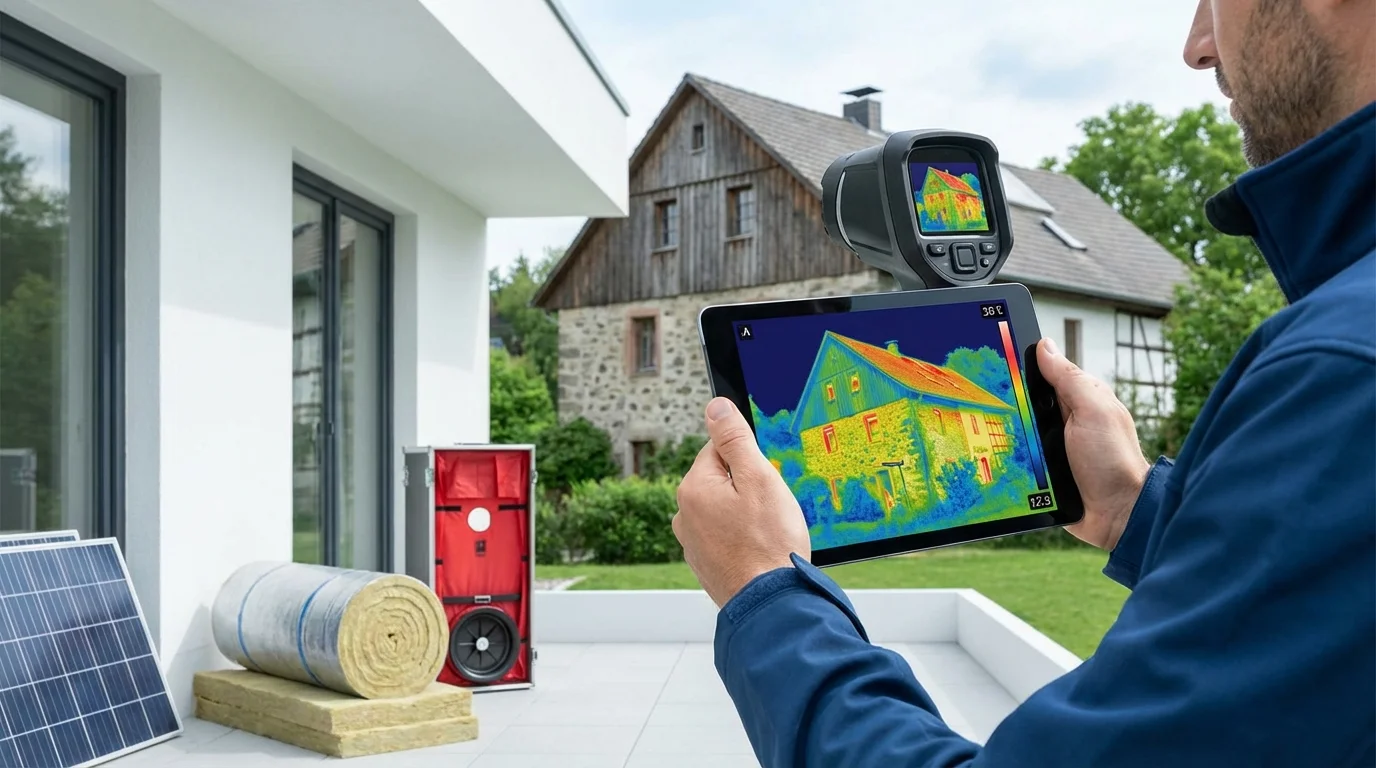
A professional energy audit is a diagnostic service that uses tools like blower doors and infrared cameras to pinpoint exact sources of energy loss in older homes. And it provides a prioritized roadmap for upgrades, ensuring investments in insulation or air sealing deliver a 15-30% reduction in annual energy costs.
An audit is the foundational step for any efficiency project in an older home. Without this data, homeowners risk spending thousands on upgrades that don't address the primary sources of energy waste. But a certified auditor identifies the specific locations of air leakage—like unsealed attic hatches, poorly insulated rim joists, and gaps around windows—that cause the most significant heat loss. So the audit report becomes a strategic plan, detailing which improvements offer the highest return on investment. This targeted approach is essential, as the Department of Energy estimates that strategic air sealing and insulation, guided by an audit, cuts heating and cooling costs by up to 30%. And many 2026 utility rebate programs require a professional home energy audit as a prerequisite for funding larger projects like insulation or window replacement.
What financial incentives and rebates are available for energy audits and upgrades in your state and from utilities?
Financial incentives for 2026 include federal tax credits covering 30% of project costs up to $3,200 annually, alongside state and utility rebates that often cover 50-100% of the audit cost itself. And these programs reduce the net cost of subsequent upgrades like insulation by thousands.
The financial support for energy efficiency is robust. The Inflation Reduction Act provides federal energy tax credits that homeowners claim for audits, insulation, and high-efficiency heating systems. But the most immediate savings come from state and utility programs. For example, many utilities offer instant rebates that cover the entire $300-$500 cost of a comprehensive energy audit for income-qualified residents. So the diagnostic service becomes free. And these local programs provide direct rebates for the upgrades recommended in the audit, such as $1.00 per square foot for attic insulation or a $500 rebate for sealing ductwork. You can find all available 2026 incentives in your area with our free rebate calculator.
"State and local governments and utilities also offer a variety of energy efficiency incentives. DSIRE is the most comprehensive source of information on these incentives." — DSIRE®
What equipment and contractor requirements qualify for energy efficiency programs and rebates?
Qualifying upgrades must meet specific ENERGY STAR® or Consortium for Energy Efficiency (CEE) standards, and work must be performed by a contractor with certifications like BPI (Building Performance Institute). And failing to meet these strict requirements results in automatic rebate denial, regardless of the project's cost.
Rebate programs don't fund just any upgrade. So the equipment installed must meet stringent efficiency tiers. For instance, insulation must meet specific R-value targets for your climate zone, and new windows must have a U-factor below 0.27 to qualify for most 2026 credits. The contractor's credentials are just as critical. Utilities require that auditors and installers hold active BPI certifications to ensure the work is performed to industry standards. And they often maintain a list of pre-approved, certified contractors on their websites. So homeowners must verify their chosen contractor is on this list before signing any contract. This step prevents the common pitfall of completing a project only to discover it’s ineligible for a rebate that would have saved $2,000.
How do you apply for energy audit rebates, and what are the income limits and deadlines?
The application process typically involves getting pre-approval from the utility, completing the audit with a certified professional, and submitting an invoice and application form before the program's deadline, often December 31, 2026. And many programs have income limits, with higher rebates available for low-to-moderate-income households.
Applying for rebates requires careful documentation. First, homeowners confirm eligibility, as many programs are tiered based on Area Median Income (AMI); households below 80% of AMI often receive enhanced rebates covering 100% of costs. Next, they schedule the audit with a program-approved contractor. After the audit, a signed application, a copy of the contractor's invoice, and the audit report are submitted through the utility's online portal. The deadline is absolute—most 2026 utility programs close applications on December 31st or when funds are exhausted, whichever comes first. So waiting until late in the year is risky, as popular programs often run out of funding by October. The entire process, from application to receiving a check, typically takes 6-8 weeks.
Can you combine different state and utility energy efficiency programs for maximum savings?
Homeowners can stack federal tax credits with one state or one utility rebate for the same project, but they generally cannot stack two utility rebates for the same upgrade. And this strategy allows for savings that cover 50-70% of the total project cost for major upgrades.
Combining incentives is the key to maximizing affordability. For example, a homeowner can claim the 30% federal tax credit (up to $1,200) for an insulation project and also receive a $1,500 rebate from their state's energy office for the same job. But they cannot claim the state rebate and a separate insulation rebate from their electric utility. The rule of thumb is one government incentive (federal or state) plus one utility incentive per project. So a $10,000 heat pump installation can benefit from a $2,000 federal tax credit and a $4,000 utility heat pump rebate, reducing the net cost to $4,000. It's crucial to read the terms for each program, as some explicitly prohibit stacking with any other financial incentive.
2026 Energy Audit & Upgrade Incentive Comparison
| Incentive Program | Rebate/Credit Amount | Key Eligibility | 2026 Deadline |
|---|---|---|---|
| Federal IRA Credit | Ended Dec 31, 2025 | — | Dec 31, 2025 |
| State (e.g., NYSERDA) | Up to $4,000 for insulation | NY residents, income limits apply | Varies by program |
| Utility (e.g., PG&E) | Up to 100% of audit cost | PG&E customer, income limits apply | When funds are depleted |
Official Sources
- ENERGY STAR — A U.S. Environmental Protection Agency program for finding certified products and local rebates.
- Department of Energy (DOE) — Federal resource for information on home energy savings, audits, and tax credits available through the Inflation Reduction Act. (note: the federal 25C and 25D credits ended for projects completed after December 31, 2025)
"Save money and energy at home by making your home more energy efficient. An energy-efficient home will help reduce high energy bills, improve comfort, and increase your home's value." — U.S. Department of Energy
Related Reading: Learn more about Spring Energy Audit Maintenance and Vapor Barrier Energy Audit.
Frequently Asked Questions
Do old drafty houses qualify for energy audit rebates?
Yes, old and drafty houses are the primary targets for energy audit rebates. Utility and state programs for 2026 are specifically designed to help homeowners identify and fix the most severe sources of energy waste. Eligibility typically depends on being a customer of the sponsoring utility, and some programs have income requirements to provide enhanced rebates covering up to 100% of the audit cost.
What does an energy audit entail for a drafty historic home?
For a historic home, an energy audit includes a standard blower door test to measure air leakage and infrared thermography to visualize heat loss. But the auditor also pays special attention to preserving the home's character. Recommendations focus on non-invasive solutions like adding insulation to attics and crawlspaces, sealing air leaks with foam and caulk, and installing interior storm windows to maintain the original facade.
What is the average cost of an energy audit for a drafty house after rebates?
The average pre-rebate cost of a comprehensive energy audit is between $300 and $700. But for 2026, many state and utility programs offer rebates that cover 50-100% of this cost. For income-qualified homeowners, the final out-of-pocket cost is often $0. For others, the net cost after a standard rebate is typically between $100 and $250.
Is an energy audit truly beneficial for reducing drafts in an old house?
Yes, an energy audit is extremely beneficial. It moves beyond guesswork by using diagnostic tools to pinpoint the exact locations of drafts, which often originate in unexpected places like recessed lighting fixtures or basement rim joists. The final report provides a prioritized action plan that, when followed, reduces drafts and lowers annual heating and cooling costs by 15-30%.
What upgrades are typically recommended after an energy audit for a drafty old house?
The most common recommendations are air sealing and insulation. This involves using caulk and spray foam to seal gaps in the attic, basement, and around windows. And it includes adding blown-in cellulose or fiberglass insulation to the attic to reach an R-value of R49-R60. Other frequent suggestions include duct sealing, installing high-efficiency water heaters, and upgrading to ENERGY STAR certified windows.
Stop Wasting Money on Drafts
Your old house has hidden energy savings waiting to be unlocked. Use the DuloCore rebate calculator to see how much you can get back on an energy audit and upgrades in 2026.
Calculate Your Savings NowLast updated April 14, 2026 — reviewed by DuloCore Editorial. About our authors.