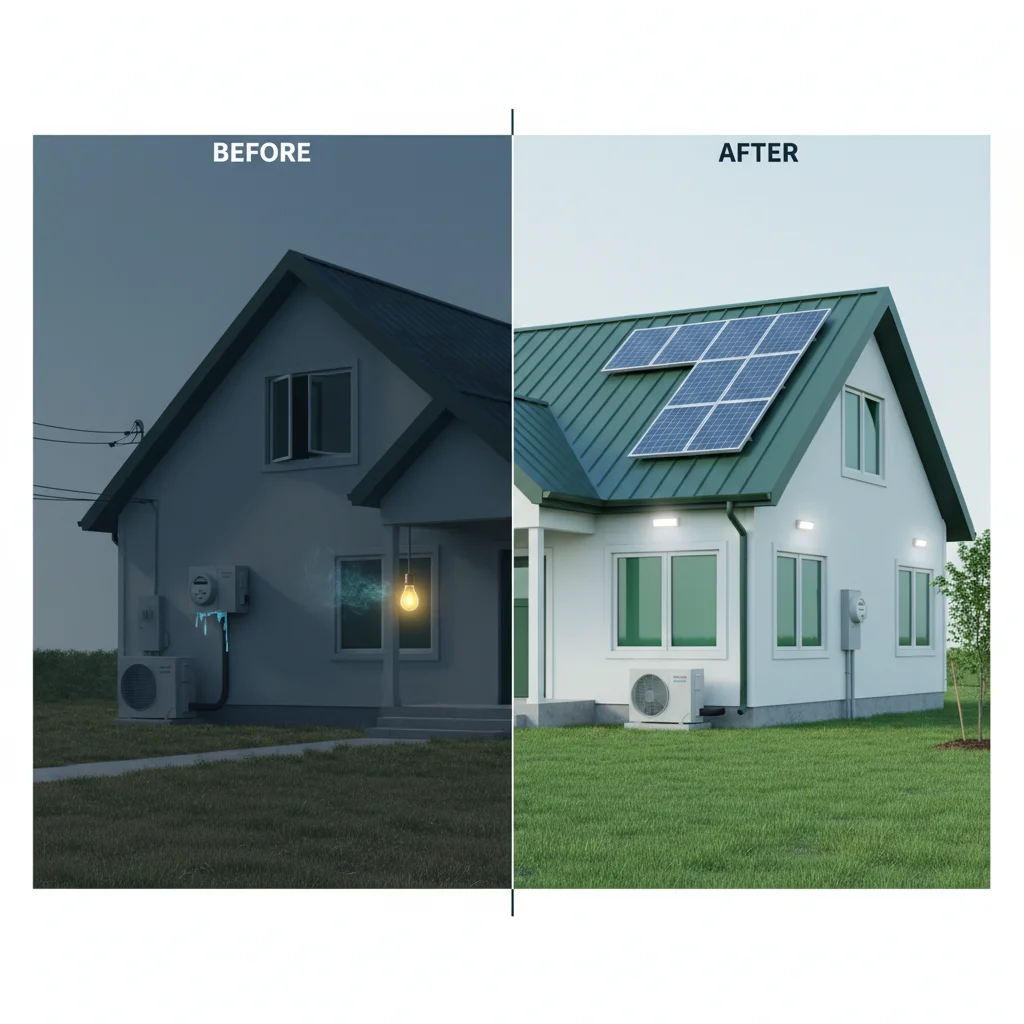
Before a professional energy audit, the average California home loses $600 to $1,200 per year through air leaks, inadequate insulation, and inefficient HVAC systems. And after implementing the recommended upgrades, homeowners cut those losses by 20% to 40% within the first 12 months.
Energy audits identify specific inefficiencies in homes, and implementing the recommended upgrades saves California homeowners $200 to $800 annually on utility bills. The federal Energy Efficient Home Improvement Credit (Section 25C) ended for property placed in service after December 31, 2025 (IRS FS-2025-05). California utility rebates add $500 to $8,000 depending on installed equipment and household income.
What Income Limits Apply to Energy Audit Rebates and Tax Credits?
The federal Energy Efficient Home Improvement Credit (Section 25C) ended for property placed in service after December 31, 2025 (IRS FS-2025-05). Federal tax credits for this work have ended, but state, local and utility rebates may still apply; check what is available at your address with the DuloCore rebate calculator. But California's TECH Clean California program restricts rebates to households earning 80% or less of Area Median Income for enhanced incentives ranging from $2,000 to $8,000 per heat pump installation.
PG&E's Energy Savings Assistance Program targets households at or below 200% of the federal poverty level, offering free energy audits and zero-cost weatherization upgrades including insulation, air sealing, and HVAC replacement. And SCE's Home Energy Improvement Program pays $500 to $2,500 for comprehensive upgrades regardless of income, with bonus incentives for moderate-income households.
So homeowners earning above the AMI threshold still qualify for federal credits and standard utility rebates, but miss the enhanced payments reserved for lower-income participants. Income verification requires recent tax returns or pay stubs submitted during the application process.
How Much Can You Actually Save With an Energy Audit Before and After Improvements?
Professional energy audits cost $300 to $500 in California, but utility programs from PG&E, SCE, and SoCalGas subsidize audits to $0 to $150 for qualifying customers. And the audit report identifies specific savings opportunities worth $400 to $1,500 per year in reduced energy costs.
Air sealing alone reduces heating and cooling costs by 10% to 20%, saving the average California home $120 to $360 annually. But combining air sealing with attic insulation upgrades from R-19 to R-49 pushes savings to $300 to $600 per year in climate zones with hot summers or cold winters.
Heat pump installations generate the largest post-audit savings, cutting HVAC energy use by 30% to 50% compared to traditional furnaces and air conditioners. So a home spending $1,200 annually on heating and cooling saves $360 to $600 after switching to a ducted heat pump system.
The payback period for audit-recommended upgrades ranges from 2 to 7 years depending on the improvement. Air sealing pays back in 1 to 3 years, insulation in 3 to 5 years, and heat pumps in 5 to 10 years before incentives. Federal credits and utility rebates shorten these timelines by 30% to 60%.
Use our free rebate calculator to estimate your specific savings based on your home's size, age, and current energy bills.
| Improvement Type | Upfront Cost | Annual Savings | Payback (Before Incentives) | Payback (After Incentives) |
|---|---|---|---|---|
| Air Sealing | $800-$1,500 | $120-$360 | 2-4 years | 1-2 years |
| Attic Insulation | $1,500-$3,000 | $200-$500 | 3-6 years | 2-4 years |
| Heat Pump (Ducted) | $12,000-$18,000 | $360-$600 | 8-12 years | 4-7 years |
| Heat Pump Water Heater | $2,500-$4,000 | $200-$400 | 6-10 years | 3-5 years |
What Documentation Do You Need to Qualify for Energy Audit Programs?
Utility-sponsored audit programs require proof of residency, a recent utility bill showing the service address, and income verification for enhanced rebates. And homeowners submit tax returns from the most recent filing year or three consecutive months of pay stubs for all household members over 18.
The audit report itself becomes required documentation for rebate applications tied to specific improvements. California's Building Energy Benchmarking Program mandates that auditors use HERS (Home Energy Rating System) certified software, and the resulting report includes itemized recommendations with estimated costs and savings projections.
Form 5695 only covers qualifying work completed by December 31, 2025 and claimed on a 2025 return; the federal 25C and 25D credits ended after that date (IRS FS-2025-05). And contractors performing the work provide Manufacturer Certification Statements confirming heat pumps meet ENERGY STAR or CEE Tier 2 requirements.
Pre-audit photos documenting existing conditions help support insurance claims if mold, water damage, or structural issues surface during the assessment. So homeowners photograph attic insulation levels, HVAC equipment nameplates, and visible air leaks before the auditor arrives.
"Energy assessments identify opportunities to save energy and money through cost-effective upgrades and behavior changes." — U.S. Department of Energy
Is Pre-Approval Required Before Getting Your Energy Audit Done?
Most California utility programs don't require pre-approval for the audit itself, but specific rebates for recommended improvements demand pre-approval before purchasing equipment or starting work. And PG&E's Home Upgrade Program requires homeowners to reserve rebate funding online before scheduling contractor bids.
TECH Clean California operates on a first-come, first-served basis with rolling enrollment periods. Contractors check real-time funding availability through the program portal before submitting applications, and homeowners receive approval within 5 to 10 business days.
But waiting until after installation means missing utility rebates that require upfront registration and approved contractor participation.
So the optimal sequence is: schedule subsidized energy audit → receive report → apply for utility rebate pre-approval → select approved contractor → complete installation → submit final documentation → claim federal tax credit when filing taxes.
What Are the Stacking Rules When Combining Multiple Energy Efficiency Incentives?
California allows stacking federal tax credits with state and utility rebates for the same improvement, but prohibits combining multiple utility rebates for identical equipment. And homeowners claim the 30% federal credit (this federal credit ended for property placed in service after December 31, 2025) on the net cost after subtracting utility rebates and state incentives.
A heat pump installation costing $15,000 with a $3,000 utility rebate qualifies for the federal credit calculated on the remaining $12,000, yielding $3,600 in tax credit value. So the total incentive package reaches $6,600, reducing the net cost to $8,400.
But combining PG&E's heat pump rebate with TECH Clean California's incentive for the same unit violates stacking rules, and applicants must choose the higher-value program. State programs like SGIP (Self-Generation Incentive Program) for battery storage stack with federal credits and utility rebates without restrictions.
Local government programs through Property Assessed Clean Energy (PACE) financing don't count as incentives for stacking purposes, but the interest paid on PACE loans isn't tax-deductible. And homeowners claiming federal credits must reduce the equipment cost basis by any subsidized loans or grants before calculating the 30% credit.
What Are the Application Deadlines for Energy Audit Rebates in 2026?
The federal Energy Efficient Home Improvement Credit (Section 25C) ended for property placed in service after December 31, 2025 (IRS FS-2025-05). But California utility rebates operate on annual budget cycles that close when funding exhausts, typically in Q3 or Q4 for popular programs.
TECH Clean California announced $120 million in funding for 2026, and past enrollment periods closed within 6 to 9 months of the January 1 opening date. And PG&E's Energy Savings Assistance Program accepts applications year-round but prioritizes customers in disadvantaged communities during peak summer and winter demand periods.
SCE's Home Energy Improvement Program runs through December 31, 2026, with quarterly funding reviews that can pause enrollment if demand exceeds budget allocations. So homeowners scheduling audits in January through March access the full year's funding pool, while those waiting until October face waitlists or reduced incentive amounts.
Local air quality management districts offer supplemental rebates for electric heat pump installations that replace gas furnaces, and these programs reset annually on July 1. Bay Area AQMD allocated $15 million for fiscal year 2025-2026, and applications submitted after March 2026 risk encountering depleted funds.
Check our energy tax credits guide for current program status and funding availability across all California utility territories.
Official Sources
- U.S. Department of Energy - Save Energy, Save Money — Federal guidance on home energy audits, efficiency upgrades, and available incentives
- DSIRE USA — Comprehensive database of state and utility energy efficiency programs with eligibility and rebate details
- IRS Energy Incentives for Individuals — Official federal tax credit information and filing requirements (note: the federal 25C and 25D credits ended for projects completed after December 31, 2025)
Related Reading: Learn more about Attic Fan Energy Savings Audit and Attic Insulation Energy Savings.
Frequently Asked Questions
What is included in a professional energy audit?
Professional energy audits include blower door testing to measure air leakage rates, infrared thermal imaging to identify insulation gaps and moisture intrusion, combustion safety testing for gas appliances, and duct leakage testing in forced-air systems. Auditors also inspect attic and wall insulation levels, HVAC equipment efficiency ratings, water heater performance, and lighting systems. The final report provides a prioritized list of improvements with estimated costs ranging from $500 to $15,000 and projected annual savings of $200 to $1,200.
How much can you save with an energy audit?
California homeowners implementing audit recommendations save $400 to $1,500 annually on utility bills depending on the age and condition of the home. Homes built before 1980 with original insulation and HVAC systems see the highest savings of $800 to $1,500, while newer homes built after 2000 save $200 to $600 through targeted air sealing and equipment upgrades. The audit itself costs $0 to $500 depending on utility subsidies, and recommended improvements pay for themselves in 2 to 10 years.
Do I need an energy audit before applying for rebates?
Most California utility rebates don't require a formal energy audit, but programs like PG&E's Home Upgrade Program and the statewide HERS whole-house rebate demand HERS-certified audit reports before approving funding. Federal tax credits for heat pump rebates don't require audits, but homeowners miss 20% to 40% of available savings by skipping the assessment and installing equipment without understanding whole-system performance issues.
How long does an energy audit take?
Basic walk-through audits take 1 to 2 hours and focus on visual inspection of insulation, HVAC systems, and obvious air leaks. Comprehensive audits with blower door testing, thermal imaging, and combustion safety analysis require 3 to 4 hours for homes under 2,500 square feet and 4 to 6 hours for larger properties. Auditors schedule appointments during moderate weather when heating and cooling systems aren't running continuously, and homeowners receive preliminary findings on-site with formal reports delivered within 5 to 10 business days.
What's the difference between a blower door test and a thermal imaging scan?
Blower door tests measure total air leakage by depressurizing the home to 50 Pascals and calculating the cubic feet per minute of air infiltration through cracks, gaps, and penetrations. Thermal imaging scans use infrared cameras to visualize temperature differences indicating missing insulation, air leakage pathways, moisture intrusion, and thermal bridging through framing members. And combining both methods identifies where air leaks and provides quantitative data showing whether the home meets California Title 24 air tightness standards of 5 air changes per hour or less.
Find Your Energy Savings Potential
Calculate your estimated rebate amount and annual savings in under 2 minutes.
Get Your Free Estimate →Last reviewed: April 14, 2026. Reviewed by DuloCore Energy Specialists. About the team.