Update (2026): The federal Energy Efficient Home Improvement Credit (Section 25C) expired December 31, 2025, following the passage of the OBBBA. Check state and local programs for current incentives.
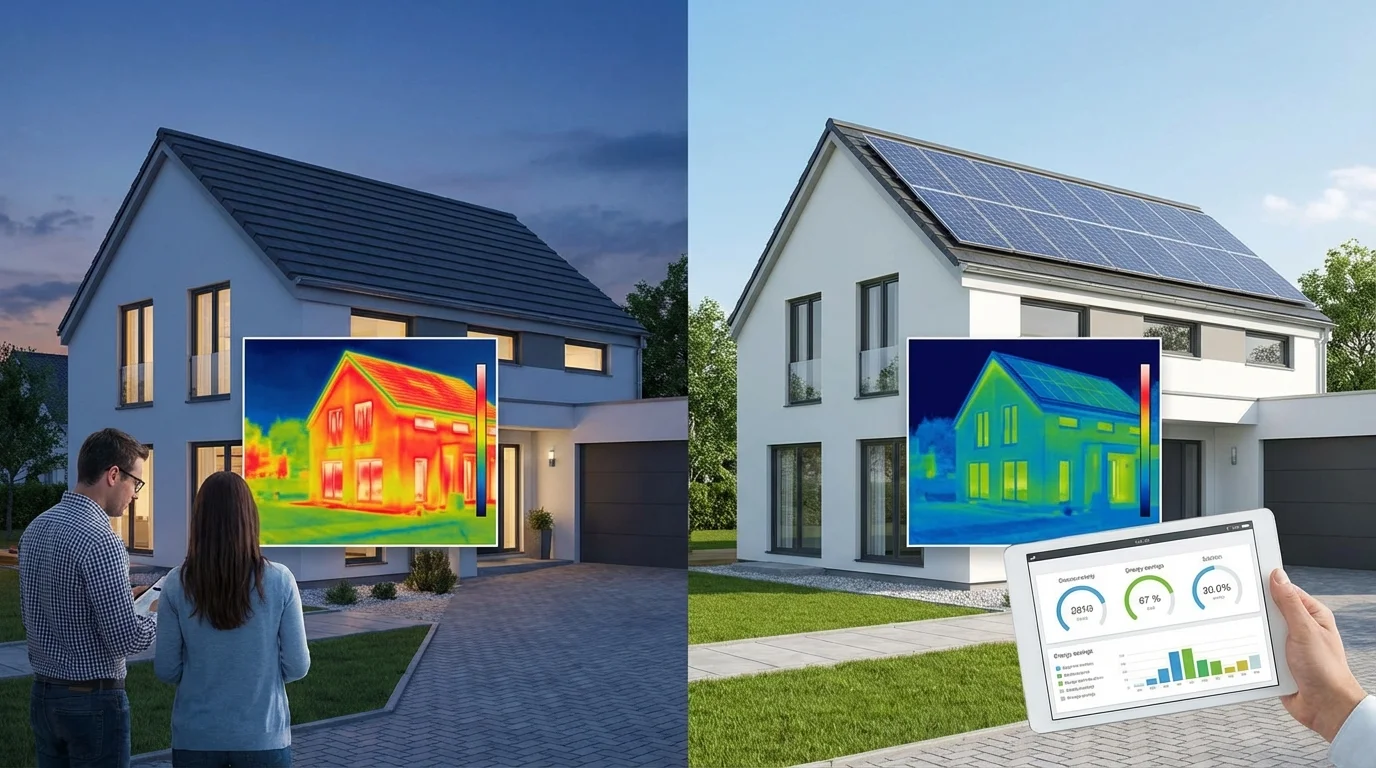
The average U.S. household spends over $2,000 annually on energy bills, with up to 30% of that energy wasted through air leaks, outdated equipment, and poor insulation. This isn't a small leak; it's a constant drain on your finances. So getting a professional home energy audit pinpoints exactly where that money is going, transforming vague expenses into a clear action plan with measurable returns. And the results directly translate into lower utility bills and access to thousands in rebates.
What Real-World Energy Savings Can You Expect After an Energy Audit?
An energy audit’s primary result is a 5% to 30% reduction in annual energy usage for homeowners who implement the recommended upgrades. This translates to an average annual savings of $200 to $400, with some households saving over $1,000 after completing comprehensive air sealing and insulation projects.
A professional home energy audit provides a roadmap to stop energy waste. So the most immediate savings come from air sealing and adding insulation, which together can cut heating and cooling costs by up to 20%. But an audit also identifies inefficient appliances and HVAC systems. Replacing an older furnace with a new ENERGY STAR model, for example, reduces heating costs by 15%. The audit report quantifies these potential savings, showing a clear before-and-after financial picture. And it prioritizes fixes, so homeowners tackle the upgrades with the fastest payback period first, maximizing their return on investment from day one.
How Much Can You Save with State & Utility Rebates for Energy Efficiency Upgrades?
Homeowners can secure between $1,000 and $8,000 in combined state and utility rebates for efficiency upgrades identified in an energy audit. These incentives, combined with federal tax credits under the IRA, often cover 50-100% of the total project cost for qualifying households in 2026.
An energy audit is the key that unlocks these funds. So once the audit identifies a need for new insulation, an upgraded heat pump, or modern windows, the report serves as required documentation for rebate applications. For instance, a state program may offer a $1,500 rebate for attic insulation, while a local utility provides another $500 for the same project. And the Inflation Reduction Act offers federal energy tax credits up to $3,200 annually for these types of improvements. You can use our free rebate calculator to find exact savings available in your zip code. The audit report validates the necessity of the work, making you eligible for thousands in direct financial assistance.
Do You Qualify? Understanding Income Limits and Eligible Equipment for Energy Audit Programs
Qualification for many 2026 energy audit rebates is tied to Area Median Income (AMI), with programs targeting households at or below 80% to 150% of AMI. Eligible equipment must be ENERGY STAR certified, including specific models of heat pumps, insulation, windows, and water heaters.
Eligibility isn't universal; it's designed to assist specific households and promote high-efficiency technology. So state-administered Home Energy Rebate Programs often have two tiers: one for households under 80% of AMI, who may get up to 100% of project costs covered, and another for those between 80-150% of AMI, who receive up to 50% coverage. And the equipment must meet strict efficiency standards. For example, insulation must meet specific R-value targets, and windows must have a certain U-factor. The audit report confirms that the proposed upgrades meet these technical specifications, which is a non-negotiable part of the rebate application process.
| Program / Incentive | Maximum Amount (2026) | Key Eligibility Requirement | Application Deadline |
|---|---|---|---|
| Federal IRA Tax Credits | Ended Dec 31, 2025 | — | December 31, 2025 |
| State Home Efficiency Rebate | Varies ($2,000 - $4,000) | Income-based (often <150% of Area Median Income) | Annually, or when funds are depleted |
| Utility Rebate (Example) | Varies ($250 - $1,500) | Must be a customer of the specific utility | Typically December 31, 2026 |
What's the Step-by-Step Application Process for Energy Efficiency Funding and Rebates?
The application process follows a clear sequence: schedule a pre-upgrade energy audit, receive the improvement report, hire a program-approved contractor to complete the work, and submit the final application with the audit results, contractor invoices, and proof of payment before the program’s deadline.
First, homeowners must find a certified energy auditor, often through their state energy office or utility. And after the audit, the report outlines the necessary upgrades, like installing specific heat pump rebates. So the next step is crucial: hiring a contractor from the program's approved list to ensure the work meets quality standards. But simply doing the work isn't enough. Homeowners must collect all documentation, including detailed invoices and the post-improvement audit report (if required), and submit it through the program’s online portal. Missing a single document or deadline often results in the denial of a rebate claim worth thousands of dollars.
Are There Deadlines or Funding Status Updates for Energy Audit Incentives in Your State?
Yes, all state and utility energy incentive programs have strict 2026 deadlines, typically December 31st or whenever the allocated funding pool is exhausted. Funding is finite and distributed on a first-come, first-served basis, making timely application critical for securing rebates.
These programs aren't open-ended. So a state may allocate $50 million for efficiency rebates in 2026, and once that money is claimed, the program closes until the next funding cycle. And homeowners can track the funding status on their state’s energy office website or through resources like the DSIRE database. Waiting until the end of the year is a risk, as popular programs for insulation and heat pumps often run out of funds by the third quarter. The key is to complete the energy audit and submit the rebate application early in the year to guarantee a spot before the money runs out.
Can I Stack Rebates? Understanding Program Rules and Contractor Requirements for Maximum Savings
Homeowners can stack federal tax credits with one state rebate and one utility rebate for the same project. But program rules typically prohibit stacking two different state rebates or two utility rebates for a single equipment upgrade, and many require using a network-certified contractor.
Stacking is the strategy for maximizing savings. For example, a homeowner installs a $10,000 heat pump. They can claim a 30% federal tax credit ($3,000), a $2,000 state rebate, and a $500 utility rebate, bringing their net cost down to $4,500. But they can't claim two different state rebates for that same heat pump. And a critical rule involves contractors. Many programs, especially those run by utilities, mandate that the installation is performed by a contractor from their pre-vetted, certified network. Using an out-of-network installer, even if they are licensed, will automatically disqualify the project from receiving the rebate.
"DSIRE is the most comprehensive source of information on incentives and policies that support renewables and energy efficiency in the United States." — DSIREUSA.org
Official Sources
- ENERGY STAR Rebate Finder — A federal tool from the EPA to find local rebates and special offers for ENERGY STAR certified products.
- Database of State Incentives for Renewables & Efficiency (DSIRE) — The most comprehensive database of state, local, utility, and federal incentives for energy efficiency.
- Department of Energy (DOE) Energy Saver — Federal guidance on home energy audits, efficiency upgrades, and available financial incentives.
Related Reading: Learn more about Energy Audit Myths Debunked and Energy Audit New Construction.
Frequently Asked Questions
How can I compare my energy consumption before and after an energy audit?
To compare consumption, gather the last 12 months of utility bills before the audit and the 12 months after improvements are made. So you compare the kilowatt-hours (kWh) of electricity or therms of natural gas used, not just the dollar amount, to account for fluctuating energy prices. This provides a true apples-to-apples comparison of your energy reduction, which is often between 5% and 30%.
What kind of energy bill savings can I realistically expect after an energy audit?
Realistically, homeowners see annual energy bill savings between $200 and $400 after implementing the core recommendations from an energy audit. And for homes with significant air leakage or ancient HVAC systems, savings can exceed $1,000 per year. The savings directly correlate to the scope of the upgrades performed, with air sealing and insulation offering the quickest and most reliable financial return.
Is a post-improvement energy audit necessary to confirm results for rebates?
Yes, for many state and utility rebate programs, a post-improvement audit, or "test-out," is mandatory. This second audit uses a blower door test to scientifically measure the reduction in air leakage (CFM50) and verifies that the new equipment was installed correctly. So this final report is a required piece of documentation for the rebate application, proving the project achieved its energy-saving goals.
What documentation from an energy audit proves the improvements for rebate applications?
The primary documentation includes the pre-audit report identifying deficiencies, the post-audit report showing measured improvements (e.g., a 40% reduction in air leakage), and dated, itemized invoices from a certified contractor. So these documents together create a paper trail that proves the work was necessary, completed to program standards, and paid for, satisfying all rebate requirements.
How soon after implementing energy audit recommendations will I see results on my utility bill?
You will see results on the very next utility bill, typically within 30 to 60 days after the improvements are completed. And improvements like air sealing and insulation have an immediate effect on how long your HVAC system needs to run. So the reduction in energy consumption is instantaneous, and the financial savings will be reflected in the first full billing cycle post-upgrade.
Unlock Your Home's Hidden Savings
An energy audit shows you where the money is going. Rebates get it back for you. Use the DuloCore Rebate Calculator to see how much you can save on insulation, heat pumps, and more in just 30 seconds.
Calculate Your Savings NowLast updated April 14, 2026 — reviewed by DuloCore Editorial. About our authors.