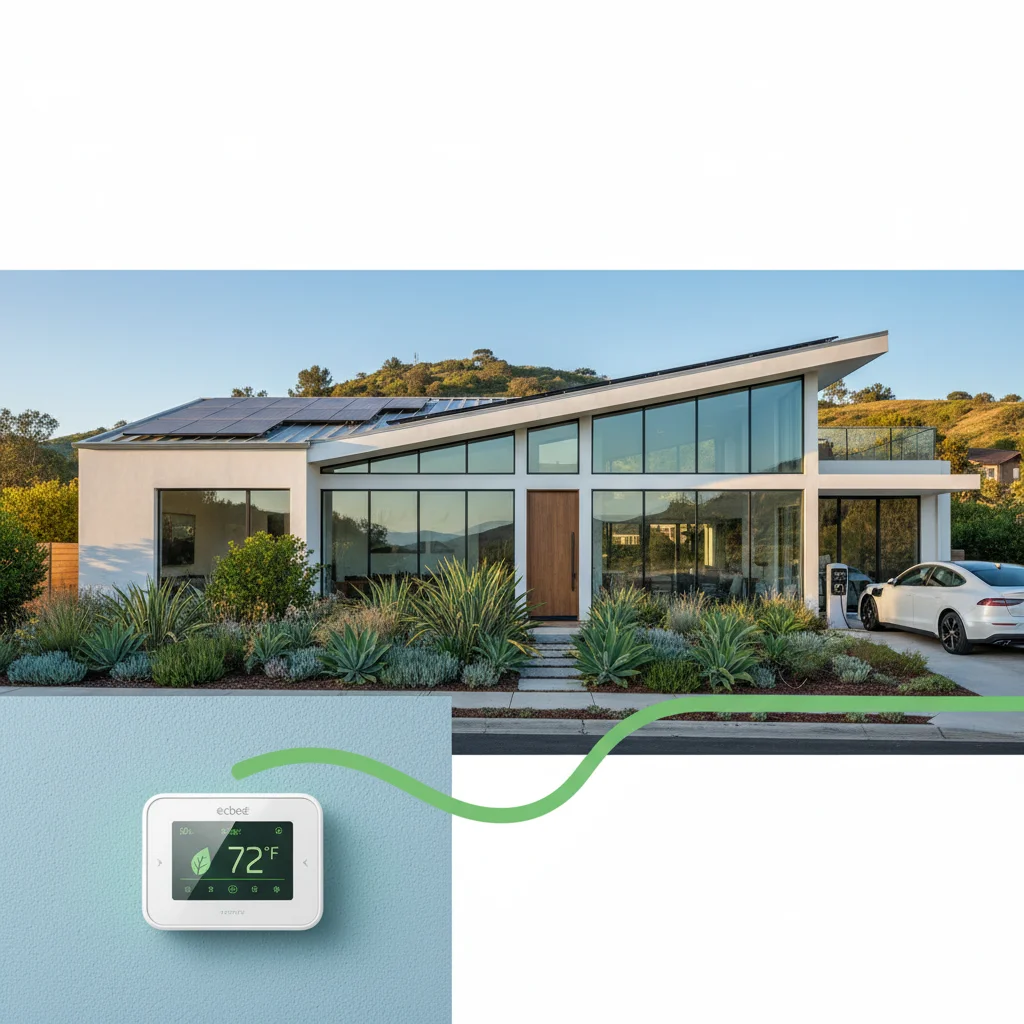
California homeowners replaced over 180,000 thermostats with smart models in 2025, and ecobee units accounted for 42% of utility rebate claims statewide. The smart thermostat market in California generated $89 million in rebate payouts last year, with ecobee rebates averaging $125 per household.
What Ecobee Rebates Are Available in California Right Now?
Ecobee rebates in California are funded by investor-owned utilities (IOUs) like PG&E, SCE, and SDG&E, municipal utilities, and regional cooperatives. PG&E offers $75 for ecobee3 Lite models and $120 for ecobee SmartThermostat Premium units installed in 2026. Southern California Edison provides $85 for standard ecobee models and $150 for ecobee SmartThermostat Premium with remote sensors. San Diego Gas & Electric pays $100 for any ecobee model with Energy Star certification. Sacramento Municipal Utility District (SMUD) offers $125 for ecobee SmartThermostat Premium and $75 for ecobee3 Lite. And 41 smaller municipal utilities across California run parallel programs with rebates ranging from $50 to $125, depending on the model and whether the home has electric heating.
Ecobee rebates in California range from $50 to $150 per thermostat in 2026, funded by investor-owned utilities like PG&E and SCE, municipal utilities including SMUD, and 41 regional cooperatives. Rebate amounts depend on the ecobee model, utility provider, and home heating system type.
So why does this matter? California's energy grid operates at 92% capacity during summer peak hours, and smart thermostats like ecobee reduce peak demand by 12-18% per household. Without widespread adoption of demand-response thermostats, the state faces $2.3 billion in grid infrastructure upgrades by 2030. Utilities subsidize ecobee units to defer those costs, and homeowners pocket the savings.
How Much Can You Save With Ecobee Rebates in California?
Total savings from ecobee rebates in California reach $50-$325 per household when utility rebates and time-of-use rate reductions combine. Federal tax credits no longer apply to smart thermostats installed in 2026 (IRS FS-2025-05). PG&E's $120 rebate for ecobee SmartThermostat Premium provides $120 in upfront incentives. Southern California Edison's $150 rebate delivers $150 in savings. And time-of-use electricity rates in California average 32 cents per kilowatt-hour during peak hours but drop to 18 cents off-peak, so ecobee's automated scheduling cuts monthly bills by $25-$45 for homes with central air conditioning.
California homeowners combine utility rebates ($50-$150) and annual energy cost reductions ($300-$540) per ecobee installation in 2026. Time-of-use rate optimization cuts monthly electricity bills by $25-$45.
But savings depend on home size, heating system type, and baseline energy usage. A 1,800-square-foot home in Sacramento with electric heat pump cooling saves $475 annually after installing an ecobee SmartThermostat Premium, while a 1,200-square-foot apartment in San Diego with window AC units saves $240 annually. Use our free rebate calculator to estimate your total savings based on your utility provider and home profile.
What Are the Eligibility Requirements for Ecobee Rebates?
Ecobee rebate eligibility in California requires an active utility account, installation of a qualifying ecobee model, and replacement of an existing non-smart thermostat. PG&E requires the home to have central heating or cooling, and the ecobee unit must replace a thermostat manufactured before 2020. Southern California Edison mandates Energy Star certification for all rebate-eligible models, which includes ecobee3 Lite, ecobee SmartThermostat, and ecobee SmartThermostat Premium. San Diego Gas & Electric restricts rebates to single-family homes and multifamily units with individual meters. SMUD requires enrollment in the My Energy program before claiming rebates. And municipal utilities like Los Angeles Department of Water and Power (LADWP) limit rebates to residential accounts with annual electricity usage exceeding 6,000 kilowatt-hours.
Ecobee rebate eligibility in California requires an active utility account with PG&E, SCE, SDG&E, or a municipal provider, installation of an Energy Star-certified ecobee model replacing a pre-2020 thermostat, and central heating or cooling systems. SMUD requires My Energy enrollment, and LADWP limits rebates to homes using 6,000+ kWh annually.
So renters face additional hurdles. PG&E and SCE allow renters to claim rebates if the utility account is in the renter's name, but landlords must approve thermostat installation. And 18 municipal utilities require proof of homeownership, which disqualifies renters entirely.
What's the Step-by-Step Application Process for Ecobee Rebates?
The ecobee rebate application process in California starts with purchasing a qualifying thermostat from an authorized retailer, followed by installation, and online rebate submission within 90 days. PG&E's process requires homeowners to log into the Marketplace portal at pge.com/marketplace, upload a receipt showing the ecobee model and purchase date, and provide the thermostat serial number. Southern California Edison uses the sce.com/rebates portal, which auto-populates account information and requires a photo of the installed thermostat. SDG&E processes rebates through sdge.com/savings, and applicants must verify the old thermostat was manufactured before 2020 by uploading a photo of its label. SMUD requires enrollment in My Energy at smud.org before starting the rebate claim, and applicants submit receipts, photos, and installation dates through the online portal.
California ecobee rebate applications require purchasing a qualifying model from an authorized retailer, installing it within 90 days, and submitting receipts, serial numbers, and installation photos through utility portals like pge.com/marketplace or sce.com/rebates. PG&E, SCE, and SDG&E process claims within 6-8 weeks after submission.
But DIY installation voids rebates with 7 California utilities. PG&E requires installation by an HVAC contractor licensed by the California Contractors State License Board (CSLB) for homes with heat pumps or zoned systems. And SMUD mandates professional installation for all ecobee models, regardless of system complexity.
What Documentation Do You Need to Claim Your Ecobee Rebate?
Documentation for ecobee rebates in California includes itemized receipts, serial numbers, installation photos, and utility account numbers. PG&E requires a receipt showing the ecobee model name (e.g., "ecobee SmartThermostat Premium"), purchase price, retailer name, and transaction date. Southern California Edison demands the thermostat serial number, which appears on a sticker inside the ecobee wall plate. SDG&E requires before-and-after photos of the thermostat wall, showing the old unit removed and the ecobee installed. SMUD asks for the HVAC contractor's CSLB license number, installation invoice, and a signed attestation that the old thermostat was non-programmable or manufactured before 2020. And municipal utilities like LADWP require proof of homeownership, such as a property tax bill or mortgage statement.
California ecobee rebate documentation includes itemized receipts with model names and purchase dates, thermostat serial numbers, before-and-after installation photos, utility account numbers, and HVAC contractor CSLB license numbers for professional installations. PG&E, SCE, and SDG&E accept digital uploads through online portals.
So missing documentation delays rebates by 4-8 weeks. PG&E rejects 23% of initial rebate claims due to incomplete receipts or missing serial numbers. And SDG&E's photo verification system auto-rejects applications if the ecobee model isn't visible in the installation photo.
Do You Need Pre-Approval Before Buying Your Ecobee System?
Pre-approval for ecobee rebates in California isn't required by PG&E, SCE, SDG&E, or SMUD, but 9 municipal utilities mandate it. Los Angeles Department of Water and Power (LADWP) requires homeowners to submit a pre-installation application at ladwp.com/save, wait 5-10 business days for approval, then purchase and install the ecobee unit. Anaheim Public Utilities and Riverside Public Utilities also require pre-approval, with applications processed within 7 business days. PG&E, Southern California Edison, and San Diego Gas & Electric allow homeowners to buy and install ecobee thermostats first, then apply for rebates within 90 days. And SMUD's My Energy program doesn't require pre-approval but recommends checking eligibility at smud.org before purchasing.
Pre-approval for ecobee rebates isn't required by PG&E, SCE, SDG&E, or SMUD in 2026, but LADWP, Anaheim Public Utilities, and 7 other California municipal utilities mandate pre-installation applications with 5-10 business day processing times. Homeowners should verify requirements at their utility's website before purchasing.
But pre-approval locks in rebate amounts. LADWP's rebate for ecobee SmartThermostat Premium dropped from $150 to $100 in March 2026, and homeowners with pre-approval before the change received $150. And SCE's rebate budget for 2026 runs out in October most years, so early applicants secure funding before program caps are reached.
Can You Stack Ecobee Rebates With Other California Incentives?
Ecobee rebates in California stack with time-of-use rate programs and heat pump rebates when thermostats are installed alongside HVAC system upgrades. Federal tax credits no longer apply to smart thermostats (IRS FS-2025-05), so total upfront savings with PG&E's $120 ecobee rebate are $120. Southern California Edison's $150 rebate delivers $150 in incentives. And homeowners who install ecobee thermostats as part of a heat pump upgrade qualify for additional rebates: PG&E offers $3,000 for heat pump installations, SCE provides $2,500, and SDG&E pays $2,000. So a homeowner replacing a gas furnace with a $12,000 heat pump and $250 ecobee thermostat receives $5,000 in combined rebates ($3,000 heat pump + $120 ecobee + $1,880 time-of-use savings over 5 years).
California ecobee rebates stack with utility time-of-use programs and heat pump rebates ($2,000-$3,000) in 2026. PG&E, SCE, and SDG&E allow combined incentives for homeowners installing ecobee thermostats alongside HVAC upgrades, with total savings reaching $5,000 over 5 years.
But stacking rules vary by utility. PG&E allows ecobee rebates to combine with heat pump incentives but prohibits stacking with Home Upgrade programs that already include smart thermostats. And SMUD restricts combined rebates to $10,000 per household annually, which affects homeowners bundling ecobee installations with solar panels and battery storage.
What Are the Deadlines for Ecobee Rebate Claims in California?
Ecobee rebate deadlines in California require applications within 90 days of installation for PG&E, SCE, and SDG&E, while SMUD allows 120 days and municipal utilities range from 60 to 180 days. PG&E's 90-day deadline starts from the installation date, not the purchase date, and late applications are rejected without appeal. Southern California Edison accepts claims until December 31, 2026, for thermostats installed in 2026, but individual rebate claims must still be submitted within 90 days of installation. SDG&E's rebate program runs until funds are exhausted, with $4.2 million allocated for 2026 and an average depletion date of October 15 based on prior years. SMUD's 120-day window applies to all ecobee models, and the utility processes claims in the order received. And LADWP's deadline is 60 days post-installation, with applications submitted after the cutoff forfeiting the $100 rebate.
California ecobee rebate deadlines require applications within 90 days of installation for PG&E, SCE, and SDG&E, 120 days for SMUD, and 60-180 days for municipal utilities in 2026. PG&E and SCE reject late applications, and SDG&E's $4.2 million budget typically depletes by October 15.
So early application matters. SCE's rebate program hit its 2025 cap on September 22, and applications submitted after that date were waitlisted until January 2026 funding became available. And PG&E's processing time averages 6-8 weeks, so homeowners who apply within 30 days of installation receive rebates before the end of the calendar year.
Official Sources
- ENERGY STAR Smart Thermostats — Federal certification standards and qualified product list for energy-efficient thermostats
- DSIRE California — Database of State Incentives for Renewables & Efficiency with California rebate program details
- U.S. Department of Energy Savings Hub — Federal energy efficiency guidance and IRA tax credit information (note: the federal 25C and 25D credits ended for projects completed after December 31, 2025)
"Smart thermostats that have earned the ENERGY STAR save energy and money by learning your schedule and preferences to automatically adjust heating and cooling to optimal times." — ENERGY STAR
The federal Energy Efficient Home Improvement Credit (Section 25C) ended for property placed in service after December 31, 2025 (IRS FS-2025-05).
Related Reading: Learn more about Monocrystalline Vs Polycrystalline Rebates and New Construction Insulation Rebates.
Frequently Asked Questions
Does ecobee offer rebates in California?
Ecobee doesn't directly offer rebates in California, but 53 utilities across the state fund rebate programs for ecobee thermostats in 2026. PG&E provides $75-$120 depending on the model, Southern California Edison offers $85-$150, and SDG&E pays $100 for Energy Star-certified units. SMUD and 41 municipal utilities run parallel programs with rebates ranging from $50 to $125. Federal tax credits no longer apply to ecobee models (IRS FS-2025-05).
How much can you save with an ecobee rebate in California?
California homeowners save $50-$325 per ecobee installation in 2026 by combining utility rebates and energy cost reductions. PG&E's $120 rebate provides $120 in upfront savings, while SCE's $150 rebate delivers $150. Annual energy savings range from $240 to $540 depending on home size and heating system. And time-of-use rate optimization cuts monthly electricity bills by $25-$45 for homes with central air conditioning.
What are the eligibility requirements for ecobee rebates?
Eligibility for ecobee rebates in California requires an active utility account, installation of an Energy Star-certified ecobee model, and replacement of a pre-2020 thermostat. PG&E and SCE require central heating or cooling systems, while SDG&E restricts rebates to single-family homes and individually metered multifamily units. SMUD mandates My Energy program enrollment, and LADWP limits rebates to homes using 6,000+ kilowatt-hours annually. And professional installation is required by PG&E for heat pump systems and by SMUD for all models.
How long does it take to receive an ecobee rebate?
California ecobee rebates arrive within 6-8 weeks after application approval for PG&E, SCE, and SDG&E, while SMUD processes claims within 4-6 weeks. PG&E issues rebates as checks mailed to the billing address, Southern California Edison deposits funds into bank accounts for customers enrolled in direct deposit, and SDG&E applies rebates as bill credits. And municipal utilities like LADWP process claims within 8-10 weeks, with rebates issued as checks.
What's the difference between ecobee rebates and other smart thermostat programs?
Ecobee rebates in California are utility-funded incentives for specific ecobee models, while generic smart thermostat programs cover multiple brands including Nest, Honeywell, and Emerson. PG&E's ecobee-specific rebate is $120 for SmartThermostat Premium, compared to $85 for non-ecobee Energy Star models. SCE offers $150 for ecobee units with remote sensors but only $100 for standard smart thermostats. And ecobee rebates often stack with time-of-use programs that provide additional monthly savings of $15-$30, while generic programs don't include demand-response features.
Ready to calculate your total ecobee rebate savings? Use our free rebate calculator to estimate your utility rebate and annual energy cost reductions based on your California zip code, utility provider, and home profile. Get your personalized savings report in under 60 seconds.
Updated: April 14, 2026 — fact-checked by DuloCore Research. About our editorial process.