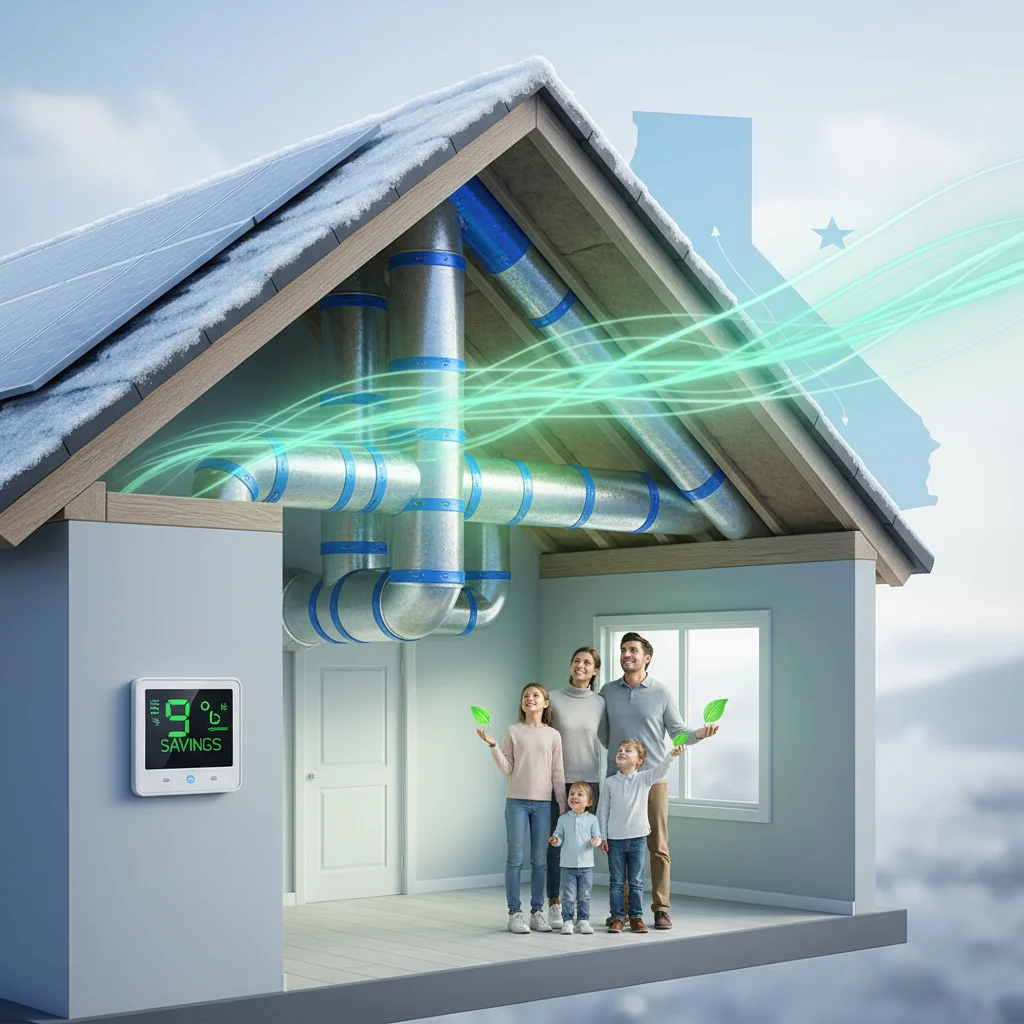
Leaky ducts waste 25% to 40% of heating and cooling energy in the average California home, costing homeowners $300 to $800 annually in lost efficiency. And California utilities and state programs now offer rebates up to $1,500 to seal those leaks, turning a weekend maintenance project into a cash-back opportunity that pays for itself within 18 months.
What are the current duct sealing rebates available in California for 2026?
California homeowners access duct sealing rebates through investor-owned utilities (PG&E, SCE, SoCalGas, SDG&E) and local government programs in 2026. PG&E offers $400 to $1,000 for duct sealing verified through energy audits, while Southern California Edison provides $200 to $600 depending on system size and leakage reduction. SoCalGas rewards $300 to $800 for gas furnace duct improvements, and SDG&E offers $500 to $1,200 for comprehensive duct sealing projects. Bay Area cities like San Francisco and Oakland add municipal incentives ranging from $200 to $500 on top of utility rebates.
So homeowners in PG&E territory who combine utility and city programs can stack $1,500 in total rebates for a duct sealing project that typically costs $1,200 to $2,500 before incentives. But not all California addresses qualify—only properties served by participating utilities or within designated municipal program zones access these rebates. And most programs require professional contractor installation with post-project verification testing to confirm leakage reduction of at least 30% compared to pre-sealing measurements.
Community Choice Aggregators (CCAs) like Marin Clean Energy and Peninsula Clean Energy also fund duct sealing rebates ranging from $300 to $700 for customers in their service territories. Municipal utilities in cities like Sacramento (SMUD) and Los Angeles (LADWP) operate separate programs with rebates between $250 and $900. The rebate calculator shows exact amounts available at your specific address based on utility provider and program eligibility criteria.
How much money can you save with California duct sealing rebates?
Duct sealing rebates reduce out-of-pocket costs by $400 to $1,500 depending on utility provider and project scope in 2026. A typical residential duct sealing project costs $1,200 to $2,500 before rebates, and homeowners in PG&E territory who qualify for both utility and municipal programs pay as little as $700 after stacking incentives. Southern California Edison customers save $200 to $600 upfront, while SoCalGas participants receive $300 to $800 back within 6 to 8 weeks of project completion.
And the ongoing energy savings compound the upfront rebate value. Sealed ducts eliminate 25% to 40% of conditioned air loss, reducing heating and cooling bills by $300 to $800 annually. So a homeowner who spends $1,800 after a $700 rebate recoups the investment in 2.25 to 6 years through lower utility bills. But homes with severe duct leakage exceeding 40% see faster payback periods of 18 to 30 months because baseline waste is higher.
Federal tax credits don't apply to duct sealing, and pairing it with heat pump rebates or other HVAC upgrades no longer adds a federal credit: the federal Energy Efficient Home Improvement Credit (Section 25C) ended for property placed in service after December 31, 2025 (IRS FS-2025-05).
What are the eligibility requirements for California duct sealing rebate programs?
California duct sealing rebate eligibility requires homeowners to meet utility service territory, home type, contractor qualification, and verification testing criteria in 2026. PG&E, SCE, SoCalGas, and SDG&E limit rebates to single-family homes and duplexes within their service areas, excluding apartments and condominiums unless the property owner controls the HVAC system. And participating contractors must hold active California C-20 HVAC licenses and complete utility-approved training courses on duct diagnostic testing procedures.
Pre-sealing duct leakage tests measure air loss as a percentage of total airflow, and most programs require baseline leakage of at least 15% to 25% to qualify for rebates. Post-sealing verification testing confirms leakage reduction of 30% or more compared to pre-project measurements, and contractors submit test results through utility online portals within 30 days of project completion. But homes with newer construction built after 2008 often fail to meet minimum leakage thresholds because Title 24 building codes already mandate tighter duct systems.
Income-qualified programs through utilities and nonprofits like GRID Alternatives expand eligibility to renters and multifamily properties for households earning 80% or less of Area Median Income (AMI). So low-income homeowners access enhanced rebates covering 75% to 100% of duct sealing costs, compared to standard programs covering 30% to 60%. The rebate calculator identifies income-qualified programs available at your address based on household size and annual earnings.
What is the deadline to apply for California duct sealing rebate programs in 2026?
California duct sealing rebate deadlines vary by utility provider and funding availability in 2026, with most programs operating on a first-come, first-served basis until annual budgets deplete. PG&E accepts rebate applications through December 31, 2026, but historically exhausts funds by October in high-demand counties like Alameda and Santa Clara. Southern California Edison and SoCalGas extend deadlines through year-end 2026 with budget reviews in September to assess remaining allocation. And SDG&E confirms funding availability through November 2026 with potential extensions into early 2027 if budget surplus exists.
Municipal programs impose stricter deadlines tied to fiscal year budgets running July 1, 2026, through June 30, 2027. So Oakland and San Francisco residents must complete projects and submit applications by June 15, 2027, to receive municipal rebates stacked on top of utility incentives. But utility rebates don't require municipal program participation and operate on separate timelines, allowing homeowners to claim utility rebates even after city deadlines pass.
Contractors reserve rebate funds at the time of pre-inspection, and most programs hold those reservations for 90 to 120 days while installation and verification testing occur. So homeowners who start projects in August 2026 have until November or December to complete work and submit final documentation before reservations expire. The sooner homeowners apply, the higher the likelihood of securing funds before annual budgets close.
"Californians can save hundreds of dollars a year by sealing and insulating their ducts, and utility rebate programs make these upgrades more affordable." — U.S. Department of Energy
How do you apply for duct sealing rebates in California?
California duct sealing rebate applications follow a four-step process: contractor selection, pre-inspection reservation, project completion, and rebate submission in 2026. Homeowners start by selecting a participating contractor from utility online directories at pge.com, sce.com, socalgas.com, or sdge.com, verifying the contractor holds an active C-20 HVAC license and completes utility-approved duct diagnostic training. And contractors conduct pre-sealing duct leakage tests to measure baseline air loss and confirm the home meets minimum leakage thresholds of 15% to 25% required for rebate qualification.
After pre-inspection, contractors reserve rebate funds through utility online portals by submitting test results and project details within 48 hours. So the rebate amount is locked in before installation begins, protecting homeowners from budget depletion during the project timeline. Contractors then seal ducts using mastic, metal tape, or aerosol sealants, and conduct post-sealing verification tests to confirm leakage reduction of at least 30% compared to baseline measurements.
Final rebate applications require contractors to upload pre- and post-sealing test results, invoices, proof of payment, and high-resolution photos of sealed duct sections through utility portals within 30 days of project completion. And utilities process rebates within 6 to 8 weeks, issuing checks or bill credits directly to homeowners. But incomplete documentation or failed verification tests delay processing by 4 to 6 weeks while contractors resubmit corrected materials.
Income-qualified applicants submit additional household income documentation through separate portals managed by utilities or nonprofit partners like GRID Alternatives. The application process adds 2 to 3 weeks for income verification but unlocks enhanced rebates covering 75% to 100% of project costs for eligible households earning 80% or less of AMI.
How do California duct sealing rebates compare to other energy efficiency incentives?
California duct sealing rebates offer lower upfront incentives but faster payback periods compared to major HVAC replacement programs in 2026. Heat pump rebates range from $2,000 to $8,000 through utility programs, but equipment and installation costs total $12,000 to $25,000, requiring 8 to 15 years to break even through energy savings alone. Duct sealing costs $1,200 to $2,500, and rebates of $400 to $1,500 reduce payback periods to 18 to 30 months for homes with severe leakage.
And duct sealing complements other efficiency upgrades by maximizing the performance of existing heating and cooling equipment. Homeowners who seal ducts before installing heat pumps reduce equipment sizing requirements by 15% to 25%, lowering upfront costs by $1,800 to $3,500. So combining duct sealing with heat pump rebates creates compounding savings that accelerate overall project payback.
But duct sealing doesn't qualify for any federal tax credit in 2026. The federal Energy Efficient Home Improvement Credit (Section 25C) ended for property placed in service after December 31, 2025 (IRS FS-2025-05). State programs like the California Energy Commission's Building Initiative for Low-Emissions Development (BUILD) provide additional grants for comprehensive whole-home retrofits that include duct sealing, but individual duct sealing projects don't qualify for BUILD funding without paired equipment installations.
Official Sources
- U.S. Department of Energy - Energy Saver — Federal guidance on duct sealing benefits and best practices
- DSIRE USA - California — Comprehensive database of California energy efficiency incentives and rebates
Related Reading: Learn more about Duct Leakage Testing Home.
Frequently Asked Questions
Who is eligible for duct sealing rebates in California?
California homeowners in PG&E, SCE, SoCalGas, and SDG&E service territories qualify for duct sealing rebates in 2026 if their homes meet minimum duct leakage thresholds of 15% to 25% and contractors achieve 30% or greater leakage reduction after sealing. Single-family homes and duplexes access standard rebates, while income-qualified households earning 80% or less of Area Median Income receive enhanced rebates covering 75% to 100% of project costs. And municipal programs in cities like Oakland and San Francisco expand eligibility criteria to include additional property types.
How much can you save with a duct sealing rebate in California?
California duct sealing rebates reduce project costs by $400 to $1,500 depending on utility provider and program stacking in 2026. PG&E customers receive $400 to $1,000, Southern California Edison offers $200 to $600, and SoCalGas provides $300 to $800 for qualified projects. Homeowners who combine utility and municipal rebates save up to $1,500 upfront, and sealed ducts reduce annual energy bills by $300 to $800 through eliminated air loss, creating total savings of $3,900 to $9,500 over 10 years.
What is the process to apply for a duct sealing rebate in California?
Homeowners apply for California duct sealing rebates by selecting participating contractors from utility directories, completing pre-sealing leakage tests to reserve funds, sealing ducts to achieve 30% or greater leakage reduction, and submitting verification test results with invoices through utility online portals within 30 days of project completion. Utilities process rebates in 6 to 8 weeks and issue checks or bill credits directly to homeowners. But incomplete documentation or failed verification tests delay processing by 4 to 6 weeks.
Are there deadline dates for duct sealing rebates in California?
California duct sealing rebate deadlines extend through December 31, 2026, for most utility programs, but funds deplete earlier in high-demand areas like Alameda and Santa Clara counties. PG&E historically exhausts budgets by October, while Southern California Edison and SoCalGas accept applications through year-end with budget reviews in September. Municipal programs operate on fiscal year timelines from July 1, 2026, to June 30, 2027, requiring project completion and application submission by June 15, 2027.
How does duct sealing compare to other HVAC rebates in California?
Duct sealing rebates of $400 to $1,500 offer lower upfront incentives than heat pump rebates of $2,000 to $8,000, but faster payback periods of 18 to 30 months compared to 8 to 15 years for heat pump installations. Duct sealing costs $1,200 to $2,500 total, while heat pumps require $12,000 to $25,000 investments. And sealing ducts before installing heat pumps reduces equipment sizing needs by 15% to 25%, lowering upfront costs by $1,800 to $3,500.
Ready to find your exact rebate amount? Use our free rebate calculator to discover all duct sealing rebates available at your address and estimate your total project savings in under 2 minutes.
Updated on April 14, 2026. Fact-checked by DuloCore Editors. About our research team.