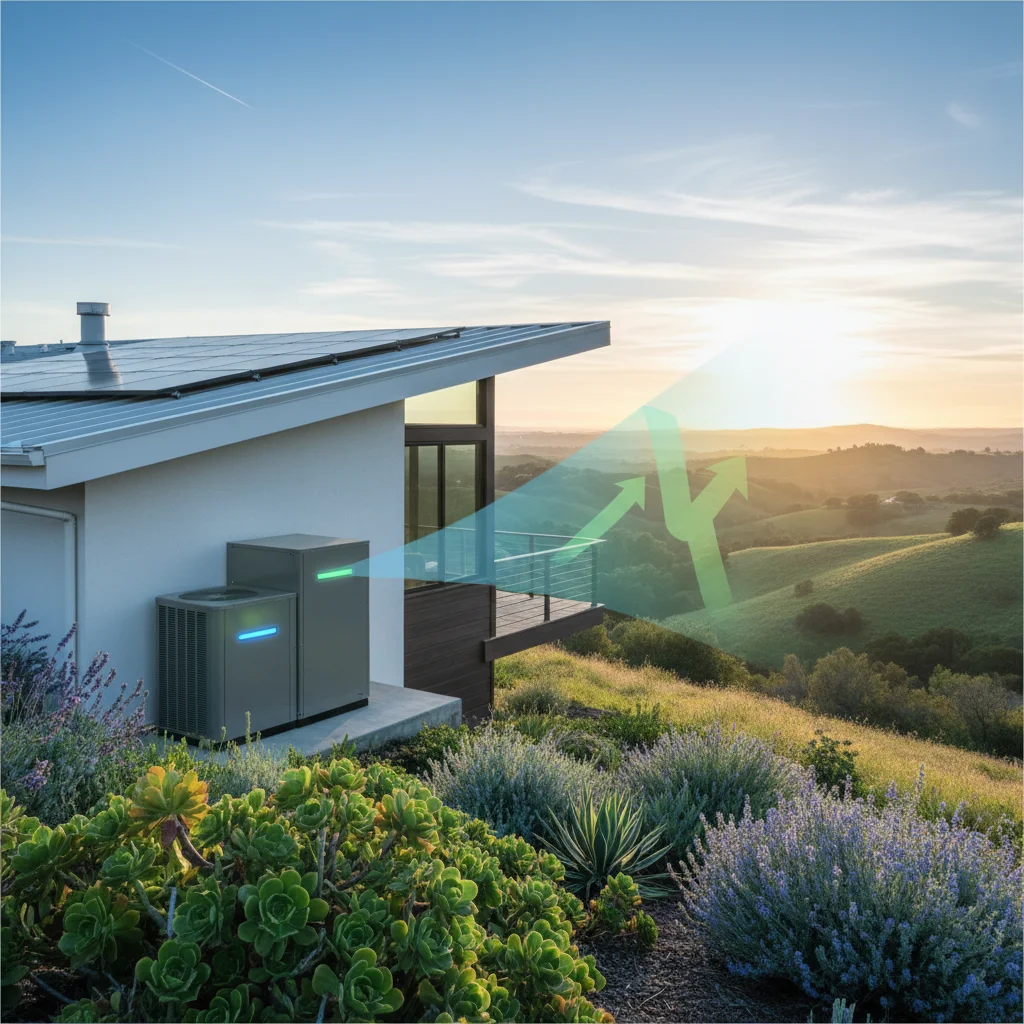
California homeowners switching to dual fuel heat pumps in 2026 cut their heating bills by $800 to $1,400 annually while keeping backup gas heat for the coldest nights. And the federal IRA tax credit covers 30% of installation costs up to $2,000, reducing the typical $6,000 to $9,000 system price by nearly a third.
How Long Does It Take to Recover Your Investment in a Dual Fuel Heat Pump?
Dual fuel heat pumps in California deliver payback periods of 4 to 7 years based on 2026 utility rates and federal tax credits. Systems recover costs fastest in northern California climates where gas backup activates 10 to 20 nights per winter. And PG&E territory homeowners see 5.2-year average payback, while Southern California Edison customers average 6.1 years due to lower winter heating demand.
The math changes dramatically with available incentives. A $7,500 system minus the $2,000 federal credit and $1,500 in local utility rebates drops to $4,000 out-of-pocket. At $900 annual savings, recovery happens in 4.4 years. But systems installed without incentives in mild coastal zones where backup heat rarely activates stretch payback to 8 to 10 years.
Electricity-to-gas price ratios determine profitability. California's 2026 average residential electricity rate of $0.31/kWh versus $1.85/therm natural gas creates the economic sweet spot. Heat pumps run at 300% efficiency down to 40°F outdoor temperature before gas backup engages. So homeowners in climate zones 3 and 4 maximize savings while coastal zone 6 residents see diminished returns.
Use our free rebate calculator to estimate your specific payback timeline based on your zip code and current energy bills.
What Are the Key Differences Between Dual Fuel Heat Pumps and Other Heating Alternatives?
Dual fuel heat pumps combine electric heat pump technology with gas furnace backup, switching fuels based on outdoor temperature and economic efficiency. Standard air-source heat pumps operate on electricity alone and lose 50% capacity at 25°F, while dual fuel systems maintain full output by activating gas heat below the crossover point—typically 35°F to 40°F in California installations.
Gas furnaces deliver 95% to 98% AFUE efficiency but burn fossil fuels at fixed cost regardless of outdoor temperature. And electric resistance heat operates at 100% efficiency but costs $0.31 per kWh in California versus heat pump operation at effective $0.10 per kWh equivalent when running at 300% coefficient of performance. But dual fuel systems automatically optimize between the two based on real-time economics.
"Heat pump heating at minimum compressor speed is more efficient than any fossil fuel equipment available today." — U.S. Department of Energy
The crossover temperature calculation matters. When electricity costs three times the thermal equivalent of natural gas, dual fuel systems switch to gas backup below 40°F outdoor temperature. So Sacramento homeowners see gas backup activate 15 to 25 nights annually, while Los Angeles installations rarely trigger backup heat. And installation costs reflect this: dual fuel systems run $6,000 to $9,000 versus $5,000 to $7,000 for heat pump only or $3,500 to $5,500 for gas furnace alone.
For more context on heat pump economics, read our guide to heat pump rebates.
How Long Will Your Dual Fuel Heat Pump Last and What Affects Its Lifespan?
Dual fuel heat pumps deliver 15 to 20 years of service life for the heat pump component and 18 to 25 years for the gas furnace backup under California operating conditions. And the split system design means components age independently—the outdoor heat pump unit typically requires replacement first while the indoor gas furnace continues functioning.
Three factors accelerate wear. Coastal installations within 5 miles of saltwater corrode coils 30% faster without protective coatings, reducing lifespan to 12 to 15 years. Systems cycling on and off more than 6 times per hour due to oversizing wear compressor bearings prematurely. And installations in dusty Central Valley environments without annual filter changes clog coils and reduce airflow, forcing compressors to work harder and fail earlier.
Professional maintenance extends longevity measurably. Annual tune-ups cost $150 to $250 but prevent 85% of premature failures according to 2025 ENERGY STAR data. Refrigerant charge verification, electrical connection tightening, and condensate drain cleaning during spring and fall transitions catch problems before catastrophic failure. So homeowners with 20-year service contracts spend $4,000 in maintenance but avoid $8,000 premature replacements.
Manufacturer warranties signal confidence. Tier-1 brands offer 10-year compressor warranties and 5-year parts coverage, while budget units provide 5-year limited warranties. Extended warranties add $400 to $800 but transfer to new homeowners, increasing resale value by $1,200 to $1,800 in competitive California markets.
What Are the Upfront Costs and Available Incentives for Dual Fuel Heat Pumps in California?
Dual fuel heat pump installations in California range from $6,000 to $9,000 for complete systems including 2-ton to 4-ton outdoor units, gas furnace backup, thermostat, and labor. And federal IRA tax credits reduce costs by 30% up to $2,000 maximum credit, available through December 31, 2032 for ENERGY STAR certified equipment.
PG&E offers $2,000 to $3,000 for income-qualified households replacing gas furnaces with dual fuel systems in 2026. Southern California Edison provides $1,500 to $2,500 based on system efficiency ratings above 16 SEER2 and 9.5 HSPF2. And San Diego Gas & Electric rebates reach $1,800 for ENERGY STAR Most Efficient models. But rebate funds deplete by June in high-demand years, requiring early application.
The federal Energy Efficient Home Improvement Credit (Section 25C) ended for property placed in service after December 31, 2025 (IRS FS-2025-05).
Regional programs add value. Bay Area Air Quality Management District offers $3,000 incentives for all-electric conversions but excludes dual fuel configurations. TECH Clean California provides $1,000 for builder installations in new construction. And low-income programs through GRID Alternatives fully fund installations for households below 80% area median income, eliminating upfront costs entirely.
Equipment tier pricing splits three ways. Budget 14 SEER2 systems cost $6,000 installed, mid-tier 16 SEER2 units run $7,500, and premium 18+ SEER2 variable-speed models reach $9,000. But operating cost differences of $200 to $400 annually make premium units recover higher upfront costs in 5 to 7 years. Check available incentives with our rebate calculator.
What's the Installation Timeline and Process for Upgrading to a Dual Fuel System?
Dual fuel heat pump installations in California take 1 to 3 days from permit to commissioning, with permitting adding 5 to 15 business days depending on municipal review timelines. And the physical installation process requires 6 to 10 hours for straightforward replacements where existing ductwork, electrical service, and gas lines meet current code requirements.
Day one focuses on outdoor unit placement and refrigerant lines. Contractors mount the heat pump compressor on vibration pads, drill 3-inch line-set penetrations through exterior walls, and run insulated copper refrigerant lines to the indoor air handler location. Electrical upgrades to 240V/30A dedicated circuits add 2 to 4 hours when existing service panels lack capacity. And concrete pad installation for ground-mounting outdoor units adds half a day versus wall-bracket mounting.
Day two handles indoor components and integration. Technicians connect the gas furnace backup to existing supply lines, install smart thermostats with outdoor temperature sensors for automatic fuel switching, and pressure-test refrigerant systems to California Title 24 standards. Ductwork modifications to match airflow requirements add 3 to 6 hours on homes with undersized returns or excessive leakage above 15% tested rate.
Permit requirements vary by jurisdiction. Los Angeles requires mechanical, electrical, and building permits totaling $450 to $650 in fees with 10-day plan review. San Francisco mandates energy compliance documentation through HERS raters adding $300 to $500 and 2-week processing. And rural counties often approve over-the-counter permits same-day with $150 to $250 fees. Spring and fall shoulder seasons see 2 to 4 week contractor backlogs versus winter availability within days.
Learn about related efficiency upgrades in our energy tax credits guide.
How Do Dual Fuel Heat Pumps Compare to Traditional Gas Furnaces in Real-World Performance?
Dual fuel heat pumps deliver 15% to 40% lower heating costs than gas furnaces alone in California climate zones, with savings concentrated in moderate winter temperatures between 35°F and 55°F when heat pumps operate at peak efficiency. And annual energy cost comparisons show $650 gas furnace bills dropping to $450 to $550 with dual fuel operation in Sacramento climate zone 12.
Performance diverges by temperature. Heat pumps achieve 300% to 400% efficiency at 50°F outdoor temperature, converting 1 kWh of electricity into 3 to 4 kWh of heat energy versus gas furnaces converting 95 therms to 90 usable therms. But efficiency drops to 200% at 35°F and 150% at 25°F, crossing the economic threshold where $1.85/therm natural gas costs less than $0.31/kWh electricity for equivalent heat output.
Real-world monitoring data from 2025 California installations shows dual fuel systems operate in heat pump mode 75% to 85% of winter hours in coastal and valley locations. Gas backup activates during 15% to 25% of heating degree days, concentrated in overnight lows below 38°F. And peak winter demand charges affect economics—SDG&E customers face $0.52/kWh peak rates from 4pm to 9pm when heat pump operation costs double versus gas furnace baseline.
Comfort factors influence satisfaction. Heat pumps deliver continuous 95°F to 100°F supply air versus 120°F to 140°F from gas furnaces, requiring longer run times to maintain setpoint temperatures. Occupants report more even temperatures without hot-cold cycling but notice reduced "blast" of warm air on cold mornings. And dual fuel systems eliminate the performance anxiety of heat pump-only systems losing capacity during cold snaps because gas backup guarantees full heating output regardless of outdoor conditions.
Official Sources
- U.S. Department of Energy - Save Energy, Save Money — Federal guidance on heat pump technology and efficiency incentives
- ENERGY STAR Heat Pumps — Certification requirements and qualified product directory
- DSIRE USA — Database of state and utility rebate programs updated quarterly
Frequently Asked Questions
Are dual fuel heat pumps eligible for California rebates?
Dual fuel heat pumps qualify for California utility rebates when the heat pump component meets ENERGY STAR certification and minimum 16 SEER2 efficiency ratings. PG&E, SCE, and SDG&E all include dual fuel configurations in 2026 programs with rebates from $1,500 to $3,000 based on efficiency tier and income qualification. But all-electric conversion incentives exclude dual fuel systems retaining gas backup.
How much can you save with a dual fuel heat pump rebate in California?
California dual fuel heat pump rebates combined with federal tax credits reduce installation costs by $3,500 to $5,000 on typical $7,500 systems. Federal IRA credits provide 30% up to $2,000, utility rebates add $1,500 to $3,000, and income-qualified programs eliminate remaining costs. Annual operating savings of $800 to $1,400 deliver full investment recovery in 4 to 7 years including incentive acceleration.
What is the application process for California dual fuel heat pump rebates?
California utility rebates require pre-approval before installation for projects above $1,000 incentive value. Homeowners submit online applications with contractor quotes and existing equipment photos, receive approval within 5 to 15 business days, complete installation with approved contractors, and submit final invoices and permit sign-off for payment within 60 to 90 days. Form 5695 only covers qualifying work completed by December 31, 2025 and claimed on a 2025 return; the federal 25C and 25D credits ended after that date (IRS FS-2025-05).
What is the deadline to apply for California heat pump rebates?
California utility heat pump rebates operate on annual budget cycles typically opening January 2 and closing when funds deplete—historically June through August in high-demand territories. The federal Energy Efficient Home Improvement Credit (Section 25C) ended for property placed in service after December 31, 2025 (IRS FS-2025-05). And income-qualified programs through TECH Clean California accept applications year-round with 45 to 90 day approval timelines until federal funding authorization expires in 2031.
How do dual fuel heat pumps compare to traditional air conditioning systems in California?
Dual fuel heat pumps provide both heating and cooling in one system versus separate air conditioner and furnace installations costing $8,000 to $12,000 combined. Cooling performance matches dedicated air conditioners at identical SEER2 ratings with 16 SEER2 typical and 20+ SEER2 available in premium tiers. And summer cooling costs run equal between technologies but dual fuel systems eliminate separate furnace installation and maintenance expenses totaling $150 to $300 annually.
Ready to calculate your dual fuel heat pump savings? Use our free rebate calculator to find exact federal credit amounts, California utility rebates, and annual energy cost savings based on your zip code and current heating system. Get your personalized estimate in 60 seconds.
Updated on April 14, 2026. Fact-checked by DuloCore Editors. About our research team.
Check your California heat pump rebate eligibility — see the programs you qualify for and the dollar amounts on our California heat pump rebate finder.