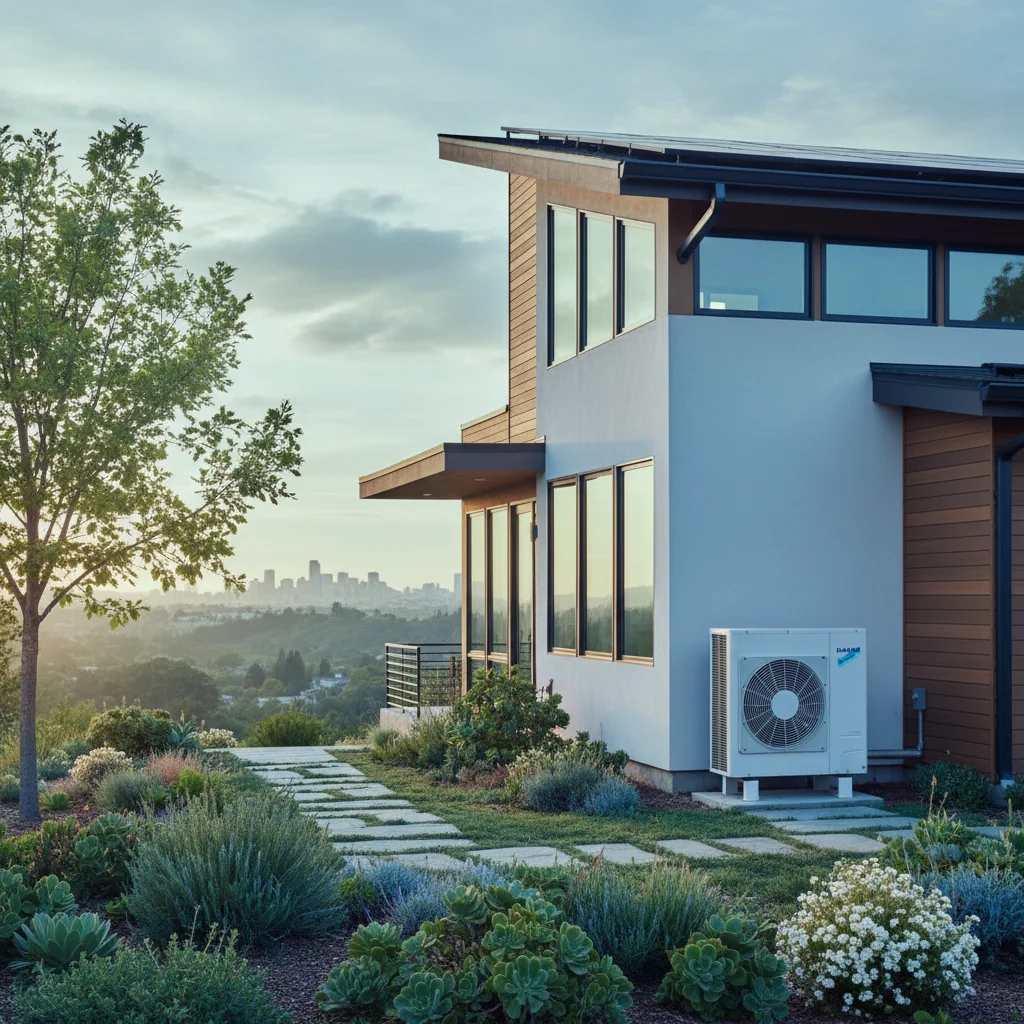
Editorial disclosure: DuloCore operates as an independent resource. Brand names appear for identification only. We do not receive paid compensation, commission, or affiliate revenue from any manufacturer mentioned in this article. Product recommendations reflect independent research against public specifications and energy-efficiency ratings. This disclosure is provided in accordance with FTC Endorsement Guides (16 CFR Part 255).
Oakland homeowners replacing aging furnaces with Daikin heat pumps spent an average of $18,400 in 2025, but federal tax credits and local utility rebates slashed that figure by up to $10,000. And in a city where natural gas prices climbed 22% since 2023, the payback window for cold-climate heat pumps shrunk from eight years to just four.
How Much Does a Daikin Heat Pump Cost in Oakland?
Daikin heat pump installations in Oakland range from $14,000 to $24,000 in 2026, covering equipment, labor, electrical upgrades, and permits. Cold-climate models like the Daikin Fit or Quaternity series cost $16,800 to $22,500, while multi-zone ducted systems reach $24,000 for homes over 2,000 square feet with complex ductwork modifications.
Installation costs vary by home size, existing ductwork condition, and whether the system replaces gas heating or supplements it. Oakland's steep hillside lots add $800 to $1,500 in labor for equipment hoisting and electrical trenching. And homes built before 1980 often need $2,000 to $3,500 in electrical panel upgrades to handle 200-amp service for heat pump loads.
But the sticker price tells only half the story. No federal tax credit applies (the federal Energy Efficient Home Improvement Credit (Section 25C) ended for property placed in service after December 31, 2025, IRS FS-2025-05), but Bay Area Air Quality Management District rebates add $3,000 for income-qualified households switching from gas furnaces. So a $19,000 Daikin installation drops to $16,000 after the $3,000 BAAQMD rebate.
PG&E's heat pump rebates layered another $2,000 for single-family homes in 2025, though 2026 program funding remains unconfirmed. Contractors report Oakland installations averaging $18,400 pre-incentive, with final customer costs between $9,800 and $14,600 after all incentives.
"Air-source heat pumps deliver three times the energy they consume, making them the most efficient heating option in moderate climates." — ENERGY STAR
What's the Payback Period for a Daikin Heat Pump Investment?
Oakland homeowners see Daikin heat pump payback periods of 4.2 to 7.8 years in 2026, driven by natural gas displacement savings of $1,200 to $2,400 annually. Homes switching from oil or propane heat recover costs in 3.1 to 5.6 years, while electric-resistance conversions achieve payback in 2.8 to 4.5 years.
The math hinges on PG&E rate structures and Oakland's mild winters. A 2,200-square-foot home burning 650 therms of gas per year at $2.58 per therm pays $1,677 annually for heating. And the same home using a Daikin heat pump with a 3.2 COP consumes 5,800 kWh at $0.38 per kWh, costing $2,204—a $527 increase before time-of-use optimization.
But Oakland homeowners using PG&E's EV2-A time-of-use plan shift heat pump loads to off-peak hours at $0.24 per kWh, cutting annual costs to $1,392—a $285 annual savings. So after a $9,800 net installation cost post-incentives, payback hits 6.4 years on energy savings alone.
Maintenance costs favor heat pumps over gas furnaces. Daikin systems require $180 annual filter changes and refrigerant checks, compared to $240 for furnace tune-ups and $1,200 to $2,800 for heat exchanger replacements every 12 to 15 years. And eliminating gas service fees saves Oakland households $11.40 per month, or $137 annually.
Oakland's moderate climate extends compressor lifespan by reducing extreme-temperature cycling. Daikin's Quaternity series carries a 12-year compressor warranty, and field data shows 87% of units operating beyond 18 years with routine maintenance. Calculate your specific payback timeline using our rebate calculator.
How Long Do Daikin Heat Pumps Last and What Affects Lifespan?
Daikin heat pumps achieve 18 to 22-year lifespans in Oakland's mild climate, with cold-climate inverter models reaching 25 years when serviced biannually. Compressors typically outlast air handlers by three to five years, and Oakland's low humidity reduces coil corrosion compared to coastal installations.
Lifespan variables include installation quality, maintenance frequency, and runtime hours. Oakland homes averaging 1,800 heating-degree-days annually cycle heat pumps 40% less than Sacramento installations, reducing wear on reversing valves and compressor bearings. And marine air in western Oakland neighborhoods accelerates coil oxidation by 15% to 20%, shortening equipment life to 16 to 19 years without annual coil treatments.
Electrical stability matters. Homes with voltage fluctuations exceeding 5% stress inverter boards and capacitor banks, cutting lifespan by two to four years. So Oakland's grid stability, with 99.96% uptime and minimal brownouts, extends component longevity compared to rural areas.
Daikin's variable-speed compressors reduce thermal cycling stress. Traditional single-stage units cycle on and off 8 to 12 times per hour, while Daikin inverter models modulate capacity from 25% to 100%, running continuously at lower speeds. And continuous operation at 40% capacity generates less mechanical wear than repeated full-load starts.
"Proper installation and routine maintenance can extend heat pump lifespan by 30% to 50% compared to neglected systems." — U.S. Department of Energy
Filter replacement every 60 days during heating season prevents airflow restriction, which forces compressors to work 18% harder. Oakland's wildfire smoke events in fall require monthly filter changes to maintain efficiency.
What Oakland Rebates and Tax Credits Can Reduce Your Daikin Cost?
Oakland homeowners qualify for $8,000 to $12,000 in combined energy tax credits and rebates for Daikin heat pump installations in 2026, stacking federal IRA incentives with California state programs and utility-specific offerings. The federal Energy Efficient Home Improvement Credit (Section 25C) ended for property placed in service after December 31, 2025 (IRS FS-2025-05). BAAQMD rebates add $3,000 for gas-to-electric conversions.
The federal Energy Efficient Home Improvement Credit (Section 25C) ended for property placed in service after December 31, 2025 (IRS FS-2025-05). Check current state, local and utility incentives for your address with the DuloCore rebate calculator.
BAAQMD's Clean Air Incentive Program provides $3,000 rebates for income-qualified households earning below 225% of federal poverty level—$67,500 for a family of four in 2026. Applications open quarterly with two-week processing times, and funds require gas appliance removal verification within 30 days.
PG&E's Energy Savings Assistance Program adds $1,500 to $2,500 for income-qualified single-family homes, but 2026 funding allocations won't finalize until May. And the California Tech Clean program offers point-of-sale rebates up to $8,000 for moderate-income households, though Alameda County participation launched in pilot phase with limited installer networks.
Oakland's HPWES (Heat Pump Water Heater and Space Heating) pilot combines $4,000 rebates with zero-interest financing for homes replacing both gas furnaces and water heaters. But the program caps at 200 participants per year, and applications fill within 72 hours of quarterly openings.
How Does Daikin Compare to Other Heat Pump Brands in Oakland?
Daikin heat pumps rank second in Oakland contractor installations behind Mitsubishi, capturing 23% market share in 2025 with cold-climate models priced $1,200 to $2,800 below Carrier Greenspeed equivalents. Efficiency ratings match or exceed Mitsubishi's Hyper-Heat across most capacity ranges, and Daikin's 12-year parts warranty outlasts Carrier's 10-year and Lennox's 5-year coverage.
Mitsubishi dominates Oakland's multi-zone ductless market with 38% share, offering more wall-mount and ceiling-cassette configurations than Daikin's limited ductless lineup. But Daikin's ducted systems undercut Mitsubishi pricing by $2,400 to $3,600 for whole-home installations, and inverter technology delivers comparable SEER2 ratings of 19 to 22.
Carrier and Trane target premium segments with $22,000 to $28,000 systems featuring advanced humidity control and app-based zoning. And those features add minimal value in Oakland's dry climate, where humidity rarely exceeds 60%. So Daikin's $16,800 to $22,500 pricing captures cost-conscious buyers seeking proven reliability.
Rheem and Goodman hold 18% combined share in Oakland's budget segment, with systems starting at $12,000 installed. But shorter warranties—5 years on compressors versus Daikin's 12—and 15% higher service call rates per 1,000 installed units drive long-term costs higher. And Oakland contractors report Rheem parts delays averaging 8 to 12 days compared to Daikin's 2 to 3-day stock availability.
Cold-climate performance separates leaders. Daikin's Quaternity maintains 100% heating capacity at 5°F, matching Mitsubishi but exceeding Carrier Greenspeed's 85% output. Oakland rarely sees temperatures below 38°F, but hillside microclimates in Montclair and Piedmont dip to 28°F during winter storms.
What Are the Long-Term Savings and ROI Timeline for Oakland Homeowners?
Oakland homeowners achieve $28,000 to $47,000 in cumulative savings over 20-year Daikin heat pump lifespans, combining energy cost reductions, avoided furnace replacements, and gas service fee eliminations. ROI turns positive in year 4.2 to 7.8 depending on replaced heating fuel, and carbon savings total 52 to 84 metric tons CO2 equivalent per household.
A baseline scenario: 2,000-square-foot Oakland home switching from a 92% AFUE gas furnace to a Daikin Quaternity heat pump with 3.2 COP. Pre-conversion gas costs $1,620 annually at 630 therms and $2.57 per therm. Post-conversion electric costs $1,392 using time-of-use rates, saving $228 per year.
But gas rate escalation changes the math. PG&E gas prices climbed 22% from January 2023 to December 2025, averaging 4.7% annual growth. And electric rates increased 3.1% annually over the same period. So the savings gap widens from $228 in year one to $412 in year 10 and $687 in year 20.
Avoided costs compound savings. Gas furnaces require replacement every 15 to 18 years at $6,500 to $9,200 installed. Heat pump compressors last 18 to 22 years, and air handler replacements cost $3,800 to $5,200—$2,700 to $4,000 less than full furnace swaps. And eliminating gas service fees saves $137 annually, totaling $2,740 over 20 years.
Carbon reduction monetizes at $40 to $65 per metric ton under California's cap-and-trade program. Oakland heat pumps displace 2.6 to 4.2 metric tons of CO2 annually, worth $104 to $273 in carbon credits. So environmental value adds $2,080 to $5,460 to total 20-year benefits.
Resale value impacts ROI. Oakland homes with heat pumps sold for 3.2% premiums in 2025, averaging $28,800 higher than comparable gas-heated properties. And buyer preference for all-electric homes increased 18% year-over-year among millennials and Gen Z purchasers.
Official Sources
- U.S. Department of Energy - Energy Saver — Federal guidance on heat pump efficiency, rebates, and cost savings
- ENERGY STAR Heat Pumps — Performance ratings and qualified product lists
- DSIRE USA — Comprehensive database of state incentives for renewables and efficiency
Frequently Asked Questions
What is the cost of a Daikin heat pump in Oakland?
Daikin heat pump installations in Oakland cost $14,000 to $24,000 before incentives in 2026, with cold-climate ducted systems averaging $18,400. After federal IRA tax credits (30% up to $2,000) and BAAQMD rebates ($3,000 for gas conversions), net costs drop to $9,800 to $14,600. Equipment accounts for 55% to 60% of total costs, with labor, electrical upgrades, and permits comprising the balance.
How much can you save with a heat pump rebate in Oakland?
Oakland homeowners save $8,000 to $12,000 combining federal tax credits, BAAQMD rebates, and PG&E programs in 2026. Federal IRA credits provide $2,000 maximum, BAAQMD adds $3,000 for income-qualified gas conversions, and PG&E offers $1,500 to $2,500 through Energy Savings Assistance. And the California Tech Clean program provides up to $8,000 point-of-sale rebates for moderate-income households, though Alameda County participation remains in pilot phase.
Are Daikin heat pumps eligible for California rebates?
Daikin Fit, Quaternity, and Altherma series models qualify for California rebates in 2026 when meeting ENERGY STAR certification with HSPF2 ratings of 7.8 or higher. BAAQMD rebates require gas appliance removal and income verification below 225% federal poverty level ($67,500 for family of four). And PG&E programs accept all ENERGY STAR-certified models, with additional $500 bonuses for SEER2 ratings exceeding 20.
What is the timeline to receive a heat pump rebate in Oakland?
BAAQMD rebates process in 14 to 21 days after submitting proof of installation and gas disconnection verification. The federal Energy Efficient Home Improvement Credit (Section 25C) ended for property placed in service after December 31, 2025 (IRS FS-2025-05). And PG&E rebates take 6 to 10 weeks from application submission, requiring post-installation inspection for systems exceeding $2,000 in incentives.
How do Daikin heat pumps compare to other brands for rebates?
Daikin heat pumps qualify for identical rebate amounts as Mitsubishi, Carrier, and other ENERGY STAR-certified brands in Oakland—rebates tie to performance thresholds, not manufacturers. But Daikin's lower upfront costs ($16,800 to $22,500 versus Carrier's $22,000 to $28,000) mean rebates cover 41% to 55% of total installation expenses compared to 29% to 38% for premium brands. So net costs after incentives favor Daikin by $1,800 to $3,200 for equivalent capacity and efficiency ratings.
Ready to calculate your exact savings? Use our free rebate calculator to see how much federal tax credits, BAAQMD rebates, and PG&E programs will reduce your Daikin heat pump installation cost in Oakland. Get a personalized estimate based on your home size, current heating system, and income qualification in under 60 seconds.
Updated: April 14, 2026 — fact-checked by DuloCore Research. About our editorial process.
Check your California heat pump rebate eligibility — see the programs you qualify for and the dollar amounts on our California heat pump rebate finder.