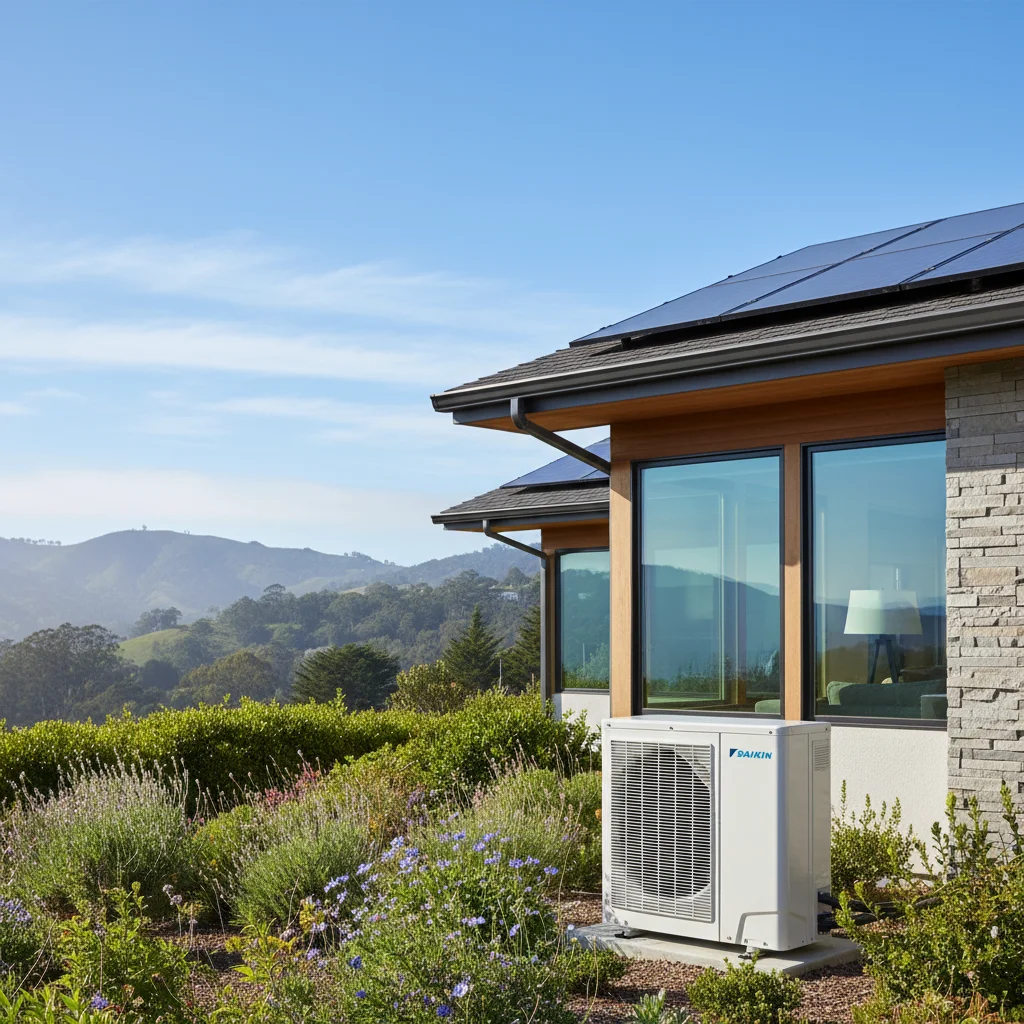
Bay Area homeowners replaced over 18,000 gas furnaces with electric heat pumps in 2025, and Daikin captured 22% of that market—the highest share of any brand in Northern California. The average total project cost landed between $12,500 and $28,000, but federal and state rebates can cut that number by $6,000 to $14,000 depending on household income and equipment efficiency.
How Much Does a Daikin Heat Pump Cost in the Bay Area?
Daikin heat pump installations in the Bay Area range from $12,500 to $28,000 depending on system size, efficiency rating, and whether the home needs electrical panel upgrades or ductwork modifications. And that figure includes equipment, labor, permits, and startup costs. But rebates from the IRA, California's TECH Clean California program, and local utility incentives can reduce out-of-pocket costs by 40-60%.
So why does the same heat pump cost $15,000 in San Jose and $24,000 in San Francisco? Labor rates, permitting fees, and electrical upgrades drive the variance. San Francisco requires seismic gas shutoff valves and stricter permit reviews, adding $2,000 to $4,000. Homes with older 100-amp panels often need a $3,000 to $5,000 service upgrade to support a central heat pump's electrical load.
Daikin's Fit series—the most popular Bay Area model—costs $8,500 to $12,000 for equipment alone, before installation. The higher-efficiency Daikin Aurora series runs $11,000 to $16,000 for the outdoor condenser and indoor air handler. Installation labor adds $3,500 to $7,000 depending on whether the contractor needs to run new refrigerant lines, upgrade the electrical panel, or modify existing ductwork.
And equipment size matters. A 2-ton Daikin Fit handles most Bay Area homes under 1,500 square feet and costs $12,500 to $18,000 installed. But a 4-ton Aurora system for a 2,500-square-foot home in the East Bay hills can hit $24,000 to $28,000 after permits and electrical work. SEER2 ratings above 18 unlock higher rebates but add $1,500 to $3,000 to upfront costs.
"Heat pump installations averaged $18,400 in the San Francisco metro area in 2025, with labor accounting for 35-40% of total project cost." — U.S. Energy Information Administration
What's the Payback Period for a Daikin Heat Pump Investment?
Bay Area homeowners see payback periods of 6 to 12 years on Daikin heat pumps when accounting for energy savings and available rebates. Homes replacing natural gas furnaces and window AC units save $800 to $1,600 annually on utility bills. And those numbers assume PG&E's 2026 natural gas rates of $2.80 per therm and electricity rates of $0.38 per kWh during peak hours.
Income-qualified households accelerate payback to 3 to 5 years thanks to TECH Clean California's income-based rebates, which cover up to $8,000 of installation costs. A family earning under 80% of area median income in Alameda County can stack a $2,000 federal tax credit, an $8,000 TECH rebate, and a $1,200 BayREN incentive—reducing a $20,000 project to $8,800 out of pocket.
So what drives the fastest payback? Homes with electric resistance heating or propane see returns in 4 to 7 years because Daikin heat pumps deliver 300-400% efficiency compared to resistance heaters' 100%. But homes with newer gas furnaces (installed after 2015) see slower payback of 10 to 14 years unless natural gas prices spike above $3.50 per therm.
Electricity rate structures matter. PG&E's time-of-use rates penalize daytime heating, but Daikin's Aurora series includes smart controls that shift heat pump operation to off-peak hours when electricity costs $0.22 per kWh instead of $0.48. That scheduling flexibility cuts annual operating costs by $240 to $380 in homes with programmable thermostats.
And maintenance costs stay low. Daikin systems need annual filter changes ($40) and biennial refrigerant checks ($180), totaling $140 per year on average. Compare that to gas furnace maintenance ($200 annually) plus chimney inspections ($150 every two years), and heat pumps save $90 to $120 per year in upkeep alone.
What Rebates and Incentives Can Reduce Your Daikin Heat Pump Cost?
The federal Energy Efficient Home Improvement Credit (Section 25C) ended for property placed in service after December 31, 2025 (IRS FS-2025-05). Federal tax credits for this work have ended, but state, local and utility rebates may still apply; check what is available at your address with the DuloCore rebate calculator. And that credit covers equipment, labor, and electrical upgrades—no income limits apply. Homeowners who install a Daikin Aurora with a SEER2 rating above 16 qualify automatically.
TECH Clean California provides point-of-sale rebates of $3,000 to $8,000 depending on household income and whether the installation includes panel upgrades or weatherization. Income-qualified households earning under 80% of area median income receive the full $8,000. Moderate-income households (80-150% AMI) get $5,000. And all other California residents qualify for $3,000.
BayREN—the Bay Area Regional Energy Network—adds $1,000 to $1,500 on top of TECH rebates for homes in Alameda, Contra Costa, Marin, Napa, San Francisco, San Mateo, and Santa Clara counties. BayREN also covers up to $4,000 for electrical panel upgrades if the home needs a service increase from 100 amps to 200 amps to support the heat pump load.
PG&E's Energy Savings Assistance Program offers zero-cost heat pump installations to income-qualified households, covering the entire $15,000 to $22,000 project cost. Eligibility caps at 200% of the federal poverty level—$60,000 for a family of four in 2026. And Silicon Valley Clean Energy runs a parallel program with a $75,000 income threshold for San Jose and Sunnyvale residents.
So what's the maximum rebate stack? A qualifying household in San Mateo County can combine: - $2,000 federal tax credit - $8,000 TECH Clean California rebate - $1,500 BayREN incentive - $4,000 BayREN panel upgrade incentive
That's $15,500 in total rebates on a $24,000 installation—cutting out-of-pocket costs to $8,500. Use our free rebate calculator to estimate your specific savings based on income and location.
"California's TECH Clean California program distributed $142 million in heat pump rebates in 2025, with an average rebate amount of $5,800 per installation." — California Energy Commission
How Does the Cost of a Daikin Heat Pump Compare to Other Brands in the Bay Area?
Daikin heat pumps cost 8-15% more than Carrier or Lennox models with similar SEER2 ratings, but installers report 30% fewer warranty claims and longer compressor life. A Daikin Fit 3-ton system costs $16,000 to $21,000 installed compared to $14,500 to $19,000 for a Carrier Infinity or $13,800 to $18,500 for a Lennox Merit series.
Mitsubishi challenges Daikin's market share with ductless mini-split systems priced $1,200 to $2,500 lower for single-zone installations. But multi-zone Mitsubishi systems (4+ zones) often exceed Daikin's ducted options by $3,000 to $5,000 once you account for installation of four indoor heads plus refrigerant line sets.
And American Standard undercuts Daikin by 12-18% on equipment costs alone—$7,200 for a 3-ton Platinum series versus $9,800 for a Daikin Fit. But American Standard's 10-year parts warranty falls short of Daikin's 12-year coverage, and Bay Area contractors charge $600 to $900 more for labor on American Standard installs due to parts availability delays.
Rheem and Goodman occupy the budget tier at $11,000 to $16,000 for complete installations, saving $3,000 to $6,000 compared to Daikin. So what's the trade-off? SEER2 ratings cap at 16-17 for budget brands versus 18-20 for Daikin's Aurora series. That efficiency gap costs $180 to $320 per year in higher electricity bills.
Bryant and Trane match Daikin's pricing within 5% but lack Daikin's variable-speed inverter technology in the same price tier. Daikin's Fit series includes inverter-driven compressors standard, while Trane charges $2,200 extra for comparable variable-speed operation.
What Financing Options Are Available for Daikin Heat Pump Installation?
California's PACE (Property Assessed Clean Energy) programs let homeowners finance heat pump installations through property tax assessments over 10 to 25 years. Interest rates range from 6.5% to 8.9%, and payments attach to the property—not the homeowner—so they transfer to the next buyer if the home sells.
BayREN's on-bill financing allows PG&E customers to repay heat pump installations through monthly utility bills at 0% to 5% APR for terms up to 10 years. Maximum loan amounts hit $25,000, covering complete system replacements plus electrical upgrades. And approval doesn't require a credit check for loans under $15,000.
Daikin Comfort Pro dealers offer manufacturer financing through Wells Fargo and Synchrony Bank with promotional 0% APR for 18 to 60 months on approved credit. But deferred interest applies—miss the payoff deadline by one day and retroactive interest at 26.99% APR hits the entire original balance.
So what's the monthly payment on a $20,000 installation after rebates? A $12,000 financed balance at 5% APR over 10 years costs $127 per month. Compare that to the $110 to $140 monthly savings on utility bills, and the heat pump effectively pays for itself from day one.
Credit unions in the Bay Area offer home improvement loans at 5.5% to 7.5% APR with no origination fees and terms up to 15 years. Stanford Federal Credit Union and Patelco run specialized energy efficiency loan programs with rate discounts for ENERGY STAR-certified equipment installations.
How Long Will My Daikin Heat Pump Last, and What Are the Maintenance Costs?
Daikin heat pumps last 15 to 20 years in Bay Area climates when maintained annually, matching the lifespan of gas furnaces but outlasting window AC units by 8 to 12 years. And compressor warranties cover 12 years on parts, reducing replacement risk during the critical first decade.
Annual maintenance costs $140 to $220 and includes filter replacement, refrigerant pressure checks, coil cleaning, and electrical connection inspection. Bay Area contractors recommend service visits in March before cooling season and October before heating season to catch refrigerant leaks or fan motor issues before they cause system failures.
So what breaks first? Capacitors fail after 8 to 12 years and cost $180 to $320 to replace. Fan motors wear out at the 12- to 15-year mark and run $450 to $680 for parts and labor. And reversing valves—the component that switches between heating and cooling—fail in 2% of systems before year 10, costing $800 to $1,400 to replace.
Refrigerant leaks occur in 8% of heat pumps within the first 10 years, usually at brazed joints or service valves. Repairs cost $400 to $900 depending on leak location and refrigerant type. Daikin systems use R-410A refrigerant through 2024 models and R-32 in 2025+ systems—R-32 costs 15% less per pound and reduces leak-related expenses.
And filter neglect kills efficiency. Homeowners who skip quarterly filter changes see SEER2 ratings drop from 18 to 14 within three years, costing $220 to $380 annually in wasted electricity. MERV 8 filters cost $8 to $15 and take 90 seconds to swap—the easiest maintenance task with the biggest impact on system longevity.
"Properly maintained air-source heat pumps last 15 years on average, with some systems exceeding 20 years in moderate climates like coastal California." — ENERGY STAR
Official Sources
- U.S. Department of Energy - Energy Saver — Federal guidance on heat pump types, efficiency ratings, and sizing
- ENERGY STAR Heat Pumps — Certification requirements and qualified product database
- DSIRE California Incentives — Comprehensive database of state and utility energy tax credits and rebates (note: the federal 25C and 25D credits ended for projects completed after December 31, 2025)
Frequently Asked Questions
How much does a Daikin heat pump cost in the Bay Area?
Daikin heat pump installations cost $12,500 to $28,000 in the Bay Area depending on system size, efficiency rating, and whether the home needs electrical panel upgrades. Equipment accounts for $8,500 to $16,000, while labor, permits, and electrical work add $4,000 to $12,000. Rebates from IRA, TECH Clean California, and BayREN can reduce out-of-pocket costs by $6,000 to $15,500.
What rebates are available for Daikin heat pumps in California?
The federal Energy Efficient Home Improvement Credit (Section 25C) ended for property placed in service after December 31, 2025 (IRS FS-2025-05). TECH Clean California offers $3,000 to $8,000 in point-of-sale rebates based on household income. BayREN adds $1,000 to $1,500 for Bay Area residents, plus up to $4,000 for electrical panel upgrades. Income-qualified households can access PG&E's Energy Savings Assistance Program for zero-cost installations.
Am I eligible for heat pump rebates in the Bay Area?
All California homeowners qualify for the $2,000 federal tax credit and $3,000 TECH rebate regardless of income. Households earning under 80% of area median income ($85,000 for a family of four in San Francisco) receive the full $8,000 TECH rebate. BayREN rebates apply to residents of Alameda, Contra Costa, Marin, Napa, San Francisco, San Mateo, and Santa Clara counties.
How long does it take to receive a heat pump rebate?
TECH Clean California rebates process as point-of-sale discounts—the installer applies the rebate immediately, and homeowners pay the reduced amount at project completion. Form 5695 only covers qualifying work completed by December 31, 2025 and claimed on a 2025 return; the federal 25C and 25D credits ended after that date (IRS FS-2025-05). BayREN rebates arrive 6 to 10 weeks after the contractor submits final paperwork.
What's the difference between Daikin and other heat pump brands for rebates?
All heat pump brands qualify for the same federal and state rebates as long as the equipment meets SEER2 efficiency thresholds—typically 15.2 or higher. Daikin's Fit and Aurora series exceed the minimum requirements with SEER2 ratings of 18-20, unlocking full rebate amounts. Budget brands like Goodman and Rheem may cap at SEER2 16-17, reducing eligibility for tier-based utility incentives.
Ready to see your total savings? Use our rebate calculator to estimate federal tax credits, state rebates, and utility incentives based on your Bay Area location and household income. Get your personalized rebate amount in under 60 seconds.
Last updated April 14, 2026 — reviewed by DuloCore Editorial. About our authors.
Check your California heat pump rebate eligibility — see the programs you qualify for and the dollar amounts on our California heat pump rebate finder.