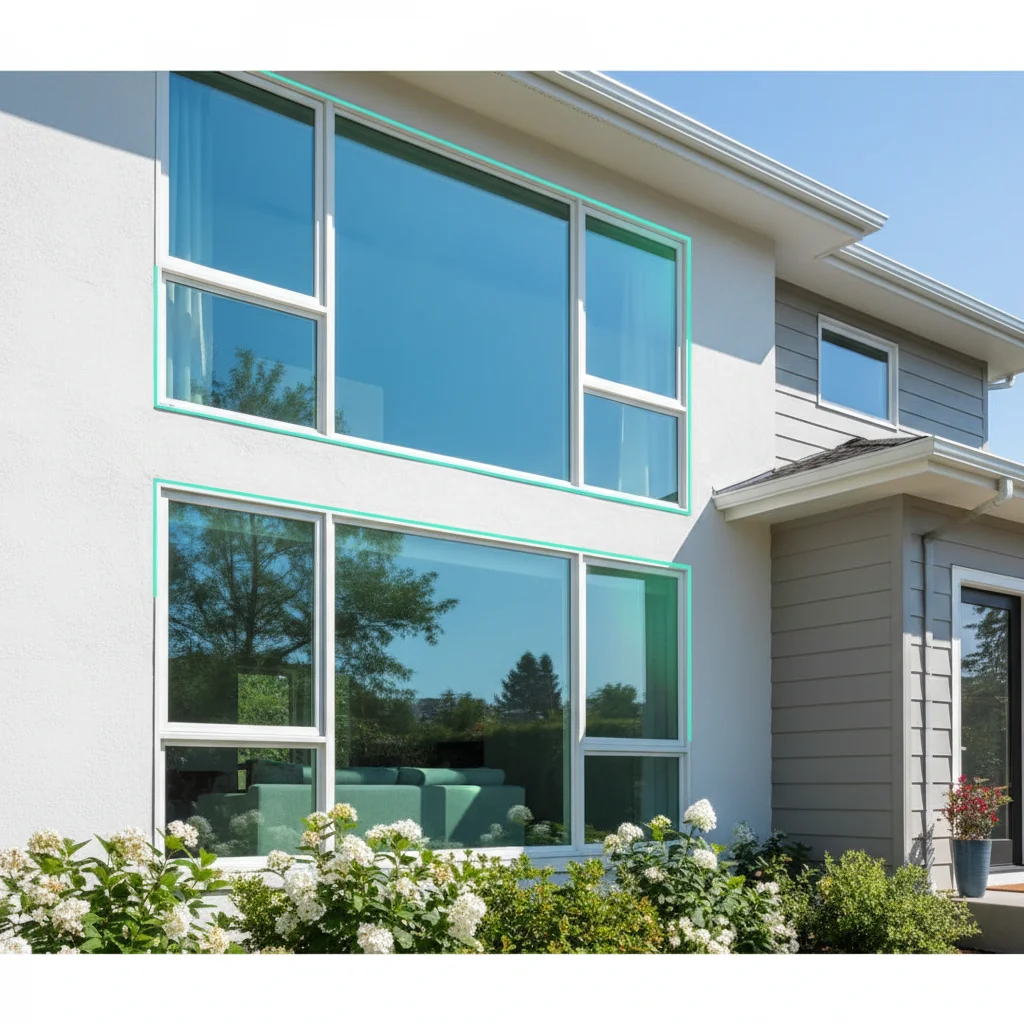
A single-family home loses 25-30% of its heating and cooling energy through inefficient windows, costing homeowners $126-$465 annually in wasted utility bills, according to the Department of Energy. And that's before factoring in drafts, condensation damage, and noise pollution.
How Much Do Replacement Windows Cost in 2026?
Replacement windows cost $300-$1,200 per window installed in 2026, with full-frame installations averaging $650-$925 and insert replacements running $300-$550. Double-pane vinyl windows sit at the lower end ($300-$600), while triple-pane fiberglass or wood-clad units reach $800-$1,200. Energy Star-certified models add 10-15% to material costs.
But the real financial question isn't upfront cost—it's payback period. A $12,000 window replacement project in a 2,000-square-foot home saves $400-$800 annually on HVAC costs, creating a 15-20 year break-even point before accounting for energy tax credits and utility rebates.
Price Breakdown by Window Type
| Window Type | Material Cost | Installation Cost | Total per Window |
|---|---|---|---|
| Single-Hung Vinyl | $150-$300 | $150-$250 | $300-$550 |
| Double-Hung Fiberglass | $300-$500 | $200-$350 | $500-$850 |
| Casement Triple-Pane | $450-$700 | $250-$400 | $700-$1,100 |
| Bay/Bow Windows | $1,000-$2,500 | $500-$1,000 | $1,500-$3,500 |
So material costs represent 50-60% of total project expense, with labor, disposal, trim work, and permit fees adding $150-$400 per window. Contractors charge $40-$65 per hour, and a typical installation takes 1-2 hours per standard-size window.
Which Replacement Windows Qualify for Tax Rebates and Credits?
The federal Energy Efficient Home Improvement Credit (Section 25C) ended for property placed in service after December 31, 2025 (IRS FS-2025-05). Federal tax credits for this work have ended, but state, local and utility rebates may still apply; check what is available at your address with the DuloCore rebate calculator. State and utility programs add $50-$150 per window in rebates, with Massachusetts offering $250 per window and California providing tiered incentives from $75-$200 based on NFRC ratings.
"Qualifying windows must meet regional Energy Star criteria, with U-factor and Solar Heat Gain Coefficient ratings varying by climate zone." — Energy Star Windows Requirements
And the combined savings stack—a $10,000 window replacement captures $3,000 federal credit plus $1,200-$2,400 in utility rebates, dropping net cost to $5,600-$5,800. Use our rebate calculator to find your exact eligibility and savings.
2026 Rebate Comparison Table
| Program | Maximum Rebate | Income Limit | U-Factor Requirement |
|---|---|---|---|
| IRA Federal Tax Credit | Ended Dec 31, 2025 | — | — |
| Massachusetts HEAT Loan | $250/window | <120% AMI | ≤0.25 |
| California TECH Initiative | $75-$200/window | None | ≤0.28 |
| Con Edison Rebate | $100/window | Commercial only | ≤0.29 |
But qualification hinges on installation by certified contractors and submission of Manufacturer's Certification Statement showing NFRC-verified performance ratings. DIY installations forfeit most rebate programs.
What's the Energy Efficiency Rating System for Replacement Windows?
The National Fenestration Rating Council (NFRC) measures windows on four metrics: U-factor (heat loss, 0.15-1.2 scale, lower is better), Solar Heat Gain Coefficient (solar radiation transmission, 0-1 scale), Visible Transmittance (daylight admission, 0-1 scale), and Air Leakage (cubic feet per minute, ≤0.3 required for Energy Star). Triple-pane argon-filled windows achieve U-factor 0.15-0.20, while budget double-pane units rate 0.28-0.35.
And those decimal-point differences compound over 20-year window lifespans. A U-factor 0.20 window loses 40% less heat than a 0.30 model, translating to $60-$120 annual savings per window in heating-dominated climates like Minneapolis or Boston.
"U-factor measures the rate of heat transfer and is expressed in Btu/(hr·ft²·°F). The lower the U-factor, the greater the window's resistance to heat flow." — Department of Energy Window Standards
So prioritize U-factor in cold climates and SHGC in hot climates. Phoenix homeowners benefit from SHGC 0.20-0.23 to block summer heat gain, while Chicago residents need U-factor ≤0.22 to prevent winter heat loss.
Which Window Brands Offer the Best Value for Your Budget?
Andersen 400 Series ($450-$650/window), Pella 250 Series ($350-$550/window), and Milgard Ultra ($300-$500/window) dominate the mid-tier rebate-eligible market, all offering NFRC-certified U-factor 0.25-0.27 and 20-year warranties. Premium manufacturers like Marvin Signature ($800-$1,200/window) and Loewen ($1,000-$1,500/window) hit U-factor 0.18-0.22 with triple-pane configurations and lifetime glass breakage warranties.
But brand matters less than certification—Energy Star Most Efficient designation guarantees rebate eligibility regardless of manufacturer. And local suppliers often match performance specs at 15-25% lower cost than national brands.
Brand Efficiency Comparison
| Brand | U-Factor Range | SHGC Range | Warranty | Average Cost |
|---|---|---|---|---|
| Andersen 400 | 0.25-0.27 | 0.24-0.29 | 20 years | $550 |
| Pella 250 | 0.26-0.28 | 0.25-0.30 | 10 years | $450 |
| Milgard Ultra | 0.27-0.29 | 0.26-0.31 | Limited lifetime | $400 |
| Marvin Signature | 0.18-0.22 | 0.20-0.25 | Lifetime glass | $1,000 |
So mid-tier brands deliver 90-95% of premium performance at 50-60% lower cost. And all major manufacturers publish NFRC labels showing certified ratings—verify before purchase to ensure rebate qualification.
How Much Does Professional Window Installation Cost?
Professional installation costs $150-$400 per window in 2026, with full-frame replacements averaging $250-$400 and insert installations running $150-$250. Labor rates vary by region—San Francisco contractors charge $65-$85/hour versus $40-$55/hour in Atlanta. Add $500-$1,200 for permits, disposal fees, and trim/casing work on whole-house projects.
And installation method drives cost variation. Full-frame replacement requires removing interior/exterior trim, cutting out the old frame, waterproofing, insulating rough openings, and installing new jambs—6-8 hours of labor for a typical home. Insert replacements slide new sashes into existing frames, cutting installation time to 1-2 hours per window.
But certified installers unlock rebate programs. Many utility rebates require BPI-certified or NATE-certified installation and post-installation blower door testing to verify air sealing performance. DIY installations save $3,000-$6,000 on a full-house project but forfeit $1,500-$3,000 in rebates.
So net cost difference narrows to $1,500-$3,000, and professional installation includes warranties covering leaks, condensation, and hardware failures—risks that DIYers absorb themselves.
When Will Replacement Windows Pay for Themselves Through Energy Savings?
Replacement windows pay for themselves in 15-30 years through reduced HVAC costs, with Energy Star Most Efficient models achieving 15-20 year payback in cold climates and 20-30 years in moderate zones. A $12,000 whole-house project saves $400-$800 annually depending on existing window U-factor, local energy rates ($0.10-$0.35/kWh), and climate zone heating/cooling degree days.
And federal tax credits accelerate ROI by 25-40%. That same $12,000 project captures $3,000 in IRA credits plus $1,200-$2,400 utility rebates, dropping net investment to $6,600-$7,800 and shortening payback to 8-15 years.
"Homeowners can save an average of $126-$465 per year by replacing single-pane windows with Energy Star certified products." — Energy Saver: Energy Efficient Windows
But payback calculations ignore non-energy benefits worth $2,000-$5,000 over window lifespan: reduced HVAC maintenance (units run 15-25% fewer cycles), eliminated condensation damage to sills/trim, improved indoor air quality, and 3-5% home resale value increase. Factor those, and breakeven occurs at 10-18 years.
So windows compete favorably with other efficiency upgrades. Heat pump rebates deliver faster payback (5-10 years) but require $8,000-$15,000 investment, while windows spread cost across 10-30 units at $300-$1,200 each.
Official Sources
- Energy Star Windows Requirements — NFRC certification standards and regional climate zone specifications
- DOE Energy Saver: Windows — Federal energy efficiency guidance and estimated savings calculations
- DSIRE USA — State-by-state rebate and incentive program database
Related Reading: Learn more about Double Pane Vs Triple Pane Windows Cost and Home Energy Audit Cost.
Frequently Asked Questions
How much do replacement windows cost on average?
Replacement windows cost $300-$1,200 per window installed in 2026, with total project costs running $3,000-$12,000 for a typical 10-window home. Double-pane vinyl models average $450-$600 installed, while triple-pane fiberglass or wood-clad units reach $800-$1,200. Material costs represent 50-60% of total expense, with labor, permits, and disposal adding $150-$400 per window.
What factors affect the price of replacement windows?
Window prices vary based on seven factors: frame material (vinyl $300-$600, fiberglass $500-$900, wood $700-$1,200), pane count (single $200-$400, double $300-$700, triple $500-$1,100), gas fill (air vs argon/krypton adds $30-$80), glazing coatings (Low-E adds $40-$100), size (standard $300-$800, oversized $1,000-$3,500), installation method (insert vs full-frame differs by $100-$200), and geographic labor rates ($40-$85/hour).
Are replacement windows tax deductible or eligible for rebates?
The federal Energy Efficient Home Improvement Credit (Section 25C) ended for property placed in service after December 31, 2025 (IRS FS-2025-05). State and utility programs add $50-$250 per window, with combined federal and local incentives covering $1,200-$5,400 on typical $10,000-$12,000 whole-house projects. Calculate your exact savings with our rebate calculator.
How long do replacement windows typically last?
Quality replacement windows last 20-30 years with proper maintenance, with vinyl frames reaching 20-25 years, fiberglass 30-40 years, and wood 30+ years when refinished every 3-7 years. Insulated glass units (IGUs) carry 10-20 year seal warranties—failed seals cause condensation between panes and reduce R-value by 25-50%. Hardware components (locks, balances, cranks) require replacement every 10-15 years at $50-$150 per window.
What's the difference between full frame and insert replacement windows?
Full-frame replacement removes the entire window unit including jambs, sills, and trim, exposing the rough opening for insulation and waterproofing before installing a complete new window—cost $500-$1,100 per window. Insert replacement slides new sashes into existing frames, preserving interior/exterior trim and cutting installation time by 60-75%—cost $300-$650 per window. Full-frame suits rotted frames or size changes, while inserts work for cosmetic upgrades on sound frames.
Ready to calculate your window replacement savings? Use our free rebate calculator to find federal tax credits and state incentives based on your location, home size, and window specifications. Get your personalized rebate estimate in under 2 minutes.
Last updated: April 14, 2026. Reviewed by the DuloCore Editorial Team. About our authors.
Check your California insulation rebate eligibility — see the programs you qualify for and the dollar amounts on our California insulation rebate finder.