The federal Residential Clean Energy Credit (Section 25D) ended for expenditures made after December 31, 2025, and the IRS treats an expenditure as made when installation is completed (IRS FS-2025-05). Check current state, local and utility incentives for your address with the DuloCore rebate calculator. And while that's still 2-3 times the price of a conventional furnace, geothermal systems slash heating bills by 40-70% and eliminate the annual maintenance headaches of combustion-based equipment.
How Much Does a Geothermal Heating System Cost to Install?
Geothermal heating systems cost $15,000 to $38,000 for a complete installation in 2026, with horizontal loop systems averaging $18,000-$25,000 and vertical loop systems running $25,000-$38,000. The loop field accounts for 60-70% of total project cost, while the indoor heat pump unit represents $5,000-$8,000 of the expense.
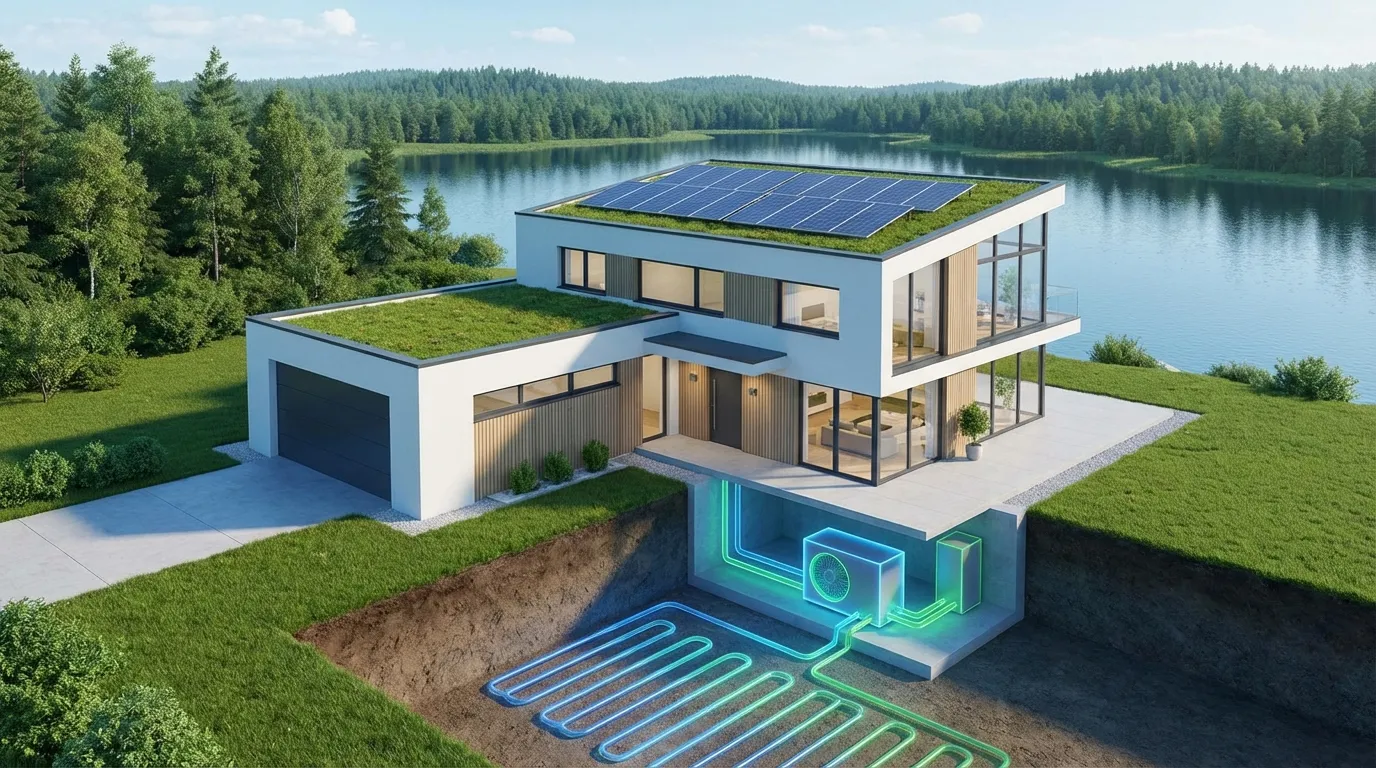
The vast majority of that price tag goes underground. Horizontal loop fields require 1,500 to 3,000 square feet of yard space and involve excavating trenches 4-6 feet deep across your property. But vertical systems drill 150-400 feet down in a much smaller footprint and work on properties with limited acreage. So homeowners with smaller lots pay $8,000-$12,000 more for vertical drilling.
Installation labor runs $3,000-$6,000 depending on soil conditions, accessibility, and regional wage rates. Rocky terrain or high water tables can push excavation costs up by 20-30%. And some installers charge extra for concrete restoration, landscaping repair, or permitting fees that add another $1,000-$2,500 to the final invoice.
"Geothermal heat pumps are the most energy-efficient, environmentally clean, and cost-effective systems for heating and cooling buildings." — U.S. Department of Energy
But here's the tension: a $25,000 upfront cost stops most homeowners cold, even when the system saves $900-$1,800 per year on heating and cooling bills. So understanding the payback timeline and available rebates becomes the deciding factor for 70% of buyers.
What's the ROI and Payback Period for Geothermal Heating?
Geothermal heating systems deliver a 7-12 year payback period in most climate zones, with annual energy savings of $900-$1,800 offsetting the $15,000-$38,000 installation cost. Homeowners in cold climates like Minnesota or Vermont see 5-7 year payback, while mild climates like Southern California stretch to 10-15 years due to lower baseline heating costs.
The math works like this: a typical household spending $2,400 annually on natural gas or propane heating drops to $600-$900 with geothermal, saving $1,500-$1,800 per year. And the 30% federal tax credit shaves $6,000-$9,000 off a $20,000-$30,000 system, accelerating payback by 3-4 years. So the net installed cost after incentives runs $14,000-$21,000 for most projects.
But payback timelines vary wildly based on what you're replacing. Swapping out an old propane furnace in a 3,000-square-foot home can save $2,200 per year, hitting payback in 6 years. Replacing an efficient natural gas furnace in a mild climate saves only $800 annually and takes 13-16 years to break even.
Use our free rebate calculator to model your specific property's payback timeline based on current fuel costs and system sizing.
Is Geothermal Heating Right for Your Climate Zone?
Geothermal heating systems perform best in USDA climate zones 3-6, where winter temperatures drop below 32°F for extended periods and annual heating loads justify the $15,000-$38,000 installation cost. Zones 1-2 (Southern states) see slower payback due to minimal heating demand, while zones 7-8 (Alaska, northern Minnesota) require larger systems and deeper loop fields.
Cold-climate states deliver the fastest ROI. Minnesota homeowners save $1,800-$2,400 per year replacing propane or oil heat, while Wisconsin and Maine see $1,500-$2,000 in annual savings. And geothermal systems maintain 300-400% efficiency even when outdoor air temperatures hit -10°F, unlike air-source heat pumps that lose 40-50% of their heating capacity below 20°F.
Moderate climate zones like California, Oregon, and coastal Washington states benefit from geothermal's dual heating and cooling efficiency. A Sacramento homeowner running a 4-ton geothermal system saves $600 on winter heating and $700 on summer cooling for $1,300 total annual savings. But the 10-12 year payback period competes with cheaper air-source heat pump options that cost $8,000-$12,000 installed.
And the ground loop field's performance stays consistent regardless of outdoor weather. Soil temperatures 4-6 feet underground hold steady at 50-60°F year-round, so the system extracts heat from a stable thermal reservoir instead of struggling against -5°F winter air or 105°F summer heat.
Geothermal vs. Traditional Heat Pumps: Which System Saves More Money?
Geothermal heat pumps save $400-$900 more per year than air-source heat pumps in cold climates, but cost $10,000-$18,000 more upfront, extending the payback period to 8-12 years compared to 4-6 years for air-source systems. Air-source heat pumps cost $6,000-$12,000 installed and deliver 200-300% efficiency in moderate climates, while geothermal maintains 300-500% efficiency year-round.
The efficiency gap widens in extreme weather. A geothermal system pulls heat from 55°F ground in January and delivers it to your home at 300-400% efficiency. An air-source heat pump extracting heat from 15°F outdoor air drops to 180-220% efficiency and burns supplemental electric resistance heat when temperatures fall below 5°F. So Minnesota homeowners save an extra $800 per year with geothermal, while Georgia homeowners save only $200-$300.
But air-source technology caught up in 2024-2026. Modern cold-climate air-source heat pumps now operate efficiently down to -15°F and cost 60% less than geothermal systems. And federal heat pump rebates cover $2,000-$8,000 of air-source installations for income-qualified households, narrowing the total cost gap.
Here's the head-to-head comparison for a 2,000-square-foot home in climate zone 5:
| System Type | Installed Cost | Annual Energy Cost | Federal Tax Credit | Net Payback Period |
|---|---|---|---|---|
| Geothermal | $25,000 | $650 | $7,500 (30%) | 8-10 years |
| Air-Source Heat Pump | $10,000 | $1,100 | $2,000 (HEEHRA) | 5-7 years |
| Natural Gas Furnace | $5,500 | $1,800 | $0 | Baseline |
Federal Tax Credits and Rebates for Geothermal Installation in 2026
Form 5695 only covers qualifying work completed by December 31, 2025 and claimed on a 2025 return; the federal 25C and 25D credits ended after that date (IRS FS-2025-05). Federal tax credits for this work have ended, but state, local and utility rebates may still apply; check what is available at your address with the DuloCore rebate calculator.
The federal Residential Clean Energy Credit (Section 25D) ended for expenditures made after December 31, 2025, and the IRS treats an expenditure as made when installation is completed (IRS FS-2025-05).
California's TECH Clean California program offers $3,000-$5,000 rebates for qualified geothermal installations through participating utilities. Massachusetts homeowners access $3,500-$10,000 through Mass Save, while New York's Clean Heat program provides $1,000-$4,000 per ton of heating capacity.
The federal Residential Clean Energy Credit (Section 25D) ended for expenditures made after December 31, 2025, and the IRS treats an expenditure as made when installation is completed (IRS FS-2025-05).
Check your local utility's 2026 rebate offerings through the Database of State Incentives for Renewables & Efficiency to stack state, federal, and utility incentives. And income-qualified households can access additional rebates of $8,000-$14,000 through the Home Energy Rebate programs launching in 2026.
Learn more about stacking incentives in our guide to energy tax credits.
What Affects the Total Cost of Geothermal Heating Systems?
Geothermal heating system costs vary by loop configuration, home size, soil conditions, and regional labor rates, with vertical systems running $10,000-$15,000 more than horizontal installations and homes above 3,000 square feet requiring 4-5 ton units that add $4,000-$8,000 to the base price.
Loop field type drives 60-70% of the cost spread. Horizontal loops cost $1,200-$1,800 per ton of heating capacity and work on properties with 1,500+ square feet of open yard space. Vertical loops run $2,000-$3,000 per ton but fit on small urban lots with limited acreage. And pond loops offer the cheapest option at $800-$1,200 per ton if you have a nearby water body at least 8 feet deep.
System sizing follows Manual J load calculations that account for home square footage, insulation levels, window efficiency, and climate zone. A well-insulated 2,000-square-foot home in zone 5 needs a 3-ton system costing $18,000-$25,000, while a poorly insulated 2,500-square-foot home requires 4 tons and runs $24,000-$32,000 installed.
Soil conditions add 10-30% to excavation costs. Rocky terrain, high water tables, or underground utilities require specialized drilling equipment that increases labor charges by $2,000-$5,000. And some jurisdictions mandate soil testing, engineering reports, or well permits that tack on another $800-$1,500 in soft costs.
Regional labor rates swing by 40-50% between markets. Boston-area installers charge $85-$110 per hour compared to $55-$70 in the Midwest, adding $2,500-$4,000 to identical projects. And remote rural areas face mobilization fees of $500-$1,200 for contractors traveling from metro hubs.
Official Sources
- U.S. Department of Energy: Geothermal Heat Pumps — Technical specifications and efficiency data for residential geothermal systems
- IRS Residential Clean Energy Credit — Official tax credit guidelines and filing requirements for 2026 (note: the federal 25C and 25D credits ended for projects completed after December 31, 2025)
- DSIRE Database — Searchable database of state, local, and utility rebate programs for geothermal installations
Related Reading: Learn more about Home Energy Audit Cost By State and Most Cost Effective Energy Upgrades.
Frequently Asked Questions
How much does a geothermal heating system cost?
Geothermal heating systems cost $15,000-$38,000 installed in 2026, with horizontal loop systems averaging $18,000-$25,000 and vertical systems running $25,000-$38,000. System size, loop configuration, soil conditions, and regional labor rates drive the final price. And the 30% federal tax credit reduces net cost by $4,500-$11,400.
What rebates are available for geothermal heating systems in 2026? (Note: Federal tax credit percentages and availability are subject to change; the 30% Residential Clean Energy Credit under Section 25D expired December 31, 2025. Verify current incentives at energy.gov.)
Geothermal systems no longer qualify for a federal tax credit (the federal 25D credit ended for expenditures made after December 31, 2025, IRS FS-2025-05), but state and utility rebates of $1,000-$10,000 may apply depending on location. California offers $3,000-$5,000 through TECH Clean California, Massachusetts provides $3,500-$10,000 via Mass Save, and New York's Clean Heat program grants $1,000-$4,000 per ton. Income-qualified households access additional Home Energy Rebate programs worth $8,000-$14,000.
Are geothermal systems eligible for federal tax credits?
The federal Residential Clean Energy Credit (Section 25D) ended for expenditures made after December 31, 2025, and the IRS treats an expenditure as made when installation is completed (IRS FS-2025-05). Form 5695 only covers qualifying work completed by December 31, 2025 and claimed on a 2025 return; the federal 25C and 25D credits ended after that date (IRS FS-2025-05).
How long does it take to install a geothermal heating system?
Geothermal system installation takes 3-7 days for horizontal loop fields and 2-4 days for vertical drilling, plus 1-2 days for indoor heat pump equipment and ductwork connections. Weather delays, soil conditions, and permit approvals can extend timelines by 1-2 weeks. Contractors schedule drilling first, then return weeks later for final equipment commissioning after concrete or landscaping restoration.
How much can you save with a geothermal heating system?
Geothermal heating systems save $900-$1,800 per year on combined heating and cooling costs compared to conventional furnaces and air conditioners. Cold climate homeowners replacing propane or oil heat save $1,500-$2,400 annually, while moderate climate zones see $800-$1,300 in savings. And geothermal systems eliminate $200-$400 in annual furnace maintenance and filter replacement costs.
Ready to calculate your geothermal savings? Use our free rebate calculator to estimate your total project cost, available incentives, and payback timeline based on your home's size, location, and current heating system.
Last updated: April 14, 2026. Reviewed by the DuloCore Editorial Team. About our authors.
Check your California heat pump rebate eligibility — see the programs you qualify for and the dollar amounts on our California heat pump rebate finder.