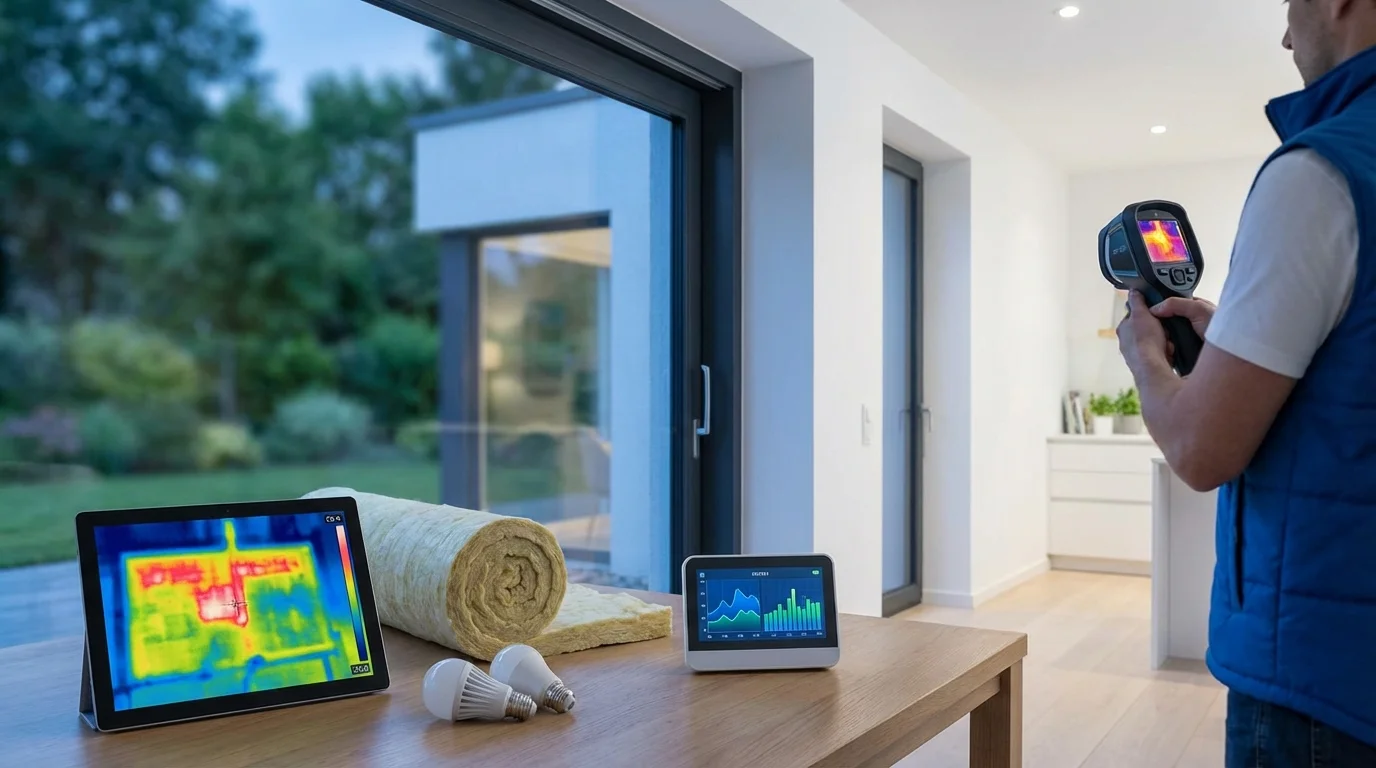
The average U.S. household wastes 20-30% of its energy through drafts, air leaks, and outdated equipment, costing hundreds of dollars each year. So addressing these small inefficiencies is the fastest way to lower utility bills without a 5-figure investment. And with 2026 rebates and tax credits, the net cost of these simple fixes drops to nearly zero.
What Are the Absolute Cheapest Home Energy Improvements I Can Make Right Now?
The most affordable home energy improvements for 2026 include air sealing with caulk and weatherstripping, installing a smart thermostat, and switching to LED lighting. And these projects typically cost under $200, offer an immediate payback in lower utility bills, and often qualify for instant utility rebates.
The lowest-hanging fruit for energy savings doesn't require a contractor. So sealing air leaks around windows, doors, and electrical outlets with caulk or weatherstripping is a weekend DIY project that costs less than $50. But its impact is immediate. The Department of Energy estimates that effective air sealing saves 10-20% on heating and cooling costs. And another simple swap is installing a programmable or smart thermostat, which saves up to 10% annually by optimizing your HVAC usage. Upgrading to LED lighting uses 75% less energy and lasts 25 times longer than incandescent bulbs. Many of these upgrades can be identified during a professional home energy audit.
The core tension for homeowners is the perceived cost of energy efficiency versus the actual, ongoing cost of energy waste. So while a new HVAC system is expensive, the cumulative financial drain from air leaks and inefficient appliances is a guaranteed loss. The average U.S. household spends over $2,200 per year on energy bills. And a 20% loss from inefficiency means throwing away $440 every single year. But federal, state, and utility incentives for 2026 are designed to erase the upfront cost barrier for these exact types of small, high-impact upgrades, turning a household expense into a smart financial investment.
How Much Can I Save: What Rebate Amounts Are Available for Energy Upgrades in My State and From My Utility?
Rebate amounts for 2026 cheap energy upgrades range from $25 instant rebates for smart thermostats to over $1,600 for insulation and air sealing projects. And savings depend on your state, utility provider, and household income, with enhanced rebates available for qualifying low-to-moderate income families.
The total value of rebates is a patchwork of federal, state, and local utility programs. So a homeowner's savings will vary. Utility companies frequently offer instant rebates of $50-$100 for purchasing an ENERGY STAR certified smart thermostat. And state energy offices provide rebates that cover up to 50-75% of the cost of insulation and air sealing, often capped around $1,600. The federal Inflation Reduction Act (IRA) provides energy tax credits covering 30% of the project cost for certain improvements, up to an annual limit. Use our free rebate calculator to find your exact savings.
Which Specific Home Energy Improvements and Equipment Are Eligible for Rebates and Incentives?
Eligible equipment for 2026 rebates focuses on ENERGY STAR certified products, including smart thermostats, LED lighting, insulation materials, and advanced power strips. And specific model numbers and efficiency ratings are often required for qualification, so always check program guidelines before purchasing any equipment for your home.
Rebate programs target products with verified energy savings. So for insulation, this includes batts, blown-in, and spray foam with specific R-values. And for smart thermostats, only models listed on the ENERGY STAR or utility-approved product list qualify. But even smaller items like advanced power strips, which prevent "vampire load" from electronics, are often eligible for $10-$25 instant rebates from utility online marketplaces. So the key is checking the specific requirements of your local program, as a non-certified product won't qualify, even if it improves efficiency.
Energy Upgrade Rebate Program Comparison (2026)
| Program Type | Typical Rebate/Credit Amount | Common Eligible Upgrades | Key Eligibility Factor |
|---|---|---|---|
| Federal Tax Credits (IRA) | Ended Dec 31, 2025 | — | Ended Dec 31, 2025 |
| State Rebate Programs | $200 - $1,600 | Insulation, Air Sealing, Audits | State Residency, Income Level |
| Local Utility Rebates | $25 - $150 (often instant) | Smart Thermostats, LED Bulbs | Being a Utility Customer |
What Are the Income Limits, Application Process, and Deadlines for Energy Efficiency Rebates?
Many 2026 state-level energy rebates have income limits, often set at 80% or 150% of the Area Median Income (AMI) to qualify for enhanced amounts. And the application process typically involves submitting a receipt and product details online, with deadlines falling at year-end or when funds are exhausted.
The application process for cheap upgrades is straightforward. So for a smart thermostat, a homeowner usually uploads a photo of the receipt or UPC code to their utility's online portal. But for larger projects like insulation, the process may require an invoice from a certified contractor. And deadlines are critical; most state and utility programs operate on a calendar year basis for 2026 and close on December 31 or whenever their allocated funding is depleted.
Can I Combine Multiple Rebates (Stacking Rules), and Do I Need Specific Contractor Requirements?
Stacking rebates from federal, state, and utility sources is generally allowed for 2026, maximizing savings on a single project. But while DIY installations like LED bulbs are fine, rebates for insulation or air sealing often require installation by a licensed or program-approved contractor to ensure quality.
Combining incentives is a powerful strategy. So a homeowner can use a $100 utility rebate on a smart thermostat and also count the remaining cost toward their annual federal tax credit limit. But it's essential to check the rules for each program, as some state funds can't be combined with other state incentives. And contractor requirements are non-negotiable for certain rebates. Programs like Home Performance with ENERGY STAR mandate work be done by Building Performance Institute (BPI) certified professionals to qualify for thousands in heat pump rebates.
How Can I Check the Funding Status of Energy Programs and Find Resources for My State and Utility?
Homeowners check 2026 energy program funding status directly on their state's Department of Energy website and their local utility's "rebates" or "ways to save" page. And resources like the DSIRE database provide a comprehensive, searchable list of all available incentives by zip code for easy access.
Program funding is finite and often distributed on a first-come, first-served basis. So it's critical to verify that a program is still accepting applications before making a purchase. And your utility's website is the most accurate source for real-time information on their specific rebates. For a broader view, government-funded clearinghouses offer links to all active programs.
"DSIRE is the most comprehensive source of information on incentives and policies that support renewables and energy efficiency in the United States." — DSIRE
So staying informed about program status ensures you don't miss out on savings for your next project, like a geothermal tax credit.
Official Sources
- ENERGY STAR Rebate Finder — A tool from the U.S. EPA to find local rebates and special offers for ENERGY STAR certified products.
- Database of State Incentives for Renewables & Efficiency (DSIRE) — A comprehensive national database of energy efficiency incentives managed by the N.C. Clean Energy Technology Center.
Related Reading: Learn more about Blower Door Test Home Energy and Energy Modeling Software Home.
Frequently Asked Questions About Cheap Home Energy Improvements & Rebates
What low-cost home energy improvements are typically eligible for rebates?
Low-cost improvements like air sealing (caulking, weatherstripping), insulation upgrades, ENERGY STAR certified smart thermostats, and LED lighting are most commonly eligible for 2026 rebates. And utility programs often provide instant rebates of $50-$100 for smart thermostats, while state programs offer up to $1,600 for insulation and air sealing work.
Which budget-friendly energy upgrades offer the best rebate return on investment?
Air sealing and adding insulation offer the best return, saving 10-20% on annual energy costs. So with rebates covering up to 75% of the project cost (capped around $1,600), the payback period is often less than one year. And smart thermostats are another top contender, with $50-$100 rebates often covering the entire device cost.
What is the easiest application process for rebates on minor home energy improvements?
The easiest applications are for instant online utility rebates. So for items like smart thermostats or advanced power strips, the discount is often applied directly at checkout on the utility's marketplace. And for post-purchase rebates, the process is typically a simple online form requiring an uploaded photo of the receipt, completed in under 10 minutes.
Find Every Rebate for Your Home in Seconds
Don't leave money on the table. Our free tool instantly finds all federal, state, and utility rebates available for your address.
Calculate Your Savings NowLast updated April 14, 2026 — reviewed by DuloCore Editorial. About our authors.