Update (2026): The federal Energy Efficient Home Improvement Credit (Section 25C) expired December 31, 2025, following the passage of the OBBBA. Check state and local programs for current incentives.
Homes in the United States leak enough energy every year to power the entire United Kingdom for seven years. This staggering amount of waste translates directly into higher utility bills for millions of homeowners, a problem that intensifies with each passing season. So, as energy costs continue to rise in 2026, identifying and sealing these invisible leaks is no longer just about environmental consciousness; it's a critical financial strategy.
How Can a BPI Certified Energy Auditor Help Me Unlock Energy Rebates and Incentives?
A BPI Certified Energy Auditor is a building science professional who conducts a comprehensive home performance assessment to identify energy-saving opportunities. The auditor's detailed report serves as the required documentation for homeowners to access thousands of dollars in 2026 federal, state, and utility energy efficiency rebates.
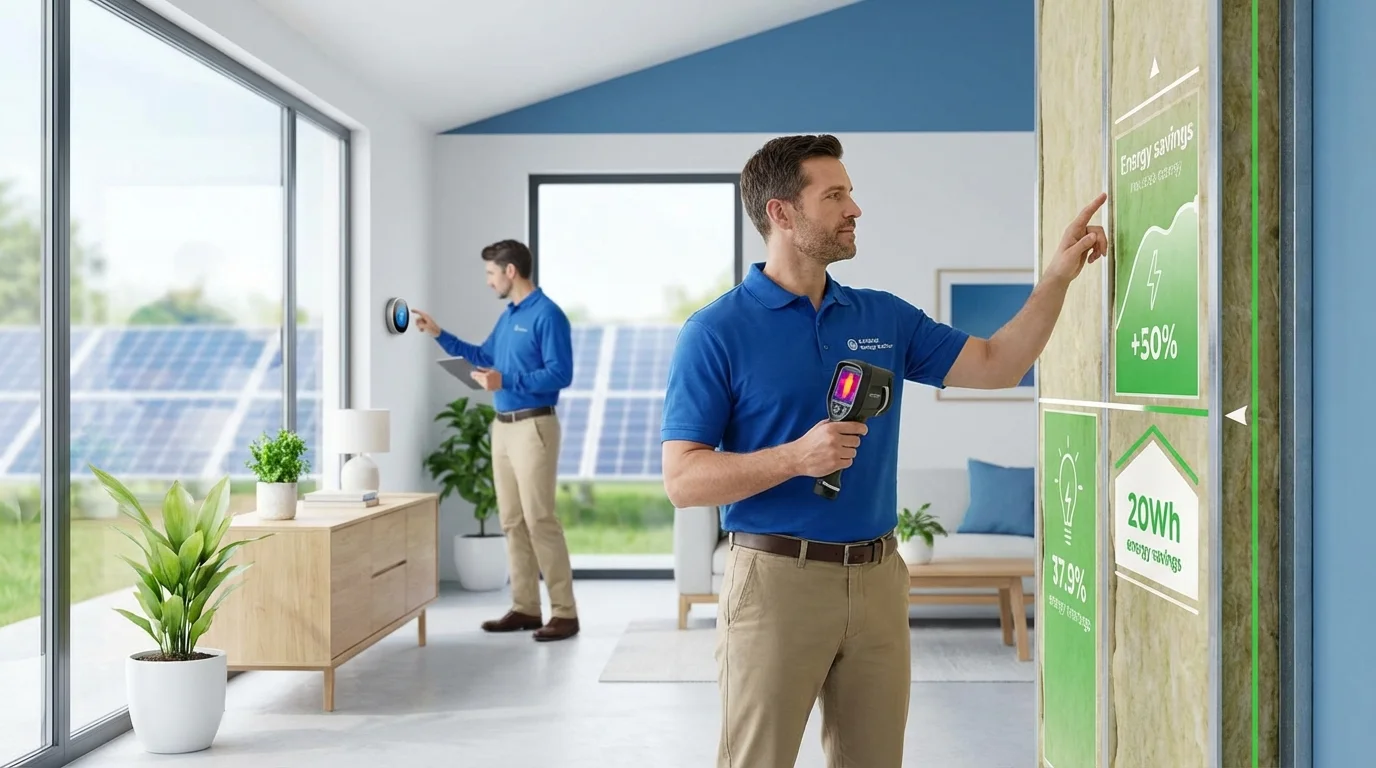
The core issue is that homeowners are paying for energy they don't even use. The U.S. Department of Energy estimates that air leaks alone account for 25% to 40% of the energy used for heating and cooling in a typical home. So, for a household with a $2,200 annual energy bill, that's up to $880 lost through cracks and gaps every single year. A BPI certified energy auditor pinpoints exactly where this money is escaping and creates a roadmap to reclaim it through targeted upgrades and rebates. This professional diagnosis, often called a home energy audit, is the essential first step. An auditor uses specialized equipment like blower doors and infrared cameras to quantify air leakage and identify insulation gaps. And the resulting report doesn't just list problems; it prioritizes solutions based on cost-effectiveness, providing the technical validation needed for programs like the IRA Home Efficiency Rebates, which offer up to $8,000 back for verified energy savings.
What Are the Key Eligibility Criteria, Including Income Limits, for Energy Programs Recommended by BPI Auditors?
Eligibility for 2026 energy rebate programs hinges on household income, location, and the specific upgrades performed. Federal programs, for instance, use Area Median Income (AMI) as a benchmark, offering up to 100% of project costs for households under 80% of AMI, making upgrades accessible.
The criteria for energy programs are precise. For the federal Home Electrification and Appliance Rebate Program, eligibility is strictly tied to income. Households earning less than 80% of their Area Median Income qualify for rebates covering 100% of the cost of new efficient electric appliances, up to $14,000. But for households earning between 80% and 150% of AMI, the rebate covers 50% of the cost. State and utility programs add another layer of complexity, with their own unique income thresholds and property type requirements. For example, a state program may offer an additional $2,000 for insulation, but only for single-family homes. A BPI auditor's assessment helps navigate these rules, ensuring homeowners apply only for the energy tax credits and rebates for which they are genuinely eligible, preventing wasted time and application denials.
What's the Step-by-Step Application Process and Important Deadlines for Rebates Identified by a BPI Auditor?
The application process for 2026 rebates typically involves five steps: initial energy audit, obtaining quotes from qualified contractors, submitting the application with the audit report for pre-approval, completing the installation, and undergoing a final inspection. Deadlines for state funds are often in Q4, while federal IRA programs run through December 31, 2025.
Navigating the rebate application process requires careful sequencing. The first step is always the BPI-certified audit. And with the auditor's report in hand, the homeowner then gets at least two quotes from program-approved contractors. So, the next step is submitting the rebate application, which includes the audit findings and the chosen contractor's bid. It is critical to wait for pre-approval from the program administrator before any work begins, as starting prematurely voids eligibility for many rebates. Once approved, the contractor completes the installation. A final inspection or submission of paid invoices is then required to release the rebate funds. While federal IRA funding is available for a decade, state and utility program funds are allocated annually and are often depleted before the December 31 deadline, making early application essential.
How Do State and Utility-Specific Programs Vary, and What Contractor Requirements Apply to Rebates?
State and utility programs for 2026 vary dramatically, with state weatherization rebates ranging from $1,500 to $7,500, while utility incentives for heat pumps can differ by $1,000 between neighboring service areas. A common thread is the mandate that all work must be performed by licensed, insured, and program-approved contractors.
The landscape of local energy incentives is fragmented. A homeowner in one state receives a $4,000 rebate for attic insulation, while a homeowner one state over receives just $1,000 for the same project. And utility programs are even more specific; one company offers a $1,200 heat pump rebate, but the utility in the next county offers only $400. This is where a BPI auditor’s local expertise becomes invaluable. Furthermore, nearly all reputable rebate programs maintain a list of approved contractors.
"Many state and local governments and utilities offer rebates or other incentives for purchasing energy-efficient products. In some cases, installation of products must be completed by a certified professional." — ENERGY STAR So, using an unlisted contractor, even if they are licensed, will result in a denied rebate application. The BPI auditor helps connect the homeowner with contractors who meet these strict program requirements.
Can I Maximize My Savings by Stacking Multiple Rebates and How Does a BPI Auditor Advise?
A BPI auditor identifies all available incentives, enabling homeowners to stack a federal tax credit with a state rebate and a utility incentive for a single 2026 project. This strategy often cuts the net project cost by 50-80%, but requires careful navigation of each program's specific stacking rules.
Stacking incentives is the most effective way to reduce out-of-pocket costs for home energy upgrades. For example, a homeowner installing a $10,000 cold-climate heat pump in 2026 can combine multiple funding sources. The federal Energy Efficient Home Improvement Credit (Section 25C) ended for property placed in service after December 31, 2025 (IRS FS-2025-05). Federal tax credits for this work have ended, but state, local and utility rebates may still apply; check what is available at your address with the DuloCore rebate calculator. And their state may offer a $3,000 rebate for high-efficiency heat pumps. So, their local utility then adds another $800 incentive. The total reduction is $5,800, bringing the final cost down to just $4,200. But program rules are critical; some state rebates cannot be combined with utility rebates for the same piece of equipment. The BPI auditor’s report will detail which incentives are stackable, providing a clear financial path and maximizing savings. You can see your potential stacked savings with our free rebate calculator.
Comparison of 2026 Home Energy Incentives
| Program Name | Maximum Amount | Key Eligibility | 2026 Deadline |
|---|---|---|---|
| IRA Federal Tax Credit | Ended Dec 31, 2025 | — | December 31, 2025 |
| State Weatherization Rebate | $1,500 - $7,500 | Varies by state; often income-based | Varies; often Q4 2026 |
| Utility Heat Pump Incentive | $500 - $5,000 | Must be a customer of the utility | Program funds are limited |
Official Sources
- DSIRE — A comprehensive database of state, local, utility, and federal incentives and policies that promote renewable energy and energy efficiency.
- ENERGY.GOV — The U.S. Department of Energy's hub for information on Inflation Reduction Act tax credits and rebates for homeowners. (note: the federal 25C and 25D credits ended for projects completed after December 31, 2025)
Related Reading: Learn more about Green Home Certification Process.
Related Reading: Learn more about Resnet Hers Rater Find.
Frequently Asked Questions
What are the prerequisites for BPI energy auditor certification?
There are no formal prerequisites to take the BPI Energy Auditor (EA) exam. However, BPI recommends candidates have some experience in building science, construction, or a related field. Most successful candidates complete a BPI-recognized training course, which typically lasts 3 to 5 days, before attempting the certification exams.
How do I become a BPI certified energy auditor?
To become a BPI Certified Energy Auditor, a candidate must pass two exams: a written online exam and a field practical exam. These exams test knowledge of building science, diagnostic testing, and health and safety protocols. Candidates typically enroll in a training course offered by a BPI Test Center, which prepares them for both exams.
How much does BPI energy auditor certification cost?
The total cost for BPI Energy Auditor certification in 2026 typically ranges from $1,800 to $2,500. This amount includes the training course fee, which makes up the bulk of the expense, as well as the fees for both the written and field certification exams, which are usually around $300-$500 each.
How long is a BPI energy auditor certification valid?
A BPI Energy Auditor certification is valid for three years. To maintain the certification, auditors must earn at least 30 BPI-approved Continuing Education Units (CEUs) during that three-year period. They must also pay a renewal fee to BPI before their certification expires to remain in active status.
What is the difference between BPI Building Analyst and Energy Auditor?
The BPI Building Analyst (BA) certification is a foundational credential focused
Last updated: April 14, 2026. Reviewed by the DuloCore Editorial Team. About our authors.