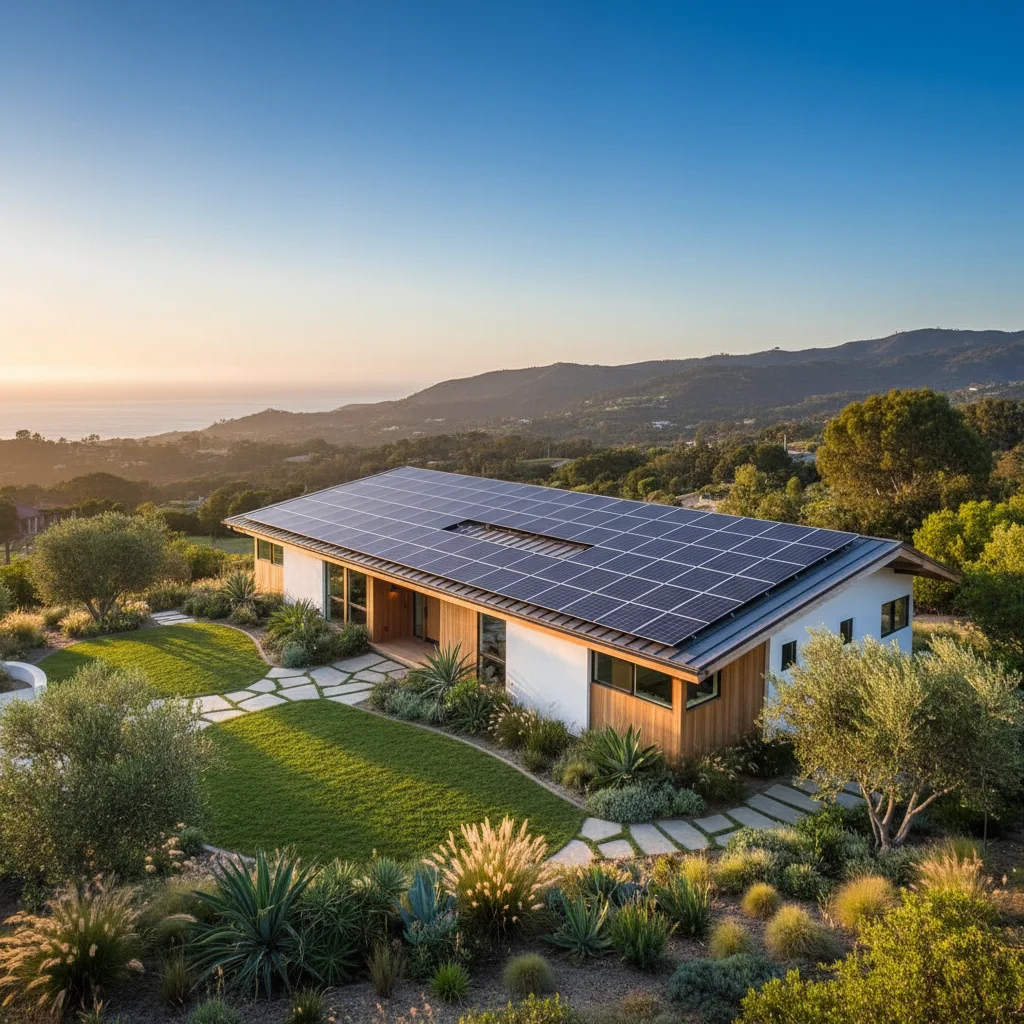
California's solar market generated $12.4 billion in installations during 2025, making it the nation's largest residential solar market for 18 consecutive years. And over 1.9 million homes now produce their own electricity through rooftop arrays. The federal Residential Clean Energy Credit (Section 25D) ended for expenditures made after December 31, 2025, and the IRS treats an expenditure as made when installation is completed (IRS FS-2025-05). Federal tax credits for this work have ended, but state, local and utility rebates may still apply; check what is available at your address with the DuloCore rebate calculator.
What Do Solar Panel Systems Cost in California? (Installation & Equipment Pricing)
Residential solar installations in California range from $15,000 to $35,000 before incentives, with an average system cost of $2.85 per watt in 2026. Equipment accounts for 40-50% of total costs, while labor, permits, and interconnection fees make up the remainder. The federal Residential Clean Energy Credit (Section 25D) ended for expenditures made after December 31, 2025, and the IRS treats an expenditure as made when installation is completed (IRS FS-2025-05). Check current state, local and utility incentives for your address with the DuloCore rebate calculator.
Average 6-kilowatt residential systems cost $17,100 before incentives, or $11,970 after applying the 30% federal tax credit. And installation costs vary by $0.30-$0.50 per watt between coastal and inland regions due to permitting complexity. Labor typically represents 30-35% of final pricing, with experienced installers commanding premium rates for faster timelines and fewer warranty claims.
Equipment quality directly impacts long-term savings. Tier 1 panels from manufacturers like Q CELLS, Canadian Solar, and REC Group cost $0.60-$0.85 per watt but deliver 20-25% higher efficiency ratings than budget alternatives. So homeowners investing in premium equipment recover costs through higher production within 8-10 years versus 12-15 years for economy systems.
But financing options alter net costs significantly. Cash purchases yield the highest lifetime returns, while solar loans add 4-8% interest over 20-year terms. Power purchase agreements (PPAs) eliminate upfront costs but transfer tax credits to the installer, reducing total savings by 15-20%. Use our free rebate calculator to compare financing structures and total cost of ownership.
| System Type | Average Cost (Before Credits) | After 30% Federal Credit (this federal credit ended for expenditures made after December 31, 2025) | Cost Per Watt |
|---|---|---|---|
| 6 kW Standard | $17,100 | $11,970 | $2.85/watt |
| 8 kW Premium | $24,000 | $16,800 | $3.00/watt |
| 10 kW + Storage | $35,000 | $24,500 | $3.50/watt |
Which Solar Panel Brands Qualify for California Rebates and Tax Credits?
All solar panels meeting UL 1703 safety certification and 25-year warranty requirements qualify for the federal 30% tax credit (this federal credit ended for expenditures made after December 31, 2025) under the Inflation Reduction Act. But California's Self-Generation Incentive Program (SGIP) specifically requires equipment listed in the California Energy Commission's certified database. Premium brands like SunPower, LG, and Panasonic consistently meet these standards with efficiency ratings exceeding 20%.
California utilities offer additional rebates for systems paired with battery storage. And SGIP provides $150-$250 per kilowatt-hour for qualifying battery installations, with higher incentives for low-income households. Equipment must meet IEEE 1547 interconnection standards and carry 10-year minimum warranties to qualify.
Tier 1 manufacturers guarantee performance degradation under 0.5% annually, ensuring systems maintain 85-90% original output after 25 years. But lesser-known brands claiming similar specs often lack third-party verification from PVEL or DNV GL testing laboratories. So installers recommending non-tier 1 equipment without independent test data risk underperforming systems that fail to meet rebate production requirements.
The California Solar Initiative (CSI) ended new enrollments in 2016, but existing participants still receive performance-based incentives through 2031. And newer net metering rules under NEM 3.0 reduce export credits by 75% compared to legacy programs, making battery storage essential for maximizing solar panel rebates.
How Do Solar Panel Efficiency Ratings Affect Your California Home's ROI?
Panel efficiency determines how much electricity generates from available roof space, directly impacting return on investment timelines. Standard residential panels convert 17-19% of sunlight into electricity, while premium monocrystalline modules achieve 21-23% efficiency. A 20% efficiency panel produces 1,200 kWh annually per kilowatt installed in California's average 6.5 peak sun hours daily.
Higher efficiency panels cost $0.15-$0.25 more per watt but generate 15-20% more electricity from identical roof areas. So homes with limited south-facing roof space recover premium costs through higher production within 6-8 years. And shaded properties benefit most from high-efficiency modules that maintain output during partial shading conditions.
Temperature coefficients reveal performance in California's hot summers. Premium panels lose only 0.26-0.35% output per degree Celsius above 25°C, while economy modules degrade 0.40-0.50% per degree. Inland regions reaching 40°C (104°F) see 5-7% lower production from heat-sensitive panels, extending payback periods by 1-2 years.
Real-world testing data from NREL shows California installations average 1.4-1.6 DC-to-AC derate factors, meaning 6 kW rated systems produce 8.4-9.6 kW actual output. But low-quality inverters and wiring reduce this to 1.2 or lower, costing homeowners $200-$400 annually in lost production. Selecting installers using Enphase IQ8 or SolarEdge HD-Wave inverters maximizes energy tax credits through higher system performance.
"Solar panels that meet the 20% efficiency threshold produce approximately 1,500 kWh per year per kilowatt installed in California's climate zones 8-16." — National Renewable Energy Laboratory
What's the Typical Payback Period for Solar Panels in California?
California solar systems achieve payback in 6-9 years under current 2026 electricity rates averaging $0.32-$0.38 per kilowatt-hour. Coastal homeowners paying PG&E's top-tier rates recover costs in 5-7 years, while inland properties with lower SCE rates see 8-10 year timelines. And pairing solar with battery storage extends payback to 10-13 years but provides backup power during grid outages.
Net metering rules directly impact return timelines. NEM 3.0 participants enrolled after April 2023 receive $0.05-$0.08 per kWh for excess generation, compared to $0.30-$0.38 under legacy NEM 2.0 agreements. So post-2023 installations require 30-40% larger battery systems to store surplus production for evening use rather than exporting at reduced rates.
Annual electricity inflation accelerates payback timelines. California rates increased 7.2% annually between 2020-2025, and grid electricity costs projected to reach $0.45-$0.52 per kWh by 2030 shorten payback periods by 12-18 months. Fixed solar production costs provide hedge against utility rate increases over 25-year system lifespans.
Homeowners claiming the 30% federal credit (this federal credit ended for expenditures made after December 31, 2025) in the installation year reduce payback by 2-3 years compared to delaying the credit or spreading it across multiple tax years. The federal Residential Clean Energy Credit (Section 25D) ended for expenditures made after December 31, 2025, and the IRS treats an expenditure as made when installation is completed (IRS FS-2025-05).
Which Climate Zones in California Are Best Suited for Solar Installation?
California's inland climate zones 12-16 produce 15-20% more solar electricity than coastal zones 3-7 due to higher annual sun exposure and fewer fog days. Desert regions including Riverside, San Bernardino, and Imperial counties average 6.8-7.2 peak sun hours daily, generating 1,650-1,750 kWh per installed kilowatt annually. Coastal areas receive 5.5-6.2 peak hours, producing 1,350-1,500 kWh per kilowatt.
Temperature impacts vary by region. And coastal installations maintain higher efficiency during summer months due to cooler ambient temperatures of 20-28°C versus inland peaks of 38-45°C. But annual production still favors inland locations despite heat-related efficiency losses of 3-5%.
Northern California zones 1-4 experience 20-30% more winter cloud cover than southern zones 10-16, creating greater seasonal production variance. Sacramento and Redding properties generate 70% of annual output during May-September, while San Diego systems maintain 55-60% summer concentration with stronger winter performance.
Snow loads and wind speeds affect equipment requirements. Mountain communities above 1,500 meters elevation need snow-rated racking systems adding $0.10-$0.15 per watt to installation costs. Coastal zones 3-5 require enhanced corrosion protection for saltwater exposure, while desert installations need dust-resistant junction boxes maintaining performance during frequent sandstorms.
So climate zone selection impacts both production capacity and equipment specifications. Homeowners in zones 12-16 achieve payback 12-18 months faster than coastal counterparts, but regions with heat pump rebates offer alternative efficiency investments for moderate climates.
"California's inland valleys receive 25-35% more annual solar irradiance than coastal regions, translating to $400-$600 higher annual production value per household system." — California Energy Commission
How Do Solar Panels Compare to Battery Storage and Other Energy Alternatives?
Standalone solar systems cost $2.85 per watt installed, while solar-plus-storage configurations run $3.50-$4.20 per watt including 10-15 kWh battery capacity. And battery-only installations without solar panels range from $8,000-$15,000 for residential systems providing 4-6 hours backup power. Net metering rates under NEM 3.0 make storage increasingly necessary, with 68% of new 2025 California installations including batteries versus 23% in 2022.
Heat pumps offer complementary efficiency gains, reducing home energy consumption by 30-50% compared to gas furnaces and air conditioners. But combining solar with heat pump upgrades requires electrical panel upgrades costing $2,500-$4,500 in 40% of California homes built before 1990. So whole-home efficiency strategies deliver better ROI than solar-only approaches.
Community solar programs provide alternatives for renters and homeowners with unsuitable roofs. Participants receive 10-15% discounts on utility bills without equipment installation. The federal Residential Clean Energy Credit (Section 25D) ended for expenditures made after December 31, 2025, and the IRS treats an expenditure as made when installation is completed (IRS FS-2025-05). And subscription contracts typically run 20 years with 2-3% annual price escalations.
Geothermal systems cost $15,000-$30,000 installed but deliver higher efficiency ratings than air-source heat pumps in extreme climates. Pairing geothermal HVAC with solar panels creates net-zero homes producing annual electricity equal to or exceeding consumption. But combined installations require $40,000-$60,000 upfront investment with 10-14 year payback periods even after federal credits.
How Long Do Solar Panels Last and What Maintenance Do They Require in California?
Premium solar panels carry 25-30 year performance warranties guaranteeing 80-85% original output at end of term. Real-world data from California's CSI program shows panels installed 2006-2010 maintain 88-92% capacity after 15 years, with annual degradation averaging 0.4-0.6%. And Tier 1 manufacturers like SunPower and LG consistently outperform warranties, retaining 90-94% capacity at 15-year milestones.
Inverter lifespans determine replacement costs. String inverters last 10-15 years and cost $1,500-$3,000 to replace, while microinverters carry 25-year warranties matching panel lifetimes. So systems using Enphase or SolarEdge microinverters avoid mid-life inverter replacement expenses totaling 8-12% of original system costs.
Annual maintenance consists of visual inspections and occasional panel cleaning. California's low rainfall in zones 12-16 requires cleaning every 3-6 months to remove dust accumulation reducing output 3-7%. Coastal installations face salt spray buildup requiring biannual cleaning, while northern regions with higher precipitation self-clean through rainfall.
But vegetation management prevents shading losses over decades. Trees growing 15-20 feet within 10 years of installation reduce production 10-25% if not trimmed annually. And utility interconnection agreements require maintaining clearances of 8-10 feet from panels to prevent fire hazards during wildfire season.
Monitoring systems track production and identify failures within 24-48 hours. App-based monitoring from installers detects individual panel failures, inverter errors, and grid connectivity issues requiring service calls. Systems without monitoring average 2-4 weeks longer resolution times, costing $50-$150 in lost production per incident.
Official Sources
- Energy.gov Solar Tax Credit Guide — Federal tax credit details and IRA provisions (note: the federal 25D credit ended for expenditures made after December 31, 2025)
- DSIRE USA California Programs — Comprehensive database of state incentives and utility rebate programs
- California Energy Commission Solar Equipment — Certified equipment lists for California rebate qualification
Related Reading: Learn more about Solar Panel Home Energy Audit and Solar Panel Rebate 2026.
Related Reading: Learn more about Best Solar Panel Companies Central Valley.
Frequently Asked Questions
What are the top-rated solar panel companies in California?
SunPower, Tesla Energy, and Sunrun lead California installations with combined 45% market share in 2025. SunPower panels achieve 22.8% efficiency with 40-year warranties, while Tesla offers integrated Powerwall storage at $11,500 per 13.5 kWh unit. Regional installers like Solar Optimum and Semper Solaris provide competitive pricing 10-15% below national averages with comparable equipment quality and local service response times under 48 hours.
How much do solar panels cost in California after rebates?
Average 6 kW systems cost $17,100 before incentives, dropping to $11,970 after the 30% federal tax credit in 2026. Adding SGIP battery incentives worth $150-$250 per kWh reduces solar-plus-storage systems from $28,000 to $19,000-$22,000 net cost. Low-income households qualify for additional DAC-SASH rebates covering 40-60% of installation costs, with final out-of-pocket expenses as low as $6,000-$8,500 for complete systems. (Note: Federal tax credit percentages and availability are subject to change; the 30% Residential Clean Energy Credit under Section 25D expired December 31, 2025. Verify current incentives at energy.gov.)
Are solar panel rebates still available in California in 2026?
The federal home energy tax credits (Sections 25C and 25D) ended for projects completed after December 31, 2025 (IRS FS-2025-05). California's SGIP battery incentive remains funded with $165 million allocated through 2027, though large-scale solar incentives ended with CSI closure in 2016. And utility-specific programs from PG&E, SCE, and SDG&E offer time-of-use rate plans maximizing solar savings without direct cash rebates.
How long does it take to get a solar rebate in California?
Federal tax credits apply when filing annual returns 2-16 months after installation depending on install date relative to tax year. SGIP battery rebates process in 60-90 days after system inspection and utility interconnection approval. But application backlogs during peak summer installation season extend SGIP timelines to 120-150 days, delaying final rebate checks to 4-5 months post-activation. Utility net metering agreements activate within 30-45 days of final inspection.
Which solar company offers the best warranty in California?
SunPower provides industry-leading 40-year complete system warranties covering panels, inverters, and racking through 2066 for systems installed in 2026. Tesla offers 25-year panel warranties with 10-year inverter coverage and lifetime Powerwall battery replacements. And regional installer Sunrun matches equipment warranties while adding 10-year workmanship guarantees on installation quality, compared to 2-5 year labor warranties from smaller contractors. Warranty claim response times average 3-5 business days for national providers versus 24-48 hours for regional installers.
Ready to find your solar savings? Calculate your federal tax credits, SGIP battery rebates, and estimated payback period with our free rebate calculator. Get personalized results based on your zip code, roof type, and current electricity costs in under 2 minutes.
Last updated April 14, 2026 — reviewed by DuloCore Editorial. About our authors.
Check your California solar rebate eligibility — see the programs you qualify for and the dollar amounts on our California solar rebate finder.