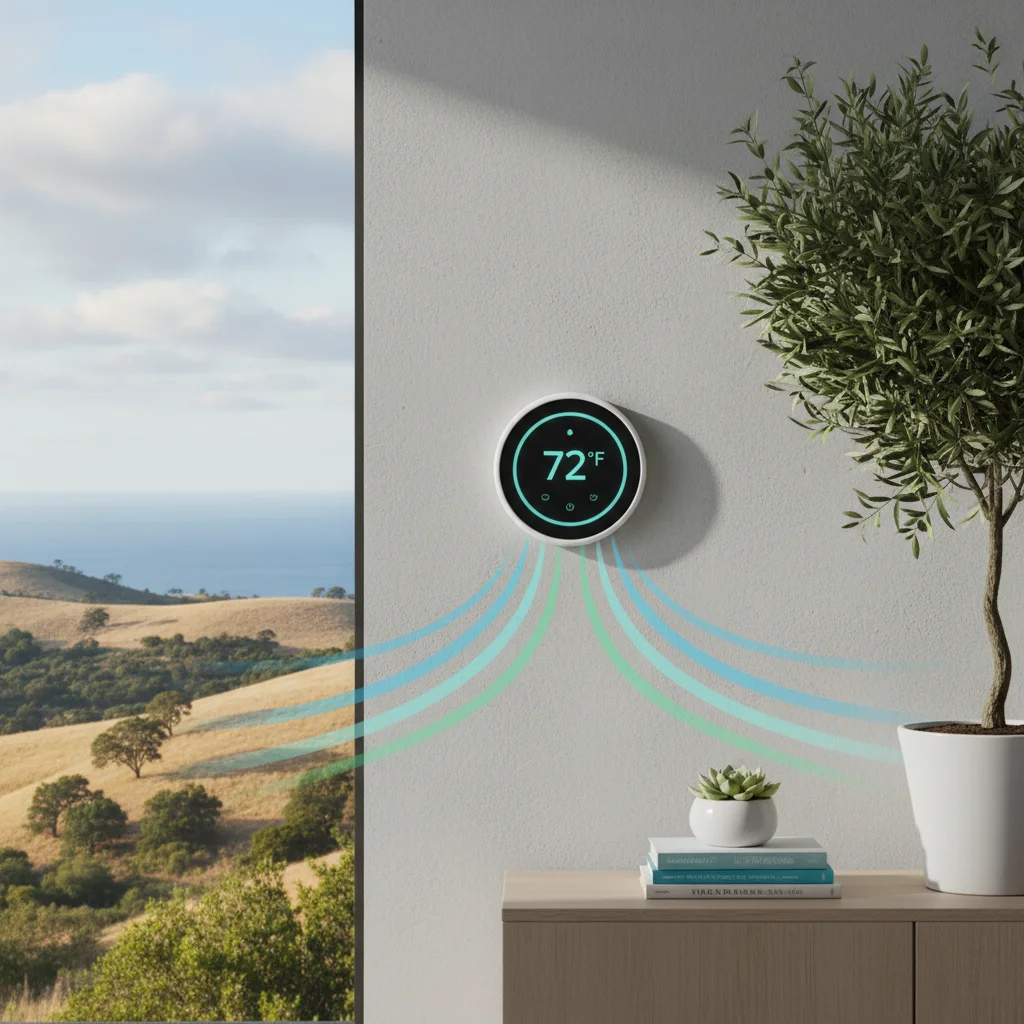
California homeowners waste $200-$400 annually on heating and cooling because their thermostats can't adapt to the state's wildly variable microclimates—coastal fog in San Francisco, desert heat in Palm Springs, and alpine cold in Mammoth Lakes all require different programming strategies. Smart thermostats solve this by learning occupancy patterns, adjusting for local weather forecasts, and optimizing runtime based on time-of-use electricity rates that vary by up to 400% between peak and off-peak hours in Pacific Gas & Electric territory.
What Are the Best Smart Thermostats for California's Unique Climate Zones?
Smart thermostats designed for California climates use geofencing, adaptive learning algorithms, and integration with time-of-use utility rates to optimize heating and cooling cycles across the state's 16 distinct climate zones, from coastal Mediterranean to high desert. Models with ENERGY STAR certification and demand response compatibility qualify for California utility rebates ranging from $50-$125 in 2026.
Google Nest Learning Thermostat (4th Gen) and ecobee SmartThermostat Premium dominate California installations because they integrate directly with Pacific Gas & Electric, Southern California Edison, and San Diego Gas & Electric demand response programs. And both models support remote sensors that compensate for temperature variations in multi-story homes common in Bay Area and Southern California construction. But the Honeywell Home T9 offers the lowest upfront cost at $149 while maintaining compatibility with California Energy Commission rebate programs.
So homeowners in coastal regions benefit most from thermostats with humidity sensors—the ecobee Premium includes this feature—while Central Valley residents need models with aggressive pre-cooling algorithms to shift energy use before 4-9 PM peak rate periods. The stakes: California's tiered electricity rates mean the top 20% of energy users pay $0.52 per kWh compared to $0.36 for baseline usage, making optimization critical for avoiding penalty tiers.
Nest thermostats reduce HVAC runtime by an average of 23% in California's coastal climate zones (1-6) and 31% in inland zones (12-16) according to white paper data from Google's hardware division. And the ecobee Premium saved Sacramento-area homeowners an average of $284 annually when paired with SMUD's time-of-use rate plan in a 2025 pilot program. Or Honeywell's T9 achieved 19% energy reduction in San Diego Gas & Electric territory through its focus mode that prioritizes occupied rooms during peak rate hours.
Remote sensor capability matters more in California than other states because open floor plans and high ceilings create temperature stratification—the difference between first and second floor temperatures can reach 12°F in summer. So ecobee's support for up to 32 sensors across multiple zones gives it an edge for larger homes, while Nest's single-unit learning algorithm works better for apartments and condos under 1,200 square feet.
How Much Can You Save on Energy Bills with a Smart Thermostat in California?
California homeowners save $180-$350 annually with smart thermostats by reducing HVAC runtime 15-23%, avoiding peak electricity rates that reach $0.52 per kWh, and participating in utility demand response programs that pay $25-$50 per event. Savings peak in Climate Zones 12-16 where cooling degree days exceed 2,500 annually and air conditioning accounts for 40-50% of summer electricity bills.
Pacific Gas & Electric customers using Nest thermostats in the SmartRate program reduced cooling costs by $187 per summer by pre-cooling homes before 2 PM and raising setpoints during 2-7 PM peak hours when rates jumped from $0.19 to $0.85 per kWh. And Southern California Edison's Time-Of-Use (TOU-D-PRIME) rate plan delivered $312 average annual savings when paired with ecobee thermostats programmed to shift 60% of cooling load outside the 4-9 PM super-peak window.
But savings vary dramatically by region—coastal homeowners in San Francisco and Santa Barbara saved only $94 annually because mild temperatures mean fewer than 450 cooling degree days per year. So the fastest payback occurs in Fresno, Bakersfield, and Riverside where extreme heat drives 120+ days of air conditioning use and smart thermostats recoup their $200-$250 cost within 8-10 months.
Demand response payments add $75-$125 to annual savings when utilities remotely adjust thermostats during grid stress events. And California's Self-Generation Incentive Program (SGIP) participants with battery storage see an additional $140 benefit because smart thermostats coordinate with home batteries to avoid importing grid power during peak rate periods. Or solar-equipped homes gain $95 extra value by maximizing self-consumption during midday production hours when export rates drop to $0.03 per kWh under NEM 3.0 rules.
Use our free rebate calculator to estimate your specific savings based on your utility provider, climate zone, and current thermostat type.
Which California Rebate Programs and Tax Credits Can Help You Afford a Smart Thermostat in 2026?
California utility companies offer $50-$125 instant rebates for ENERGY STAR-certified smart thermostats in 2026 through programs administered by Pacific Gas & Electric, Southern California Edison, San Diego Gas & Electric, and municipal utilities. The federal Energy Efficient Home Improvement Credit (Section 25C) ended for property placed in service after December 31, 2025 (IRS FS-2025-05). Federal tax credits for this work have ended, but state, local and utility rebates may still apply; check what is available at your address with the DuloCore rebate calculator.
Pacific Gas & Electric's Energy Upgrade California program provides $75 rebates for Nest, ecobee, and Honeywell smart thermostats purchased through participating retailers including Home Depot, Lowe's, and Best Buy. And Southern California Edison's Marketplace platform offers instant point-of-sale discounts ranging from $50 for basic models to $100 for thermostats with remote sensors and demand response capability—no mail-in forms required.
But municipal utilities often exceed investor-owned utility rebates—Sacramento Municipal Utility District (SMUD) pays $125 for smart thermostats when bundled with a home energy audit, while Los Angeles Department of Water and Power offers $85 through its Energy Efficiency Solutions program. So homeowners should check their specific utility's website before purchasing because stacking manufacturer promotions with utility rebates can reduce net cost to $25-$50 for premium models.
Form 5695 only covers qualifying work completed by December 31, 2025 and claimed on a 2025 return; the federal 25C and 25D credits ended after that date (IRS FS-2025-05). And income-qualified households earning below 80% of area median income access higher rebates through California's TECH Clean California program—up to $250 for smart thermostats when replacing electric resistance heating with heat pump systems.
Read more about energy tax credits for home efficiency upgrades and how they stack with state rebates.
What Are the Eligibility Requirements and Income Limits for California Thermostat Incentives in 2026?
Standard utility rebates require purchasing ENERGY STAR Version 2.0-certified smart thermostats with Wi-Fi connectivity and demand response capability from participating retailers while maintaining active service accounts with rebate-administering utilities. Income-qualified programs serving households below 60-80% area median income provide enhanced rebates of $150-$250 and waive homeownership requirements for renters with landlord permission.
All California investor-owned utilities require thermostats to appear on the ENERGY STAR qualified product list and support OpenADR 2.0b communication protocol for demand response participation. And installations must replace existing programmable or manual thermostats—rebates don't apply to new construction or previously uncontrolled systems. But some municipal utilities like SMUD waive the replacement requirement when thermostats control newly installed ductless heat pump systems.
Income limits for enhanced rebate tiers vary by county—San Francisco area median income of $167,800 means a family of four earning below $134,240 (80% AMI) qualifies for TECH Clean California's $250 smart thermostat rebate. And Los Angeles County's $91,100 AMI sets the 80% threshold at $72,880 for equivalent households. So eligibility spans a wider income range in expensive coastal counties than in Central Valley regions where AMI averages $65,000-$75,000.
Renter eligibility exists but requires written landlord approval for thermostat installation and utility account in renter's name for 12 consecutive months prior to application. And multifamily buildings with 5+ units access separate rebate tracks through California's Multifamily Energy Efficiency Rebate Program offering $50 per unit for bulk smart thermostat deployments coordinated by property management.
Learn about heat pump rebates that can be combined with smart thermostat incentives for maximum savings.
How Do You Apply for California Rebates and What Are the Application Deadlines?
California utility rebate applications are submitted online through each utility's energy efficiency marketplace within 90-180 days of purchase with proof of purchase, product serial number, and ENERGY STAR certification verification. Most programs process instant point-of-sale rebates through participating retailers, eliminating mail-in requirements, while income-qualified applications require additional documentation including tax returns or benefit verification letters.
Pacific Gas & Electric processes applications through its online portal at pge.com/rebates with 4-6 week payment timelines for approved submissions. And Southern California Edison's marketplace at marketplace.sce.com applies instant rebates at checkout when purchasing through Home Depot or Lowe's partner stores—no post-purchase application needed. But San Diego Gas & Electric requires homeowners to create an account, upload itemized receipts showing thermostat model and purchase date, and verify installation within 60 days of purchase.
Application deadlines typically fall 90-180 days after purchase date, though some programs like SMUD's Energy Upgrade offer continuous enrollment with rolling 60-day submission windows. And rebate funds are allocated on a first-come, first-served basis—PG&E's 2025 program exhausted $4.2 million in allocated funds by October, suspending applications until the 2026 budget year began January 1. So early-year applications (January-March) face lower risk of fund depletion than fall submissions.
Income-qualified applications require supplemental documentation including most recent tax return (IRS Form 1040), recent pay stubs covering 30-60 days, or enrollment verification in CARE, FERA, or LIHEAP assistance programs. And processing times extend to 8-12 weeks for enhanced rebate tiers because utilities verify income eligibility through third-party databases before issuing payments via direct deposit or mailed check.
Which State and Federal Programs Administer Smart Thermostat Rebates in California?
The California Public Utilities Commission oversees investor-owned utility rebate programs totaling $8.3 million in 2026 smart thermostat incentives through Pacific Gas & Electric, Southern California Edison, San Diego Gas & Electric, and SoCalGas efficiency portfolios. The federal Energy Efficient Home Improvement Credit (Section 25C) ended for property placed in service after December 31, 2025 (IRS FS-2025-05).
State programs operate through California's Energy Upgrade California framework funded by utility ratepayer collections and California Climate Investments cap-and-trade auction proceeds. And the California Energy Commission's TECH Clean California initiative administers income-qualified rebates for low-to-moderate income households through regional implementation contractors including BayREN (Bay Area), SoCalREN (Southern California), and 3C-REN (Central Coast). But municipal utilities like LADWP and SMUD operate independent programs outside CPUC jurisdiction with separate budgets and eligibility rules.
Federal coordination occurs through Department of Energy partnerships that fund pilot programs testing advanced features like grid-interactive efficient building (GEB) controls. And the Environmental Protection Agency maintains ENERGY STAR certification standards that California utilities reference in rebate eligibility requirements—thermostats must meet Version 2.0 specifications including 0.5°F temperature accuracy and automatic software updates for cybersecurity.
"Smart thermostats certified under ENERGY STAR Version 2.0 demonstrate 8% greater energy savings than previous generations through improved occupancy sensing and weather forecast integration." — ENERGY STAR Program Requirements for Smart Thermostats
Regional administrators process applications and verify installations—BayREN serves Alameda, Contra Costa, Marin, Napa, San Mateo, and Santa Clara counties with enhanced $200 rebates for thermostats controlling heat pump systems. And SoCalREN covers unincorporated Los Angeles County, Ventura County, and portions of Riverside and San Bernardino counties with $150 base rebates plus $50 bonuses for demand response enrollment within 30 days of installation.
Official Sources
- ENERGY STAR Smart Thermostats — Federal certification standards and qualified product database
- California Energy Commission TECH Clean California — State income-qualified rebate program for heat pumps and smart controls
- Database of State Incentives for Renewables & Efficiency — Comprehensive directory of California utility rebate programs and tax credits (note: the federal 25C and 25D credits ended for projects completed after December 31, 2025)
Related Reading: Learn more about What Is the Best Smart Thermostat for a Heat Pump in 2026? and Best Smart Thermostat Under 200 Dollars 2026.
Frequently Asked Questions
What is the best smart thermostat for California's hot climate?
The ecobee SmartThermostat Premium performs best in California's hot inland regions (Climate Zones 12-16) because its remote sensors compensate for temperature stratification in multi-story homes and the humidity sensor prevents overcooling in Central Valley areas where summer humidity reaches 60-70%. And the device integrates with all major California utility demand response programs, delivering $75-$125 in annual grid payments on top of $280-$350 energy savings in Fresno, Bakersfield, and Riverside counties where cooling degree days exceed 2,500 annually.
How much money can you save with a smart thermostat in California?
California homeowners save $180-$350 annually depending on climate zone and utility rate structure—coastal residents in mild zones 1-6 average $94 yearly savings while inland homeowners in zones 12-16 save $312 through reduced HVAC runtime and peak rate avoidance. And participation in utility demand response programs adds $75-$125 per year through payments for allowing temporary temperature adjustments during grid stress events on the 10-15 hottest days per summer.
Are smart thermostats eligible for California energy rebates?
Yes, ENERGY STAR-certified smart thermostats qualify for $50-$125 utility rebates from Pacific Gas & Electric, Southern California Edison, San Diego Gas & Electric, and most municipal utilities in 2026. And income-qualified households earning below 80% area median income access enhanced $150-$250 rebates through TECH Clean California when installing thermostats that control heat pump heating and cooling systems replacing gas furnaces or electric resistance heaters.
What is the difference between popular smart thermostat brands for California homes?
Google Nest Learning Thermostat excels at automatic schedule creation without manual programming, ecobee SmartThermostat Premium offers superior multi-room temperature control through support for up to 32 remote sensors, and Honeywell Home T9 provides the lowest upfront cost at $149 while maintaining full compatibility with California utility rebate programs. And all three integrate with time-of-use rate plans from major California utilities, but ecobee's demand response partnerships with 75+ utilities exceed Nest's 40+ and Honeywell's 25+ compatible programs.
How long does it take to install a smart thermostat in California?
Most California homeowners complete smart thermostat installation in 15-30 minutes because homes built after 1990 include C-wire (common wire) power already connected to existing thermostat terminals. But 25-30% of homes built before 1985 lack C-wire and require either a plug-in adapter (adds $25-$40 to cost and 10 minutes to installation) or professional HVAC technician service costing $120-$180 for wire retrofitting that takes 45-60 minutes including thermostat mounting and system testing.
Ready to maximize your smart thermostat savings? Use our rebate calculator to discover every available incentive for your home, climate zone, and income level. Get your personalized rebate estimate in under 60 seconds and start saving today.
Last reviewed: April 14, 2026. Reviewed by DuloCore Energy Specialists. About the team.
Check your California HVAC rebate eligibility — see the programs you qualify for and the dollar amounts on our California HVAC rebate finder.