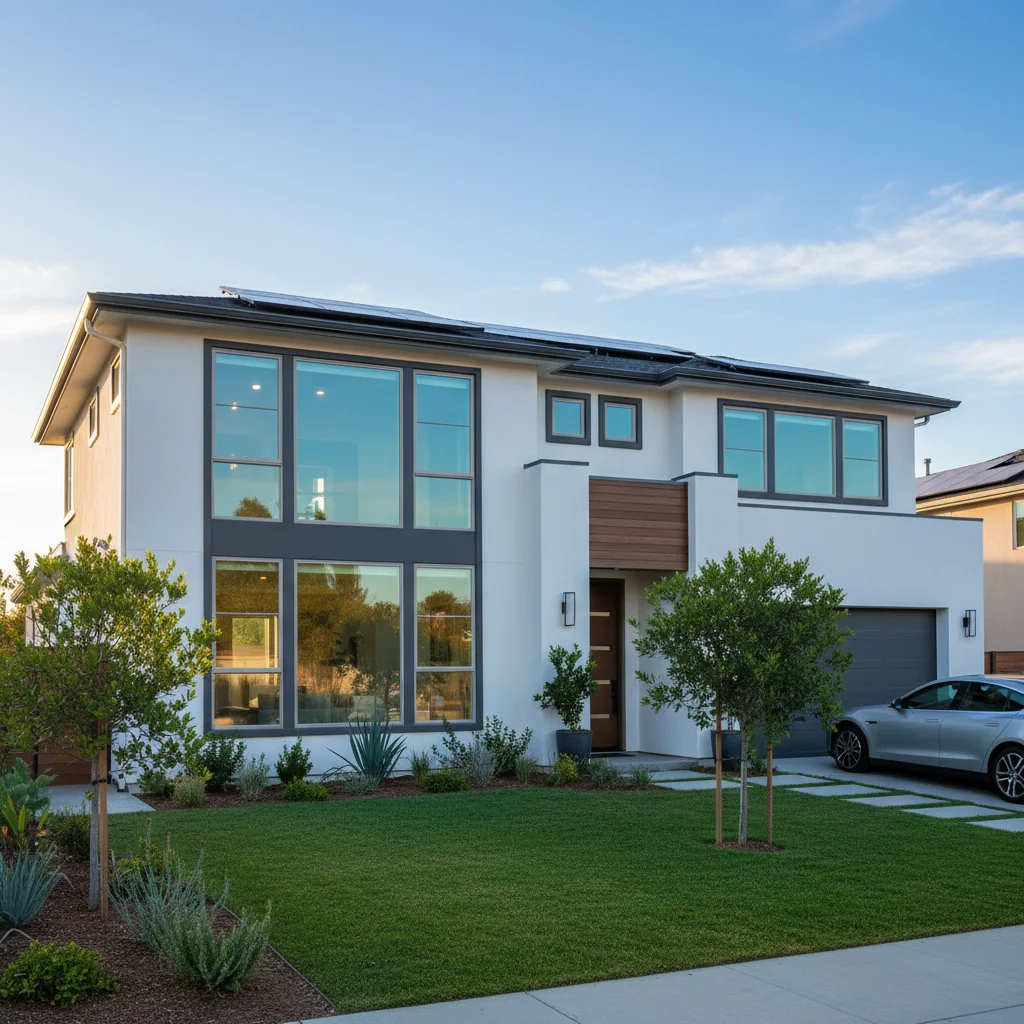
Sacramento homeowners replaced over 47,000 windows in 2025, but most left $1,200 to $3,400 in federal tax credits unclaimed. The federal Energy Efficient Home Improvement Credit (Section 25C) ended for property placed in service after December 31, 2025 (IRS FS-2025-05). Federal tax credits for this work have ended, but state, local and utility rebates may still apply; check what is available at your address with the DuloCore rebate calculator.
How Much Do Replacement Windows Cost in Sacramento in 2026?
Replacement window installations in Sacramento range from $450 to $1,200 per window in 2026, depending on frame material, glazing type, and installation complexity. Vinyl double-hung windows with Low-E glass cost $450 to $650 per window installed, while fiberglass or wood-clad triple-pane windows with argon fill run $800 to $1,200 per window. Full-house replacements for a typical 2,000-square-foot Sacramento home with 15 windows total $6,750 to $18,000.
Sacramento's climate zone 12 designation under California Title 24 requires replacement windows to meet a maximum U-factor of 0.30 and Solar Heat Gain Coefficient (SHGC) of 0.23 for south-facing exposures. And these thresholds align closely with federal ENERGY STAR Most Efficient criteria, meaning windows that meet California code often qualify for IRA tax credits without additional upgrades.
But installation costs vary significantly by window type. Double-hung vinyl windows cost 15% to 25% less than casement or awning styles due to simpler hardware. Retrofit installations that preserve existing frames run $200 to $350 per window, while full-frame replacements that include new jambs and sills cost $450 to $1,200. So homeowners planning whole-house upgrades see per-window costs drop 10% to 18% compared to single-window replacements due to contractor efficiency.
Labor accounts for 35% to 45% of total replacement window costs in Sacramento. A licensed contractor charges $150 to $250 per window for standard installations, with premiums of $50 to $100 per window for second-story work or complex architectural features. And permit fees in Sacramento County add $75 to $150 per project, regardless of window count.
Which Replacement Windows Qualify for Federal Tax Credits and Rebates?
The federal Energy Efficient Home Improvement Credit (Section 25C) ended for property placed in service after December 31, 2025 (IRS FS-2025-05). Qualifying windows must achieve a U-factor of 0.20 or lower and an SHGC of 0.25 or lower in the Northern climate zone, which includes Sacramento.
California's Tech Clean initiative offers additional point-of-sale rebates of $150 to $400 per window for low- to moderate-income households, defined as earning 80% to 150% of Area Median Income. Sacramento's AMI threshold sits at $78,500 for a family of four in 2026, making households earning $62,800 to $117,750 annually eligible for stacked incentives combining federal credits and state rebates.
But not all ENERGY STAR windows qualify for the maximum credit. The IRA framework requires windows to meet the Most Efficient designation, which represents the top 25% of certified products. Standard ENERGY STAR windows with U-factors of 0.27 to 0.30 don't qualify for federal credits, though they still meet California Title 24 requirements and reduce energy consumption by 15% to 25% compared to single-pane units.
SMUD's Energy Assistance Program Rate provides an additional $200 per window rebate for customers enrolled in the California Alternate Rates for Energy (CARE) program, which serves households earning below 200% of the federal poverty level. And these rebates stack with IRA credits and Tech Clean incentives, delivering combined savings of $550 to $1,000 per qualifying window for eligible Sacramento residents.
"ENERGY STAR Most Efficient windows deliver up to 40% greater energy savings than products that meet minimum ENERGY STAR requirements." — ENERGY STAR
How Long Does It Take to Recoup Your Investment in New Windows?
Sacramento homeowners installing ENERGY STAR Most Efficient windows recoup their investment in 7 to 12 years through reduced cooling and heating costs. A typical 2,000-square-foot home with 15 windows sees annual energy savings of $250 to $420 after replacing single-pane units with triple-pane Low-E windows. And when factoring in the 30% federal tax credit and SMUD rebates, net payback periods drop to 5 to 8 years.
Cooling cost reductions drive the majority of Sacramento window payback calculations. Single-pane windows with aluminum frames lose 10 to 15 BTUs per square foot per hour in summer, while triple-pane units with insulated vinyl or fiberglass frames lose just 2 to 4 BTUs. This translates to 18% to 28% lower air conditioning runtime during Sacramento's 90°F to 105°F summer months, saving $180 to $310 annually on a typical $1,100 cooling bill.
But heating season savings matter too. Sacramento's 2,600 heating degree days per year mean replacement windows save $70 to $110 annually in natural gas costs by reducing heat loss during December through February. And homes with electric resistance heat or heat pumps see proportionally larger heating savings of $120 to $190 per year.
Window orientation significantly impacts payback periods. South- and west-facing windows with low SHGC coatings deliver 25% to 40% faster payback than north-facing units due to greater solar heat rejection. A west-facing living room with three 4x5-foot windows saves $85 to $140 annually just from reduced afternoon heat gain, compared to $45 to $70 for identical north-facing bedroom windows.
Use our free rebate calculator to find your specific savings based on window count, orientation, and current utility rates.
How Do Replacement Windows Compare to Other Home Efficiency Upgrades?
Replacement windows deliver lower absolute energy savings than heat pump installations or attic insulation upgrades but offer faster payback for homes with single-pane units. Adding R-38 to R-60 attic insulation costs $1,800 to $3,200 and saves $380 to $650 annually in Sacramento, achieving payback in 3 to 6 years. Heat pump conversions cost $8,000 to $14,000 and save $900 to $1,600 per year, paying back in 5 to 9 years. Replacement windows cost $6,750 to $18,000 and save $250 to $420 annually, with 7 to 12-year payback.
But windows provide non-energy benefits that other upgrades don't match. New windows reduce outdoor noise transmission by 20 to 35 decibels, increase home resale value by 70% to 85% of installation cost, and eliminate condensation issues that cause mold growth. And unlike attic insulation or duct sealing, replacement windows offer immediate visual and comfort improvements that homeowners notice daily.
Stacking window replacements with other envelope upgrades accelerates combined payback. Homes installing both R-49 attic insulation and ENERGY STAR Most Efficient windows see 30% to 45% greater total savings than either upgrade alone, because reduced heat loss through the ceiling increases the relative impact of window efficiency. So whole-house envelope projects deliver 15% to 22% shorter payback periods than sequential single-upgrade approaches.
The IRA federal tax credit framework incentivizes combined upgrades through its $1,200 annual cap on heat pumps, water heaters, and other mechanical systems versus the $600 cap on windows and insulation. Homeowners maximizing credits install qualifying heat pumps and windows in the same tax year, claiming $1,800 in total credits on a $6,000 combined expenditure.
What's the Expected Lifespan of Different Window Types?
Vinyl replacement windows last 20 to 30 years in Sacramento's climate, while wood-clad fiberglass units last 30 to 40 years and all-wood windows require replacement or rebuilding after 15 to 25 years. And glazing technology degrades faster than frames: Low-E coatings maintain 90% effectiveness for 15 to 20 years, while argon gas fills leak at 1% to 2% annually, reducing insulation value to near-zero after 25 to 30 years.
Frame material determines both initial cost and lifecycle value. Vinyl windows cost $450 to $650 installed but warp in direct sun exposure after 18 to 22 years, particularly on south- and west-facing walls. Fiberglass frames cost $650 to $950 but resist thermal expansion and maintain structural integrity for 35 to 45 years. Wood-clad frames combine aluminum or vinyl exteriors with wood interiors, offering 25 to 35-year lifespans at $700 to $1,100 per window.
But maintenance requirements vary dramatically. Vinyl windows need zero exterior maintenance beyond occasional washing, while wood-clad units require repainting or staining every 8 to 12 years at $40 to $80 per window. All-wood windows demand refinishing every 5 to 8 years, adding $1,200 to $2,400 in maintenance costs over a 20-year ownership period for a 15-window home.
Glazing technology has evolved significantly since 2020. Triple-pane windows installed in 2026 use krypton gas fills and heat-mirror suspended films that maintain U-factors below 0.15 for 25 to 30 years. Older double-pane Low-E windows from the 2010s degrade to U-factors of 0.35 to 0.45 after 15 to 18 years as seals fail and coatings oxidize, losing 40% to 60% of their original insulation value.
"High-performance windows with properly sealed insulated glass units maintain thermal performance for 20 to 25 years before measurable degradation occurs." — U.S. Department of Energy
Official Sources
- ENERGY STAR Windows and Doors — Federal efficiency criteria and Most Efficient product listings
- U.S. Department of Energy Windows Guide — Performance specifications and energy savings data
- Database of State Incentives for Renewables & Efficiency — California and Sacramento-area rebate program details
Related Reading: Learn more about Storm Windows Vs Replacement Windows.
Related Reading: Learn more about Best Energy Efficient Windows 2026.
Frequently Asked Questions
What replacement windows qualify for Sacramento rebates in 2026?
The federal Energy Efficient Home Improvement Credit (Section 25C) ended for property placed in service after December 31, 2025 (IRS FS-2025-05). California Tech Clean rebates of $150 to $400 per window apply to households earning 80% to 150% of Area Median Income. And SMUD provides an additional $200 per window for CARE program participants earning below 200% of federal poverty level.
How much can you save with replacement window rebates in Sacramento?
Eligible Sacramento households combining federal IRA credits, California Tech Clean rebates, and SMUD incentives save $550 to $1,000 per qualifying window on installations completed in 2026. A typical 15-window home replacement costing $9,750 receives $1,800 in federal credits, $2,250 to $6,000 in state rebates for qualifying income levels, and up to $3,000 in SMUD rebates, reducing net cost to $0 to $4,700 depending on household income and utility enrollment.
What is the deadline for Sacramento window replacement rebates?
The federal Energy Efficient Home Improvement Credit (Section 25C) ended for property placed in service after December 31, 2025 (IRS FS-2025-05). California Tech Clean rebates operate on a first-come, first-served basis until annual funding exhausts, typically in September to November each year. SMUD Energy Assistance Program rebates have no fixed deadline but require CARE program enrollment before installation begins. And all programs require installations by licensed contractors to qualify.
Do I need a contractor or can I install replacement windows myself for rebates?
The federal IRA tax credit, California Tech Clean rebates, and SMUD incentives all require installation by licensed contractors with current C-17 Glazing Contractor or C-61 Limited Specialty classifications in California. DIY installations don't qualify for any incentive programs. And Sacramento County building permits mandate professional installation for all full-frame window replacements, with inspections verifying Title 24 energy code compliance.
What's the difference between federal and Sacramento state window rebates?
The federal IRA credit provides a 30% tax credit (this federal credit ended for property placed in service after December 31, 2025) up to $600 annually on all qualifying window and door improvements, claimed when filing income taxes. California Tech Clean offers point-of-sale rebates of $150 to $400 per window for income-qualified households, applied at purchase to immediately reduce costs. And SMUD rebates provide $200 per window for CARE enrollees, paid within 6 to 8 weeks after installation verification, specifically for Sacramento Municipal Utility District customers only.
Ready to calculate your window replacement savings? Use our rebate calculator to see exactly how much you'll save with federal IRA credits, California Tech Clean rebates, and SMUD incentives based on your home's window count and household income. Get your personalized estimate in under 60 seconds.
Last reviewed: April 14, 2026. Reviewed by DuloCore Energy Specialists. About the team.
Check your California insulation rebate eligibility — see the programs you qualify for and the dollar amounts on our California insulation rebate finder.