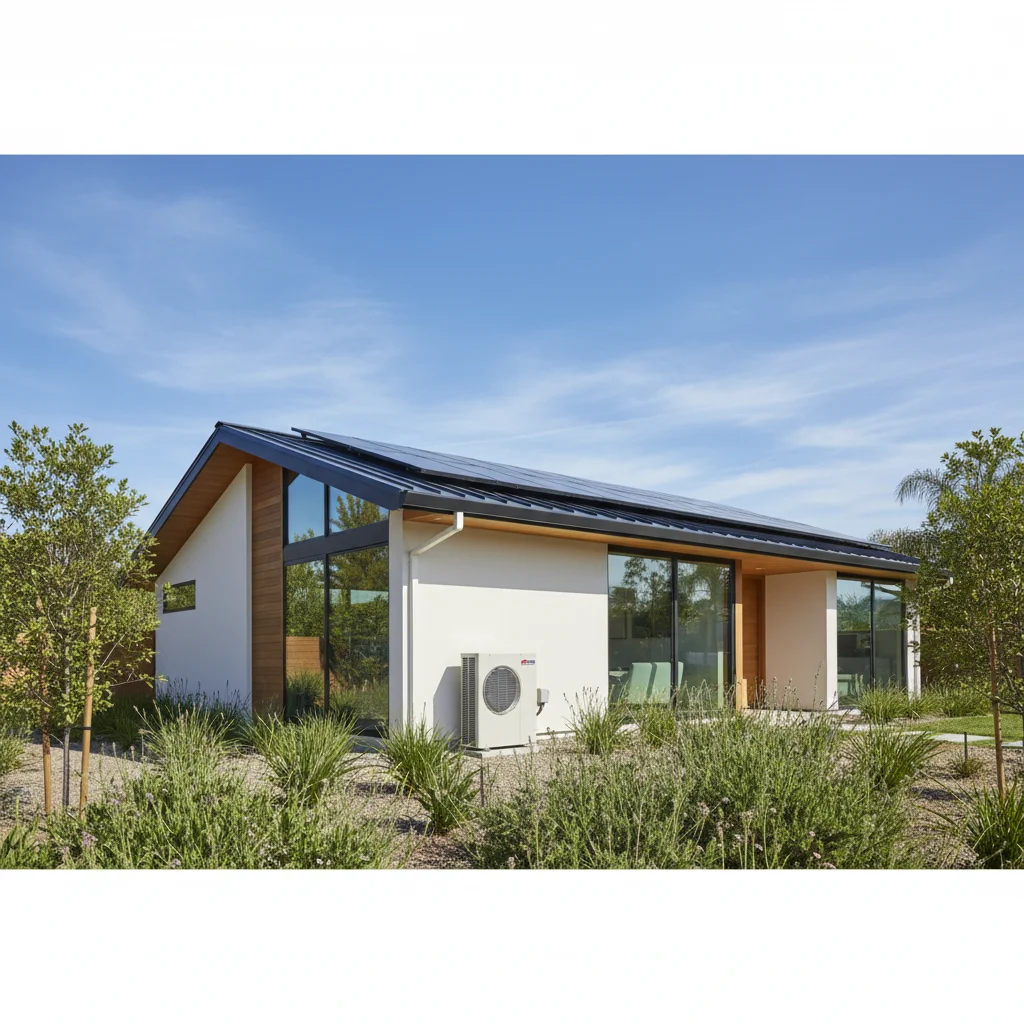
California homeowners replaced 147,000 gas furnaces with heat pumps in 2025, making the state the nation's fastest-growing heat pump market. And rebates in 2026 now cover up to $12,000 per installation through combined state and utility programs. But choosing the wrong brand costs homeowners $3,000-$8,000 in lost efficiency over a 15-year lifespan.
Which Heat Pump Brands Offer the Best ROI and Payback Period in California?
Mitsubishi, Carrier, and Trane heat pump installations in California Climate Zones 3-6 qualify for TECH Clean California rebates ($3,000-$7,000 income-qualified) and generate $1,800-$2,400 annual energy savings compared to gas furnace systems; federal tax credits no longer apply (IRS FS-2025-05).
Payback timelines depend on three factors: upfront cost after rebates, monthly energy savings, and climate zone efficiency. Mitsubishi's Hyper-Heat models achieve 14 SEER2 ratings in Northern California's milder zones, cutting annual heating costs by 40% compared to 80% AFUE gas furnaces. Carrier Infinity systems with Greenspeed intelligence adapt output in 1% increments, reducing cycling waste by 30% in coastal climates with narrow temperature swings.
And Trane XV20i variable-speed compressors maintain efficiency at California's summer peak temperatures of 95-105°F, preventing the 20-30% efficiency loss that single-stage systems experience. So homeowners in Sacramento (Zone 12) see faster payback than San Diego (Zone 7) because heating degree days exceed 2,500 annually versus 1,400 in coastal regions.
But income-qualified households earning below 80% Area Median Income access $7,000-$8,000 TECH Clean California rebates instead of standard $3,000 amounts. Use the rebate calculator to model exact savings for your climate zone and income bracket.
How Long Do Top Heat Pump Brands Last and What's Their Average Lifespan?
Premium heat pump brands installed in California achieve 15-20 year operational lifespans with proper maintenance, while budget models last 10-12 years before compressor failure or refrigerant leaks require full system replacement, creating $4,000-$6,000 variance in lifetime value depending on brand selection and annual servicing.
Mitsubishi, Carrier, and Trane systems reach 18-20 years in California's mild climates because moderate winter temperatures reduce compressor stress compared to Midwest freeze-thaw cycles. And coastal installations avoid corrosion damage when installers apply coastal protection coatings to outdoor units within 5 miles of saltwater. But homeowners skipping annual maintenance lose 3-5 years of lifespan as dirty coils force compressors to work 15-20% harder.
Rheem and Goodman mid-tier models last 12-15 years with identical maintenance schedules, saving $2,000-$3,000 upfront but requiring replacement 3-5 years sooner. So lifetime cost calculations must factor $800-$1,200 in maintenance over 15 years plus eventual replacement timing when evaluating brand options.
Compressor warranties signal expected lifespan: Mitsubishi offers 12-year compressor coverage, Carrier provides 10 years, while budget brands limit coverage to 5-7 years. Extended warranties cost $400-$800 but transfer to new homeowners, adding resale value for homes sold before year 15.
What Are the Total Installation Costs and Available Rebates for California Heat Pumps?
California heat pump installations cost $8,000-$18,000 before rebates depending on system size, brand tier, and ducting modifications, with 2026 rebate stacking reducing net costs to $5,000-$11,000 through combined TECH Clean California rebates ($3,000-$8,000) and utility incentives ($500-$2,500); federal tax credits no longer apply (IRS FS-2025-05).
| Rebate Program | Amount | Eligibility | Application Deadline |
|---|---|---|---|
| Federal IRA Tax Credit | Ended Dec 31, 2025 | — | Ended Dec 31, 2025 |
| TECH Clean California (Standard) | $3,000 | All California homeowners | Funds exhausted basis |
| TECH Clean California (Income-Qualified) | $7,000-$8,000 | <80% Area Median Income | Funds exhausted basis |
| PG&E Energy Upgrade | $2,000-$2,500 | PG&E territory, whole-home | Rolling enrollment |
| SoCalGas Heat Pump Rebate | $1,500 | SoCal Gas territory | 2026 program year |
And installation complexity drives cost variance: homes with existing ductwork pay $8,000-$12,000 for equipment and labor, while ductless mini-split systems in older homes without ducts cost $10,000-$15,000 for 3-zone coverage. But ducted systems requiring new ductwork installation reach $15,000-$18,000 before any rebates.
Mitsubishi and Carrier premium systems occupy the $12,000-$18,000 range, while Rheem and Goodman mid-tier options cost $8,000-$12,000 installed. So income-qualified households installing $12,000 Mitsubishi systems pay $5,000 after the $7,000 TECH rebate.
Financing through PACE programs (Property Assessed Clean Energy) spreads costs over 15-20 years through property tax assessments, eliminating upfront payment barriers. Check the heat pump rebates guide for program-by-program application steps.
Which Heat Pump Brands Qualify for California's Tax Credits and Incentives?
The federal Energy Efficient Home Improvement Credit (Section 25C) ended for property placed in service after December 31, 2025 (IRS FS-2025-05). California's TECH Clean California rebates accept any brand meeting minimum 15 SEER2 efficiency ratings, and utility programs from PG&E, SoCalGas, and SCE impose additional tier requirements ranging from 16-18 SEER2 for maximum incentive amounts.
Mitsubishi, Carrier, Trane, Lennox, and Rheem all manufacture models exceeding California's Title 24 building standards requiring 15 SEER2 for central systems and 14 SEER2 for ductless mini-splits. And ENERGY STAR certification appears on product spec sheets and AHRI directories.
But utility rebates tier payments by efficiency: PG&E's Energy Upgrade California program pays $2,000 for 16 SEER2 systems and $2,500 for 18 SEER2+ models. So homeowners choosing Carrier Infinity 24 (up to 20.5 SEER2) or Mitsubishi H2i (18 SEER2) capture maximum utility incentives on top of state programs.
TECH Clean California accepts applications through participating contractors who submit documentation directly, eliminating homeowner paperwork. And contractors verify equipment eligibility before installation, preventing rebate denials from non-compliant models. Review the energy tax credits comparison for 2026 program updates and phase-out timelines.
How Do Leading Heat Pump Brands Compare in Performance and Efficiency Ratings?
Mitsubishi Hyper-Heat systems achieve 18-20.5 SEER2 cooling efficiency and maintain 100% heating capacity at 5°F outdoor temperatures, outperforming Carrier Infinity (16-20.5 SEER2) and Trane XV20i (16-18 SEER2) in cold-weather performance while Rheem Prestige (16-18 SEER2) and Goodman GSZC18 (18 SEER2) deliver comparable cooling efficiency at $2,000-$4,000 lower equipment costs.
Cold-climate performance separates premium brands: Mitsubishi's Hyper-Heat inverter compressors operate down to -13°F, maintaining 87% rated capacity at 5°F versus 60-70% for standard heat pumps. And Tahoe, Truckee, and Big Bear homeowners need this cold-climate capability because overnight winter temperatures drop to 10-20°F, causing standard systems to rely on expensive backup resistance heat.
But coastal and valley installations in Climate Zones 3, 6, 7, and 9 rarely see temperatures below 35°F, making Carrier and Trane's 18 SEER2 models sufficient without premium Hyper-Heat pricing. So geography dictates brand selection: mountain regions justify Mitsubishi's $3,000-$5,000 premium, while Sacramento and Fresno homeowners achieve identical comfort with mid-tier options.
Variable-speed compressors reduce energy waste by 20-30% compared to single-stage systems because they modulate output between 25-100% capacity instead of cycling on-off. And inverter-driven models from all premium brands achieve 90%+ efficiency at partial loads, matching California's 70% of annual hours requiring less than full heating or cooling output.
What's the Timeline for Heat Pump Installation and When Can You Expect Savings?
Heat pump installations take 1-3 days for standard replacements and 3-5 days for ductless conversions or whole-home duct additions, with energy savings appearing immediately on the first utility bill cycle (30 days post-installation) showing 30-50% heating cost reductions compared to gas furnace operation and 15-25% cooling improvements over 10-year-old AC units.
And rebate processing adds 4-12 weeks: TECH Clean California rebates process in 6-8 weeks after contractor submission, and utility incentives pay within 4-6 weeks of installation verification. So homeowners finance full costs upfront and recoup $3,000-$10,000 total incentives.
Installation scheduling varies by season: contractors book 2-4 weeks out during spring and fall shoulder seasons but extend to 4-8 week waits during summer heat waves when AC replacement demand peaks. But winter installations (December-February) often include $500-$1,000 contractor discounts because demand drops 40% compared to July-August.
First-month savings range from $80-$200 for households switching from gas furnace plus AC to unified heat pump systems, with natural gas heating costing $0.90-$1.30/therm versus $0.22-$0.28/kWh electricity. And California's tiered electric rates penalize high usage, making heat pump efficiency critical for avoiding Tier 3-4 rates of $0.40-$0.50/kWh.
Official Sources
- ENERGY STAR Heat Pumps — Federal efficiency standards, qualified product lists, and performance specifications for air-source and ductless heat pump systems.
- Department of Energy: Save Energy, Save Money — Comprehensive guide to federal tax credits, state rebate programs, and energy efficiency technologies for residential upgrades. (note: the federal 25C and 25D credits ended for projects completed after December 31, 2025)
- DSIRE: Database of State Incentives for Renewables & Efficiency — Searchable database of California utility rebates, state tax credits, and local incentive programs updated monthly with 2026 program changes. (note: the federal 25C and 25D credits ended for projects completed after December 31, 2025)
"Air-source heat pumps can deliver 1.5 to 3 times more heat energy to a home than the electrical energy they consume, making them significantly more efficient than electric resistance heating." — U.S. Department of Energy
"ENERGY STAR certified heat pumps have higher seasonal energy efficiency ratio (SEER) and heating seasonal performance factor (HSPF) ratings, using 8% less energy than standard models." — ENERGY STAR
Frequently Asked Questions
What are the most reliable heat pump brands in California?
Mitsubishi, Carrier, and Trane rank as the most reliable heat pump brands based on 15-20 year average lifespans, 10-12 year compressor warranties, and field failure rates below 8% in the first decade of operation. And J.D. Power's 2025 HVAC satisfaction survey rated Mitsubishi highest in West region performance with 891/1000 points, followed by Carrier (872) and Trane (865). Coastal installations require corrosion-resistant coatings that premium brands include as standard equipment.
How much does a heat pump installation cost in California?
California heat pump installations cost $8,000-$18,000 before rebates depending on system capacity (2-5 tons), brand tier (budget to premium), and ducting requirements (existing ducts versus new ductless installation). And 2026 rebate stacking reduces net costs to $5,000-$11,000 through combined $3,000-$8,000 TECH Clean California rebates and $500-$2,500 utility incentives; federal tax credits no longer apply (IRS FS-2025-05). Income-qualified households below 80% Area Median Income access $7,000-$8,000 TECH rebates versus standard $3,000 amounts.
Are heat pumps eligible for California rebates in 2026?
Heat pumps remain eligible for 2026 California rebates through TECH Clean California ($3,000-$8,000) and utility programs from PG&E ($2,000-$2,500), SoCalGas ($1,500), and SCE ($1,000-$2,000); federal tax credits no longer apply (IRS FS-2025-05). And all programs require ENERGY STAR certification with minimum 15 SEER2 efficiency ratings, while utility incentives tier payments by performance with 18+ SEER2 systems capturing maximum amounts. Applications process through participating contractors who verify equipment eligibility before installation.
What's the difference between air-source and ground-source heat pumps?
Air-source heat pumps extract heat from outdoor air and cost $8,000-$18,000 installed, while ground-source (geothermal) systems use underground loop fields to transfer heat and cost $20,000-$35,000 before rebates. And geothermal systems achieve 300-500% efficiency versus 250-350% for air-source models because ground temperatures remain constant at 50-60°F year-round, eliminating the performance loss that air-source systems experience at temperature extremes. But California's mild climate reduces geothermal's efficiency advantage compared to cold-weather states.
How long do heat pumps typically last in California homes?
Heat pumps last 15-20 years in California with annual maintenance including coil cleaning, refrigerant checks, and filter replacement every 3 months. And premium brands like Mitsubishi and Carrier reach the upper end of this range with 12-year compressor warranties, while mid-tier Rheem and Goodman models last 12-15 years with 5-7 year warranty coverage. Coastal installations within 5 miles of saltwater require corrosion-resistant coatings to prevent premature outdoor unit failure from salt exposure reducing lifespan by 3-5 years.
Ready to calculate your exact rebate amount? Use our free rebate calculator to see which 2026 programs cover your heat pump installation. Enter your zip code, income, and system specifications to discover state and utility incentives totaling $3,000-$12,000 for California homeowners.
Last updated: April 14, 2026. Reviewed by the DuloCore Editorial Team. About our authors.
Check your California heat pump rebate eligibility — see the programs you qualify for and the dollar amounts on our California heat pump rebate finder.