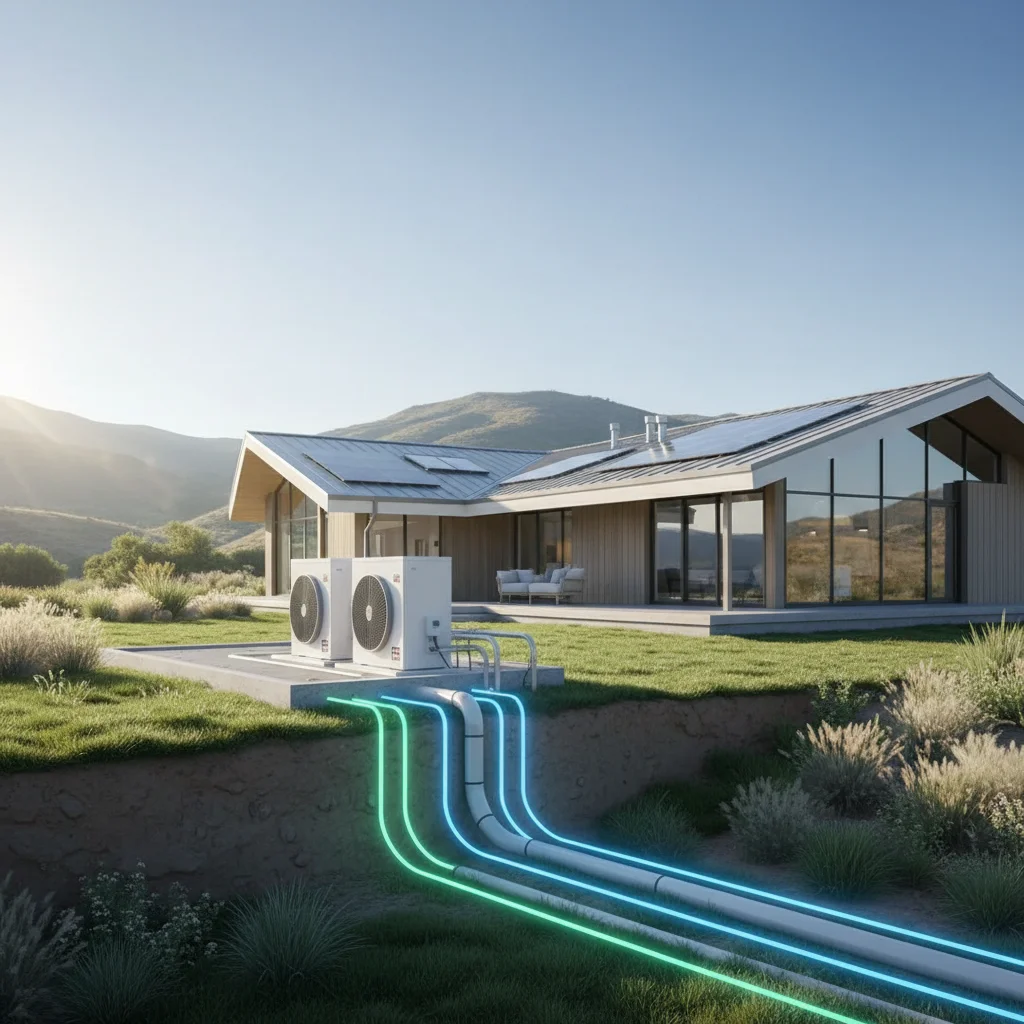
California homeowners installing geothermal heat pumps in 2026 can access up to $14,000 in combined federal tax credits and state rebates, but only if they work with NABCEP-certified installers who meet California Energy Commission specifications. And fewer than 200 installers statewide hold the proper credentials to guarantee maximum rebate eligibility.
What Makes a Geothermal Installer "Best" in California?
Top California geothermal installers hold NABCEP certification, carry C-20 HVAC contractor licenses, maintain IGSHPA accreditation, and demonstrate at least 50 completed closed-loop installations. These installers submit proper documentation to the California Energy Commission for rebate approval and maintain $2 million liability coverage for ground-loop drilling operations.
But certification alone doesn't guarantee quality installation. The best installers conduct thermal conductivity testing of soil conditions before drilling, size ground loops based on Manual J load calculations, and provide 10-year warranty coverage on heat exchanger components. So homeowners gain confidence through installer portfolios showing completion timelines averaging 5-7 days for residential systems.
California's three climate zones require different ground-loop configurations. And installers serving Northern California typically drill vertical boreholes 150-400 feet deep, while Southern California installers often use horizontal trenching at 6-foot depths due to moderate soil temperatures. The best contractors match system design to regional geology and building size.
"Geothermal heat pumps use the constant temperature of the earth to heat and cool buildings more efficiently than conventional systems" — U.S. Department of Energy
Which Geothermal Systems Qualify for California Rebates and Tax Credits?
The federal Residential Clean Energy Credit (Section 25D) ended for expenditures made after December 31, 2025, and the IRS treats an expenditure as made when installation is completed (IRS FS-2025-05). Federal tax credits for this work have ended, but state, local and utility rebates may still apply; check what is available at your address with the DuloCore rebate calculator. California's Tech Clean program provides additional $3,000-$6,000 rebates for low-income households replacing natural gas furnaces with geothermal heat pumps.
The IRA replaced the expired Section 25C and 25D credits on January 1, 2026, maintaining the 30% credit rate but removing annual dollar caps. So a $25,000 geothermal installation now generates a $7,500 federal tax credit without the previous $2,000 limitation. And homeowners can combine this credit with California's Self-Generation Incentive Program rebates ranging from $2.00-$4.50 per watt of installed capacity.
Local utility districts offer performance-based incentives averaging $400-$1,200 annually. But these payments require bi-annual efficiency verification through certified energy monitoring systems. PG&E's Advanced Energy Rebuild program adds $5,000 for whole-home electrification projects replacing gas furnaces and water heaters simultaneously.
| Program | Credit Amount | Income Limit | Deadline |
|---|---|---|---|
| Federal IRA Tax Credit | Ended Dec 31, 2025 | — | Ended Dec 31, 2025 |
| California Tech Clean | $3,000-$6,000 | 80% AMI | Dec 31, 2026 |
| SGIP Equity Resiliency | $2.00-$4.50/watt | 80% AMI | Ongoing |
How Much Can You Save? ROI and Payback Period for California Geothermal
California geothermal systems cost $18,000-$30,000 installed but deliver annual energy savings of $1,200-$2,400 compared to natural gas forced-air systems. And factoring in the 30% federal tax credit plus state rebates averaging $4,000, net installation costs drop to $8,600-$17,000 for most homeowners.
Payback periods range from 6-12 years depending on utility rates and climate zone. But Northern California homes heating with propane see 4-6 year payback due to higher fuel costs averaging $3.50 per gallon. Southern California installations face longer 10-15 year timelines because mild winters reduce heating demand and associated savings.
Monthly utility bills decrease 40-60% after geothermal installation. So a Sacramento household spending $280 monthly on gas and electric heating typically saves $140-$168 monthly, totaling $1,680-$2,016 annually. Use our free rebate calculator to estimate your specific savings based on home size and current utility costs.
Over a 25-year system lifespan, total savings reach $30,000-$50,000 for average California homes. And factoring in avoided maintenance costs for furnace replacements every 15-20 years adds another $8,000-$12,000 in lifecycle value.
Geothermal vs. Heat Pumps vs. Traditional HVAC: Which Is Right for You?
Geothermal heat pumps deliver 300-400% efficiency compared to 200-250% for air-source heat pumps and 95-98% for high-efficiency gas furnaces. But installation costs run $18,000-$30,000 for geothermal versus $8,000-$15,000 for air-source heat pumps and $4,000-$8,000 for gas furnaces.
Air-source heat pump rebates reach $8,000-$12,000 in California, making them cost-competitive after incentives. But geothermal systems maintain full capacity in extreme temperatures while air-source units lose 25-40% efficiency below 25°F. So mountain communities above 4,000 feet elevation see better performance from geothermal installations.
Operating costs tell the real story. Geothermal systems cost $0.04-$0.06 per kWh of heating versus $0.08-$0.12 for air-source heat pumps and $0.15-$0.22 for natural gas furnaces at current California rates. And geothermal ground loops require zero maintenance for 50+ years while outdoor air-source units need coil cleaning and refrigerant checks every 2-3 years.
Traditional gas furnaces suit homeowners prioritizing low upfront costs over long-term savings. But California's building electrification mandates will phase out gas connections in new construction by 2030, pushing retrofit costs higher for future conversions.
How Long Do Geothermal Systems Last and What's the Maintenance Cost?
Geothermal ground loops last 50-100 years while indoor heat pump units require replacement every 20-25 years. And annual maintenance costs average $150-$300 for filter changes and refrigerant checks compared to $200-$400 for gas furnace tune-ups including combustion testing.
The ground loop represents the most durable component because buried HDPE piping resists corrosion and maintains thermal efficiency indefinitely. But indoor heat exchangers and compressors wear similarly to conventional HVAC equipment. So homeowners budget $6,000-$9,000 for heat pump replacement around year 22-25 while keeping the original ground loop intact.
Major repairs occur less frequently than traditional systems. Geothermal units average 0.8 service calls annually versus 1.3 calls for gas furnaces and 1.1 calls for air-source heat pumps according to DOE reliability studies. And eliminating combustion components removes carbon monoxide risks and annual safety inspections.
"Ground source heat pumps are among the most efficient and comfortable heating and cooling technologies available because they use the earth's natural heat to provide heating, cooling, and often, water heating" — EPA Energy Star
Extended warranties covering 10 years on compressors and heat exchangers cost $800-$1,500 but reduce long-term risk. California's energy tax credits don't apply to maintenance contracts, but system longevity often makes extended coverage unnecessary.
What's the Installation Process and Timeline with Top California Installers?
Professional geothermal installation takes 5-10 days from ground loop drilling through final system commissioning. And the process requires site evaluation, soil testing, permit approval, trenching or drilling, loop installation, heat pump setup, and performance verification.
Week 1 involves geological assessment and Manual J load calculations determining loop field size. Installers test soil thermal conductivity and mark underground utilities before drilling. But permit approval from county building departments adds 2-4 weeks in most California jurisdictions.
Week 2-3 brings drilling or trenching operations. Vertical installations drill 150-400 foot boreholes requiring specialized equipment and water trucks. And horizontal loops need excavation equipment creating trenches 6 feet deep across 1,500-3,000 square feet of yard space.
Final installation connects ground loops to indoor heat pump units through supply and return manifolds. Contractors pressure-test the closed-loop system, fill with water-antifreeze mixture, purge air pockets, and verify flow rates. So commissioning includes refrigerant charging, thermostat programming, and 48-hour performance monitoring ensuring design temperatures.
Top installers provide digital monitoring systems tracking energy consumption and identifying efficiency degradation. And California homeowners access real-time data through smartphone apps showing monthly savings versus baseline usage.
Official Sources
- U.S. Department of Energy: Geothermal Heat Pumps — Federal guidance on geothermal technology and efficiency standards
- DSIRE USA: California Incentives — Comprehensive database of state and federal energy rebates
- Energy Star: Geothermal Heat Pumps — Certification requirements and qualified product listings
Frequently Asked Questions
What are the qualifications for a geothermal installer in California?
California geothermal installers must hold an active C-20 HVAC contractor license, maintain IGSHPA installer certification, and carry $2 million liability insurance covering ground-loop drilling operations. Top installers also earn NABCEP accreditation and demonstrate 50+ completed installations. And contractors must register with the California Contractors State License Board and pass trade examinations covering refrigeration, electrical, and hydronic systems.
How much does a geothermal system installation cost in California?
Total installation costs range from $18,000-$30,000 depending on system size, loop configuration, and soil conditions. Vertical closed-loop systems averaging $22,000-$30,000 cost more than horizontal installations at $18,000-$25,000 due to specialized drilling equipment. But after applying the 30% federal IRA tax credit and California rebates averaging $4,000, net costs drop to $8,600-$17,000 for qualifying homeowners.
What rebates are available for geothermal installation in California?
The federal Residential Clean Energy Credit (Section 25D) ended for expenditures made after December 31, 2025, and the IRS treats an expenditure as made when installation is completed (IRS FS-2025-05). California's Tech Clean program offers $3,000-$6,000 for income-qualified households, while SGIP provides $2.00-$4.50 per watt for battery-coupled systems. And local utility rebates from PG&E, SCE, and SDG&E add $400-$1,200 annually through performance-based incentives requiring energy monitoring systems.
How long does a geothermal system installation take?
Professional installation requires 5-10 days of active work plus 2-4 weeks for permit approval. Vertical drilling operations take 2-3 days for residential systems while horizontal trenching completes in 1-2 days. And final commissioning including pressure testing, refrigerant charging, and performance verification adds 1-2 days before system operation.
What is the difference between geothermal and heat pump systems?
Geothermal heat pumps exchange heat with stable underground temperatures while air-source heat pumps use outdoor air. Geothermal systems deliver 300-400% efficiency year-round versus 200-250% for air-source units that lose capacity below 25°F. But geothermal installations cost $10,000-$15,000 more upfront despite lower operating costs of $0.04-$0.06 per kWh compared to $0.08-$0.12 for air-source systems.
Ready to find out how much you can save with geothermal? Use our free rebate calculator to get an instant estimate of your federal tax credits, California rebates, and projected energy savings based on your home's specific details.
Updated: April 14, 2026 — fact-checked by DuloCore Research. About our editorial process.
Check your California heat pump rebate eligibility — see the programs you qualify for and the dollar amounts on our California heat pump rebate finder.