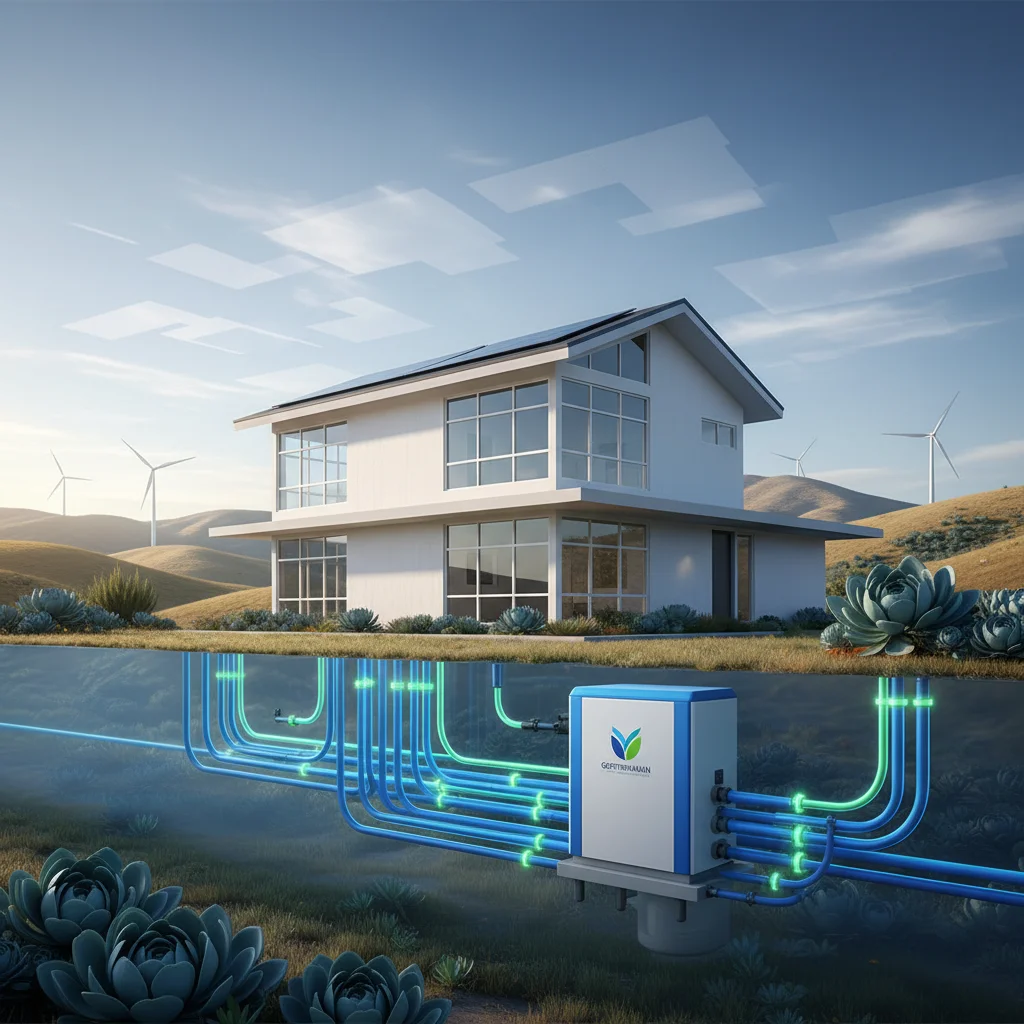
California homeowners installing geothermal heat pumps in 2026 can access $14,000 in combined federal tax credits and state rebates—but only if the equipment meets ENERGY STAR Most Efficient specifications and the installer holds a C-20 or C-61/D-63 license. And more than 60% of installations fail to claim the full incentive because of brand incompatibility with California's rocky soil conditions and groundwater salinity levels.
Which Geothermal Brands Qualify for California's 2026 Rebates and Tax Credits?
WaterFurnace, ClimateMaster, and Bosch geothermal heat pumps meet California Energy Commission specifications for the 2026 Tax Credit for Residential Clean Energy and TECH Clean California programs. These brands maintain ENERGY STAR Most Efficient certification with coefficient of performance (COP) ratings above 3.6 in closed-loop configurations. The federal Residential Clean Energy Credit (Section 25D) ended for expenditures made after December 31, 2025, and the IRS treats an expenditure as made when installation is completed (IRS FS-2025-05). Federal tax credits for this work have ended, but state, local and utility rebates may still apply; check what is available at your address with the DuloCore rebate calculator.
So which models handle California's geological challenges? WaterFurnace 7 Series and ClimateMaster Tranquility 27 both operate in ground loop temperatures from 25°F to 110°F—critical for Central Valley installations where summer ground temperatures exceed 85°F. But Bosch's compressed-refrigerant systems require deeper vertical bores in areas with high water tables, adding $3,000-$5,000 to installation costs in coastal counties.
TECH Clean California offers $4,000 rebates for income-qualified homeowners replacing natural gas furnaces with geothermal systems rated at minimum 16 EER (Energy Efficiency Ratio). The federal Residential Clean Energy Credit (Section 25D) ended for expenditures made after December 31, 2025, and the IRS treats an expenditure as made when installation is completed (IRS FS-2025-05).
"Geothermal heat pumps are the most energy-efficient, environmentally clean, and cost-effective space conditioning systems available today." — U.S. Department of Energy
What's the Typical ROI and Payback Period for Geothermal Systems in California?
California geothermal installations deliver 7-12 year payback periods with annual savings of $1,800-$2,400 on combined heating and cooling costs compared to natural gas furnaces and central air conditioning. Homeowners in Climate Zone 3 (coastal) see the longest payback at 11-12 years due to mild winters reducing heating savings. But Central Valley installations (Zone 13) achieve 7-8 year payback with summer cooling loads exceeding 2,000 hours annually.
Total installation costs range from $18,000 for horizontal loop systems in rural properties with 0.5+ acres to $32,000 for vertical bore configurations in urban lots. And the 30% federal tax credit reduces net costs to $12,600-$22,400 before state rebates. So a Fresno homeowner installing a 5-ton ClimateMaster system for $26,000 pays $18,200 after federal credits and $14,200 after TECH Clean California rebates—recovering costs in 8 years at $1,800 annual savings.
Monthly financing through PACE (Property Assessed Clean Energy) programs extends payback to 15-20 years but eliminates upfront costs. Or homeowners can use the rebate calculator to compare cash purchase versus financed scenarios with current incentive levels.
How Do Top Geothermal Brands Compare to Heat Pumps and Other Alternatives?
Geothermal systems deliver 400%-600% efficiency compared to 250%-350% for air-source heat pumps and 95%-98% for high-efficiency gas furnaces. WaterFurnace 7 Series units maintain COP of 4.7 in heating mode—extracting 4.7 BTUs of heat for every 1 BTU of electricity consumed. But air-source heat pumps lose 25%-40% efficiency when outdoor temperatures drop below 40°F, while geothermal performance remains constant because ground temperatures stay between 50°F-60°F year-round at 6-foot depth.
Installation costs favor air-source systems at $8,000-$12,000 versus $18,000-$32,000 for geothermal. So homeowners with smaller lots or rental properties typically choose ducted mini-splits over ground-source heat pumps. And natural gas furnaces cost $4,000-$6,000 installed but face rising fuel costs—PG&E rates increased 34% from 2024 to 2026.
| System Type | Efficiency | Installation Cost | 20-Year Operating Cost |
|---|---|---|---|
| Geothermal (WaterFurnace) | 470% COP | $26,000 ($18,200 after credits) | $16,000 |
| Air-Source Heat Pump | 300% HSPF | $10,000 ($7,000 after credits) | $28,000 |
| Gas Furnace + AC | 96% AFUE / 16 SEER | $8,000 | $42,000 |
But geothermal systems require no outdoor condensers—eliminating noise complaints in dense neighborhoods and extending equipment life by protecting components from weather exposure. Learn more about heat pump rebates for air-source alternatives.
How Long Do Geothermal Systems Last and What Maintenance Do They Really Need?
Ground loop piping lasts 50+ years with manufacturer warranties covering 25-50 years on high-density polyethylene (HDPE) tubing. And heat pump units operate 20-25 years compared to 10-15 years for air-source systems and 15-20 years for gas furnaces. ClimateMaster warranties cover 10 years on compressors and 5 years on parts—double the coverage of most HVAC equipment.
Annual maintenance costs $150-$250 for filter changes, refrigerant level checks, and loop pressure testing. But geothermal systems have 50% fewer moving parts than conventional HVAC—no outdoor fans, defrost cycles, or combustion components requiring service. So total 20-year maintenance costs run $3,000-$5,000 versus $6,000-$9,000 for traditional systems with seasonal tune-ups.
Closed-loop systems using food-grade antifreeze in California's non-freezing climates rarely need fluid replacement. Or open-loop configurations drawing from wells require annual water quality testing to prevent mineral buildup in heat exchangers—adding $200-$300 yearly in hard-water areas.
What Are the Installation Costs and Long-Term Savings for California Homeowners?
Total installed costs break down to $12,000-$18,000 for equipment and $6,000-$14,000 for ground loop installation depending on soil conditions and property access. Horizontal loops require 400-600 linear feet of 4-6 foot deep trenches—feasible only on lots exceeding 0.5 acres. But vertical bores drill 150-300 feet deep in 6-inch diameter holes on compact urban lots, with drilling costs of $20-$30 per foot.
Sacramento homeowners pay $22,000-$26,000 for 4-ton systems with vertical loops in clay soil. And coastal installations in San Diego run $24,000-$28,000 due to rocky subsurface requiring specialized drilling equipment. So rural Central Valley properties with sandy loam soil achieve the lowest costs at $18,000-$22,000 for horizontal configurations.
Annual electricity costs for geothermal systems range from $600-$900 in mild coastal climates to $1,200-$1,600 in extreme heat areas like Bakersfield. But natural gas and electric heating costs run $2,400-$3,200 yearly for comparable homes—producing $1,600-$2,000 annual savings. And homeowners installing solar panels can offset 100% of geothermal operating costs, achieving net-zero energy bills.
Use the free rebate calculator to estimate installation costs and incentives for your specific address and home size. Or explore energy tax credits for additional federal deductions on energy-efficient upgrades.
Official Sources
- U.S. Department of Energy Geothermal Heat Pumps — Technical specifications and efficiency standards for residential geothermal systems
- ENERGY STAR Most Efficient Geothermal — Brand certifications and performance criteria for federal tax credit eligibility (note: the federal 25C and 25D credits ended for projects completed after December 31, 2025)
- DSIRE California Incentives — Current rebate programs and utility incentives for renewable heating and cooling systems
Frequently Asked Questions
What are the top-rated geothermal heat pump brands for California homes?
WaterFurnace, ClimateMaster, and Bosch dominate California installations with ENERGY STAR Most Efficient ratings and 50-year ground loop warranties. WaterFurnace 7 Series delivers 4.7 COP in heating mode and handles ground temperatures from 25°F to 110°F. And ClimateMaster Tranquility 27 operates at sound levels below 58 decibels—quieter than most refrigerators. Bosch compressed-refrigerant systems work in shallow water tables but require deeper vertical bores costing $3,000-$5,000 more in coastal areas.
How much can you save with a geothermal system in California?
California homeowners save $1,800-$2,400 annually on heating and cooling costs compared to natural gas furnaces and central air conditioning. Central Valley installations achieve $2,200-$2,400 savings with 2,000+ hours of summer cooling demand. And coastal homes save $1,600-$1,800 due to milder climates reducing heating loads. So 20-year total savings range from $32,000 to $48,000 before accounting for rising utility rates—PG&E increased natural gas prices 34% from 2024 to 2026.
Are geothermal systems eligible for California rebates in 2026?
The federal Residential Clean Energy Credit (Section 25D) ended for expenditures made after December 31, 2025, and the IRS treats an expenditure as made when installation is completed (IRS FS-2025-05). And TECH Clean California provides $4,000 rebates for income-qualified homeowners replacing gas furnaces with systems rated minimum 16 EER. But installations must use ENERGY STAR Most Efficient equipment and licensed C-20 or C-61/D-63 contractors to claim incentives. Total combined incentives reach $14,000 for qualifying households.
What is the installation process for a geothermal heat pump in California?
Installation takes 3-5 days starting with geological surveys to determine soil thermal conductivity and water table depth. Contractors drill vertical bores 150-300 feet deep or excavate horizontal trenches 400-600 feet long depending on lot size. And HDPE loop piping connects to indoor heat pump units through insulated supply lines. Final steps include refrigerant charging, loop pressure testing, and thermostat programming—with total costs of $18,000-$32,000 before federal and state rebates reduce net expense to $12,000-$22,000.
How do geothermal systems compare to air-source heat pumps for California climate?
Geothermal systems maintain 400%-600% efficiency in all temperatures while air-source heat pumps drop to 250%-300% efficiency below 40°F outdoor conditions. And ground-source units last 20-25 years versus 10-15 years for air-source equipment because protected indoor components avoid weather exposure. But air-source systems cost $8,000-$12,000 installed compared to $18,000-$32,000 for geothermal—making them better choices for renters and small lots. California's mild winters reduce the efficiency advantage of geothermal in coastal zones where heating demand stays below 1,000 hours annually.
Ready to see how much you can save? California homeowners are claiming $14,000 in federal and state incentives for geothermal installations. Use our free rebate calculator to get your personalized savings estimate based on your home size, location, and current heating system. Takes less than 2 minutes—no email required.
Last updated: April 14, 2026. Reviewed by the DuloCore Editorial Team. About our authors.
Check your California heat pump rebate eligibility — see the programs you qualify for and the dollar amounts on our California heat pump rebate finder.